


Most investors think commercial real estate means glass office towers in the CBD. That mental image costs them real money. Singapore’s commercial property market is far broader, and far more accessible, than most landlords realize. From heritage shophouses in Chinatown to B1 industrial units near residential estates, the asset classes on offer are genuinely diverse. This guide walks you through exactly what commercial real estate covers in Singapore, what the 2026 numbers look like, how the regulatory framework works, and which strategies are producing results for investors building serious portfolios right now.
Table of Contents
- Defining commercial real estate: Scope and categories
- Singapore commercial real estate: Market performance and trends
- Regulatory framework: Zoning, ownership, and acquisition mechanics
- Investment strategies: Maximizing opportunity in Singapore CRE
- Our perspective: Rethinking commercial real estate investment in Singapore
- Expand your portfolio: Get expert guidance and insights
- Frequently asked questions
Key Takeaways
| Point | Details |
|---|---|
| Broad CRE definition | Commercial real estate in Singapore includes offices, retail, industrial, and mixed-use properties used for business income. |
| 2026 market outlook | Singapore’s commercial real estate market is resilient with rising office rents and diverse investment opportunities. |
| Key regulations apply | Investors must understand zoning rules, foreign ownership policies, and industrial use constraints for strategic acquisitions. |
| Flexible investment strategies | Successful investors diversify portfolios across asset types and adapt to new leasing models like flex spaces and mixed-use developments. |
Defining commercial real estate: Scope and categories
Singapore investors sometimes treat commercial and industrial property as interchangeable terms. They are not, and getting this wrong during acquisition can create serious zoning headaches. Let’s break down exactly what falls under commercial real estate in Singapore.
Commercial real estate refers to properties used primarily for business purposes to generate income through leasing, operations, or appreciation, distinct from residential properties for personal habitation. That single definition covers an enormous range of assets in Singapore, from a single shophouse unit in Tanjong Pagar to a strata retail floor in an Orchard Road mall.
The primary CRE types include office, retail, industrial, multifamily, and hotels. In Singapore specifically, this translates to office blocks, shopping complexes, shophouses, and mixed-use developments with commercial podiums, all zoned by the Urban Redevelopment Authority (URA). Industrial properties under the B1 and B2 categories, governed largely by JTC Corporation, are technically a distinct class but are commonly grouped under the commercial investment umbrella by Singapore practitioners.
Here is a quick reference of the major CRE categories you will encounter as a Singapore investor:
| Category | Examples in Singapore | Primary governing body |
|---|---|---|
| Office | CBD Grade A towers, suburban offices | URA |
| Retail | Orchard malls, neighborhood shops | URA |
| Shophouses | Chinatown, Geylang, Telok Ayer | URA |
| Mixed-use | Commercial podium with residential above | URA |
| Industrial B1 | Light industrial, clean tech, logistics | JTC / URA |
| Industrial B2 | Heavy industrial, manufacturing | JTC |
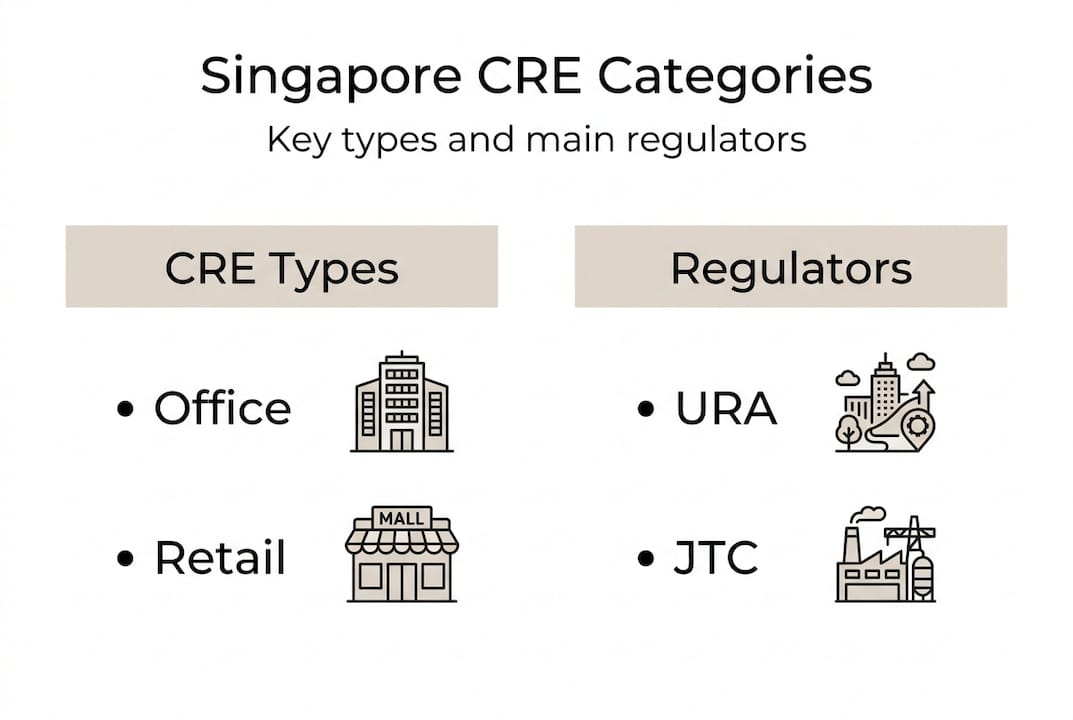
The core difference from residential property is purpose and income structure. Residential property is for personal habitation and regulated under a separate stamp duty framework. Commercial property is held for yield, capital appreciation, or operational use, and the acquisition rules, taxes, and financing ratios differ significantly.
Understanding the B1 versus B2 distinction matters for portfolio planning. B1 industrial properties, such as business parks and light industrial units, can be located close to residential areas because they produce minimal pollution or noise. B2 properties involve heavier industrial processes and are located in more remote industrial zones. If you are looking at benefits of Singapore commercial property that include flexible tenant profiles and stronger yields, B1 units often offer a compelling middle ground between pure commercial and heavy industrial exposure.
One critical distinction worth noting: URA zoning classifies shophouses under “Residential with Commercial at 1st Storey” in some areas, meaning the ground floor operates commercially while upper floors serve residential purposes. This creates a genuinely unique asset class with dual income potential that most first-time CRE investors overlook entirely.
Singapore commercial real estate: Market performance and trends
With categories clarified, let’s explore the numbers, performance, and emerging trends shaping investment in Singapore.
The headline figure is striking. Singapore’s 2025 property investment hit S$40 billion total, the highest in a decade, with commercial transactions accounting for S$17 billion, concentrated in prime office and retail. That level of institutional confidence in Singapore CRE is not accidental. It reflects structural supply constraints, strong occupier demand, and the city-state’s continued positioning as a regional financial hub.
For 2026, the fundamentals remain solid. CBD Grade A office rents have hit S$12.04 per square foot per month, a 17-year high. Office vacancy sits between 6% and 11% depending on submarket and grade. Yields across commercial asset classes range from 3.5% to 6%, which compares favorably against Singapore residential yields that typically land below 3%.
“The tight supply pipeline for Singapore office space, just 4 million square feet expected between 2026 and 2030, is one of the most significant structural tailwinds for investors holding Grade A or near-Grade A office assets in the CBD.”
Let’s look at what current market data means practically for different investor profiles:
| Asset class | Indicative yield (2026) | Vacancy range | Rent trend |
|---|---|---|---|
| CBD Grade A office | 3.5% to 4.5% | 6% to 8% | Rising (17-yr high) |
| Suburban office | 4% to 5% | 8% to 11% | Stable |
| Retail (prime) | 4% to 5.5% | Moderate | Recovering |
| Shophouses | 2.5% to 3.5% | Low | Appreciating |
| Industrial B1 | 5% to 6% | Moderate | Stable to rising |
Three trends are actively shaping where smart capital flows in 2026. First, mixed-use development demand is accelerating. Occupiers want assets where retail, F&B, and office components coexist, reducing commute friction and supporting live-work-play concepts. Second, tight supply in the CBD creates sustained upward rent pressure, rewarding landlords who hold well-located office stock. Third, flexible workspace operators are expanding, which pressures traditional landlords to reconsider long-term lease structures in favor of shorter, higher-yielding arrangements.
For investors who want to review the broader picture, staying current with Singapore commercial property trends is essential before committing capital. The macro environment matters too. Reading a solid market analysis Singapore real estate report helps you contextualize these sector figures within the full investment landscape. And for forward-looking planning, reviewing a detailed property market forecast lets you stress-test your assumptions about rent, yield, and exit timing.
The demand drivers underpinning this performance include Singapore’s role as a financial and technology hub, sustained population of high-income professionals, and a steady pipeline of regional corporate headquarters relocating to the city. These are not short-term trends. They reflect Singapore’s deliberate economic strategy, which gives CRE investors a relatively stable policy environment compared to regional peers.
Regulatory framework: Zoning, ownership, and acquisition mechanics
Understanding market performance, next comes the mechanics: what investors must know about Singapore’s regulatory framework before making any commercial acquisition.
Singapore’s regulatory framework for commercial property is more investor-friendly than most people expect, particularly for foreigners. Here are the key mechanisms you need to understand:
-
URA commercial zoning. The Urban Redevelopment Authority controls the master plan, which designates land for commercial, residential, mixed-use, or industrial purposes. A property zoned “Commercial” can be used for offices, retail, F&B, and certain service businesses. Zoning changes require formal URA approval, which affects redevelopment potential significantly.
-
Mixed-use zoning rules. Properties zoned “Residential with Commercial at 1st Storey” include many shophouses. URA guidelines for these properties require the ground floor to operate commercially, while upper floors can serve residential purposes, making them a versatile asset class.
-
JTC industrial properties. JTC Corporation manages much of Singapore’s industrial land. B1 industrial properties permit clean and light industrial use, and they can be located near residential areas. B2 properties permit heavier industrial activities and are sited in more isolated zones accordingly.
-
The 60/40 industrial rule. Industrial properties must allocate at least 60% of their total floor area to core industrial use. The remaining 40% can be used for ancillary purposes such as offices or canteens. Violating this ratio can trigger enforcement action from JTC, so tenant mix planning at B1 and B2 assets requires careful attention.
-
Government Land Sales (GLS). The government periodically releases commercial and mixed-use sites through the GLS program. This is the primary mechanism for adding new supply to the market, and monitoring the confirmed and reserve list sites gives you an early signal of where new competition may emerge in specific submarkets.
-
Foreign ownership and ABSD. This is the single biggest regulatory advantage Singapore CRE offers foreign investors. Foreigners can buy commercial properties without paying Additional Buyer’s Stamp Duty. Compare that to residential property, where foreign buyers pay 60% ABSD. Commercial real estate effectively levels the playing field for international capital.
Pro Tip: If you are a foreign investor comparing residential and commercial acquisitions in Singapore, the ABSD differential alone can represent millions of dollars on a comparable investment. Running a full stamp duty calculation before choosing your asset class is a non-negotiable first step. The guide to foreign investment rules breaks down these rules in plain language.
The Buyer’s Stamp Duty (BSD) for commercial property follows a tiered structure, and Seller’s Stamp Duty (SSD) does not apply to commercial properties in the same way it does to residential. These mechanics create meaningful holding-cost advantages for commercial investors relative to the residential sector.
Investment strategies: Maximizing opportunity in Singapore CRE
With the regulatory landscape mapped out, we can now explore actionable ways to invest and grow your portfolio in Singapore CRE.
The most common mistake investors make is treating commercial real estate as a monolithic strategy. In reality, different CRE sub-sectors require completely different approaches, risk tolerances, and tenant management skills. Here are the strategies producing results in the current market:
Income-generating asset selection
Shophouses remain one of the most strategically interesting assets in Singapore CRE. Ground floors generate commercial rent from F&B or retail tenants, while upper floors can be leased as residential units or serviced accommodation. This dual-income structure creates yield resilience when one market softens. Multifamily properties classified as commercial when income-focused follow a similar logic, and investors who understand this classification advantage can access favorable commercial financing ratios.
Flexible workspace versus traditional office leases
Flex spaces and co-working operators offer landlords higher headline rents but more tenant turnover than conventional three to five year leases. Traditional leases provide income stability and predictability but can lock you into below-market rents during strong cycles. The right balance depends on your cash flow needs and how confident you are in sustained occupier demand for your specific submarket.
Portfolio diversification tactics
- Hold a mix of office and industrial assets to offset sector-specific cycles
- Target B1 industrial units in established estates like Ubi, Paya Lebar, or Toa Payoh for stable yields around 5% to 6%
- Include at least one mixed-use asset to capture both retail recovery and office demand
- Consider shophouses for capital appreciation potential in conservation areas where supply is permanently constrained
Overlooked opportunities
The market’s focus on CBD prime office creates relative neglect of suburban offices and business parks. These assets offer stronger yields, more accessible entry prices, and solid tenant demand from SMEs and tech companies that cannot justify CBD rental levels. For investors who want to identify undervalued investment hotspots, suburban commercial corridors deserve serious attention before institutional capital catches up.
Pro Tip: When evaluating a commercial lease, look beyond the headline rent. Factor in rent-free periods, fit-out contributions, and break clauses. A seemingly lower rent with no incentives can outperform a higher rent with significant landlord concessions over a full lease cycle. Review solid commercial leasing tips before entering any negotiation.
Pitfalls to avoid
Overleveraging on a single asset class concentrates your risk precisely when the market turns. Ignoring the 60/40 JTC rule during B1 acquisition creates tenant mix problems post-purchase. Underestimating the cost and complexity of managing heritage shophouses, including conservation area restrictions on renovations, catches investors off guard consistently. None of these are unavoidable, but they require deliberate planning before you commit.
Our perspective: Rethinking commercial real estate investment in Singapore
Most investors arrive at commercial real estate after being priced out of or frustrated by the residential market. That framing is a mistake because it positions CRE as a consolation prize rather than a first-choice strategy. The investors who build genuinely strong commercial portfolios in Singapore treat CRE as its own discipline from day one.
The biggest underrated opportunity right now sits in mixed-use assets outside the CBD, particularly in maturing towns like Tampines, Jurong East, and Woodlands, where government decentralization plans are creating genuine commercial clusters. These locations are not glamorous, but they are structurally supported by policy and population.
Conventional wisdom says chase the prime CBD office market for safety. Our view is that tight supply there has already compressed yields to a point where the risk-reward is less compelling than it appears. Suburban B1 units and conservation shophouses offer stronger total returns when you factor in yield, appreciation, and the policy certainty of Singapore’s urban planning.
Tracking Singapore property trends tells you where the market is. Understanding the structural reasons behind those trends tells you where it is going. That distinction is what separates investors who time the market from investors who compound wealth through it.
Expand your portfolio: Get expert guidance and insights
Knowing the market is one thing. Acting on it with confidence is another. The CRE strategies discussed here work best when applied to assets that match your financial profile, risk tolerance, and portfolio goals.
At Aesthetic Havens, we work with property investors and landlords across Singapore to identify commercial opportunities that fit their specific objectives. Whether you are evaluating your first commercial acquisition or expanding an existing portfolio, having experienced Singapore real estate agents on your side changes the outcome. Explore the benefits of commercial property and connect with a trusted Singapore realtor to get a strategy aligned to your goals.
Frequently asked questions
What qualifies a property as commercial real estate in Singapore?
A property is considered commercial in Singapore if its primary use is for business operations or income generation, including office towers, retail malls, shophouses, and industrial spaces. URA zoning designations determine the permitted use for any given property.
Can foreigners buy commercial real estate in Singapore without ABSD?
Foreign investors can purchase commercial properties without paying Additional Buyer’s Stamp Duty, which is a significant advantage compared to residential property where foreigners pay 60% ABSD. This makes Singapore CRE one of the most accessible commercial markets in Asia for international capital.
What are the main types of commercial real estate available in Singapore?
The main CRE types include office, retail, industrial, multifamily, and hotels, with Singapore-specific categories spanning CBD offices, suburban business parks, shophouses, mall retail, and B1/B2 industrial units.
What yields and rents can investors expect in Singapore commercial real estate for 2026?
CBD Grade A rents hit S$12.04 psf/month, a 17-year high, with overall commercial yields ranging from 3.5% to 6% and vacancy rates between 6% and 11% depending on asset class and location.
Recommended
- Singapore Commercial Real Estate Outlook 2025: A Definitive Guide for Investors & Businesses in the Office, Retail, and Industrial Sectors | Aesthetic Havens
- Singapore Commercial Property Trends: Opportunities for 2026
- Step-by-step guide: How to buy commercial property in Singapore
- The Ultimate Guide to Smarter Singapore Property Investments in 2025 | Aesthetic Havens


