


Private residential prices in Singapore rose 0.9% quarter on quarter in Q1 2026, following 0.6% growth in Q4 2025, with full-year 2025 growth landing at 3.3%. Those aren’t the numbers of a market running out of steam. While global headlines fixate on interest rate uncertainty and economic slowdowns elsewhere, Singapore’s property market is quietly doing what it has always done: holding firm and moving forward. This article breaks down exactly why that matters for you as an investor, what the latest data signals about 2026’s best opportunities, and how to position yourself strategically in one of Asia’s most resilient real estate markets.
Table of Contents
- Singapore property market overview: Trends and growth in 2026
- Core reasons to invest: Stability, resilience, and long-term value
- Key risks and nuances: Policy, cost, and opportunity cost
- Maximizing returns: Where, what, and how to invest in 2026
- A fresh perspective: Why Singapore property’s future still shines
- Take the next step with expert guidance
- Frequently asked questions
Key Takeaways
| Point | Details |
|---|---|
| Stable growth outlook | Singapore’s property market is set for moderate but steady appreciation through 2026. |
| Capital preservation | Real estate investment in Singapore offers a reliable hedge against inflation with generally lower risk than equities. |
| Policy and cost awareness | Investors must factor in strong government controls, taxes, and opportunity cost of capital. |
| Best returns require strategy | Targeting the right segments and timing is essential for maximizing returns amid changing supply and demand. |
Singapore property market overview: Trends and growth in 2026
With the market’s surprising growth in mind, let’s look at the 2026 data more closely.
The narrative that Singapore property is “too expensive to grow further” keeps getting challenged by real numbers. The URA’s Q1 2026 data confirms sequential price increases across the private residential segment. This is not a blip. It reflects structural demand forces that have been building for years, including a constrained land supply, rising construction costs, and a growing base of local upgraders moving from public to private housing.
What the numbers actually show
| Indicator | Q4 2025 | Q1 2026 |
|---|---|---|
| Private residential price change (q-o-q) | +0.6% | +0.9% |
| Full-year 2025 growth | 3.3% | N/A |
| 2026 new project launches | N/A | 17 (vs. 26 in 2025) |
| Estimated unit completions in 2026 | N/A | ~7,000 units |
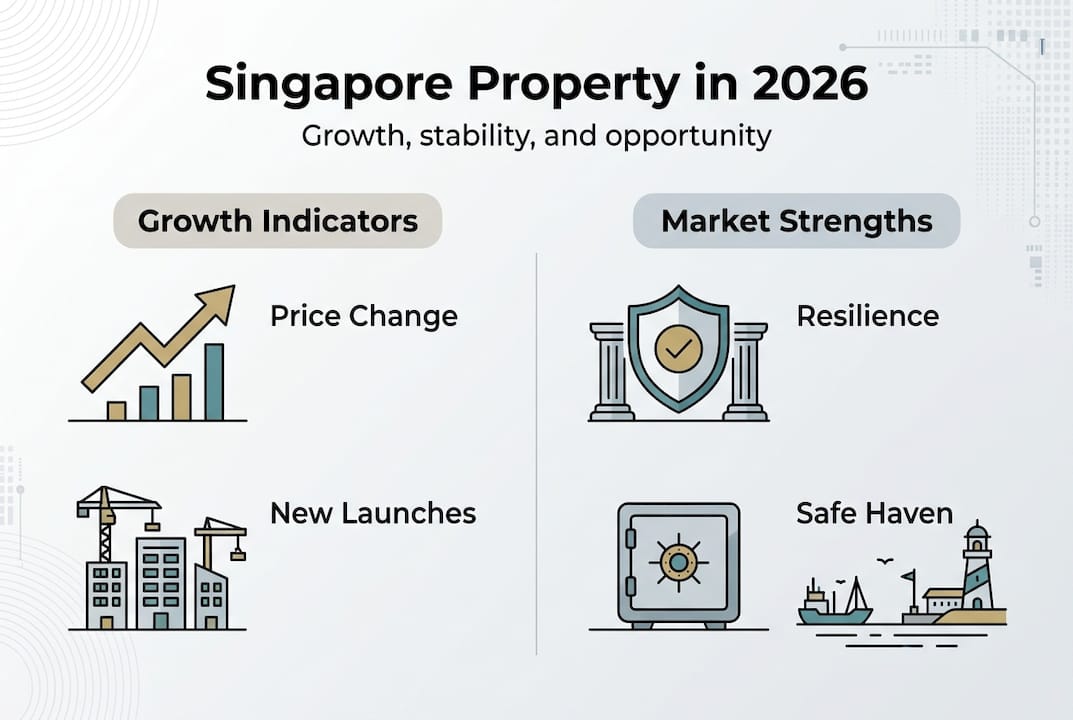
Fewer new launches in 2026 actually tighten available choice for buyers, which supports prices in the short term. At the same time, completions rising to around 7,000 units means more secondary market inventory will enter circulation, moderating any sharp upward surge. This balance is what creates a measured, sustainable growth environment rather than a speculative spike.
Where growth is concentrated
The Outside Central Region (OCR) and Rest of Central Region (RCR) are the zones capturing the most investor attention right now. OCR properties attract HDB upgraders, a massive and steady buyer segment. RCR appeals to both local professionals and savvy investors looking for value relative to the Core Central Region (CCR). Freehold properties across all zones continue to attract long-term holders who prioritize perpetual tenure over leasehold depreciation.
Key drivers shaping 2026 investor interest include:
- HDB upgrader activity: Hundreds of thousands of HDB flats have crossed their Minimum Occupation Period (MOP), pushing owners toward private property purchases
- Interest rate trajectory: Expectations of easing rates make mortgage financing more accessible, boosting buyer confidence
- Safe-haven capital flows: Global investors seeking a politically stable, rule-of-law jurisdiction continue to regard Singapore as a preferred destination
According to a widely referenced 2026 market outlook, moderate growth of 2 to 5% is the consensus forecast for the full year, driven by supply normalization and the continued appeal of Singapore as a safe-haven investment destination. The 2026 commercial property segment is seeing similar resilience, with industrial and retail assets performing strongly alongside residential.
The big-picture takeaway: Singapore’s market isn’t booming recklessly, but it isn’t stagnant either. It’s moving in a measured, policy-guided direction that rewards patient, informed investors far more than speculators chasing quick flips.
Core reasons to invest: Stability, resilience, and long-term value
Now that we’ve established the market outlook, let’s explore why investors keep favoring Singapore property over other asset classes.
Ask most investors why they hold Singapore property and you’ll hear one word repeatedly: stability. That’s not a marketing slogan. It reflects a genuinely distinctive characteristic of this market compared to stocks, bonds, or crypto. Private residential property here has delivered roughly 4% annualized returns over the past decade. That number may look modest next to equity markets in bull years, but it comes with a fundamentally different risk profile.

Comparing asset classes
| Asset class | Typical annualized return | Volatility | Inflation protection |
|---|---|---|---|
| Singapore private residential | ~4% | Low | Strong |
| Singapore equities (STI) | ~5 to 7% | Moderate to high | Moderate |
| Singapore Savings Bonds (SSBs) | ~3 to 3.5% | Very low | Limited |
| Global equities | ~7 to 10% | High | Variable |
The table above illustrates that property sits in a useful middle ground: better inflation protection than bonds, far lower volatility than equities, and the added benefit of being a tangible, leverageable asset. You can borrow against property at relatively low rates. You can’t do that with a stock portfolio without significant risk.
Real estate as an inflation hedge
One of the most underappreciated aspects of property investment is how it responds to inflation. When construction costs rise, replacement values increase, which puts a floor under property prices. When rental demand grows as residents face higher living costs, rental yields also tick upward. Both dynamics work in your favor as a property owner in ways that cash savings or fixed-income instruments simply cannot replicate.
“Property isn’t just about price appreciation. For many investors, it’s the only asset class that simultaneously generates income, builds equity through mortgage paydown, and appreciates in real terms over time.”
The safe-haven premium
Singapore’s governance quality, transparent legal system, and political stability are not just marketing points for tourism boards. They are quantifiable factors that attract institutional and high-net-worth capital in times of global stress. When other markets wobble, Singapore tends to hold. This “premium for predictability” is real, and it’s embedded in property prices here in a way that long-term investors benefit from even when short-term growth looks modest.
Pro Tip: If your primary investment goal is capital preservation rather than maximum growth, Singapore property is one of the few assets globally where you can expect reliable appreciation with downside protection built into the market’s DNA.
For investors evaluating different property types, exploring the benefits of commercial property investment in Singapore can reveal compelling yield opportunities that complement a residential-heavy portfolio.
Key risks and nuances: Policy, cost, and opportunity cost
While the benefits are clear, savvy investors must also weigh the risks and fine print.
Singapore property is not a risk-free investment. Understanding where the friction points are is essential before committing significant capital.
Government policy intervention
The Singapore government actively manages the property market through a toolkit of cooling measures. These include the Additional Buyer’s Stamp Duty (ABSD), Loan-to-Value (LTV) limits, and Total Debt Servicing Ratio (TDSR) rules. For foreign buyers, the ABSD rate currently sits at 60%, which is a near-prohibitive barrier for residential purchases. Commercial properties do not attract ABSD, making them an important alternative for overseas investors looking to gain Singapore real estate exposure.
Key risks to be aware of include:
- High entry costs: Stamp duties, legal fees, and agent commissions can add 5 to 8% to your total purchase cost
- Luxury property taxation: Properties priced above S$3 million face higher ABSD tiers, compressing net returns in the ultra-premium segment
- Limited speculative upside: Policy tools are designed specifically to prevent runaway price growth, which caps the short-term gains that speculators seek
- Illiquidity: Unlike stocks, you cannot exit a property position in minutes. Transaction timelines run to weeks or months
- Opportunity cost: The capital locked into a property deposit and monthly mortgage could alternatively be deployed into diversified global equities or Singapore Savings Bonds
Understanding ABSD for different buyer profiles
The foreigner property rules in Singapore are among the strictest in Asia. A Singaporean citizen buying a first property pays 0% ABSD. A Singaporean buying a second property pays 20%. A foreigner pays 60% regardless of how many properties they own. This tiered structure means the math for foreign residential buyers is extremely challenging to justify purely on investment returns.
The cooling measures framework is also subject to revision at any time. The government has tightened and occasionally relaxed measures based on market conditions, which introduces policy risk that is hard to hedge against in advance.
Pro Tip: If you’re a foreign investor eyeing Singapore real estate, run a complete after-tax return calculation before proceeding. Many investors focus on gross appreciation but overlook how ABSD, legal costs, and holding costs interact to compress net returns significantly.
The honest framing is this: Singapore property is excellent for capital preservation and moderate long-term wealth building. It is not the right vehicle for investors seeking high-growth, high-yield plays or short-term trading profits.
Maximizing returns: Where, what, and how to invest in 2026
Armed with risk awareness, here’s how to make the most of current opportunities.
Knowing that the market offers moderate, stable growth is one thing. Knowing precisely where within that market to allocate capital is what separates strong returns from average ones.
Step-by-step approach for 2026
-
Target OCR and RCR new launches: These regions offer better price-to-value ratios than the CCR and benefit from the strong upgrader demand wave. Projects near MRT stations with upcoming line completions have historically outperformed broader market averages.
-
Prioritize freehold over leasehold where budget allows: Freehold properties retain value better over longer holding periods and appeal to a broader buyer pool during resale. In a market where recent price trends favor patient holding strategies, perpetual tenure is a meaningful differentiator.
-
Account for the supply pipeline: With around 57,000 private units, including executive condominiums, scheduled to complete in coming years, certain micromarkets may face temporary rental and resale supply pressure. Research the specific completion timeline for your target area before committing.
-
Time your financing structure carefully: With interest rates expected to ease gradually through 2026, locking into a long fixed-rate mortgage at current levels could be advantageous compared to waiting. Speak to multiple mortgage brokers to compare structures, not just headline rates.
-
Explore undervalued pockets before they rerate: Certain neighborhoods that were overlooked during the last upcycle are showing early signs of demand pickup. Exploring Singapore’s top undervalued hotspots can reveal pockets where entry prices still offer genuine upside before mainstream interest drives values higher.
Segments with the strongest current fundamentals
The 2026 launch calendar is notably leaner than 2025, with only 17 projects scheduled versus 26 the year before. This reduced new supply creates more pricing power for existing projects and well-located resale units. For investors who can identify quality assets at fair value today, the window before broader rate easing generates fresh demand enthusiasm is worth acting on.
Pro Tip: New launches in Singapore often sell at a premium to reflect developer marketing costs and early-stage risk pricing. For investors focused on yield from Day 1, a well-selected resale unit in an in-demand location can often outperform a new launch on a net return basis when total costs are factored in.
Seasoned investors should also consider portfolio diversification within Singapore property itself. Combining residential holdings with industrial or commercial assets reduces correlation risk and can improve overall portfolio yield.
A fresh perspective: Why Singapore property’s future still shines
Let’s go beyond the numbers and look at what most investors miss in the bigger picture.
Here’s the contrarian view that most market commentaries miss entirely: the very features that critics cite as limitations are actually what make Singapore property so durable as an investment.
The 64% of Singaporeans who prefer property over stocks and bonds aren’t being irrational. They’re making a psychologically and financially sound choice for their goals. High ABSD for foreigners? That barrier protects local prices from volatile speculative foreign capital. Policy-capped upside? That same policy eliminates crash risk. Lower returns than equities? That lower return comes bundled with leverage, rental income, and a tangible asset you can physically improve.
We’ve seen investors abandon Singapore property for seemingly higher-yielding alternatives, only to return after equity volatility wipes out years of gains. The long-term property advantages are not just financial. They include the predictability, the financing leverage, and the psychological security of owning an asset backed by Singapore’s reputation as one of the world’s most stable economies.
The smarter question is never “is Singapore property the highest-returning asset?” It’s “which asset best fits my risk tolerance, time horizon, and wealth goals?” For most investors, Singapore property earns its place in that answer.
Take the next step with expert guidance
If you’re ready to act on these insights, expert support can make all the difference.
Navigating Singapore’s property market in 2026 requires more than just reading market reports. Entry costs are high, policy rules are nuanced, and the difference between a good deal and a great one often comes down to timing and local knowledge. At Aesthetic Havens, we specialize in helping investors like you identify the right opportunities, whether you’re exploring top commercial property benefits, building a residential portfolio, or just starting your property investment journey.

Working with an experienced Singapore real estate agent ensures you get personalized analysis, not generic advice. Visit Aesthetic Havens to connect with Aman Aboobucker and the ERA Realtors team for guidance tailored to your investment goals and risk profile.
Frequently asked questions
Is Singapore property still a stable investment in 2026?
Yes, the market is forecast to deliver moderate growth of 2 to 5% in 2026, supported by supply normalization, resilient upgrader demand, and Singapore’s enduring safe-haven status.
Do foreigners face additional barriers when investing in Singapore property?
Yes, foreigners are subject to ABSD rates up to 60% on residential purchases, but commercial property remains free of ABSD, making it a viable alternative for overseas investors.
How do Singapore property returns compare to stocks and bonds?
Private residential property has delivered roughly 4% annualized returns over the past decade, offering greater stability and inflation protection than bonds, with lower volatility than equities.
What are the main risks of investing in Singapore property?
Government policy interventions, high entry costs and ABSD tiers, illiquidity, and the opportunity cost of capital locked in property all represent significant risks that investors must factor into their total return calculations.
Recommended
- Top benefits of investing in commercial property in Singapore
- Singapore Commercial Property Trends: Opportunities for 2026
- Foreigner’s Guide to Buying Property in Singapore (2025 Regulations & Taxes) | Aesthetic Havens
- Unlocking Value: The Top 5 Undervalued Singapore Neighbourhoods for Property Investment in 2025 | Aesthetic Havens


