


Most people assume a real estate advisor is just a fancier version of a property agent. That assumption costs investors real money. In Singapore’s property market, where regulatory complexity, stamp duties, and leasehold nuances can wipe out years of gains, the difference between transactional support and genuine advisory is enormous. This guide breaks down exactly what real estate advisory covers, how it differs from working with a standard agent, and why serious buyers and investors in Singapore should understand this distinction before making their next move.
Table of Contents
- Defining real estate advisory: Beyond buying and selling
- Key components of real estate advisory for Singapore investors
- Singapore-specific rules and edge cases
- Trends, technologies, and the future of advisory
- Our perspective: What most investors miss about real estate advisory
- Unlocking your next step with expert support
- Frequently asked questions
Key Takeaways
| Point | Details |
|---|---|
| Strategic guidance matters | Comprehensive real estate advisory supports smarter, risk-managed investments far beyond simple transactions. |
| Local rules affect returns | Navigating Singapore’s property regulations is essential and requires specialized expertise for successful investing. |
| Technology is reshaping advisory | AI and advanced data analysis are now critical tools for making informed real estate decisions in Singapore. |
| Choose advisors wisely | Institutional-grade, unbiased advisory can add more value than relying solely on traditional property agents. |
Defining real estate advisory: Beyond buying and selling
When most investors picture getting help with property, they imagine someone showing them units, negotiating an offer, and collecting a commission. That’s what a standard agent does. Real estate advisory is a different category of service entirely.
Real estate advisory is a strategic service that goes beyond transactions to include financial planning, market analysis, portfolio construction, risk management, and valuation for property investors. In practical terms, this means your advisor isn’t just asking “what do you want to buy?” They’re asking “what do you want your wealth to look like in 10 years, and how does property fit into that picture?”
Here’s a direct comparison to make the distinction clear:
| Feature | Traditional property agent | Real estate advisor |
|---|---|---|
| Primary focus | Completing transactions | Long-term investment strategy |
| Revenue model | Commission per sale | Retainer, consulting fees, or advisory commission |
| Market analysis | Basic comparable listings | Macro and microeconomic data modeling |
| Risk management | Limited | Central to the service |
| Portfolio view | Usually single property | Full portfolio construction |
| Ongoing support | Post-sale relationship varies | Continuous portfolio monitoring |
Understanding these agent roles and benefits is useful context, but the key distinction is mindset. Agents are incentivized by volume and deal closure. Advisors are incentivized by your outcome. That structural difference changes everything about the advice you receive.
A typical real estate advisory engagement might include several of the following services:
- Portfolio audit: Assessing your current holdings for performance, risk, and alignment with your goals
- Financial modeling: Running projections for cash flow, capital appreciation, and exit scenarios
- Market intelligence: Delivering research on price trends, demand drivers, and regulatory impacts
- Asset selection: Identifying properties that fit your investment thesis, not just your budget
- Risk mapping: Flagging exposure to leasehold decay, oversupply, or regulatory tightening
- Transaction structuring: Advising on ownership structures, decoupling, and tax efficiency
“Strategic advisory is the difference between buying a property and building a portfolio. Investors who skip this step often find themselves holding assets that look good on paper but underperform when it matters most.”
For Singapore investors, this strategic layer isn’t a luxury. It’s often the margin between a strong return and a costly mistake.
Key components of real estate advisory for Singapore investors
Now that we understand advisory’s strategic nature, what actually goes into these services for Singapore investors?
The foundation is data. Advisors analyze macroeconomic and microeconomic factors such as interest rates, inflation, GDP, local supply and demand, and use these to identify undervalued assets and mitigate cyclical risks. In Singapore’s case, this analysis includes factors like government land sales (GLS) programs, urban redevelopment plans, and population growth corridors.

Here’s how the key components typically break down:
| Advisory component | What it involves | Investor benefit |
|---|---|---|
| Macroeconomic analysis | Interest rates, GDP growth, inflation modeling | Timing purchases and exits correctly |
| Microeconomic research | Neighborhood demand, supply pipeline, rental yields | Finding outperforming districts |
| Portfolio construction | Asset allocation across property types and regions | Diversification and risk reduction |
| Valuation | Independent assessments of market and investment value | Avoiding overpaying or underestimating |
| Risk assessment | Leasehold decay, regulatory exposure, liquidity | Protecting downside scenarios |
| Exit strategy | Resale market conditions, buyer profiling | Maximizing returns at disposal |
For smarter property investment, these components don’t work in isolation. They form an integrated process. Here’s how a well-structured advisory engagement moves through them:
- Discovery: Understand the investor’s financial position, goals, timeline, and risk tolerance
- Market scan: Run macroeconomic and local market analysis to identify favorable conditions
- Asset screening: Filter properties by yield, capital growth potential, and regulatory fit
- Due diligence: Validate valuations, legal title, and lease tenure
- Acquisition support: Structure the purchase to minimize stamp duty and maximize financing efficiency
- Portfolio review: Revisit the strategy regularly as market conditions evolve
One area where Singapore advisors add tremendous value is identifying Singapore’s undervalued neighborhoods before the broader market prices them in. This requires both quantitative data and on-the-ground knowledge of planning intentions, transit upgrades, and demographic shifts.
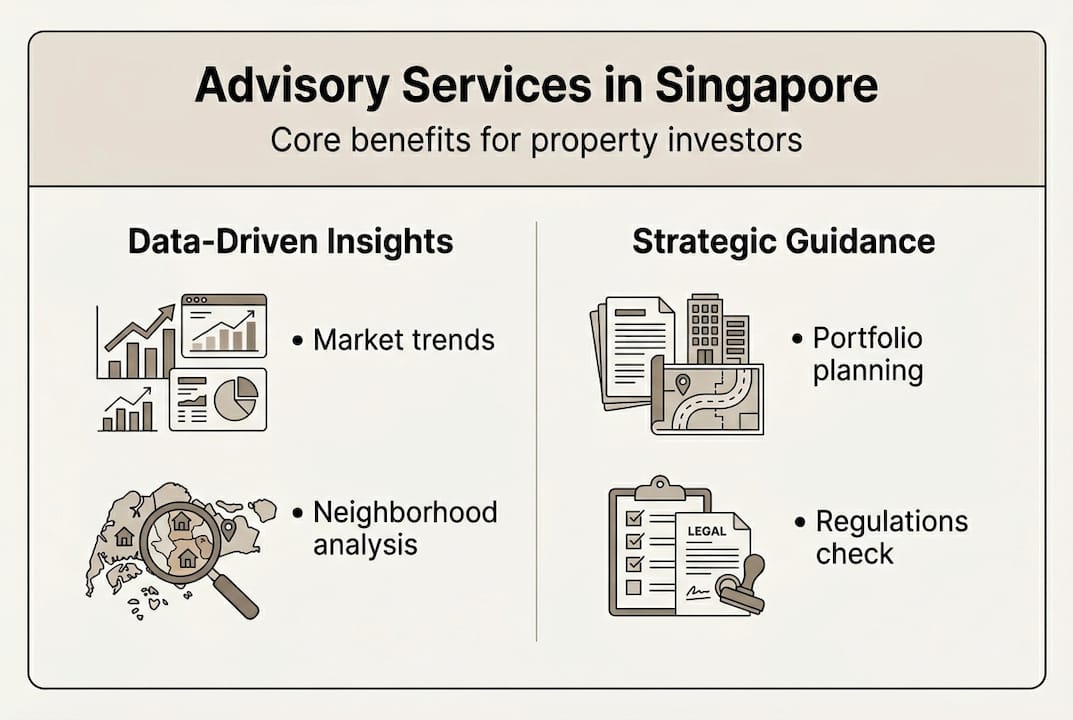
Pro Tip: Ask your advisor to show you their data sources. Top-tier advisors use platforms like URA’s REALIS, CoStar, and proprietary AI scoring models. If an advisor’s “market analysis” is based primarily on gut feel or recent transactions, that’s not advisory. That’s anecdote with a price tag.
Singapore-specific rules and edge cases
Beyond general strategies, Singapore’s market requires advisors who understand critical local rules and exceptions that can dramatically affect investment outcomes.
Singapore operates one of the most regulated property markets in the world. For investors, this creates complexity at every stage. The rules around stamp duties alone require careful planning. The Additional Buyer’s Stamp Duty, commonly known as ABSD, adds 20% or more to the purchase price for Singaporeans buying a second property, and up to 60% for foreign buyers on any residential purchase. Getting this wrong isn’t a minor inconvenience. It’s a six-figure cost.
Edge cases in Singapore include ABSD optimization, TDSR compliance, decoupling for second properties, HDB-to-private upgrades, and leasehold decay modeling using Bala’s Table. Each of these requires specific expertise:
- ABSD optimization: Structuring ownership to minimize stamp duty, including the use of trusts or phased acquisitions
- TDSR compliance: The Total Debt Servicing Ratio caps total debt repayments at 55% of gross monthly income. Advisors help investors structure loans to stay within this limit while maximizing borrowing capacity
- Decoupling: A strategy where married couples separate ownership of a jointly held property so one spouse can purchase a second property without incurring ABSD. This window has narrowed considerably since regulatory changes in 2023
- HDB-to-private upgrades: HDB owners face a five-year minimum occupation period before selling, and timing this upgrade correctly is critical for capital efficiency
- Leasehold decay: Properties with shorter remaining leases depreciate in predictable ways, modeled through Bala’s Table, which assigns depreciation percentages based on years remaining
The property cooling measures introduced in recent years have added further layers of complexity. Many investors don’t realize that some cooling measures have carve-outs or exemptions that a well-informed advisor can legally leverage.
For foreign buyers specifically, the landscape is even more restrictive. Understanding the full picture of regulations for foreign buyers is non-negotiable before committing capital. Foreign nationals are largely restricted to private condominiums and cannot purchase landed homes without special approval from the Singapore Land Authority.
Affordability calculations are equally nuanced. Most buyers underestimate how mortgage and affordability rules interact with TDSR and Loan-to-Value ratios, especially when they already hold an outstanding home loan.
Pro Tip: Bala’s Table is a useful guide for leasehold depreciation, but experienced advisors know it doesn’t always reflect actual secondary market pricing. In some mature estates, short-lease properties have held value better than the table suggests, driven by en bloc potential or location premiums. Treat Bala’s Table as a starting point, not a final verdict.
Trends, technologies, and the future of advisory
Finally, let’s look at how forward-thinking advisory adapts to Singapore’s regulatory, technological, and climate-driven challenges.
The advisory landscape is changing fast. Individual agents who focus on transactions and negotiations are increasingly being differentiated from institutional advisory platforms that emphasize data platforms, AI scoring models, and co-investment structures. The gap between these two service levels is widening, and investors who don’t recognize it are leaving value on the table.
The AI and PropTech revolution is reshaping how advisors source intelligence, score assets, and model future performance. Machine learning models now scan thousands of transactions to identify pricing anomalies that human analysts would miss. Automated valuation models, combined with human judgment, are making advisory faster and more precise.
Here are the key trends shaping real estate advisory in Singapore right now:
- AI-driven asset scoring: Algorithms rank properties by investment quality using yield, lease tenure, location data, and buyer demand signals
- Climate risk integration: Green building certifications, flood zone mapping, and energy efficiency ratings are entering valuation models
- Institutional co-investment platforms: High-net-worth investors are gaining access to advisory-led pooled investment structures
- Regulatory change tracking: Advisory firms now use automated regulatory monitoring to alert clients to policy changes before they hit the news
- Cross-border investment tools: Singapore investors looking at Malaysia, Australia, and the UK benefit from advisory platforms with integrated foreign property data
Climate risks and regulatory changes, including OECD findings on data gaps in property markets, add layers to advisory that conventional approaches simply don’t account for. Singapore’s low-lying coastal areas, increasing urban heat, and government green building mandates are beginning to influence which properties will hold long-term value.
The emerging commercial trends across industrial, logistics, and mixed-use sectors are also generating new advisory demand. Investors who once focused purely on residential are diversifying, and they need advisors who understand these asset classes with the same depth.
“The next generation of advisory isn’t about who knows the most listings. It’s about who has the best data infrastructure, the clearest analytical framework, and the most honest assessment of what your portfolio actually needs.”
The investors who will perform best in the next cycle are those who treat advisory as an ongoing relationship, not a one-time consultation.
Our perspective: What most investors miss about real estate advisory
Let’s cut through the confusion and share what seasoned investors and institutional clients have learned about getting the most value from real estate advisory.
The biggest mistake we see is transactional thinking applied to a strategic problem. Investors spend weeks comparing unit prices and zero time thinking about their overall portfolio structure. They optimize for the deal instead of the outcome.
Serious investors understand that the value of advisory is in the questions it forces you to answer: What’s your exit strategy? How does this property affect your tax position? What happens if interest rates rise another 1%? These aren’t questions agents typically ask.
For complex portfolios, established firms like Colliers, Savills, and JLL provide unbiased valuations and market intelligence that individual agents simply cannot match. The institutional-grade research these firms produce is genuinely different from what most investors access through standard market channels.
The commercial investment advantages that advisory unlocks are particularly underappreciated among retail investors who have never looked beyond residential.
Pro Tip: When vetting an advisor in Singapore, ask three questions: What data platforms do you use? Can you show me a sample portfolio analysis? How are you compensated, and does that create any conflict of interest? The answers will tell you whether you’re dealing with a genuine advisor or a well-dressed salesperson.
Unlocking your next step with expert support
If you’re ready to move beyond “just buying” and approach investing strategically, it pays to start with the right support.
Real estate advisory isn’t for everyone. But if you’re managing multiple properties, planning to upgrade, or looking to build wealth systematically through property, generic advice simply won’t cut it. You need someone who understands Singapore’s unique regulatory environment, reads the data, and aligns their success with yours.

At Aesthetic Havens, we work with buyers and investors who want more than a transaction. As a trusted realtor in Singapore operating under ERA Realtors, Aman Aboobucker brings advisory-grade thinking to every client engagement. Whether you need Singapore market analysis to time your next purchase, or you’re exploring diversification into an industrial real estate guide for new asset classes, the conversation starts with your goals, not our listings.
Frequently asked questions
What exactly does a real estate advisory firm do?
A real estate advisory firm provides strategic guidance including financial planning, market analysis, portfolio design, and risk management, going well beyond simply helping clients buy or sell property.
How does real estate advisory differ from using a property agent?
Institutional advisory emphasizes long-term data analysis, AI scoring, and portfolio strategy, whereas agents primarily focus on facilitating transactions and negotiating individual deals.
What Singapore-specific regulations can advisors help navigate?
Advisors assist with ABSD optimization, TDSR compliance, decoupling strategies, HDB-to-private upgrade timing, and understanding how leasehold decay affects long-term asset values.
Are data and technology important for modern real estate advisory?
Yes, data platforms and AI scoring are now central to advanced advisory, and climate and regulatory risk data gaps identified by the OECD confirm that future-proofed advisory requires this institutional-grade intelligence.
Recommended
- Real estate agents in Singapore: roles & key benefits
- Foreigner’s Guide to Buying Property in Singapore (2025 Regulations & Taxes) | Aesthetic Havens
- What is industrial real estate? A guide for Singapore investors
- The Ultimate Guide to Smarter Singapore Property Investments in 2025 | Aesthetic Havens


