


Most people picture a plain concrete box when they hear “industrial real estate.” That mental image costs investors money. Singapore’s industrial sector spans everything from climate-controlled cold storage facilities and precision manufacturing plants to R&D labs and multi-story automated logistics hubs—all of it supporting Singapore’s economy at its most foundational level. If you’re a property investor or business owner trying to figure out whether industrial assets deserve a place in your portfolio, this guide breaks down what the sector actually includes, how Singapore’s zoning rules shape your options, and what the numbers say about where the market is heading.
Table of Contents
- Understanding industrial real estate: Definition and key uses
- Singapore industrial zoning: B1 vs B2 and key regulations
- Current market trends and demand drivers
- Investment considerations: Opportunities and risks in industrial assets
- Why Singapore investors must rethink industrial real estate strategy
- Unlock Singapore industrial property opportunities with the right expert
- Frequently asked questions
Key Takeaways
| Point | Details |
|---|---|
| Industrial real estate variety | Singapore’s industrial real estate includes highly specialized properties beyond warehouses, such as flex, logistics hubs, and R&D sites. |
| Regulatory essentials | Understand URA’s B1/B2 zoning and 60:40 usage rule to prevent compliance issues and enhance investment value. |
| Growing market opportunity | High occupancy rates and sustained demand, particularly from logistics and e-commerce, underpin a positive outlook for industrial assets. |
| Investment frameworks | Success requires balancing lease types, asset modernization, and tenant needs amid rapid technological change. |
Understanding industrial real estate: Definition and key uses
Industrial real estate is not a single asset type. It is a broad category of properties designed to support the physical operations of businesses, covering everything from storage and distribution to production and scientific research. The common thread is function: these spaces exist to move, make, or develop things, not primarily to house people or retail activity.
In Singapore’s context, industrial properties range from manufacturing plants to last-mile logistics sites, including cold storage and R&D labs. That range matters enormously when you are evaluating an investment or seeking space for your own operations.
Here is a quick breakdown of the main industrial property types you will encounter in Singapore:
- Warehouses (bulk and last-mile): Traditional high-ceiling storage and distribution centers, plus smaller urban fulfillment hubs servicing e-commerce delivery networks
- Manufacturing facilities: Purpose-built spaces for light assembly, precision engineering, electronics, or heavy industrial output
- Flex spaces: Hybrid properties combining office, light production, and storage under one roof, popular with SMEs
- Cold storage: Temperature-controlled facilities critical for food, pharma, and biomedical supply chains
- R&D and high-tech: Specialized labs and science park units for product development, testing, and innovation
Each type supports a different part of the supply chain. A cold storage operator in Jurong has very different needs from a biomedical firm at one-north. This matters because demand drivers, tenant profiles, lease structures, and ultimately asset values differ across these sub-types.
Industrial real estate is the backbone of every physical product you buy. Before it reaches a shelf or your doorstep, it passed through industrial space: manufactured, stored, sorted, and dispatched.
For investors already familiar with buying commercial property in Singapore, industrial assets introduce a new layer of operational logic. The value is not just in the building but in what that building enables for its tenant.
Singapore industrial zoning: B1 vs B2 and key regulations
Before you put a single dollar into Singapore industrial property, you need to understand the Urban Redevelopment Authority’s zoning framework. Get this wrong and you face compliance fines, restricted tenants, and stalled operations.

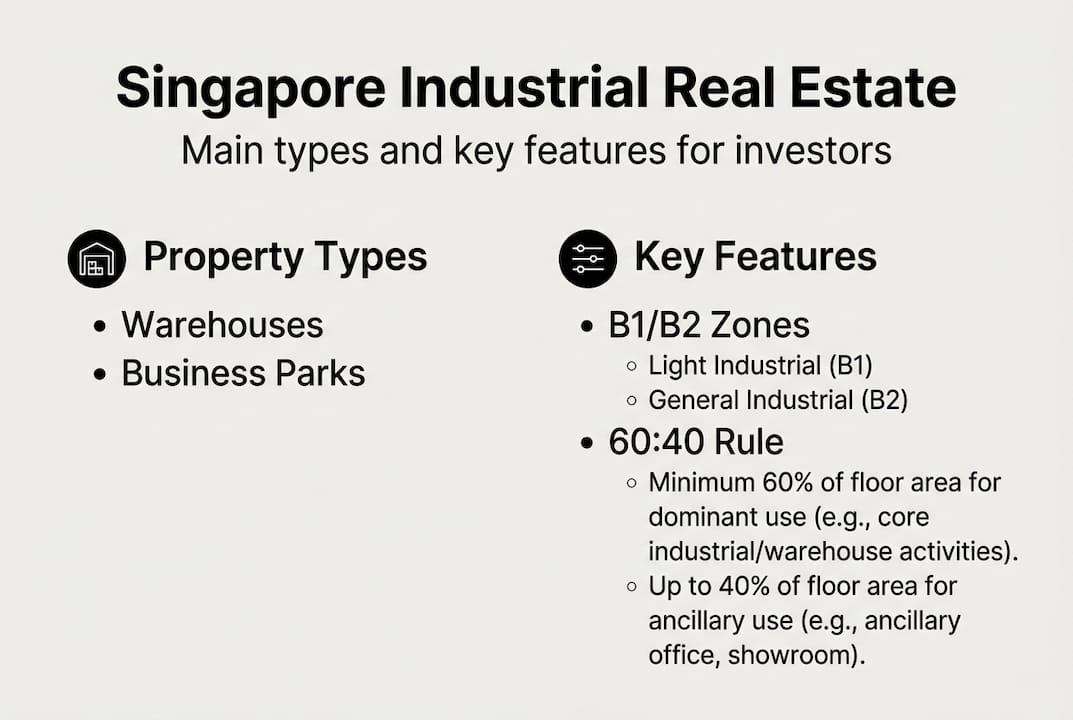
Singapore’s URA defines B1 for light, clean industries and B2 for heavier manufacturing, each with specific guidelines including nuisance buffers and the 60:40 rule. These two classifications shape everything from who can legally occupy the unit to how close the building can sit to residential zones.
| Feature | B1 (light industry) | B2 (general industry) |
|---|---|---|
| Typical uses | Electronics, printing, food processing | Heavy manufacturing, chemical plants |
| Location | Near residential/commercial areas | Peripheral industrial estates |
| Buffer zone | 50-meter nuisance buffer | 100-meter nuisance buffer |
| Compliance risk | Lower | Higher |
| Property value | Generally higher | Lower, with specialized demand |
The 60:40 rule applies to both zones. At least 60% of your gross floor area must be used for core industrial activities such as manufacturing, warehousing, or R&D. The remaining 40% can serve ancillary purposes like offices, showrooms, or staff canteens. Violating this ratio is one of the most common compliance errors investors and tenants make.
For state land properties, JTC Corporation adds another layer of controls, including approved use clauses and assignment restrictions. This means you cannot simply lease a JTC unit to any tenant you choose without checking permitted use categories first.
Regulatory must-knows for first-time industrial investors:
- Confirm zoning class before purchasing (B1 vs B2 dictates your tenant pool)
- Check the 60:40 compliance requirement for all intended uses
- Verify JTC or freehold status and any assignment restrictions
- Review approved use categories in the lease and align with tenant activity
Pro Tip: Zoning directly impacts your rental yield and tenant options. A B1 unit in a mixed-use industrial park typically attracts a wider, higher-quality tenant base than a B2 asset in a remote estate. Always match the zone to your target tenant before committing.
Keeping a close eye on property trends in 2026 will also help you anticipate regulatory shifts and rezoning activity that could affect asset values.
Current market trends and demand drivers
The numbers backing Singapore’s industrial market are hard to ignore. Singapore’s Q3 2025 industrial figures show a total stock of 53.9 million square meters, an occupancy rate of 89.1%, and sustained growth in both price and rental indexes. These are not vanity metrics. They reflect genuine, broad-based demand.
According to JTC Q3 2025 data, the industrial market has maintained resilience even as the broader economy navigates global uncertainty. The key demand drivers are structural, not cyclical.
Macro forces shaping industrial real estate demand:
- E-commerce growth requiring more last-mile and urban fulfillment infrastructure
- Onshoring and supply chain diversification increasing Singapore’s manufacturing appeal
- Automation and robotics adoption lifting demand for high-spec, tech-ready facilities
- Pharmaceutical and biomedical sector expansion driving Science Park and cold storage demand
- 3PL (third-party logistics) operators consolidating into larger, modern hub facilities
The performance gap between asset types is widening. High-tech and science park properties are seeing stronger rental growth than generic warehouses. Specialized segments such as cold storage command significant rental premiums due to limited supply and high build costs.
A development like Space 18 illustrates exactly how the market is evolving. Modern, purpose-built industrial assets with quality specifications are pulling ahead of older stock on both occupancy and rental rates.
| Asset type | Occupancy trend | Rental outlook |
|---|---|---|
| High-tech/R&D | Strong, above market | Rising |
| Logistics/warehouse | Stable | Steady to rising |
| Cold storage | Very tight | Premium and growing |
| Older B2 manufacturing | Softening | Flat to declining |
For investors tracking opportunities in industrial trends, the message is clear: positioning in specialized and automation-ready segments outperforms generic warehouse plays over a medium-term horizon.
Investment considerations: Opportunities and risks in industrial assets
Knowing the market exists is one thing. Knowing how to participate is another. Industrial real estate offers several entry points depending on your capital, risk appetite, and involvement preferences.
Direct ownership gives you control over asset management and tenant selection, but requires compliance diligence and sector knowledge. Industrial REITs listed on the Singapore Exchange (SGX) offer more liquid exposure to the same underlying demand, with professional management and portfolio diversification built in. Private fund structures sit in between, typically requiring higher minimums but offering targeted exposure to specific segments.
Long lease structures of 10 to 20 years are common in institutional industrial assets, often structured as triple net (NNN) or built-to-suit (BTS) arrangements. Class A modern assets command premium yields over older stock, which faces growing obsolescence risk. The lesson: asset quality increasingly separates winners from underperformers.
Steps to evaluate an industrial investment:
- Confirm zoning classification and permitted uses under URA and JTC guidelines
- Analyze tenant profile and business sector: how specialized is their operation?
- Review lease structure, term length, and break clauses carefully
- Assess the building’s spec: ceiling height, floor loading, power supply, and tech readiness
- Evaluate proximity to key logistics nodes: ports, airports, and expressways
- Compare age and condition against new supply entering the same submarket
Demand from electronics manufacturers and third-party logistics operators remains the backbone of Singapore’s industrial occupancy. These tenants commit to long leases and invest heavily in fit-out, making them among the stickiest in any asset class.
The investment benefits of commercial and industrial real estate in Singapore also include generally lower stamp duties compared to residential properties, making the entry math more attractive for serious investors.
Pro Tip: Prioritize assets with fit-for-purpose design and entrenched tenants who cannot easily relocate. A pharmaceutical cold chain operator or precision engineering firm embedded in your building is a very different risk profile from a general storage tenant. Tenant stickiness is a moat.
The bigger risk in today’s market is chasing yield in aging assets without factoring in the commercial property outlook for capital expenditure requirements and potential vacancy as tenants upgrade.
Why Singapore investors must rethink industrial real estate strategy
Here is the uncomfortable truth most industrial property guides skip: age and price per square foot are poor proxies for value in Singapore’s industrial market. A newer, high-spec unit with a specialized tenant at a higher price point will almost always outperform a cheap older building with a generic occupier.
Singapore’s land scarcity has created something unusual globally: multi-story industrial buildings where precision, functionality, and REIT-grade specifications matter more than location alone. You will not find this asset profile easily in most other markets. That is both the challenge and the opportunity.
Investors who chase the lowest entry price in older B2 estates often discover the hidden costs: aging infrastructure, tight parking, low ceiling heights, and tenants with weak covenant strength. The smarter play is recognizing that Singapore’s industrial future is tied to AI and PropTech innovation, automation readiness, and supply chain specialization. Properties that enable those functions will hold and grow value. Properties that don’t will face increasing headwinds regardless of their current occupancy.
The investors winning in this market are not the ones buying the most units. They are buying the right units in segments where tenant demand is structural and durable.
Unlock Singapore industrial property opportunities with the right expert
Understanding the theory is valuable. Acting on it confidently is something else entirely. Singapore’s industrial property market rewards those who can read zoning nuances, anticipate tenant demand shifts, and structure transactions correctly from the start.
At Aesthetic Havens, we work with investors and business owners navigating exactly these decisions. Whether you are evaluating your first industrial asset, expanding a portfolio, or seeking a business premise that fits both your operation and compliance requirements, our team provides bespoke analysis grounded in current market data. Explore the latest Singapore commercial property trends or connect with our real estate agents to discuss a strategy tailored to your goals.
Frequently asked questions
What is the difference between B1 and B2 industrial property in Singapore?
B1 and B2 zoning differ primarily in the intensity of industrial use permitted: B1 hosts light, clean industries near urban areas with a 50-meter buffer, while B2 allows heavier manufacturing in peripheral zones with a 100-meter buffer.
What activities are allowed in Singapore industrial real estate zones?
Core activities include manufacturing, warehousing, logistics, or research. The 60:40 rule limits ancillary uses such as offices and showrooms to a maximum of 40% of the total floor area.
Are industrial properties a good investment in Singapore now?
Demand remains strong, particularly for logistics and automation-ready spaces. High occupancy and rental growth reported in Q3 2025 support a positive medium-term outlook for well-located, modern industrial assets.
What are the lease terms like for Singapore industrial assets?
Industrial leases often run 10 to 20 years, with many structured as triple net or built-to-suit arrangements. JTC properties carry leaseholds of 30 to 60 years, adding a tenure consideration for long-term investors.
Recommended
- Singapore Commercial Real Estate Outlook 2025: A Definitive Guide for Investors & Businesses in the Office, Retail, and Industrial Sectors | Aesthetic Havens
- Singapore Commercial Property Trends: Opportunities for 2026
- Top benefits of investing in commercial property in Singapore
- The Ultimate Guide to Smarter Singapore Property Investments in 2025 | Aesthetic Havens


