


Signing a commercial lease in Singapore without fully understanding what you’re committing to can cost your business tens of thousands of dollars. Many business owners focus on location and monthly rent, then discover too late that reinstatement costs, mismatched zoning approvals, or rigid lease terms have left them exposed. This guide walks you through every stage of the commercial leasing process, from foundational terminology to regulatory compliance, so you can negotiate confidently, avoid expensive mistakes, and secure a space that genuinely supports your business goals.
Table of Contents
- Key terms and requirements: What you need to know before starting
- Comparing property types and recent market trends
- The leasing process: Step-by-step guide for business tenants
- Regulatory compliance: Retail vs. office/industrial leases
- Understanding costs, taxes, and legal obligations
- Common pitfalls and troubleshooting: What to watch out for
- Our perspective: What business tenants often overlook in commercial leases
- Work with experts to secure your ideal commercial space
- Frequently asked questions
Key Takeaways
| Point | Details |
|---|---|
| Know core lease terms | Understanding key lease clauses and obligations protects your interests and avoids unpleasant surprises. |
| Compare property options | Regularly benchmark rental rates, property types, and market trends to make cost-effective decisions. |
| Follow the leasing process | A step-by-step approach from needs identification to handover ensures a smooth commercial lease experience. |
| Stay compliant | Complying with Singapore’s regulations, including LARPA and URA rules, is essential for lease security and business continuity. |
| Avoid costly errors | Watch out for common pitfalls, and seek expert advice where needed to minimize risk and unexpected costs. |
Key terms and requirements: What you need to know before starting
Before you view a single property, you need to speak the language of commercial leases. Key lease terms include lease tenure, rent structure, security deposit, permitted use, fit-out, reinstatement, assignment/subletting, break clauses, insurance, and renewals. Each one carries financial and legal weight.
Permitted use is particularly critical. The Urban Redevelopment Authority (URA) zones properties for specific activities, and operating outside your approved use can result in fines or forced closure. A space zoned for “office” cannot legally host a food and beverage outlet without a change-of-use approval.
Here are the core cost benchmarks you should have in mind before starting your search:
| Property type | Typical rent range (psf/pm) | Security deposit | Min. lease term |
|---|---|---|---|
| CBD Grade A office | S$10.00 to S$14.00 | 2 to 3 months | 2 to 3 years |
| Suburban retail | S$8.00 to S$15.00 | 2 to 3 months | 2 to 3 years |
| Industrial/warehouse | S$1.50 to S$3.50 | 2 to 3 months | 2 to 3 years |
Key documents you should prepare before approaching a landlord:
- Latest 2 years of audited financial statements or management accounts
- Business registration certificate (ACRA)
- Directors’ identification documents
- A business plan or tenancy proposal outlining your intended use
- Proof of available capital for deposit and fit-out
Pro Tip: Build a lease checklist that covers every term above before you start viewing. Gaps in preparation are where costly oversights happen. The Singapore commercial real estate outlook is also worth reviewing to set realistic expectations before you begin.
Comparing property types and recent market trends
With a foundation in key terms and requirements, it’s time to consider where your business fits amid Singapore’s dynamic commercial property landscape in 2026.
Singapore’s commercial market divides into three main segments: office, retail, and industrial. Each serves different operational needs and comes with distinct lease structures and risk profiles.

CBD Grade A office rents reached S$12.04 to S$12.40 psf/pm in early 2026, with vacancy rates between 4% and 11% and growth forecasts of 2% to 5% for the year. That tight supply means landlords hold more negotiating power in prime locations right now.
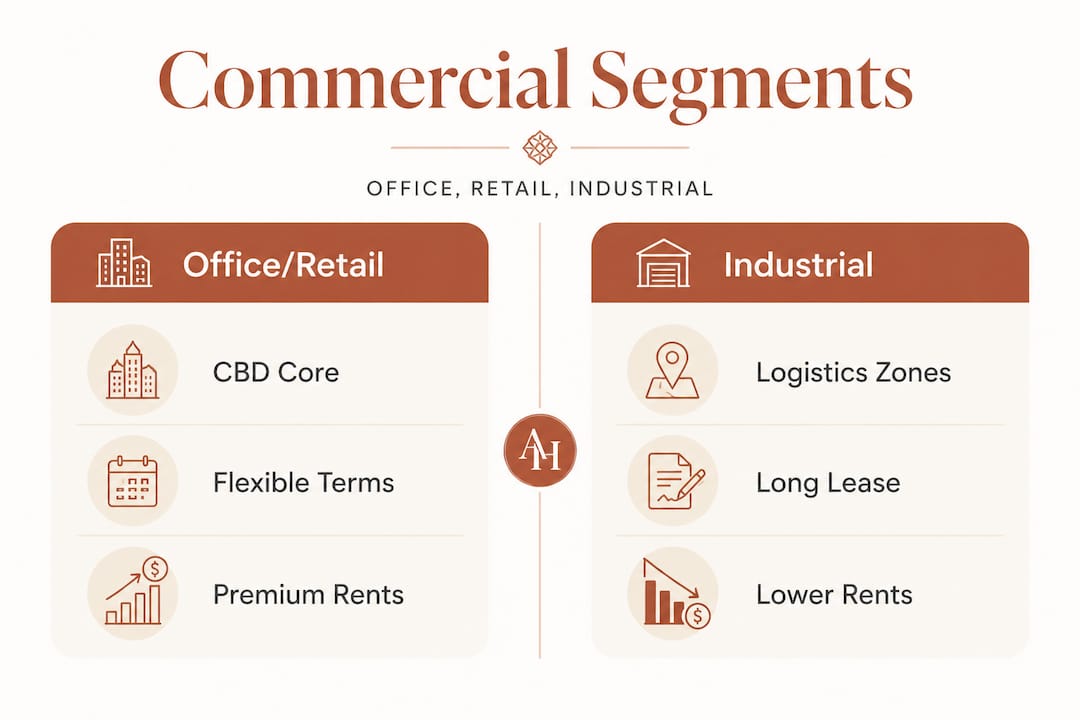
| Segment | Avg. rent (psf/pm) | Vacancy rate | Fit-out flexibility | Best for |
|---|---|---|---|---|
| CBD Grade A office | S$12.04 to S$12.40 | 4% to 11% | Moderate | Professional services, finance |
| Suburban office | S$6.00 to S$9.00 | 8% to 15% | High | Tech, startups, back-office |
| Retail (prime) | S$25.00 to S$45.00 | 6% to 9% | Low | F&B, lifestyle, fashion |
| Industrial | S$1.50 to S$3.50 | 8% to 12% | High | Logistics, light manufacturing |
Key indicators to watch for the rest of 2026:
- Office: Demand from financial services and tech firms keeps prime vacancies low. Decentralized hubs like one-north and Jurong are gaining traction as cost-conscious alternatives.
- Retail: Experiential and F&B concepts continue to outperform. Landlords are more willing to negotiate for tenants who drive foot traffic.
- Industrial: E-commerce growth sustains demand for last-mile logistics space, particularly in the west of Singapore.
For a deeper read on where each segment is heading, the commercial property trends for 2026 breakdown and the Singapore rental market outlook are both worth your time.
The leasing process: Step-by-step guide for business tenants
Understanding the market and property options prepares you to navigate each step of the leasing journey efficiently and strategically.
Important note: Commercial leases involve longer terms of 3 to 5 years and significantly higher tenant responsibilities than residential leases. Plan for vacancy risks, capital expenditure, and exit liquidity before you sign.
Here is the standard leasing process for business tenants in Singapore:
- Define your requirements. Nail down your space needs, budget, preferred location, permitted use, and ideal lease term before you search.
- Property search and viewings. Engage a commercial agent or search listings. View multiple properties and assess fit-out condition, accessibility, and building management quality.
- Submit a letter of intent (LOI). This non-binding document outlines your proposed rent, term, and key conditions. It signals serious intent and opens formal negotiation.
- Due diligence. Verify URA zoning, check for outstanding maintenance issues, and confirm the landlord’s title to the property. Review any existing tenancy encumbrances.
- Negotiate the lease. Push for rent-free periods (typically for fit-out), favorable reinstatement terms, subletting rights, and a break clause if your business needs flexibility.
- Legal review. Engage a solicitor to review the full lease agreement. Never skip this step, regardless of how straightforward the deal appears.
- Execute the lease and pay deposit. Sign the agreement, pay the security deposit (typically 2 to 3 months’ rent), and stamp the lease with IRAS within 14 days.
- Handover and fit-out. Take possession of the space and begin fit-out within the agreed rent-free period.
Pro Tip: License approvals from agencies like NEA, URA, or the Singapore Food Agency can take 4 to 8 weeks. Align your fit-out timeline with these approvals so you’re not paying rent on a space you can’t yet operate. For more tactical advice, see these commercial leasing tips before you enter negotiation.
Regulatory compliance: Retail vs. office/industrial leases
After learning the steps to lease execution, it’s essential to ensure all legal and regulatory obligations are met based on your property type.
Singapore’s regulatory framework treats retail leases very differently from office and industrial leases. Retail leases must comply with the Leases of Retail Premises Act (LARPA) and its mandatory Code of Conduct. Any deviation from the Code must be formally declared to the Fair Tenancy Industry Committee (FTIC).
“Retail tenants gain meaningful protections under the LARPA Code, including standardized lease terms and dispute resolution pathways, but they must declare any agreed deviations to the FTIC to remain compliant.”
Key compliance points tenants must not overlook:
- URA zoning: Your intended business activity must match the property’s approved use. Apply for change-of-use well before your target opening date.
- HDB shophouses: These carry specific restrictions on permitted trade categories and operating hours. Violations can result in lease termination.
- Conservation shophouses: URA imposes strict guidelines on renovations and signage. Fit-out costs can be significantly higher.
- Industrial properties: JTC and HDB-managed industrial spaces have strict rules on the percentage of ancillary office space allowed within the unit.
- Fire safety and accessibility: All premises must meet SCDF fire safety standards and BCA accessibility requirements before you can operate.
For a clear picture of how agent expertise helps you stay compliant, the guide on agent roles for compliance is a practical resource.
Understanding costs, taxes, and legal obligations
Equipped with regulatory awareness, you should address the practical side: the financial and legal responsibilities of a sound commercial lease.
Stamp duty on leases is calculated based on the annual rent and lease term, and the tenant is responsible for paying it. Legal fees for lease drafting and review are also negotiable between parties.
Common hidden costs that catch tenants off guard:
- Reinstatement costs: You are typically required to restore the space to its original condition at lease end. This can run S$20,000 to S$100,000+ depending on the extent of your fit-out.
- Air-conditioning maintenance: Tenants are often responsible for servicing the A/C units within their space, even if the building’s central system is landlord-managed.
- Property tax escalation clauses: Some leases pass property tax increases directly to the tenant.
- Gross turnover (GTO) rent: Common in retail leases. If your sales exceed a threshold, you pay an additional percentage on top of base rent.
| Cost item | One-time or recurring | Typical range |
|---|---|---|
| Security deposit | One-time (refundable) | 2 to 3 months’ rent |
| Stamp duty | One-time | 0.4% to 3% of total rent |
| Legal fees | One-time | S$1,500 to S$5,000 |
| Fit-out costs | One-time | S$30 to S$150+ psf |
| Service charge | Recurring | S$0.50 to S$2.00 psf/pm |
| Reinstatement | One-time (end of lease) | S$20,000 to S$100,000+ |
If you’re weighing leasing against ownership, the guide on buying commercial property in Singapore lays out the financial comparison clearly.
Common pitfalls and troubleshooting: What to watch out for
With knowledge of costs and compliance, mitigating risk means anticipating and avoiding the most common leasing blunders.
Breaches of commercial leases typically lead to negotiation, mediation, or litigation. HDB shops and shophouses carry specific use restrictions, and early termination often means covering the landlord’s costs to find a replacement tenant.
The most common mistakes business tenants make:
- Misreading the break clause. Many tenants assume they can exit freely after a break period. In practice, break clauses often require 6 months’ written notice and full compliance with all lease obligations at the time of exercise.
- Ignoring reinstatement obligations. Tenants who install heavy fit-outs without documenting the original condition face enormous reinstatement bills at lease end.
- Assuming verbal agreements hold. Landlords and building managers sometimes make verbal promises about improvements or concessions. If it’s not in the lease, it doesn’t exist legally.
- Failing URA compliance checks. Starting operations before securing the correct use approval can result in stop-work orders and fines.
- Overlooking subletting restrictions. Many leases prohibit subletting without landlord consent. If your business model depends on subletting part of your space, negotiate this upfront.
Pro Tip: Every concession, waiver, or side agreement must be documented in a written addendum to the lease and signed by both parties. Verbal promises are unenforceable. For a complete walkthrough of the leasing journey, the complete Singapore leasing guide covers scenarios from entry to exit.
Our perspective: What business tenants often overlook in commercial leases
Most guides tell you to compare rents and check zoning. That’s necessary but not sufficient. What we consistently see at Aesthetic Havens is that the tenants who face the biggest problems aren’t the ones who ignored the basics. They’re the ones who optimized for the wrong thing.
Focusing exclusively on headline rent is the most common trap. A space at S$9.00 psf with a rigid 5-year term, no break clause, and full reinstatement obligations can cost far more than a space at S$11.00 psf with a 3-year term, a break option at year 2, and a landlord who agrees to a partial reinstatement waiver. The math only becomes visible when you model the total cost of occupancy, not just the monthly check.
The second overlooked issue is “permitted use” mismatches. Business owners often fall in love with a space and then try to retrofit their operations to fit the zoning. That’s backwards. Your URA-approved use should be the first filter, not an afterthought. We’ve seen businesses spend S$80,000 on fit-out before discovering their intended activity required a change-of-use that the landlord would not support.
Finally, exit planning is almost always an afterthought. What happens if your business grows faster than expected and you need more space? What if it contracts? Negotiating a subletting right or a break clause at the start costs you very little. Trying to negotiate your way out of a lease mid-term can cost you everything. Understanding how agent expertise helps at the negotiation stage is where real value gets created, not just in finding the space but in structuring the deal so it works for your business across its full term.
Work with experts to secure your ideal commercial space
Navigating Singapore’s commercial leasing market is genuinely complex, and the stakes are high. The right professional support can mean the difference between a lease that supports your growth and one that constrains it.
At Aesthetic Havens, we work with business owners across office, retail, and industrial segments to identify suitable spaces, negotiate favorable terms, and ensure full regulatory compliance from day one. Understanding the real estate agent benefits in a commercial context goes well beyond finding listings. Our agent services for commercial leasing cover market analysis, lease structuring, and compliance checks so you can focus on running your business. Connect with our team at Aesthetic Havens to start your commercial property search with confidence.
Frequently asked questions
What is the typical security deposit for renting commercial property in Singapore?
Most leases require a security deposit of 2 to 3 months’ gross rent, payable upfront by the tenant at lease signing.
How does LARPA affect retail tenants in Singapore?
LARPA mandates a Code of Conduct for qualifying retail leases and requires any agreed deviation from the Code to be formally declared to the FTIC.
Who is liable for service charges and maintenance under Singapore commercial leases?
Tenants are generally responsible for interior maintenance and service charges unless specific terms are negotiated differently in the lease agreement.
What happens if a tenant breaches a commercial lease?
Breaches are typically resolved through negotiation, mediation, or litigation, with tenants potentially liable for the landlord’s costs to find a replacement tenant.
Are legal fees for commercial lease agreements negotiable?
Yes, legal fees for lease drafting and review are negotiable and can often be shared or capped as part of the overall lease negotiation.


