


Yes, you can buy residential property under a trust in Singapore. The structure is legal, well-established, and used by families across the income spectrum. But three hard constraints shape every trust purchase before you even call a lawyer.
Three must-knows before you go further:
- Cash only. CPF funds cannot be used for a trust purchase, and banks are generally unwilling to lend against a trust title. Budget for a full cash outlay.
- ABSD (Trust) applies. An additional buyer’s stamp duty applies to residential property purchased to be held on trust for a beneficiary while the settlor is alive, representing a significant cost for such transactions.
- Approvals matter. HDB flats placed in trust require prior written approval from the Housing & Development Board. Foreign beneficiaries and certain transactions may also trigger scrutiny under the Residential Property Act and the Land Dealings Approval Unit (LDAU).
The governing authorities are the Inland Revenue Authority of Singapore (IRAS) for stamp duty and tax treatment, the HDB for public housing, and the Trustees Act (Cap. 337) for the legal framework of trustee powers and duties. Get familiar with all three before you commit.
Key Takeaways
| Point | Details |
|---|---|
| ABSD (Trust) at 35% | On a S$2 million property, ABSD alone adds — to the purchase cost. |
| Cash-only purchase | CPF cannot be used and most banks will not lend against a trust title. |
| HDB and LDAU approvals | HDB flats require prior written HDB approval; foreign beneficiaries may need LDAU clearance. |
| Tax on trust income | Rental income is taxed at 17% at trustee level unless beneficiaries are ordinarily entitled under the deed. |
| Aesthetic Havens advisory | Aesthetic Havens provides title strategy scoping and professional referrals before you commit to legal fees. |
Table of Contents
- What “holding property on trust” actually means in Singapore
- Who can be settlor, trustee, and beneficiary, and what approvals you need
- Which trust types are commonly used for property in Singapore
- ABSD (Trust) rules, stamp duty, and how trust income is taxed
- How trust purchases are actually funded in Singapore
- Step-by-step checklist for setting up a trust to buy property
- What trustees can and must do with trust property
- How to sell or transfer a property held in trust
- Pros, cons, and who should actually use a trust structure
- Typical timeline and estimated costs for a trust property purchase
- Practitioner perspective: red flags and mistakes to avoid
- A note on how Aesthetic Havens approaches trust-based purchases
- Aesthetic Havens can guide you through the trust purchase process
- Sources
What “holding property on trust” actually means in Singapore
When you hold property on trust, legal title and beneficial ownership split into two separate things. The trustee holds the legal title, meaning their name appears on the land register. The beneficiary holds the equitable interest, meaning they are the true economic owner. That split is the whole point of the structure.
In practice, this means a parent can buy a private condominium, register it in their own name as trustee, and have a minor child as the beneficial owner from day one. The child cannot sign contracts, but their interest is real and enforceable. If the trustee later tries to sell the property without authority, the beneficiary’s equitable interest can bind a third-party buyer who had notice of the trust.
Families choose trust ownership for several reasons. Estate planning for minors is the most common: parents want a child to own property without the child having legal capacity to deal with it. Privacy is another driver, since the beneficial owner’s name does not appear on the public register. Asset protection from creditors, income allocation across family members, and holding property for beneficiaries living abroad are all legitimate motivations too.
One underappreciated advantage is the interaction with probate. Property held on trust does not form part of the settlor’s estate on death in the same way that personally owned property does, which can simplify distribution and reduce delays. Families who have watched an estate get tied up in probate for months often find this argument compelling. For a broader look at how Singapore handles property inheritance, the Singapore property inheritance guide from Aesthetic Havens covers the legacy-planning angle in detail.
Pro Tip: If the main reason you are considering a trust is short-term tax convenience, pause. A will nomination or joint ownership arrangement is almost always simpler, cheaper, and faster to set up. Trusts earn their complexity only when the planning horizon is long and the goals are genuinely multi-dimensional.
Who can be settlor, trustee, and beneficiary, and what approvals you need
The three roles work like this:
- Settlor: The person who creates the trust and transfers the property (or funds to buy it) into it. The settlor can also be the trustee, but cannot be the sole beneficiary.
- Trustee: The legal owner who manages the property for the beneficiaries. Can be an individual or a corporate trustee. Must act in the beneficiaries’ best interests at all times.
- Beneficiary: The person with the equitable interest. Can be a minor, an adult, a Singapore citizen, a permanent resident, or in some cases a foreigner.
- Successor trustee: Named in the deed to step in if the original trustee dies, becomes incapacitated, or resigns.
HDB flats carry a specific approval requirement. Both HDB and private properties can be trust property, but creating a trust over an HDB flat requires prior written approval from the Housing & Development Board. Skip that step and the trust may be void or unenforceable. The HDB vs. private property distinction matters enormously here, and the HDB vs. private property guide explains the approval landscape in more detail.
Foreign beneficiaries add another layer. The Residential Property Act restricts foreign ownership of certain residential properties, and the Land Dealings Approval Unit (LDAU) may need to be involved where the beneficial owner is not a Singapore citizen. If your beneficiary holds a foreign passport, get legal advice on this before drafting the deed. For a full breakdown of how foreign ownership rules interact with stamp duties and approvals, the foreigner’s guide to buying property in Singapore covers the key thresholds.
Minors are treated as equitable beneficial owners from the moment the trust is constituted. They cannot exercise legal powers over the property, but their interest is protected. Practitioners commonly lodge a caveat on the title to put the world on notice of the minor’s beneficial interest, and the trust deed itself typically restricts the trustee from selling or mortgaging without court approval or specific conditions being met.
A parent acting as trustee for their own minor child is the most common trust structure in Singapore. It is straightforward in concept but carries real legal weight: the parent must act as a fiduciary, not as an owner. Decisions about the property must be made in the child’s interest, not the parent’s convenience. Mixing personal finances with trust assets is a breach of duty, regardless of how informal the arrangement feels within a family.
Corporate trustees, used more often by wealthier families or complex multi-beneficiary structures, bring professional management and continuity but add annual fees that can run into thousands of dollars per year.
Which trust types are commonly used for property in Singapore
Different trust structures achieve different outcomes. The right wrapper depends on how much control you want to retain, how many beneficiaries are involved, and what your tax and creditor-protection goals are.
| Trust Type | Control Retained | Creditor Protection | Flexibility | Probate Avoidance |
|---|---|---|---|---|
| Revocable (living) trust | High — settlor can amend or revoke | Low — assets still reachable | High | Yes |
| Irrevocable trust | Low — changes require beneficiary consent | Strong | Low | Yes |
| Discretionary (family) trust | Moderate — trustee has discretion | Strong | High | Yes |
| Nominee/bare trust | None — nominee acts on instructions | None | High | Partial |
When each type makes sense:
- Revocable trust: Best for straightforward estate planning where the settlor wants to retain control during their lifetime. Easy to unwind if circumstances change. Not useful for creditor protection because the assets are still legally reachable.
- Irrevocable trust: Chosen when the goal is genuine asset protection or locking in a gift to a beneficiary. Once constituted, the settlor cannot take the property back. Creditors of the settlor generally cannot reach it.
- Discretionary (family) trust: The trustee decides how and when to distribute income or capital among a class of beneficiaries. Common for multi-generational family investment structures. Gives the trustee flexibility to respond to changing family circumstances.
- Nominee/bare trust: The nominee holds legal title but has no discretion. They act entirely on the beneficial owner’s instructions. Used for privacy or administrative convenience, not for estate planning. Offers no creditor protection and limited probate benefit.
For a deeper look at how trust ownership compares to individual and joint title structures, the property title types guide from Aesthetic Havens is worth reading before you decide.
ABSD (Trust) rules, stamp duty, and how trust income is taxed
This is where the economics of a trust purchase either work or fall apart.
On a S$1.5 million condominium, that is S$525,000 in ABSD on top of the standard Buyer’s Stamp Duty. The numbers change the entire affordability calculation.
Singapore introduced significant changes to ABSD treatment for trust purchases starting from May 9, 2022. Before that date, trust purchases were treated differently. If you are reading older articles or relying on advice given before 2022, verify the current position directly with IRAS, because the rules shifted materially. IRAS is the authoritative source for current rates and effective dates.
Key stamp duty and tax points:
- Buyer’s Stamp Duty (BSD) applies to all purchases, trust or otherwise, at the standard progressive rates.
- ABSD (Trust) at 35% applies on top of BSD when the property is purchased to be held on trust for a beneficiary while the settlor is alive.
- The trust deed itself may attract a fixed stamp duty depending on its structure. Confirm with your solicitor.
- If the trust property earns rental income, that income is treated as the statutory income of the trustee and taxed at a flat rate of 17%. However, where beneficiaries are ordinarily entitled under the deed, their share may instead be assessed at their personal income tax rates, which could be lower.
- The timing of when beneficial interest is created matters. ABSD treatment differs depending on whether the trust is constituted at the point of purchase or through a later transfer. Get this sequenced correctly with your tax advisor.
For example, stamp duties on a property purchased into trust can amount to a significant portion of the purchase price, including both Buyer’s Stamp Duty and additional buyer’s stamp duty for trusts. That is before legal fees, trustee costs, or any financing. The ABSD alone is why many families pause and reconsider whether a trust is the right vehicle.
How trust purchases are actually funded in Singapore
The financing picture is blunt. Properties purchased to be held on trust must generally be fully paid for in cash. CPF Ordinary Account funds cannot be used, and banks are typically unwilling to extend a loan for a trust purchase. That is not a soft guideline. It is the practical reality for the vast majority of trust transactions in Singapore.
Why are lenders cautious? The trust structure complicates enforcement. If the trustee defaults, the lender’s ability to recover against the property depends on the trust terms, the identity of the beneficiaries, and whether the court will allow a forced sale. Most retail banks find that risk unacceptable and simply decline.
Funding options in practice:
- Full cash purchase: The most common route. The settlor funds the purchase entirely from personal savings or liquid assets.
- Trustee personal guarantee: Some lenders, particularly private banking arms, will extend credit if the trustee personally guarantees the loan. This exposes the trustee to personal liability and is not available through standard retail channels.
- Corporate or trust banking structures: Wealthier families sometimes hold property through an investment-holding company rather than a bare trust, which gives lenders a more familiar security structure. This adds corporate compliance costs.
- Restructured purchase: An individual buys the property first in their own name, then later transfers it into a trust. This approach carries its own ABSD and stamp duty implications and must be planned carefully to avoid anti-avoidance issues.
Lenders who do engage with trust purchases typically require clear documentation of the trustee’s authority and may ask for personal guarantees from the trustee or beneficiaries. Never assume a lender will accept a trust title without checking first.
Pro Tip: Before you instruct a solicitor or pay any option fee, call your intended lender and ask specifically whether they will lend against a property held on trust. Get the answer in writing. Discovering a lender’s policy after you have exercised an option is an expensive mistake.
Step-by-step checklist for setting up a trust to buy property
The sequence below reflects the standard process for a Singapore residential trust purchase. Your solicitor will adapt it to your specific structure.
- Define your objectives and choose the trust type. Decide whether you need a revocable, irrevocable, or discretionary structure. Confirm the identities of all settlors, trustees, and beneficiaries.
- Draft and execute the trust deed (Deed of Settlement). Engage an estate lawyer to prepare the deed. It must specify trustee powers, beneficiary entitlements, distribution rules, and succession provisions.
- Check HDB or LDAU approval requirements. If the property is an HDB flat, apply for written approval before proceeding. If the beneficiary is a foreigner, check LDAU requirements under the Residential Property Act.
- Confirm financing and fund the purchase. Verify lender policy on trust titles. Arrange full cash funding or, if a lender is involved, confirm the guarantee structure in writing.
- Exercise the option and proceed to conveyancing. The trustee signs all purchase documents in their capacity as trustee. The conveyancing solicitor must be briefed on the trust structure from the outset.
- Stamp the trust deed and pay stamp duties. Execute the Deed of Settlement, transfer assets into the trust, and stamp the deed where required. Pay BSD and ABSD (Trust) within the statutory deadline.
- Lodge a caveat to protect beneficiary interests. File a caveat on the title to put third parties on notice of the beneficiary’s equitable interest. This is especially important for minor beneficiaries.
- Register the title in the trustee’s name. The Singapore Land Authority registers the property in the trustee’s name. The trust deed is not lodged publicly, but the caveat signals the trust arrangement.
- Update insurance, tenancy documents, and records. Ensure property insurance names the trustee correctly. If the property will be rented, tenancy agreements should be executed by the trustee.
- Maintain separate trust accounts and records. Keep trust funds and income entirely separate from personal accounts. Document all trustee decisions in writing.
Documents to prepare: trust deed, proof of funds, trustee identification, beneficiary details, HDB/LDAU approval letters (where applicable), stamping forms, and the conveyancing checklist. The real estate due diligence checklist from Aesthetic Havens is a useful companion for the pre-purchase verification steps.
Who to engage at each stage: estate lawyer (deed drafting), conveyancing solicitor (title and stamping), tax advisor (ABSD and income tax planning), corporate trustee company (if using a professional trustee), and lender (if any financing is involved).
What trustees can and must do with trust property
Trustees are not passive title-holders. They carry active legal duties and must exercise real judgment.
Standard trustee powers typically included in a well-drafted deed:
- Renting out the property and collecting rental income on behalf of beneficiaries
- Maintaining, insuring, and repairing the property
- Investing trust funds prudently in accordance with the Trustees Act
- Charging the property as security, if the deed expressly permits it
- Appointing agents, solicitors, or property managers to assist with management
- Distributing income or capital to beneficiaries as the deed directs
Under the Trustees Act (Cap. 337), trustees owe fiduciary duties to beneficiaries. They must act in good faith, avoid conflicts of interest, keep trust assets separate from personal assets, and account for all income and expenditure. A trustee who breaches these duties is personally liable to the beneficiaries.
When a trust property is rented out, rental income is collected by the trustee and treated as trust income. If beneficiaries are ordinarily entitled under the deed, their share is assessed at personal income tax rates. Record-keeping matters here: maintain a separate trust bank account, issue proper receipts, and file tax returns accurately.
Corporate trustees, typically trust companies or law firm trust arms, charge annual administration fees. These vary by provider and complexity but can run from a few thousand dollars per year for simple structures to significantly more for multi-asset or multi-beneficiary arrangements. The benefit is continuity and professional accountability. The cost is real and recurring, so factor it into the long-term economics.
How to sell or transfer a property held in trust
Selling a trust property is not the same as selling your own home. The trustee must act within the powers granted by the deed and, in many cases, must obtain beneficiary consent before proceeding.
Steps for a trustee-led sale:
- Review the trust deed to confirm the trustee has power to sell and whether beneficiary consent is required.
- Obtain written consent from adult beneficiaries (and court approval if minor beneficiaries are involved, depending on deed terms).
- Instruct a conveyancing solicitor who understands the trust structure.
- Prepare transfer documentation in the trustee’s name and capacity.
- Settle any outstanding stamp duties and confirm ABSD implications of the sale or transfer.
- Remove the caveat (if one was lodged) once the sale is completed and proceeds are ready for distribution.
- Distribute sale proceeds to beneficiaries in accordance with the deed terms.
For buyers purchasing from a trust:
- Run a caveat search before exercising any option. A caveat on the title signals a trust or third-party interest.
- Confirm whether you are acquiring the property free of the trust (as a bona fide purchaser for value without notice) or subject to it.
- Ask the trustee’s solicitor to confirm the trustee’s authority to sell in writing before you commit.
For trustees protecting beneficiary interests on sale:
- Never release sale proceeds to yourself as trustee without accounting to beneficiaries.
- Document the distribution in writing and retain records for at least five years.
- If the trust continues after the sale (for example, the proceeds are reinvested), update the trust records to reflect the new asset.
Pros, cons, and who should actually use a trust structure
Buying a home in trust can give you greater control over what happens to the property when you die and may avoid probate, but it is more complicated than buying conventionally and can make refinancing and mortgages more complex. That tension is the honest summary of the tradeoff.
Who benefits most from a trust structure:
- Parents buying a private property for a minor child who cannot yet hold legal title
- Wealthy families with multi-generational planning goals and the cash to absorb ABSD
- Buyers who prioritize privacy and do not want the beneficial owner’s name on the public register
- Families with beneficiaries abroad who need a Singapore-resident trustee to manage local assets
- Individuals with creditor-protection concerns, where an irrevocable trust is properly constituted
Who should generally avoid a trust for property:
- Buyers who need CPF funds or a standard bank mortgage to finance the purchase
- First-time buyers or those with limited liquidity who cannot absorb the 35% ABSD
- Buyers whose primary goal is a simple inheritance transfer, where a will or CPF nomination is cheaper and faster
- Anyone relying on informal arrangements without a properly drafted deed
Common alternatives and when they fit better:
- Joint ownership: Simpler, cheaper, and allows CPF use. Works well for couples or parent-adult child purchases where both parties can hold legal title.
- Will nomination: Directs property on death without the cost and complexity of a trust. No ABSD consequence. Suitable when the planning horizon is purely post-death.
- CPF nomination: Covers CPF savings but not property directly. Often used alongside a will.
Putting a home in trust can help avoid probate and plan for incapacity, but it can be expensive, time-consuming, and can complicate refinancing and mortgage arrangements. The honest answer is that trusts are powerful tools for the right situation and expensive mistakes for the wrong one.
Typical timeline and estimated costs for a trust property purchase
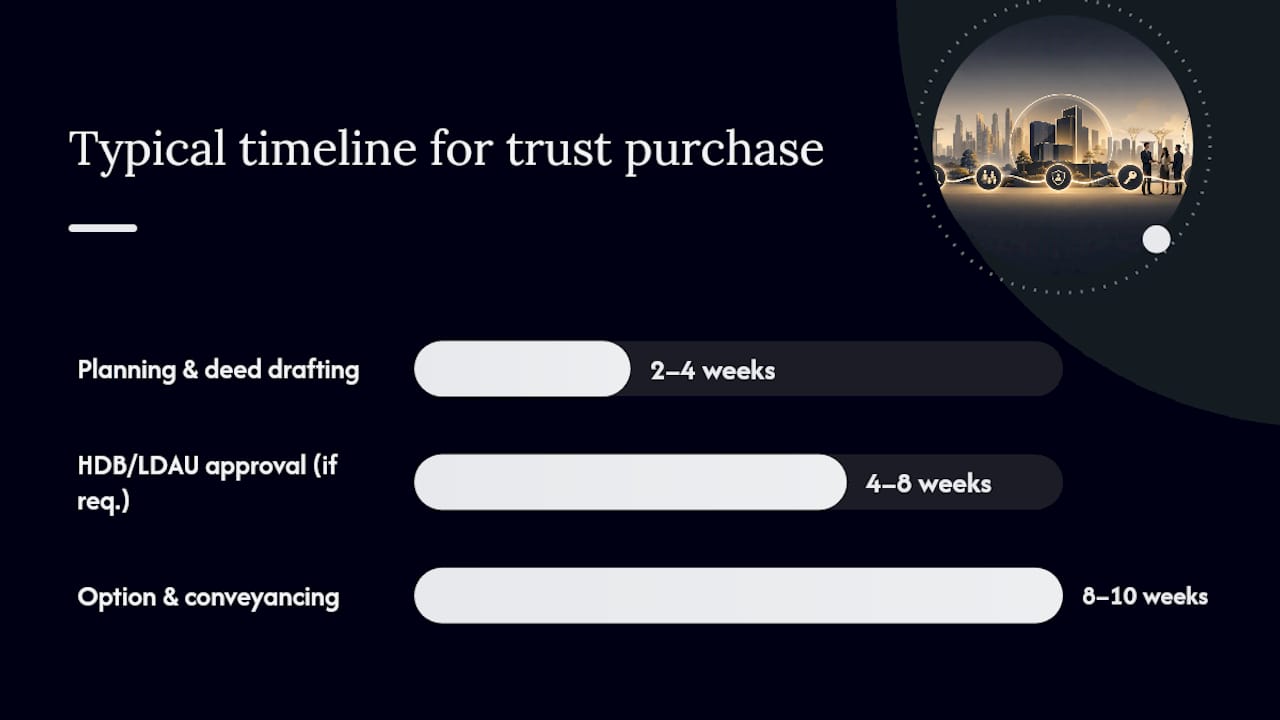
The timeline from decision to registered trust ownership typically runs 10–16 weeks for a standard private property transaction. HDB approvals or LDAU clearances add time.
| Stage | Typical Duration |
|---|---|
| Planning, legal advice, and deed drafting | 2–4 weeks |
| HDB/LDAU approval (if required) | 4–8 weeks (concurrent where possible) |
| Option exercise and conveyancing | 8–10 weeks (standard completion period) |
| Stamping (BSD and ABSD) | Within a few weeks of signing |
| Caveat lodgement | Within days of completion |
Example cost breakdown (S$2 million private condominium):
These figures are illustrative examples, not definitive legal or tax advice. Obtain specific quotes from your solicitor and trustee company, and verify current stamp duty rates with IRAS before committing.
Practitioner perspective: red flags and mistakes to avoid
Most trust purchase problems are avoidable. They cluster around a handful of recurring mistakes that practitioners see repeatedly.
Common red flags:
- Relying on verbal promises between family members instead of a properly executed deed
- Using an untested individual trustee with no understanding of fiduciary duties
- Failing to apply for HDB written approval before creating a trust over a flat
- Under-budgeting ABSD and discovering the cash shortfall after the option is exercised
- Assuming a bank will lend against a trust title without checking first
- Treating a nominee arrangement as equivalent to a properly constituted trust
Practitioner tips:
- Confirm lender acceptance of the trust title in writing before you pay any option fee.
- Stamp the trust deed correctly and on time. Late stamping attracts penalties.
- Lodge a caveat for minor beneficiaries immediately after completion. Do not wait.
- Avoid informal nominee arrangements without a proper deed. They offer none of the legal protections of a real trust and can create serious disputes on death or relationship breakdown.
- Budget ABSD into your affordability calculation from day one, not as an afterthought.
Pro Tip: Before instructing any solicitor, spend 30 minutes mapping your objectives against the three main constraints: cash availability, ABSD cost, and approval requirements. If any one of those three is a blocker, the trust structure may not be viable for your situation. A short advisory call with a property consultant can help you run that check before you spend money on legal fees.
A note on how Aesthetic Havens approaches trust-based purchases
Most clients who come to us asking about trust purchases are parents. They want to secure a property for a child who is too young to hold title, and they have heard that a trust is the way to do it. That instinct is right, but the execution is where things get complicated.
What we consistently find is that the ABSD conversation is the turning point. Once a family sees the actual number, they often want to explore whether there is a sequencing strategy that achieves the same outcome with lower upfront cost. Sometimes there is. Sometimes the trust is still the right answer despite the cost. The case-by-case analysis is what matters, and that is where Aesthetic Havens focuses its advisory work.
We do not draft trust deeds. What we do is help clients understand the property side of the equation clearly before they engage lawyers: which title structure fits their goals, what the financing reality looks like, and which approvals they need to budget time for. That scoping work saves clients from expensive surprises.
Aesthetic Havens can guide you through the trust purchase process
Navigating a trust property purchase in Singapore means coordinating legal, tax, and financing decisions simultaneously, and getting the sequence wrong is costly. Aesthetic Havens, operating under ERA Realtors, provides advisory support specifically for buyers working through complex title strategies like trust ownership.
The practical help covers title strategy advice, introductions to estate lawyers and conveyancing solicitors experienced in trust transactions, coordination with lenders on trust title acceptance, and a structured due diligence process from option to completion. Understanding why a property consultant adds value at this stage is straightforward: the cost of a missed approval or a misstimed stamp duty payment far exceeds the cost of getting expert guidance upfront.
A 30-minute scoping call with Aman covers your objectives, the property type you are considering, the beneficiary profile, and a quick feasibility check against the ABSD, financing, and approval constraints. From there, you get a clear picture of whether a trust is the right structure or whether an alternative title approach serves you better. Reach out through Aesthetic Havens to schedule that conversation.
Sources
Rules around ABSD, HDB approvals, and trustee taxation change. Always cross-check directly with primary sources before making any financial or legal commitment.
Primary institutions:
- Singaporelegaladvice
- Buying a Home in Trust – Investopedia
- Can a Trust Buy a House? – HousesLaw
- Buying a Home in Trust – Fidelity
Reputable legal explainers:
Cross-checking IRAS directly is non-negotiable. Legal commentary sites reflect the rules as they understood them at the time of writing. The IRAS website carries the current operative rates and any subsequent amendments.
This article is general information, not a substitute for advice from a qualified lawyer. Consult a qualified legal professional about your own circumstances before acting on anything here.
Recommended
- Foreigner’s Guide to Buying Property in Singapore (2025 Regulations & Taxes) | Aesthetic Havens
- Step-by-step guide: How to buy commercial property in Singapore
- How to Buy Commercial Property in Singapore: A Step-by-Step Guide | Aesthetic Havens
- Property Title Types Explained: Singapore Buyer’s Guide


