


An Option to Purchase (OTP) is the legal instrument a seller grants to give a buyer the exclusive right to buy a property at an agreed price within a fixed period. In Singapore, the single most critical distinction is this: for HDB resale flats, you must use the HDB-prescribed OTP form with a fixed 21-calendar-day option period, while private-property OTPs have no mandated government form and typically run 14 days. Miss the HDB deadline or use a non-standard form, and the agreement is void under the Housing and Development Act.
Before anything else, here is what you must do in the first 24–48 hours after receiving an OTP:
- Confirm your HDB Flat Eligibility (HFE) letter or bank Approval-in-Principle (AIP) is current and covers the purchase price.
- Calculate the exact Option Exercise Fee you owe and confirm you can pay it before the expiry deadline.
- Instruct a conveyancing solicitor immediately, or for HDB transactions, confirm your Resale Portal workflow and submission windows.
- Diarize the option expiry date and time (4:00 PM on Day 21 for HDB; the agreed time for private property).
- For private OTPs, ask your solicitor to review the document before you pay the option fee, and not after.
Pro Tip: For HDB resale transactions, the seller’s Intent to Sell must have been registered for at least 7 days before the OTP can be granted. Verify this on the HDB Resale Portal before handing over any money.
Key Takeaways
The most important thing to understand about an Option to Purchase in Singapore is that HDB resale transactions are governed by a mandatory prescribed form with fixed fees and a 21-day deadline, while private OTPs are negotiable documents drafted to protect the seller.
| Point | Details |
|---|---|
| HDB OTP is non-negotiable | The prescribed form cannot be altered; any supplemental agreement is void under the Housing and Development Act. |
| Option period deadlines are hard | HDB expires at 4:00 PM on Day 21; private typically 14 days — missing either forfeits your deposit. |
| Stamp duty is due within 14 days | BSD and ABSD must be paid to IRAS within 14 days of exercising the OTP; late payment attracts penalties. |
| Instruct a solicitor before paying | For private OTPs especially, get independent conveyancing review before the option fee changes hands, not after. |
| Aesthetic Havens advisory | Aesthetic Havens provides document checks, solicitor referrals, and portal support to protect buyers at every OTP stage. |
Table of Contents
- How the option to purchase works in Singapore: HDB vs private property
- Step-by-step: how to grant and exercise an HDB resale OTP
- Step-by-step: how private-property OTPs work and what to negotiate
- How to exercise the OTP correctly and protect your evidence
- What happens after you exercise: stamp duty, submissions, and completion
- If you or the seller backs out: forfeiture, remedies, and your legal options
- Buyer protection checklist and negotiation tips for OTP transactions
- Quick timeline: from OTP to completion
- What buyers consistently get wrong about OTPs in Singapore
- Aesthetic Havens guides you through every OTP stage
- Sources
How the option to purchase works in Singapore: HDB vs private property
The legal form, fee limits, and what you can and cannot change differ sharply between HDB and private transactions. Getting this wrong is not a technicality — it can void your agreement entirely.
HDB resale OTPs: what is fixed by law
According to HDB’s official OTP rules, the prescribed form is mandatory and cannot be amended. The Option Period is exactly 21 calendar days, expiring at 4:00 PM on Day 21. The Option Fee must be between S$1 and S$1,000, and the combined total of the Option Fee plus the Option Exercise Fee cannot exceed S$5,000.

Any supplemental agreement that attempts to vary these terms is invalid. That means a side letter promising a longer option period, a higher deposit, or any additional condition is legally worthless and could expose both parties to penalties. The HDB Important Notes on the OTP also require that the seller holds a valid Intent to Sell registered at least 7 days before granting the OTP, and the buyer must hold a valid HFE letter or Intent to Buy.
Private-property OTPs: what you can negotiate
For private residential properties, there is no government-mandated form. As the Council for Estate Agencies (CEA) explains, the seller’s law firm drafts the OTP, and market convention sets the option fee at around 1% of the purchase price, with the exercise fee bringing the total initial deposit to roughly 5%. The option period is typically 14 days but is negotiable.
Because the seller’s solicitor drafts the document, bespoke clauses can shift risk significantly toward the buyer. Completion date traps, tenant-occupancy warranties, and encumbrance carve-outs are all possible. Independent conveyancing advice before signing is not optional — it is the single most effective protection you have.
| Feature | HDB Resale OTP | Private Property OTP |
|---|---|---|
| Prescribed form | Yes — HDB form only | No — seller’s solicitor drafts |
| Option period | 21 calendar days (fixed) | Typically 14 days (negotiable) |
| Option Fee | S$1–S$1,000 | ~1% of purchase price (market norm) |
| Total deposit cap | S$5,000 (Option Fee + Exercise Fee) | ~5% total (negotiable) |
| Supplemental agreements | Prohibited and void | Permitted if correctly drafted |
| Preconditions | Intent to Sell (7-day cooling-off), HFE/Intent to Buy | Bank AIP, solicitor review recommended |
| Variation risk | Any change voids the agreement | Bespoke clauses can shift risk to buyer |
Pro Tip: For HDB transactions, check the seller’s Minimum Occupation Period (MOP) status and confirm the Intent to Sell is active on the HDB Resale Portal before negotiating price. For private property, run a title search and caveats check through your solicitor before paying the option fee — encumbrances discovered after exercise are your problem, not the seller’s.
Step-by-step: how to grant and exercise an HDB resale OTP
The HDB resale process is tightly sequenced. Every step has a portal action, a document requirement, or a deadline attached to it. Here is the full buyer-side walkthrough.
Preconditions before the OTP is granted
- Seller registers Intent to Sell on the HDB Resale Portal and waits the mandatory 7-day cooling-off period.
- Buyer obtains a valid HFE letter (or registers an Intent to Buy on the portal, as applicable). Without this, the OTP cannot be legally granted.
- Both parties agree on the purchase price and the Option Fee amount (between S$1 and S$1,000).
Granting the OTP
- Seller downloads the prescribed OTP form from HDB InfoWEB — no other form is valid.
- Seller completes all required fields: NRICs of all parties, the property address, the agreed purchase price, the Option Fee amount, and the Option Expiry Date.
- Seller signs the OTP and hands it to the buyer together with receipt of the Option Fee.
- Buyer signs the acknowledgement of receipt on the OTP.
The 21-day option period
The clock starts the day after the OTP is granted. The option expires at 4:00 PM on Day 21. During this window, the buyer must:
- Obtain or confirm the bank’s Letter of Offer (or confirm HDB loan eligibility via the HDB Flat Loan Eligibility letter).
- Arrange a property valuation if required by the bank or HDB.
- Confirm CPF withdrawal eligibility and amounts with CPF Board.
Exercising the OTP
- Buyer signs the Acceptance page of the OTP before the 4:00 PM deadline on Day 21.
- Buyer pays the Option Exercise Fee (combined with the Option Fee, total must not exceed S$5,000).
- Buyer delivers the signed Acceptance and payment to the seller or their authorised agent and obtains a signed, time-stamped acknowledgement on the buyer’s copy.
- Both parties submit the joint resale application via the HDB Resale Portal within the submission window specified by HDB after exercise.
| Payment | Amount | Who keeps it if OTP lapses? |
|---|---|---|
| Option Fee | S$1–S$1,000 | Seller retains |
| Option Exercise Fee | Up to S$5,000 minus Option Fee | Seller retains (buyer forfeits) |
| Total deposit cap | S$5,000 (Option Fee + Exercise Fee) | Seller retains both if buyer does not exercise |
Statistic callout: The HDB option period is fixed at 21 calendar days, expiring at exactly 4:00 PM on Day 21. There is no grace period and no extension mechanism under the prescribed form.
Step-by-step: how private-property OTPs work and what to negotiate
Private OTPs give buyers more flexibility and more exposure at the same time. The absence of a mandated form means the document you receive could be straightforward or loaded with risk-shifting clauses.
Market norms and typical amounts
The seller’s law firm prepares the OTP. On grant, the buyer pays an option fee of around 1% of the purchase price. On exercise, the buyer pays a further exercise fee, bringing the total initial deposit to approximately 5%. The CEA confirms there is no standardized government form for private residential properties, and buyers should obtain independent conveyancing advice because seller-drafted OTPs may contain bespoke clauses.
The option period is typically 14 days, but buyers can negotiate an extension — particularly useful when waiting for a bank Letter of Offer. Some sellers agree to 21 days, especially in a slower market.
What your solicitor must review before you sign
- Completion date clauses: a tight completion window can leave you scrambling for funds if your bank is slow.
- Tenant and occupancy warranties: if the property is tenanted, confirm the tenancy terms are disclosed and the vacant-possession date is realistic.
- Encumbrance and fixtures clauses: check what is included in the sale and whether any charges, liens, or caveats are outstanding.
- Condition precedents: some OTPs include conditions that, if not met, allow the seller to withdraw without penalty.
- Subject-to-sale clauses: rare and risky for sellers, but occasionally requested by buyers who need to sell their existing property first. Sellers rarely agree, and the clause adds complexity.
The CEA also provides a standard OTP template for private residential transactions that DIY buyers can reference, though independent legal review is still strongly recommended even when using a template.
What you can ask for
You have more room to negotiate than most buyers realize. Ask for:
- An extended option period (21 days instead of 14) tied to receipt of your bank’s Letter of Offer.
- A clause making exercise conditional on the bank’s Letter of Offer being issued.
- Escrow arrangements for large exercise sums, so funds are held by a solicitor rather than paid directly to the seller.
- Staged completion dates if you are coordinating a simultaneous sale.
Private OTPs are drafted by the seller’s solicitor to protect the seller. Every clause that is not challenged or negotiated before you pay the option fee is a clause you have accepted. Your solicitor’s job is to find the ones that hurt you — but only if you instruct them before the money changes hands, not after.
Pro Tip: Ask your agent to confirm in writing who is authorised to receive the exercise fee and the signed Acceptance. If the seller’s solicitor is the authorised recipient, get that confirmed in the OTP itself — delivering to the wrong person does not constitute valid exercise.
How to exercise the OTP correctly and protect your evidence
Exercising the OTP is a legal act with a hard deadline. The steps below apply to both HDB and private transactions, with differences noted.
- Review the OTP one final time with your solicitor before the deadline. Confirm the expiry date, time, and the authorised recipient for the exercise documents.
- Sign the Acceptance page of the OTP. For HDB, this is the prescribed form’s acceptance section. For private, it is the acceptance clause in the seller’s OTP document.
- Prepare the Option Exercise Fee payment. For HDB, this is a cheque or cashier’s order payable as specified. For private property, your solicitor’s trust account is the standard route for larger sums.
- Deliver the signed Acceptance and payment to the authorised recipient — seller, their agent, or their solicitor — before the deadline.
- Obtain a signed, time-stamped acknowledgement on your copy of the OTP. This is your proof of exercise. Do not leave without it.
- Confirm your solicitor has lodged the exercise and is proceeding with stamp duty steps immediately.
For HDB transactions, both parties must then submit the joint resale application via the HDB Resale Portal within the window HDB specifies after exercise.
Pro Tip: Never exercise at the last hour. Allow at least a full business day before the deadline so your solicitor can lodge the Buyer’s Stamp Duty (BSD) and Additional Buyer’s Stamp Duty (ABSD) steps immediately. BSD and ABSD are payable within 14 days of exercise — diarize this date the moment you sign the Acceptance, because late payment attracts penalties and will block IRAS registration of the sale.
Statistic callout: BSD and ABSD are due within 14 days of exercising the OTP. Missing this deadline triggers penalties from IRAS and can stall the entire transaction.
What happens after you exercise: stamp duty, submissions, and completion
Exercise is not the finish line. Several administrative deadlines trigger immediately, and missing any one of them can delay or derail the transaction.
Stamp duty: the 14-day clock
BSD and ABSD are payable within 14 days of exercising the OTP. Your solicitor will calculate the amounts and arrange payment through IRAS. For foreign buyers or those purchasing a second property, ABSD rates can be substantial — confirm your liability before you exercise, not after. A practical guide to ABSD and eligibility checks is worth reviewing if you are a non-resident or purchasing an additional property.
HDB resale submission
- Both buyer and seller submit the joint resale application via the HDB Resale Portal within the window HDB specifies.
- HDB will assess eligibility, confirm grants, and schedule an appointment for the resale completion.
- Typical HDB resale completion runs 8–10 weeks from the joint submission, though timelines vary.
Private property conveyancing
- Your solicitor lodges the stamp duty, registers a caveat to protect your interest, and acts on the bank’s instructions.
- The bank releases the loan funds on completion day.
- Typical private property completion is 8–12 weeks from exercise, depending on the completion date agreed in the OTP.
What you need to have ready
- Confirm CPF withdrawal amounts with CPF Board and ensure the CPF Ordinary Account balance is sufficient.
- Obtain the bank’s formal Letter of Offer and sign the mortgage documents.
- Arrange fire insurance (mandatory for HDB; strongly recommended for private).
- Check for outstanding strata levies or maintenance fees if buying a strata-titled property.
- Confirm the solicitor has cleared all encumbrances and outstanding charges on the title.
Pro Tip: Ask your solicitor to run a property title check immediately after exercise. Any caveat or charge that surfaces after completion is significantly harder and more expensive to resolve.
If you or the seller backs out: forfeiture, remedies, and your legal options
Understanding what happens when things go wrong is as important as knowing the process when they go right.
If the buyer does not exercise
For HDB transactions, the buyer forfeits the Option Fee (up to S$1,000) and the Option Exercise Fee if already paid, subject to the S$5,000 combined cap. The seller retains both amounts. For private property, the buyer forfeits the option fee (typically 1% of the purchase price). If the buyer has already exercised and then fails to complete, the seller may forfeit the exercise fee and potentially pursue further damages depending on the OTP terms.
If the seller breaches after granting the OTP
This is where the unilateral nature of the OTP matters. Once the seller grants the OTP, they are bound — the buyer is not yet bound until they exercise. If the seller refuses to proceed after the buyer has validly exercised:
- HDB transactions: HDB can impose sanctions on the seller, and the buyer is entitled to a return of all monies paid. Escalate to HDB immediately and preserve all documentary evidence.
- Private property transactions: the buyer can seek specific performance (a court order compelling the seller to complete the sale), claim damages, or demand return of the deposit. Specific performance is available because land is considered unique under Singapore law, but it requires prompt legal action.
If a seller tries to back out after you have validly exercised a private OTP, do not accept a refund and walk away without legal advice. Specific performance is a real remedy in Singapore courts, and the cost of pursuing it is often far less than the loss of a property you have already committed to.
Practical steps if the seller breaches:
- Preserve every document: the signed OTP, your acknowledgement receipt, payment records, and all correspondence.
- Instruct your solicitor immediately — delay weakens your position for specific performance.
- For HDB, file a complaint through the HDB Resale Portal and contact HDB directly.
- Do not make any further payments or sign any variation until your solicitor has reviewed the situation.
Pro Tip: The signed, time-stamped acknowledgement you collected at exercise is your single most important piece of evidence. Without it, proving the date and time of exercise becomes a dispute of facts rather than a matter of record.
Buyer protection checklist and negotiation tips for OTP transactions
This checklist covers what your solicitor should do immediately and what you should ask for before signing anything.
What to instruct your solicitor to do on day one
- Run a title search to confirm the seller’s ownership and identify any encumbrances, charges, or outstanding mortgages.
- Conduct a caveats search to check whether any third party has a prior claim on the property.
- Verify there are no outstanding CPF liens or bank charges that the seller has not disclosed.
- Confirm the property’s tenure and title type — freehold, leasehold, or strata — and flag any restrictions on transfer. The real estate due diligence checklist from Aesthetic Havens covers this in detail.
- Confirm in writing who is authorised to receive the exercise fee and the signed Acceptance, and how funds will be held.
- Diarize the BSD/ABSD payment deadline (14 days from exercise) and the HDB submission window or private completion date.
Negotiation checklist: what to ask for before you pay the option fee
- Request an extended option period (21 days) if you need more time to secure financing.
- Ask for a condition-on-Loan clause: exercise is conditional on the bank issuing a Letter of Offer by a specified date.
- For large exercise sums, request escrow arrangements so funds are held by a solicitor rather than released directly to the seller.
- Ask for a staged completion date if you are coordinating the sale of your existing property.
- For private OTPs, ask the seller’s solicitor to confirm in writing what fixtures and fittings are included in the sale price.
What to verify about the OTP document itself
- For HDB: confirm the form was downloaded from HDB InfoWEB and has not been altered. Any amendment voids the agreement.
- For private: check that the OTP serial number and property description match the title documents exactly.
- Confirm the Option Expiry Date and time are stated clearly and unambiguously.
- Check that the authorised recipient for exercise is named in the document.
Pro Tip: Ask your agent to provide a written record of all verbal representations made during negotiation — price, inclusions, completion date. Verbal promises that are not in the OTP are not enforceable. If it matters to you, it must be in the document.
Quick timeline: from OTP to completion
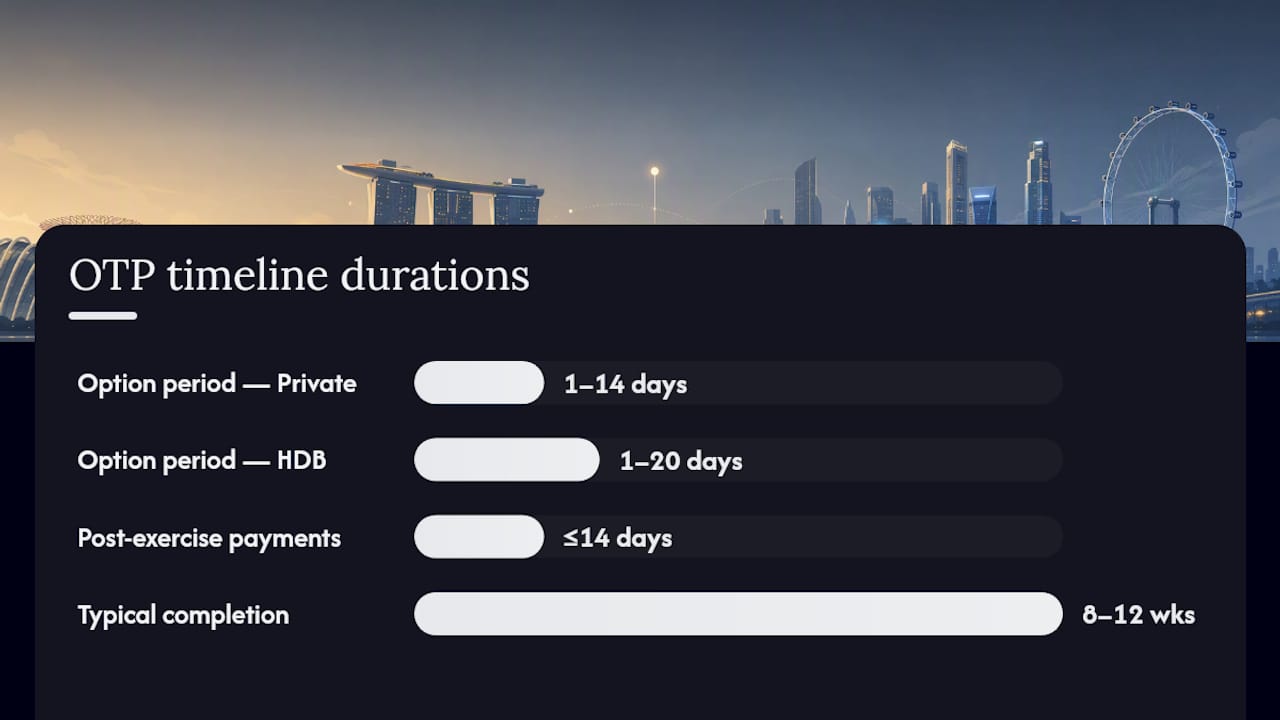
Use this as a reference to track deadlines and who is responsible at each stage.
Day 0 — OTP granted:
- Buyer pays Option Fee and receives signed OTP with acknowledgement.
- Buyer instructs conveyancing solicitor immediately.
- Solicitor begins title search and caveats check.
- Buyer confirms bank AIP or HFE letter is current.
Days 1–14 (private) or Days 1–20 (HDB):
- Bank processes loan application and issues Letter of Offer.
- Solicitor reviews OTP clauses (private) or confirms HDB form compliance.
- CPF Board confirms withdrawal eligibility and amounts.
- Buyer confirms exercise decision with solicitor before deadline.
Day 14 or Day 21 — OTP exercise deadline:
- Buyer signs Acceptance, pays Option Exercise Fee, delivers to authorised recipient.
- Buyer collects signed, time-stamped acknowledgement.
- Solicitor lodges stamp duty steps immediately.
Within 14 days of exercise:
- BSD and ABSD paid to IRAS via solicitor.
- HDB: joint resale application submitted via HDB Resale Portal.
- Private: solicitor lodges caveat and acts on bank instructions.
Weeks 8–12 (typical completion):
- HDB: HDB schedules resale completion appointment; buyer and seller sign transfer documents.
- Private: solicitor arranges completion appointment; bank releases funds; keys handed over.
Statistic callout: For HDB resale transactions, the combined Option Fee and Option Exercise Fee is capped at S$5,000. For private property, the total initial deposit is conventionally around 5% of the purchase price.
What buyers consistently get wrong about OTPs in Singapore
Most buyers treat the option period as a formality. It is not. The option period is the buyer’s only protected window to confirm financing, run due diligence, and negotiate any remaining issues — and once it expires, the option fee is gone.
The single most common mistake is paying the option fee before instructing a solicitor. For private transactions especially, the OTP you receive has been drafted to protect the seller. Clauses around completion dates, vacant possession, and encumbrances can all shift material risk to the buyer, and most buyers do not read them carefully enough to notice. By the time the solicitor flags a problem, the option fee has already been paid and the buyer is under pressure to proceed.
A second recurring issue is timing the exercise too close to the deadline. Buyers who exercise on the afternoon of Day 21 leave no buffer for payment processing, acknowledgement collection, or solicitor lodgement. One banking delay or traffic jam can mean a forfeited deposit.
The HDB vs private property comparison from Aesthetic Havens is worth reading before you start negotiations, because the rules that protect you in an HDB transaction simply do not exist in the private market. Knowing which framework applies to your purchase changes how you approach every step.
Aesthetic Havens guides you through every OTP stage
Navigating an OTP transaction without support means managing legal deadlines, bank timelines, CPF coordination, and solicitor instructions simultaneously, often for the first time. Aesthetic Havens, operating under ERA Realtors, provides hands-on buyer advisory at every stage: document checks before you pay the option fee, solicitor referrals for independent conveyancing review, funds planning to confirm you can meet the exercise fee and stamp duty deadlines, and portal submission assistance for HDB resale applications.
For buyers who want a structured process from OTP to completion, the property sales workflow guide on the Aesthetic Havens site maps out every milestone and who handles what at each stage. Whether you are buying your first HDB resale flat or a private condominium, the advisory process starts with a single conversation. Reach out to Aman directly through Aesthetichavens to get your OTP reviewed before you commit.
Sources
The procedures and rules in this guide draw from the following authoritative sources. Verify current forms and deadlines directly with HDB and CEA before transacting.
For practical support with your OTP transaction, visit Aesthetic Havens for advisory, solicitor referrals, and buyer guidance across HDB and private property purchases in Singapore.
This article is general information, not a substitute for advice from a qualified lawyer. Consult a qualified legal professional about your own circumstances before acting on anything here.


