


Property tenure is the legal basis on which a person owns or occupies land or a building, defining their rights, responsibilities, and financial obligations. Understanding what is tenure in property matters before you sign any contract, because tenure determines how long you can hold a property, what you owe while you hold it, and what you can do with it. The main property tenure types recognized in England and Wales are freehold, leasehold, commonhold, and shared ownership. Each carries distinct legal weight under frameworks like the Law of Property Act 1925. Getting tenure wrong costs buyers money and can block mortgage approvals entirely.
What is tenure in property and why does it matter?
Tenure defines ownership rights, maintenance duties, and financial obligations such as ground rent and service charges under property law. That definition is the starting point for every property decision you make. Whether you are buying a flat, investing in a commercial unit, or renting out a house, tenure shapes what you legally control and what you owe.
Tenure is more than a legal formality. It directly affects property value, mortgage availability, and owner autonomy. A buyer who skips tenure verification can end up locked into ground rent obligations or a lease so short that no lender will finance the purchase.

The property tenure definition also varies in practice. Freehold and leasehold are the two most common forms, but shared ownership and commonhold add important layers. Knowing the difference between them before you make an offer is the clearest advantage any buyer or investor can have.
Pro Tip: Ask your solicitor to confirm tenure status in writing before you exchange contracts. Verbal assurances from sellers are not legally binding.
What are the main types of property tenure?
Freehold
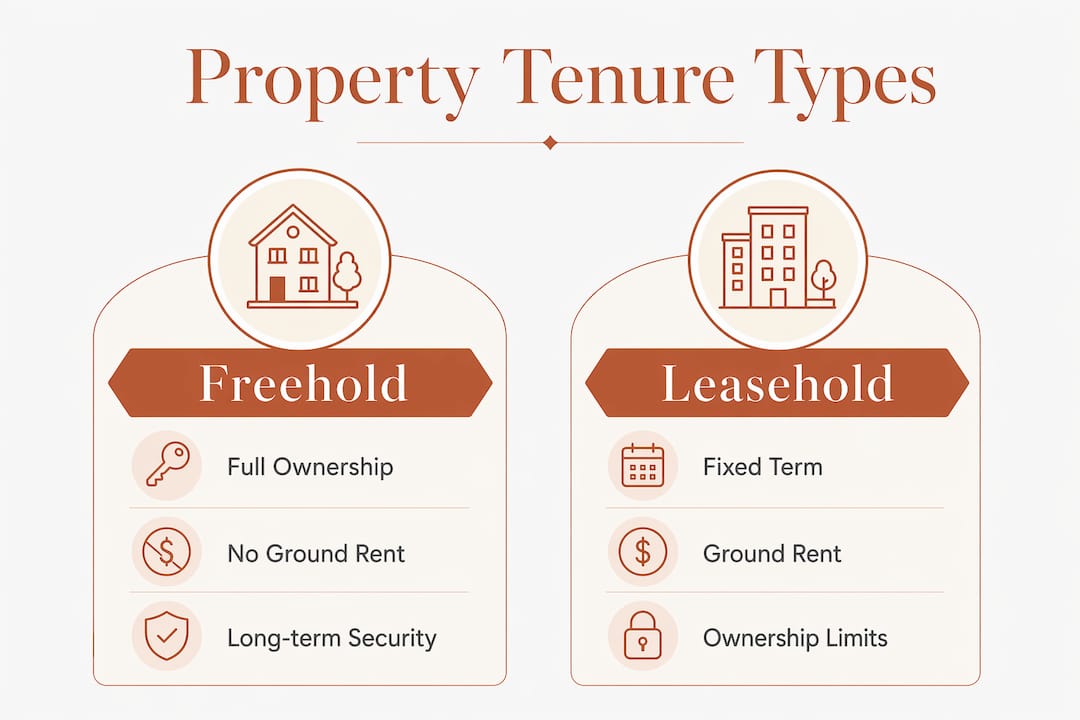
Freehold tenure is legally defined as an “estate in fee simple absolute in possession.” That phrase means you own the land and the building on it indefinitely, with no termination date and no ground rent. You manage your own maintenance and insurance. Lenders generally prefer freehold because the security is clean and permanent. Freehold interests tend to be preferred by investors because they are perpetual and impose fewer restrictions, promoting greater ownership autonomy.
Leasehold
Leasehold tenure grants the right to occupy a property for a fixed term, often from 99 to 999 years, after which ownership reverts to the freeholder unless extended or purchased. Leaseholders pay ground rent and service charges to the freeholder. Short leases reduce property value and limit mortgage options significantly. Leaseholds are commonly used in joint ventures and institutional holdings to let original owners retain land control through covenants and reversion rights.
Commonhold
Commonhold tenure allows individual ownership of units within a building, with shared areas managed collectively by a commonhold association. It was introduced in 2002 as a leasehold alternative. Despite government promotion, its adoption remains very limited in practice, leaving most buyers subject to leasehold regimes instead.
Shared ownership
Shared ownership lets buyers purchase a percentage of a property and pay rent on the remainder, with options to buy further shares over time. This is called staircasing. It combines ownership and tenancy rights in one arrangement, which creates a hybrid set of financial obligations.
| Tenure type | Ownership duration | Ground rent | Service charges | Mortgage ease |
|---|---|---|---|---|
| Freehold | Indefinite | None | Owner managed | High |
| Leasehold | Fixed term (99–999 years) | Yes | Yes | Varies by lease length |
| Commonhold | Indefinite (unit only) | None | Shared via association | Moderate |
| Shared ownership | Partial, extendable | Possible | Yes | Conditional |
Pro Tip: Always verify tenure status for new builds and houses. Some new build houses are sold as leasehold with ground rent obligations, which buyers often assume only applies to flats.
How does tenure affect property value and mortgage options?
Tenure strongly influences mortgage availability and terms. Short leaseholds often limit lender acceptance and loan length, sometimes making a property unmortgageable. Most lenders require a minimum number of years remaining on a lease after the mortgage term ends, typically 70 to 85 years at the point of application.
The financial consequences of tenure extend beyond mortgage approval. Ongoing costs differ sharply between tenure types:
- Ground rent: Leaseholders pay annual ground rent to the freeholder, which can escalate under certain lease terms.
- Service charges: Leaseholders and shared ownership buyers pay service charges covering building maintenance, insurance, and communal area upkeep.
- Maintenance costs: Freeholders carry all maintenance costs independently, with no shared structure to spread expenses.
- Staircasing costs: Shared ownership buyers pay legal and valuation fees each time they purchase additional shares.
- Lease extension costs: Leaseholders facing a short lease must pay to extend it, which involves legal fees and a premium to the freeholder.
Mortgage brokers recommend early tenure verification to avoid financing problems late in a transaction. A buyer who discovers a 65-year lease after agreeing a price faces either a renegotiation or a failed deal. Understanding investment property financing early in the process prevents these late-stage surprises.
Pro Tip: If you are buying a leasehold or shared ownership property, consult a property broker before making an offer. Knowing the lease length and service charge history upfront shapes your negotiating position.
What legal and practical responsibilities come with each tenure type?
Tenure type determines who is responsible for what, and the gap between types is significant. Getting clarity on obligations before purchase prevents disputes and unexpected bills.
- Freeholders manage all maintenance and insurance independently. There is no landlord to call and no service charge to dispute. The full cost and responsibility sit with the owner.
- Leaseholders must comply with lease covenants, which can restrict alterations, subletting, or even pet ownership. They pay ground rent and service charges to the freeholder or managing agent. Reviewing the landlord’s leasing obligations helps buyers understand what a freeholder is legally required to provide.
- Commonhold owners share management duties through a commonhold association. Every unit owner has a vote in how the building is run and how funds are spent. This removes the freeholder from the equation entirely.
- Shared ownership buyers pay rent on the portion they do not own, alongside mortgage payments on the portion they do. Each staircasing transaction requires a new valuation and legal work, adding cost and complexity over time.
- Flying freeholds create a special legal challenge. A flying freehold occurs when part of one freehold property physically overlaps or underlies another, such as a room above a shared passageway. Flying freeholds complicate mortgage eligibility and require specialized legal review. Many lenders refuse to lend on them without indemnity insurance.
Effective property management under any tenure type reduces long-term costs and protects asset value. The obligations differ, but the principle is the same: know what you are responsible for before you commit.
Common pitfalls buyers miss when checking property tenure
Tenure looks simple on the surface. The complications hide in the details, and those details carry real financial weight.
- Short lease length: A lease with fewer than 80 years remaining triggers a “marriage value” calculation when extending, which significantly increases the premium owed to the freeholder. Buyers who do not check remaining lease length before purchase can face extension costs that wipe out expected equity gains.
- New build leasehold houses: Some new build houses are leasehold with ground rent liabilities, a fact many buyers miss because they assume houses are always freehold. Always request the title register, not just the marketing brochure.
- Escalating ground rent clauses: Some leases contain clauses that double ground rent every 10 or 25 years. These clauses have made properties unmortgageable and unsellable in several documented cases.
- Flying freeholds: These are not immediately visible from a standard viewing. A solicitor’s title check is the only reliable way to identify them.
- Commonhold rarity: Despite being a cleaner ownership model, commonhold remains rare. Buyers attracted to commonhold properties should verify the management structure carefully, since the legal framework is less tested than leasehold.
- Management company quality: For leaseholds and commonholds, the quality of the managing agent or association directly affects service charge levels and building condition. Small details like management structure and remaining lease length critically impact legal and financial outcomes.
Thorough due diligence means reading the full lease, checking the title register at HM Land Registry, reviewing three years of service charge accounts, and getting independent legal advice. Skipping any of these steps is where costly surprises originate.
Key Takeaways
Property tenure is the single most important legal detail to verify before committing to any property purchase, because it determines ownership rights, ongoing costs, and mortgage eligibility.
| Point | Details |
|---|---|
| Tenure defines ownership rights | It sets out who owns the property, for how long, and under what financial conditions. |
| Freehold is the cleanest title | Indefinite ownership with no ground rent makes freehold the preferred choice for investors and lenders. |
| Short leases create real risk | Leases below 80 years trigger higher extension costs and can block mortgage approval entirely. |
| New builds need tenure checks | Some new build houses are leasehold with ground rent obligations, regardless of how they are marketed. |
| Flying freeholds need specialist advice | Properties with overlapping freehold boundaries require specialized legal review and may need indemnity insurance. |
Why I think most buyers underestimate tenure until it costs them
Tenure is the part of a property transaction that buyers treat as paperwork. They focus on price, location, and condition. Tenure gets a glance and a nod. That is the mistake I see most often, and it is the one with the longest financial tail.
I have worked with buyers who fell in love with a flat, agreed a price, and then discovered the lease had 62 years left. The seller had no idea. The buyer’s lender pulled out. The deal collapsed. A five-minute tenure check at the start would have changed the entire approach.
Freehold is generally the better position for long-term investors. You control the asset fully, lenders are comfortable, and there are no third-party obligations eating into your returns. But leasehold is not inherently bad. Long leases on well-managed buildings in strong locations can be excellent investments. The key is knowing exactly what you are buying before you commit.
The detail that surprises people most is ground rent escalation. A clause that doubles ground rent every 25 years sounds harmless at £200 per year. At year 50, that becomes £800. At year 75, it becomes £1,600. Some leases escalate faster. That is not a theoretical risk. It has made properties unsellable in practice.
My consistent advice: get a solicitor to review the full lease and title register before you make an offer, not after. And if you are buying leasehold, treat the service charge history as seriously as the asking price. It tells you more about the true cost of ownership than any marketing document will.
— Aman
How a property consultant helps you navigate tenure complexity
Understanding tenure types is one thing. Applying that knowledge to a live transaction under time pressure is another.

At Aesthetic Havens, we help buyers, investors, and tenants cut through tenure complexity before it becomes a problem. Whether you are evaluating a leasehold flat with a short lease, assessing a new build house for hidden ground rent clauses, or comparing freehold and shared ownership options, our advisory process covers the tenure checks that protect your investment. Working with a property consultant means you get tenure verified, service charge histories reviewed, and mortgage implications assessed before you commit. That preparation reduces legal risk and keeps transactions on track. Reach out to Aesthetic Havens to get expert guidance on your next property decision.
FAQ
What is property tenure in simple terms?
Property tenure is the legal right to own or occupy land or a building. It defines how long you hold the property, what you owe during that time, and what restrictions apply to your use of it.
What is the difference between freehold and leasehold?
Freehold means you own the land and building indefinitely with no ground rent. Leasehold means you own the right to occupy for a fixed term, after which ownership reverts to the freeholder unless the lease is extended.
Can a house be leasehold?
Yes. Some new build houses are sold as leasehold with ground rent obligations, even though buyers often assume houses are always freehold. Always check the title register to confirm tenure status.
How does lease length affect a mortgage?
Short leaseholds limit lender acceptance and loan terms. Most lenders require the lease to have a significant number of years remaining beyond the end of the mortgage term, and leases below 70–80 years often make financing difficult or impossible.
What is commonhold and why is it rare?
Commonhold allows individual ownership of units in a building with shared areas managed by a commonhold association. It was introduced in 2002 but remains rare in practice, with most buyers still subject to leasehold arrangements.


