


Private property ownership is defined as holding full legal title to real estate, giving you complete control over its use, modification, and sale. For anyone weighing residential options, that control is the foundation of every financial and lifestyle benefit that follows. The question of why choose private property comes down to three things: autonomy, long-term wealth, and personal well-being. This guide breaks down each advantage, compares private ownership to communal housing, and covers the real costs you need to plan for before you sign.
What are the key benefits of owning private property?
Private property ownership gives you a level of personal freedom that no rental or communal housing arrangement can match. You decide the color of the walls, the layout of the garden, and whether to add a home office or a second bathroom. That freedom is not just a lifestyle perk. Research shows that freedom of choice is the primary psychological channel linking secure property rights to improved personal well-being.
The financial case is equally strong. When you own a freehold home, every mortgage payment builds equity. That equity becomes a financial asset you can borrow against, sell, or pass on to the next generation. Private ownership also creates the material foundation for broader wealth building, including investment and philanthropy, as the Acton Institute notes in its work on private ownership and social responsibility.

Privacy is another concrete advantage. In a private home, you share no walls, no lobbies, and no communal facilities with neighbors. You control who enters your property and when. That separation matters for families with children, professionals working from home, and anyone who values quiet and personal space.
The well-being data is specific. A one-standard-deviation increase in property rights security raises affective well-being by 0.11 standard deviations across 164 countries. That finding holds across cultures and income levels. It means the sense of security that comes with owning your home is not just emotional. It is measurable.
- Full customization: Renovate, extend, or redesign without seeking approval from a body corporate.
- Privacy and space: No shared entrances, lifts, or communal areas.
- Equity growth: Every payment reduces debt and increases your ownership stake.
- Psychological security: Secure property rights correlate directly with higher life satisfaction.
- Long-term asset: Private homes can be leased, sold, or inherited on your terms.
Pro Tip: Before you buy, calculate your projected equity after five years using a mortgage amortization table. Most buyers are surprised how quickly ownership stake grows in the early years.
How does private property compare with public or communal housing?
The core difference between private property and communal housing is who controls the decisions and who pays for what. In a sectional title or government housing scheme, a body corporate or housing authority sets the rules, manages maintenance, and charges levies. In a private freehold home, you hold all of that responsibility and all of that authority.
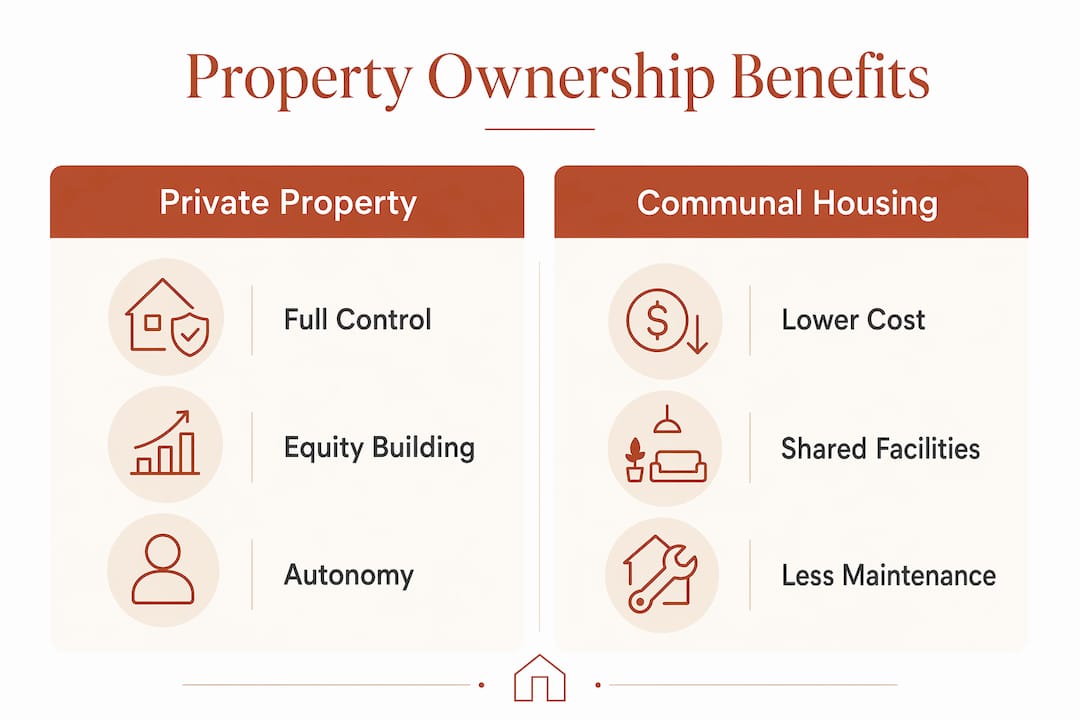
Choosing a freestanding home means trading lower upfront costs and shared upkeep for greater autonomy and space. Sectional title properties typically carry lower purchase prices and pool maintenance costs across all owners. Private homes require you to manage and fund every repair yourself. That trade-off suits buyers who want control and can budget for it.
Pro Tip: When comparing a private home to a sectional title, add the estimated annual maintenance cost to the private home’s price. That gives you a true cost comparison over five years.
| Feature | Private freehold home | Sectional title | Government housing |
|---|---|---|---|
| Ownership control | Full | Shared with body corporate | Limited |
| Customization | Unrestricted | Subject to body corporate rules | Highly restricted |
| Maintenance responsibility | Owner only | Shared across owners | Housing authority |
| Privacy level | High | Moderate | Low to moderate |
| Purchase price | Higher | Lower | Subsidized |
| Investment potential | Strong | Moderate | Limited |
| Security management | Owner’s responsibility | Shared or managed | Varies |
Government housing developments often suffer from deferred maintenance and limited resale appeal. Private estates near business centers and transport hubs retain value and attract tenants far more effectively. That gap in investment performance is a key reason buyers with long-term financial goals favor private residential property.
Communal housing suits buyers who want lower entry costs, shared facilities, and less hands-on management. Private property suits buyers who prioritize control, privacy, and wealth building. Neither is wrong. The right choice depends on your budget, lifestyle, and investment goals.
What long-term investment benefits do private properties offer?
Private property is one of the most reliable vehicles for building long-term wealth available to individual buyers. Location, professional management, and market demand all compound over time in ways that government or subsidized housing cannot replicate.
Private estates near highways and business centers attract tenants more consistently and retain value longer than government housing developments. That advantage comes from deliberate location planning and ongoing professional upkeep. Government developments often prioritize affordability over location, which limits their long-term appreciation potential.
The leasing opportunity is significant. A well-located private home generates rental income that can offset mortgage costs or fund further investment. Understanding how to select investment property for maximum returns is the difference between a home that pays for itself and one that simply costs money.
| Investment factor | Private property | Government housing |
|---|---|---|
| Capital appreciation | Strong, location-driven | Limited, policy-dependent |
| Rental income potential | High in well-located estates | Low, restricted by regulations |
| Professional management | Available and value-adding | Inconsistent |
| Resale market depth | Broad buyer pool | Narrow, often restricted |
| Long-term value retention | High with maintenance | Declines without authority upkeep |
Higher capital appreciation in private estates stems directly from professional management and superior location planning. That is not a coincidence. It is the result of owners and developers having strong financial incentives to maintain and improve their assets. Private ownership aligns your interests with the long-term value of the property in a way that public housing simply does not.
For buyers thinking about portfolio growth, undervalued Singapore neighborhoods offer entry points where private residential values are still rising. Identifying those areas early is where real wealth creation happens.
What practical responsibilities come with private property ownership?
Private property ownership delivers control, but control comes with full accountability. Every cost that a body corporate or housing authority would cover in communal housing falls entirely on you as the owner.
Freehold property owners must prepare for the full range of maintenance responsibilities, and most buyers underestimate structural repair costs. A roof replacement, plumbing overhaul, or foundation repair can cost tens of thousands of dollars. Budgeting for these events from day one is not optional. It is the difference between a manageable asset and a financial burden.
Security is another direct cost. In a sectional title or gated development, security is pooled and managed. In a private freestanding home, you install, monitor, and fund your own alarm systems, cameras, and perimeter measures. That cost is real and ongoing.
- Structural maintenance: Roof, walls, plumbing, and electrical systems are your responsibility.
- Garden and exterior: Landscaping, driveways, and fencing require regular upkeep.
- Security systems: Alarms, cameras, and access control are owner-funded.
- Insurance: Buildings insurance, contents insurance, and public liability cover are all separate costs.
- Emergency reserves: Set aside a maintenance fund equal to at least 1% of the property’s value each year.
The buyers who thrive in private ownership are those who treat the home as a business asset. They budget for maintenance, review insurance annually, and track the property’s market value. That discipline turns a home into a wealth-building tool rather than just a place to live.
Key Takeaways
Private property ownership delivers measurable advantages in autonomy, well-being, and long-term financial returns, but only when buyers enter with clear eyes about the full cost of ownership.
| Point | Details |
|---|---|
| Well-being is measurable | Secure property rights raise affective well-being by 0.11 standard deviations, proven across 164 countries. |
| Control is the core advantage | Private owners customize, renovate, and manage their homes without body corporate approval. |
| Investment performance is stronger | Private estates near business hubs outperform government housing in capital appreciation and rental yield. |
| Full costs must be budgeted | Maintenance, security, and insurance are entirely the owner’s responsibility in freehold property. |
| Location drives long-term value | Professional management and deliberate location planning are the key drivers of private property value retention. |
What I’ve learned after years of guiding private property buyers
Most buyers come to me focused on the purchase price. That is the wrong number to obsess over. The real question is total cost of ownership over ten years, including maintenance, insurance, security, and the opportunity cost of capital tied up in the asset.
The autonomy argument for private property is real, but I have seen buyers underestimate how much work that autonomy requires. A freehold home is not passive. It demands attention, budgeting, and occasional large expenditures. Buyers who treat it like a set-and-forget investment often end up with a deteriorating asset.
What I find most compelling about private ownership is the alignment of incentives. When you own the property outright, every improvement you make directly increases your wealth. That is not true in a rental or a heavily regulated communal scheme. The private property system rewards stewardship in a way that shared ownership models simply cannot replicate.
My honest advice: buy private property when you are ready to manage it like an asset, not just live in it like a home. The financial rewards for buyers who do that are substantial. For buyers who do not, the costs can outweigh the benefits quickly.
— Aman
Ready to find the right private property for you?
Choosing the right private home requires more than comparing prices. It requires understanding location dynamics, total ownership costs, and how a specific property fits your long-term financial goals. Aesthetic Havens, operated under ERA Realtors, provides exactly that kind of guidance.

Whether you are buying your first private home or expanding a residential portfolio, working with a trusted Singapore realtor gives you access to market intelligence, negotiation support, and property valuation expertise that most buyers cannot access on their own. Aman Aboobucker and the Aesthetic Havens team specialize in matching buyers with private residential properties that align with both lifestyle and investment objectives. Reach out for a personalized consultation and make your next property decision with confidence.
FAQ
Why choose private property over a sectional title?
Private property gives you full control over customization, maintenance decisions, and security without body corporate rules. The trade-off is that all costs fall entirely on you as the owner.
What are the main financial benefits of private property ownership?
Private property builds equity over time and offers stronger capital appreciation than government or communal housing, especially in well-located estates with professional management.
Is private property a good investment for rental income?
Private properties in well-located estates attract tenants consistently and generate stronger rental yields than government housing. Location and ongoing maintenance are the two biggest drivers of rental performance.
How much should I budget for private property maintenance?
A widely used rule is to set aside at least 1% of the property’s value per year for maintenance. Structural repairs, security systems, and garden upkeep are the largest recurring costs for freehold owners.
Does owning private property improve personal well-being?
Research across 164 countries shows that a one-standard-deviation increase in property rights security raises affective well-being by 0.11 standard deviations. The primary mechanism is the sense of freedom and personal control that ownership provides.


