


Many Singapore landlords assume that signing a lease and collecting rent is the full extent of their job. That assumption can be expensive. Over-occupancy fines for private residential properties can reach S$200,000 if URA rules are ignored, and that is before factoring in unauthorized subletting penalties. Whether you own an HDB flat, a condo unit, or a shophouse, your obligations as a landlord go well beyond the tenancy agreement itself. This guide walks you through the core duties, compliance steps, and practical strategies for both residential and commercial leasing in Singapore.
Table of Contents
- Singapore landlord obligations: HDB vs. private property
- Leasing commercial properties: Duties, negotiation, and risk
- Screening tenants and compliance: Safeguarding your property
- Key best practices and handling tough scenarios
- A landlord’s view: Going beyond the basics for peace of mind
- Partnering for leasing success in Singapore
- Frequently asked questions
Key Takeaways
| Point | Details |
|---|---|
| Know regulatory differences | Landlord duties vary widely between HDB and private property—approval and occupancy limits are key. |
| Protect against legal risks | Strict screening and joint inspections help prevent fines and costly tenant breaches. |
| Master commercial leasing steps | Commercial leases demand more negotiation, due diligence, and custom agreements than residential. |
| Document and update everything | Clear records, timely notifications, and ongoing communication minimize disputes and penalties. |
Singapore landlord obligations: HDB vs. private property
Not all rental properties are governed the same way. HDB flats fall under the Housing and Development Board’s framework, while private properties are regulated by URA and the Urban Redevelopment Authority. The rules differ significantly, and mixing them up is a common and costly mistake.
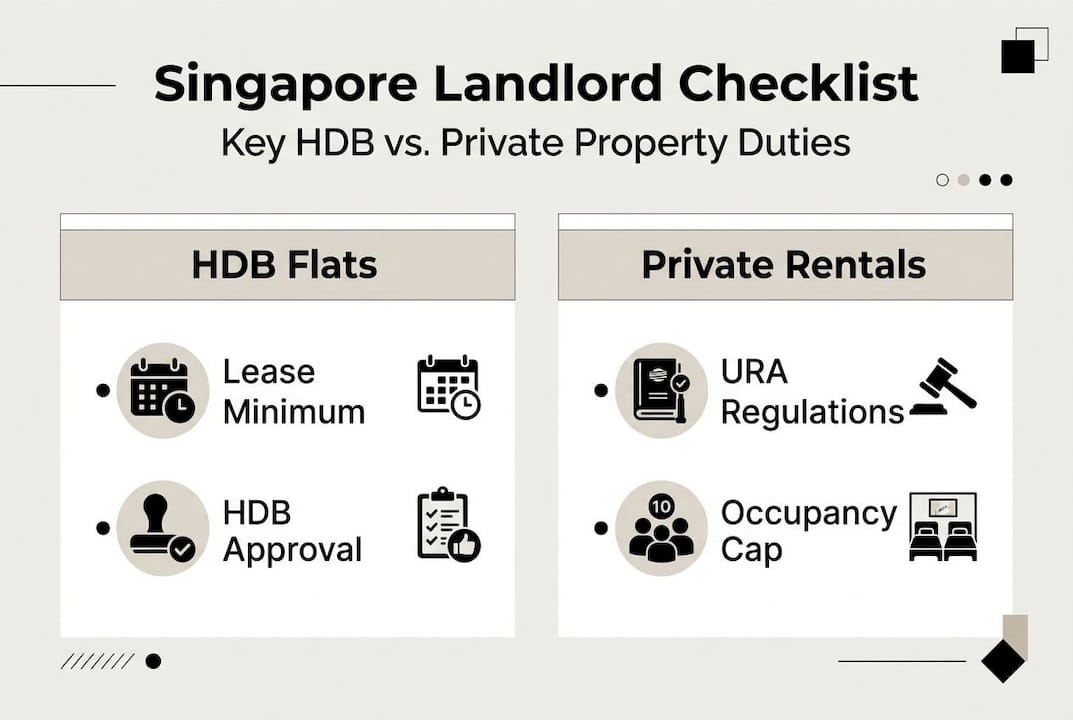
For HDB landlords, the process starts well before you list your unit. You must meet the Minimum Occupation Period before renting out your flat or any bedroom, and HDB approval is required at every stage. Owner-occupancy is mandatory when renting out individual rooms, meaning you must live in the flat yourself. Permanent Residents face additional restrictions on who they can rent to. The maximum number of occupants per flat is strictly capped, and breaching this limit is treated seriously.
For private property landlords, URA regulations specify minimum lease periods and detailed occupancy caps for private residences, with heavy fines for violations. The standard cap is six unrelated persons, rising to eight for units larger than 90 square meters, provided you register with URA. Minimum lease terms apply too, and short-term rentals below the threshold are prohibited.
| Feature | HDB flat | Private residential |
|---|---|---|
| Min lease term | 6 months (whole unit) | 3 months |
| Approval required | Yes, HDB | URA registration for higher cap |
| Occupancy cap | Strictly capped by flat type | 6 standard, 8 with registration |
| Owner-occupancy | Required for room rental | Not required |
| Max fine for breach | S$50,000 | S$200,000 |
You can explore HDB eligibility rules and current private property market trends to stay updated on regulatory shifts that affect your leasing strategy.
Key documentation duties for landlords:
- HDB: Submit rental application via HDB portal, maintain updated tenant list, report changes within 7 days
- Private: Register with URA if applying for 8-person cap, retain copies of all tenancy agreements
- Both: Keep copies of tenant passes, verify legal status, use CEA-endorsed agreement templates
- Both: Conduct joint inspections at move-in and move-out with written records
For condo rental insights specific to private leasing, understanding what tenants expect in 2026 can sharpen your negotiating position.
Leasing commercial properties: Duties, negotiation, and risk
Commercial leasing operates on a different playing field. Unlike residential tenancies, commercial lease agreements are highly negotiable, and there is no standard government template that governs every clause. That flexibility is a double-edged sword.
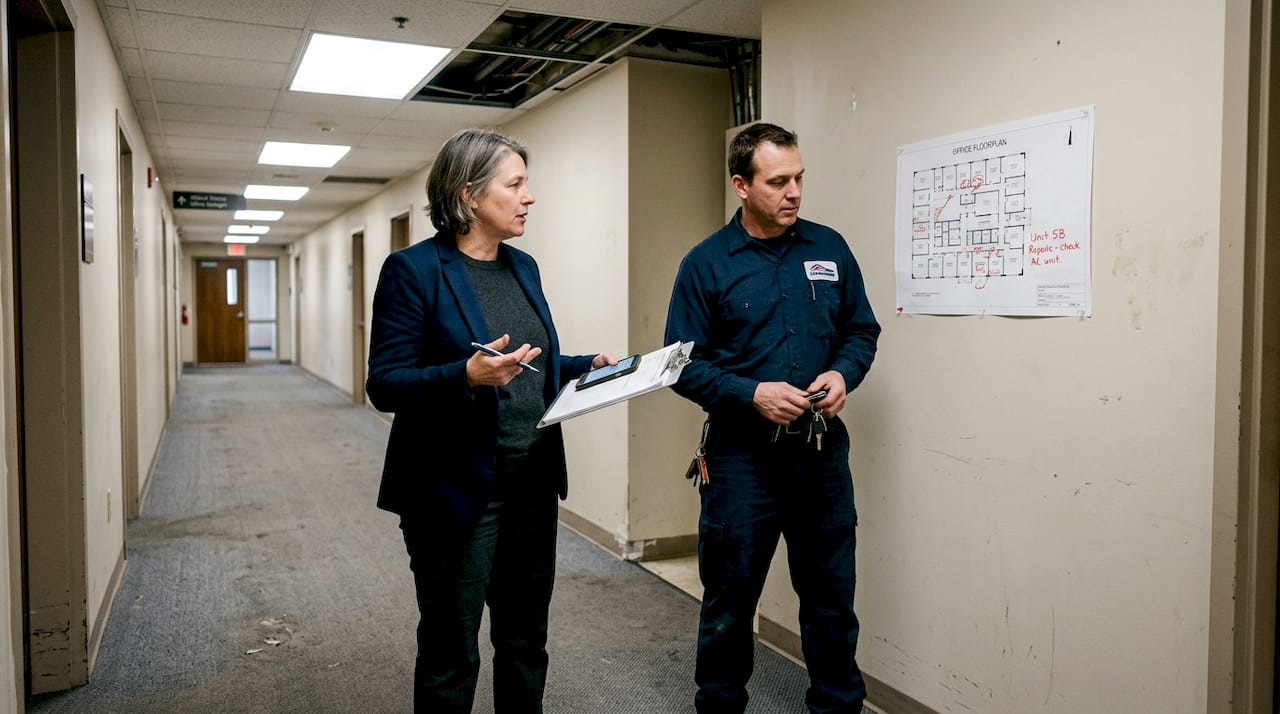
Landlords are responsible for all core structural repairs, while tenants handle interior upkeep in commercial leases. This means if the roof leaks or the main electrical system fails, that cost lands on you. Tenants, on the other hand, are expected to maintain the interior fit-out, fixtures, and any modifications they make.
| Lease clause | Landlord responsibility | Tenant responsibility |
|---|---|---|
| Structural repairs | Yes | No |
| Interior maintenance | No | Yes |
| Insurance | Strongly advised | Often required by contract |
| Usage restrictions | Define and enforce | Comply with stated use |
| Renewal terms | Negotiate upfront | Provide notice per agreement |
Compliance is non-negotiable. Landlords must actively prevent illegal use, including vice activities under the Women’s Charter, and require tenant insurance. This means your due diligence does not end at signing. You need to know what your tenant is actually doing in the space.
Main stages of commercial leasing:
- Market review: Assess comparable rents, vacancy rates, and demand in your submarket
- Negotiation: Agree on rent, lease term, fit-out allowances, and permitted use clauses
- Agreement drafting: Work with a lawyer to tailor the tenancy agreement to your risk profile
- Documentation: Collect business registration, insurance certificates, and relevant licenses
- Compliance checks: Verify permitted use, confirm insurance is active, and schedule periodic reviews
Pro Tip: Always define permitted use as narrowly as practical in your commercial lease. A clause that says “retail” is far weaker than one that specifies “F&B retail, excluding nightclub or entertainment use.” This single detail can protect you from legal exposure under the Women’s Charter.
Understanding agent roles in commercial leasing can also help you navigate negotiations with greater confidence, especially for first-time commercial landlords. The benefits of investing in commercial property are real, but only if your lease structure protects your asset from day one.
Screening tenants and compliance: Safeguarding your property
Getting the right tenant is not just about financial security. It is about protecting your property, your legal standing, and your peace of mind. Thorough screening is the single most effective risk management tool available to landlords.
Best practice is for landlords to verify tenant passes, income, and use CEA agreement templates. Regular joint inspections are also strongly advised. This is not bureaucratic box-ticking. It is your first line of defense against occupancy violations, illegal subletting, and disputes over property condition.
Verification checklist for landlords:
- Check validity of Employment Pass, S Pass, Work Permit, or Long-Term Visit Pass
- Request recent payslips or bank statements as proof of income
- Confirm the tenant’s employer or business registration where relevant
- Use CEA-endorsed tenancy agreement templates for all residential leases
- Conduct a joint inspection with a written inventory at handover
- Photograph all rooms and common areas before keys are handed over
Pro Tip: Schedule a brief walkthrough every three to four months, with proper notice given to tenants. This is not about distrust. It is about catching early signs of unauthorized subletting or overcrowding before they become a regulatory problem.
Rent increases at renewal typically fall between 3% and 7%, based on market conditions. Pushing significantly beyond that range without justification creates friction and, in some cases, tribunal risk. Working with a trusted property agent helps you benchmark renewals accurately and handle the paperwork correctly. Staying informed through AI-driven property tools is also becoming standard practice for landlords who want real-time rental data.
Key best practices and handling tough scenarios
Even diligent landlords can miss small steps or get tripped up by unusual scenarios. The edge cases are where penalties accumulate.
Day-to-day landlord actions:
- Document the handover thoroughly with a signed inventory and timestamped photos
- Notify HDB or update URA records within the required timeframe when tenants change
- Handle repair requests promptly and keep written records of all maintenance completed
- Update your tenant list whenever occupants change, even for short periods
- Review your tenancy agreement at least 60 days before expiry to avoid holdover situations
Diplomatic clauses are worth including for expat tenants. These allow early termination if the tenant is relocated by their employer, which protects both parties and reduces the risk of disputes. Non-resident breaches, such as tenants subletting to unregistered occupants, are more common than landlords expect. Spotting them early through routine inspections is far cheaper than dealing with them after a complaint is filed.
On rent reviews, the market sets the tone:
“Rent increases are normally set by the market, between 3 and 7% on renewal, but no official rent control exists in Singapore.” Singapore landlords who push beyond market norms without clear justification risk tribunal challenges and damaged tenant relationships.
HDB room rental must have owner-occupancy with strict maximum occupant limits per flat, while commercial leases nearly always require tenant insurance as a standard clause. These are not optional extras. They are baseline protections that experienced landlords build into every agreement.
Insurance is underused in residential leasing. Commercial landlords routinely require tenants to carry liability coverage, and there is no reason residential landlords should not do the same. It reduces your exposure if a tenant causes damage or injury on the premises. You can review rental yield strategies to understand how insurance costs factor into your overall return calculations.
A landlord’s view: Going beyond the basics for peace of mind
Here is something most compliance guides will not tell you: the landlords who face the fewest problems are not necessarily the ones with the most detailed contracts. They are the ones who invest in the relationship.
Tick-box compliance gets you through an audit. It does not prevent a tenant from quietly subletting a room or ignoring a slow leak until it becomes structural damage. The landlords we see navigate leasing most successfully treat their tenants as long-term partners, not just revenue sources. They check in. They respond fast. They adapt agreements when circumstances change.
Contrary to common practice, waiting until renewal to address issues almost always makes them harder to resolve. Small problems, whether a disputed repair or a creeping occupancy issue, grow when ignored. Early, direct communication costs nothing and saves considerable legal fees.
Pro Tip: Build a shared digital folder with your tenant from day one. Store the inventory, inspection photos, and all communication there. When disputes arise, and they will, having a clear paper trail in a mutually accessible format resolves them faster than any clause in your agreement.
Working with specialists who understand both the regulatory and relational sides of leasing, like those who handle agent roles in commercial leasing, gives you a structural advantage that goes well beyond paperwork.
Partnering for leasing success in Singapore
Navigating Singapore’s leasing landscape is manageable when you have the right support behind you. From HDB approvals to commercial lease drafting, the details matter and missing one can cost far more than the rent you collect.
At Aesthetic Havens, we work with landlords across residential and commercial portfolios to simplify compliance, sharpen tenant screening, and structure agreements that protect your asset. Whether you need guidance on documentation, want help benchmarking your rental rate, or are exploring the commercial leasing benefits of your next investment, our team brings hands-on expertise to every stage. Connect with us to explore how agent support for commercial landlords can reduce your risk and improve your returns.
Frequently asked questions
What approvals must a Singapore landlord get before renting out an HDB flat?
HDB must approve all flat or room rentals after the Minimum Occupation Period is fulfilled, and landlords must confirm eligibility before listing the property.
What is the occupancy cap for private residential property rentals?
Standard occupancy cap is 6 unrelated persons, and this may increase to 8 for units over 90 square meters with prior URA registration.
Who is responsible for repairs in commercial leases?
Landlords handle structural repairs while tenants are typically responsible for interior upkeep and any modifications they make to the unit.
How should landlords handle rent increases in Singapore?
Market increases of 3 to 7% at renewal are standard, and excessive hikes without justification can be challenged at a Small Claims Tribunal or equivalent review body.
Recommended
- Agent roles in Singapore commercial leasing: unlock value
- The Singapore Rental Market in 2025: Navigating Opportunities & Challenges | Aesthetic Havens
- Foreigner’s Guide to Buying Property in Singapore (2025 Regulations & Taxes) | Aesthetic Havens
- Best Property Agent in Singapore: How to Choose the Right One for You | Aesthetic Havens


