


Additional Buyer Stamp Duty (ABSD) is a mandatory tax on residential property purchases in Singapore, paid on top of the standard Buyer Stamp Duty (BSD), and calculated on the higher of the purchase price or the property’s market value. The Inland Revenue Authority of Singapore (IRAS) administers ABSD as a direct market cooling measure, with rates that vary sharply by buyer profile, residency status, and number of properties already owned. Whether you are a Singapore Citizen buying your second home or a foreign national entering the market for the first time, understanding what is ABSD Singapore means knowing exactly how much extra cash you need at the point of signing.
What is ABSD in Singapore and who does it apply to?
ABSD is defined as a transaction tax levied on buyers of residential property in Singapore, imposed in addition to BSD. The Ministry of Finance introduced ABSD to regulate market entry and curb speculative buying, and it applies to every residential property purchase where the buyer meets certain profile criteria. The tax is designed as a one-time transaction tax to control market entry, separate from the recurring annual property tax charged on the asset itself.
ABSD applies to Singapore Citizens (SCs), Singapore Permanent Residents (PRs), foreigners, and entities such as companies and trusts. SCs buying their first residential property pay 0% ABSD. The rate rises steeply with each subsequent purchase and is highest for foreign nationals and corporate entities. The tax exists precisely because Singapore’s residential market is small, internationally attractive, and highly susceptible to price inflation driven by speculative demand.

How do ABSD rates vary by buyer profile and property count?
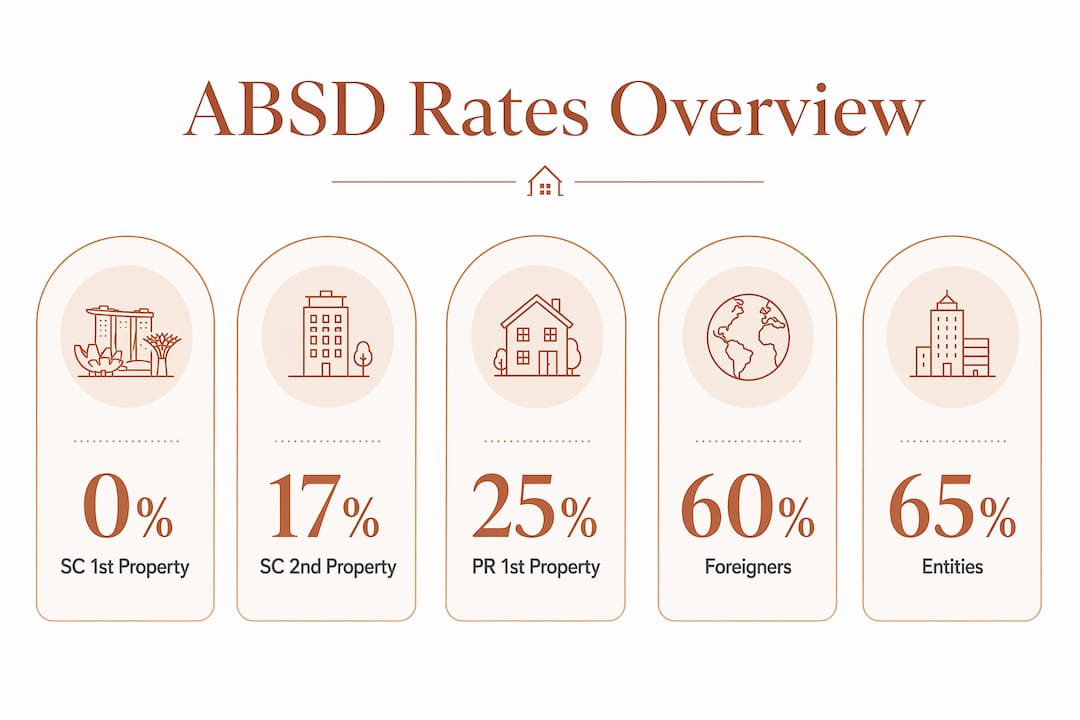
ABSD rates follow a progressive structure tied to two variables: the buyer’s residency status and the number of residential properties already owned. The table below shows the key rate tiers currently in effect.
| Buyer Profile | 1st Property | 2nd Property | 3rd and Beyond |
|---|---|---|---|
| Singapore Citizen (SC) | 0% | 20% | 30% |
| Singapore Permanent Resident (PR) | 5% | 30% | 35% |
| Foreigner | 60% | 60% | 60% |
| Entity (company, trust) | 65% | 65% | 65% |
Foreigners pay 60% ABSD regardless of whether it is their first or subsequent purchase, a rate that was raised in april 2023 to dampen speculative foreign buying. That single rate hike effectively priced out a large segment of international speculators overnight.
Joint purchases carry an important rule. When buyers with different residency profiles purchase together, the highest applicable rate among them applies to the full property value with no pro-rating. A Singapore Citizen buying jointly with a foreigner pays the foreigner rate of 60% on the entire purchase price, not a blended figure. This catches many couples and business partners off guard.
Pro Tip: If you are a Singapore Citizen married to a PR or foreigner, structure the purchase carefully before signing anything. The ownership profile at the point of contract determines the ABSD rate, not your intentions afterward.
How is ABSD calculated and when must it be paid?
The taxable base for ABSD is the higher of the purchase price or the property’s market value, a rule designed to prevent buyers from under-declaring transaction prices. If you agree to buy a condominium at S$1.5 million but IRAS assesses its market value at S$1.6 million, your ABSD is calculated on S$1.6 million. This matters most in private treaty deals where pricing can be negotiated below market.
The payment timeline is strict. ABSD must be paid within 14 days of signing the Option to Purchase (OTP) or the Sale and Purchase Agreement (SPA), whichever comes first. That deadline applies even if you expect to receive a remission later. You pay first, then apply for a refund if eligible.
Here is a practical calculation example for a Singapore PR buying a second property at S$1.5 million:
- Confirm the taxable value: S$1.5 million (assuming market value matches purchase price).
- Apply the applicable ABSD rate: 30% for a PR’s second property.
- Calculate ABSD payable: 30% × S$1,500,000 = S$450,000.
- Add BSD on top: BSD is calculated separately on a progressive scale starting at 1%.
- Total upfront stamp duty: ABSD plus BSD, payable within 14 days of signing.
That S$450,000 ABSD figure must come from cash or CPF, not from the bank loan. Lenders do not finance stamp duty. This upfront liquidity requirement is one of the most significant financial constraints for property investors building a portfolio in Singapore.
What exemptions and remission options reduce ABSD liability?
ABSD remission is available in specific, well-defined circumstances. The most commonly used remission applies to married couples where at least one spouse is a Singapore Citizen. ABSD may be remitted if the SC sells their previous property within six months of purchasing the new one. The couple must not own any other residential property at the time of purchase, and the application for remission must be submitted to IRAS after the sale is completed.
Certain foreign nationals also benefit from reduced rates. Nationals from the United States, Iceland, Liechtenstein, Norway, and Switzerland are treated the same as Singapore Citizens for ABSD purposes under Free Trade Agreements. An American buying their first residential property in Singapore pays 0% ABSD, the same rate as a local SC. This is a significant and underused advantage that many eligible buyers are unaware of.
Key conditions and pitfalls to know:
- The six-month remission window starts from the date of purchase of the new property, not the date of signing.
- Both spouses must be named on the new property for the married couple remission to apply.
- Holding property through a trust or nominee does not eliminate ABSD liability. IRAS actively scrutinizes arrangements designed to avoid ABSD, and penalties apply for schemes deemed abusive.
- Decoupling (removing one owner from a jointly held property before buying a new one) is a legal strategy but requires careful legal and financial advice before execution.
Pro Tip: The six-month window for the SC married couple remission is tight. Line up your resale timeline before you commit to a new purchase. Missing the deadline means forfeiting the entire remission.
How does ABSD relate to other Singapore property taxes?
ABSD sits within a broader property tax framework that includes BSD and annual property tax. Understanding how these three interact clarifies the full cost of property ownership in Singapore.
BSD is paid by every buyer of any property type, calculated on a progressive scale based on purchase price. ABSD is an additional layer paid only by buyers who meet certain profile criteria. Both are one-time transaction taxes paid at the point of purchase. Annual property tax, by contrast, is a recurring charge on the assessed annual value of the property, paid every year regardless of whether the property is sold.
| Tax Type | When Paid | Who Pays | Rate Basis |
|---|---|---|---|
| Buyer Stamp Duty (BSD) | At purchase | All buyers | Progressive, on purchase price |
| Additional Buyer Stamp Duty (ABSD) | At purchase | Profile-based buyers | Flat rate by buyer category |
| Annual Property Tax | Every year | All owners | Annual value of property |
Property tax rates for non-owner-occupied properties now range from 12% to 36%, reflecting the government’s intent to tax investment properties more heavily than owner-occupied homes. This progressive annual charge compounds the cost of holding multiple properties over time. Taken together, ABSD and escalating property tax rates make speculative property holding increasingly expensive, which is precisely the policy goal.
The rationale behind ABSD as a cooling measure is to pair a high entry cost with a rising holding cost, discouraging both speculative buying and long-term hoarding of residential assets. For genuine owner-occupiers, the tax burden remains manageable. For investors accumulating multiple units, the combined tax load is a real constraint on returns.
What is the practical impact of ABSD on property investors?
ABSD fundamentally changes the math on property investment in Singapore. For a Singapore Citizen buying a second property at S$2 million, the 20% ABSD alone adds S$400,000 to the upfront cost. That sum must be funded from liquid assets before the bank loan is even drawn. Investors who underestimate this cash requirement find themselves unable to complete transactions they have already committed to.
The impact extends beyond cash flow. ABSD affects the loan-to-value (LTV) calculation indirectly. Banks assess affordability based on the total debt servicing ratio (TDSR), and a large upfront ABSD payment reduces the cash buffer available for loan repayments. Investors planning a second or third property purchase need to model the full cost stack, including ABSD, BSD, legal fees, and renovation, before committing.
Practical considerations for investors include:
- Timing of prior property sales: Selling an existing property before signing on a new one can reduce ABSD liability by one tier for SCs and PRs.
- Ownership structure: Sole ownership versus joint ownership affects which ABSD tier applies. Consult a property consultant or tax advisor before deciding.
- Rental yield versus ABSD cost: At 20–30% ABSD on a second property, the payback period from rental income alone is long. Investors must factor in capital appreciation expectations to justify the entry cost.
- New launch versus resale: ABSD applies equally to both, but new launch payment schedules may give buyers more time to liquidate existing assets before the six-month remission window closes.
For a detailed breakdown of how ABSD applies specifically to foreign buyers, the foreigners’ guide to buying property covers the full regulatory picture. Investors building a portfolio should also review the 2026 investment checklist for a structured approach to managing tax exposure alongside other acquisition costs.
Key Takeaways
ABSD is a mandatory upfront tax on residential property purchases in Singapore, with rates ranging from 0% for first-time Singapore Citizen buyers to 65% for entities, and it must be paid within 14 days of signing the purchase contract.
| Point | Details |
|---|---|
| ABSD rate by profile | Rates range from 0% (SC first property) to 65% (entities), with foreigners paying 60% flat. |
| Joint purchase rule | The highest applicable rate among all buyers applies to the full property value with no pro-rating. |
| Payment deadline | ABSD must be paid within 14 days of signing the OTP or SPA, even if remission is expected. |
| Remission for SC couples | Married couples with at least one SC can claim remission if the prior property is sold within six months. |
| FTA exemptions | US, Norwegian, Swiss, Icelandic, and Liechtenstein nationals pay ABSD at the same rate as Singapore Citizens. |
My take on ABSD after years in the Singapore market
Most buyers treat ABSD as a number to look up after they have already fallen in love with a property. That is the wrong sequence. ABSD should be the first calculation you run, before viewings, before financing conversations, and before you set your budget ceiling.
What I have seen repeatedly is buyers who have the down payment ready but have not accounted for ABSD as a separate cash outlay. A Singapore PR buying a second property at S$1.8 million faces S$540,000 in ABSD alone. That is not a rounding error. It is a number that changes whether the deal makes sense at all.
The remission rules are genuinely useful for SC upgraders, but the six-month window is unforgiving. I have seen clients miss it by weeks because they did not plan the resale timeline before committing to the new purchase. The government does not grant extensions. Planning the exit from your current property before you sign on the next one is not optional.
The broader policy direction is clear. Singapore’s government has consistently signaled that residential property is a home first and an investment vehicle second. ABSD rates have moved in one direction over the past decade. Investors who build their strategy around the assumption that rates will fall are taking a risk that the data does not support. The smarter approach is to plan around current rates and treat any future reduction as a bonus, not a baseline.
— Aman
Working with a property consultant on ABSD planning
Navigating ABSD without professional guidance is possible, but the cost of a mistake is high. A single miscalculation on buyer profile or ownership count can result in tens of thousands of dollars in unexpected tax liability.
At Aesthetic Havens, the advisory process starts with a full review of your current property holdings, residency status, and purchase timeline before any property is shortlisted. That sequence matters because ABSD liability is locked in at the point of signing, not after. Working with a property consultant means you understand your exact ABSD exposure before you fall in love with a unit. For international buyers, the role of an international property consultant includes identifying FTA exemptions and structuring purchases to minimize tax liability from day one.
FAQ
What is ABSD in Singapore?
ABSD stands for Additional Buyer Stamp Duty, a tax on residential property purchases in Singapore paid on top of the standard Buyer Stamp Duty. Rates vary by buyer residency status and number of properties owned, ranging from 0% to 65%.
How does ABSD work for joint purchases?
When buyers with different residency profiles purchase a property together, the highest applicable ABSD rate among them applies to the full purchase price with no pro-rating. A Singapore Citizen buying jointly with a foreigner pays the full 60% foreigner rate.
Can ABSD be refunded or remitted?
Yes, in specific cases. Married couples where at least one spouse is a Singapore Citizen can apply for remission if they sell their prior property within six months of the new purchase. Certain foreign nationals from FTA countries also qualify for SC-equivalent rates.
When must ABSD be paid?
ABSD must be paid within 14 days of signing the Option to Purchase or the Sale and Purchase Agreement. Payment is required upfront even if the buyer expects to receive a remission afterward.
Do foreigners always pay 60% ABSD in Singapore?
Most foreigners pay a flat 60% ABSD on any residential property purchase. However, nationals from the United States, Norway, Switzerland, Iceland, and Liechtenstein are treated as Singapore Citizens under Free Trade Agreements and pay 0% on their first property.


