


Securing the right industrial space is rarely as simple as finding a building and signing papers. The industrial property leasing workflow involves multiple moving parts, from defining your operational specs to negotiating lease clauses that could cost or save you hundreds of thousands of dollars over a lease term. Miss one step, and you risk delays, compliance issues, or locking yourself into terms that don’t fit how your business actually runs. This guide walks you through every phase of the process, so you can move faster, negotiate smarter, and avoid the mistakes that slow most tenants down.
Key takeaways
| Point | Details |
|---|---|
| Know your specs before searching | Clear height, dock doors, and power capacity must be defined before touring any property. |
| Plan for a longer timeline | The industrial leasing process takes 3 to 6 months depending on improvements needed. |
| Understand your lease structure | NNN, gross, and modified gross leases assign expenses very differently. Know which you’re signing. |
| Lease abstraction saves money | Converting lease documents into structured data reduces errors and surfaces critical dates you’d otherwise miss. |
| Administration starts at signing | Tracking renewals, CAM reconciliations, and audit windows must begin the day the lease is executed. |
Industrial property leasing workflow: what to prepare first
Before you tour a single property or speak to a broker, you need to do internal homework. This is the phase most tenants skip or rush, and it’s exactly where costly misalignments begin.
Start by defining your operational requirements with real specificity. What clear height and dock doors does your operation actually need? What is your required power capacity in amps? Do you need truck court depth for 53-foot trailers? These are not optional questions. They determine which properties even qualify, and brokers can’t represent you effectively without this information.
Equally important is understanding your budget ceiling and preparing financial documentation early. Landlords of industrial properties will request financials before entertaining serious offers, especially in competitive markets. Have two to three years of financial statements and bank references ready before the search begins.
You also need to understand the three main lease structures used in industrial real estate:
- NNN (Triple Net): The tenant pays base rent plus property taxes, insurance, and common area maintenance. This is the most common structure in industrial leasing.
- Industrial Gross: The landlord covers structural repairs, parking lot maintenance, and roof, while you cover utilities and sometimes janitorial costs.
- Modified Gross: A hybrid where expenses are split by negotiation. The specific split matters enormously, so read every line.
Finally, assemble your team before you need them. A tenant-rep broker, a real estate attorney, an internal finance contact, and ideally an industrial property management advisor should all be aligned before you start touring. Waiting until you have a deal on the table to find legal counsel is one of the most common and most avoidable delays in the process.
| Requirement | Documentation or Action Needed |
|---|---|
| Space specifications | Written list of clear height, dock doors, power, and truck court needs |
| Financial readiness | 2-3 years of financials, bank references, entity documents |
| Lease structure familiarity | Internal briefing or advisor consultation on NNN vs. gross structures |
| Legal representation | Retain a real estate attorney before LOI stage |
| Broker engagement | Signed tenant-rep agreement with an industrial specialist |
From property search to signed letter of intent
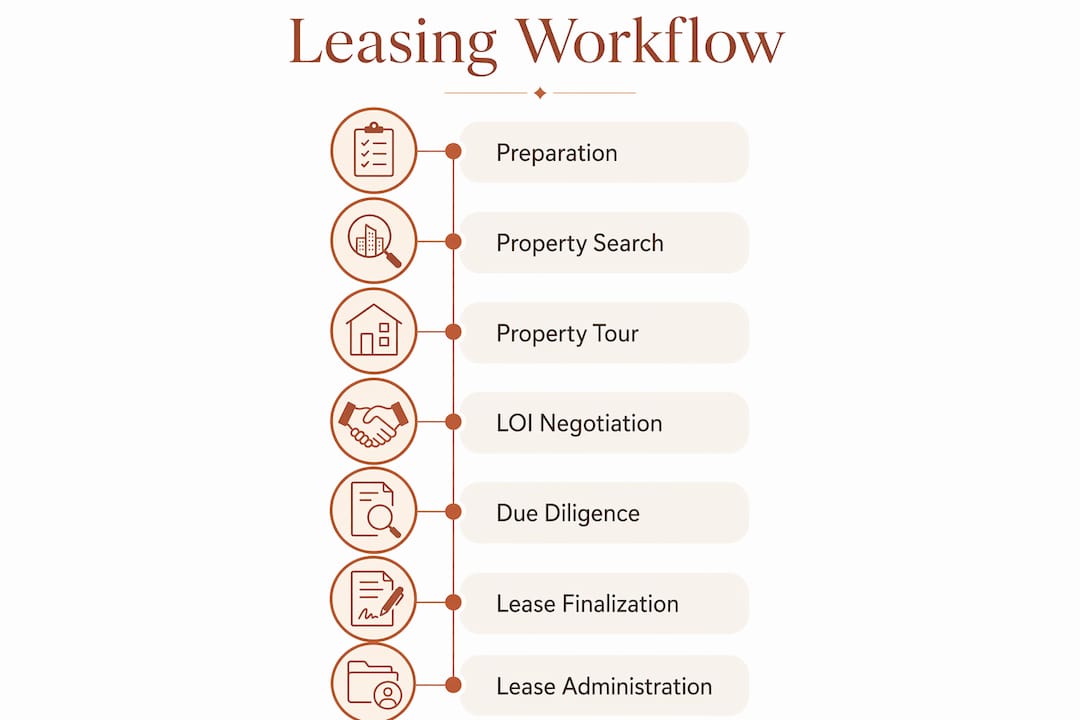
With preparation complete, the active leasing process moves through three distinct stages. Each has its own timeline, decision points, and risks.
Stage 1: Requirement definition and property search
Your broker uses your operational criteria to generate a shortlist of qualifying properties. This stage typically runs 30 to 60 days, depending on market availability. Tighter specifications in competitive markets can push that timeline out further. The best practice here is to apply a consistent scoring framework to every property. If you define your criteria upfront, you can rank options quickly and avoid the trap of falling in love with a space that doesn’t operationally work. Keeping investment criteria in active context improves deal screening efficiency significantly.

Stage 2: Property touring and operational evaluation
Tour at minimum three to five properties before shortlisting. During each tour, assess the physical specs against your documented requirements. Don’t evaluate aesthetics. Evaluate dock leveler capacity, floor load ratings, fire suppression systems, and power panel location. Bring your operations manager, not just your finance team. The person running the facility daily will catch problems your CFO won’t see.
Stage 3: Letter of Intent and term negotiation
Once you identify a preferred property, you submit a Letter of Intent. The LOI negotiation phase typically takes 2 to 4 weeks and covers base rent, lease term, rent escalations, tenant improvement allowances, and free rent periods. This is where you establish the commercial framework of the deal before attorneys draft the actual lease.
- Submit LOI with your proposed terms (Days 1-3)
- Receive landlord’s counteroffer (Days 5-10)
- Negotiate back-and-forth on key economics (Days 10-21)
- Execute the agreed LOI (Days 21-28)
- Begin formal lease drafting based on LOI terms (Days 28+)
Tenants frequently underestimate how long negotiation and term alignment actually take. Starting earlier than you think necessary reduces the risk of timeline compression later.
Pro Tip: Push for a CAM cap during LOI negotiation, not after. Tenants who negotiate CAM charge caps during the LOI phase get better protections than those who try to add them during lease drafting.
Due diligence, lease finalization, and tenant improvements
The LOI is agreed. Now the real work begins. This phase covers roughly 30 to 60 additional days and is where most of the legal and operational risk in the entire workflow for leasing sits.
Due diligence should cover four areas without exception:
- Zoning and permitted use: Confirm your specific operations are permitted. A warehouse zoned for light industrial may not permit your manufacturing process or hazardous materials storage.
- Environmental review: Phase I environmental assessments identify prior contamination risks that could become your liability under certain lease structures.
- Property condition: Commission a physical inspection covering roof, HVAC, electrical, and structural systems. Build the cost of any deficiencies into your lease negotiations.
- Title and encumbrances: Confirm there are no liens or ownership disputes that could affect your right to occupy.
Once due diligence clears, your attorney drafts and reviews the formal lease. Pay close attention to the permitted use clause, assignment and subletting rights, and early termination provisions. These clauses will matter when your business circumstances change, and they always change.
Pro Tip: Get your attorney involved at the LOI stage, not after. Early legal involvement on commercial real estate leases prevents expensive redrafting and catches issues before they become deal killers.
Lease abstraction should happen before you sign. AI-powered abstraction tools can convert your full lease document, including amendments and side letters, into structured data that feeds directly into your property management system. This step is frequently skipped by tenants and regretted almost universally.
| Due Diligence Item | Who Is Responsible | Typical Timeframe |
|---|---|---|
| Zoning and permitted use review | Real estate attorney | 5-10 days |
| Phase I environmental assessment | Environmental consultant | 10-15 days |
| Property condition inspection | Licensed inspector | 3-5 days |
| Lease document review and markup | Real estate attorney | 7-14 days |
| Lease abstraction and data entry | Lease admin team or AI tool | 3-7 days |
Ongoing lease administration after execution
Signing the lease is not the finish line. For business owners managing industrial properties, the post-execution phase is where long-term cost control and risk management actually happen. This is what separates tenants who manage their lease well from those who get surprised by bills they should have seen coming.
Critical date tracking is the foundation of good lease administration. Renewal options, notice windows, and lease expiration dates all have hard deadlines. Miss your renewal notice window by a day and you may lose the right to renew at a favorable rate entirely.
CAM reconciliation is another area where attention pays off. CAM reconciliation typically occurs 90 to 120 days after year end, concentrated in Q1. Landlords send annual reconciliation statements, and you have a limited window to dispute inaccurate charges. That window is often only 30 to 90 days. Missing it forfeits your right to dispute charges.
Best practices for ongoing lease administration:
- Load all critical dates into a centralized lease management system with automated reminders at 12, 6, and 3 months before key deadlines
- Review CAM reconciliation statements line by line, not just the total amount owed
- Reconcile amendments and side letters against the base lease before any budget forecasting cycle
- Document every landlord-tenant communication in writing, especially verbal agreements about repairs or modifications
- Monitor your audit rights window and calendar it at the same time you receive the reconciliation statement
Pro Tip: Assign one person internally to own the lease file. When lease administration is everyone’s job, it becomes no one’s job, and that’s when expensive mistakes get made.
My take on where the process actually breaks down
From my experience working with business owners across Singapore’s commercial and industrial property market, the biggest problems in this process don’t come from legal complexity. They come from starting without clear operational criteria, then trying to retrofit requirements onto properties that were never right to begin with.
I’ve seen tenants spend eight weeks negotiating a lease only to discover during due diligence that the permitted use clause excluded their core business activity. That discovery could have been made in week one with a two-line zoning check. The same pattern repeats with CAM caps. I rarely see tenants raise CAM protections at the LOI stage. They focus on rent and tenant improvement allowances, then get hit with a CAM reconciliation bill 14 months later that they had no leverage to fight.
What I’ve found actually works is treating lease abstraction not as an administrative task but as a financial control. When you can see every obligation, every date, and every escalation clause in a single structured view, you make better decisions. You also catch discrepancies in CAM billing faster because you know exactly what the lease says.
The other thing I’d push back on is the tendency to rush due diligence to “keep momentum.” Deals that close fast because due diligence was compressed often become operational problems within 18 months. Balancing speed with thoroughness is a skill, and it comes from knowing which checks are genuinely fast and which need real time. Knowing how to read industrial real estate documents properly is what separates informed decisions from expensive guesses.
— Aman
How Aesthetic Havens supports your leasing process
If you’re working through an industrial or commercial property lease in Singapore and want expert guidance from someone who knows the market, Aesthetic Havens can help. Aman Aboobucker and the team at ERA Realtors support business owners and corporate clients at every stage of the process, from requirement definition and property search through lease negotiation and post-signature administration.
Whether you’re securing your first industrial space or managing a growing portfolio, working with an experienced Singapore property advisor who understands the full leasing workflow makes a measurable difference. You can also explore the detailed breakdown of agent roles in commercial leasing to understand exactly how professional support adds value at each step. Reach out directly to start a conversation about your specific requirements.
FAQ
How long does the industrial leasing process take?
The typical industrial leasing process takes 3 to 4 months for move-in-ready spaces and 6 or more months when significant tenant improvements are needed.
What is the difference between NNN and industrial gross leases?
In an NNN lease, the tenant pays base rent plus taxes, insurance, and CAM charges. In an industrial gross lease, the landlord covers structural maintenance and parking, while the tenant covers utilities and internal operating costs.
When should I involve a real estate attorney?
You should retain a real estate attorney before submitting a Letter of Intent. Early legal involvement prevents expensive revisions during the formal lease drafting stage and protects your rights during negotiations.
What is lease abstraction and why does it matter?
Lease abstraction converts your full lease document into structured data, making critical dates, obligations, and clauses easy to track and manage. It reduces the risk of missed deadlines and billing disputes.
What happens if I miss my CAM audit window?
Missing the audit window in an NNN lease, which is often only 30 to 90 days after reconciliation delivery, typically means you forfeit your right to dispute any inaccurate charges for that period.


