


Many landlords and investors in Singapore believe that leasing a property is as straightforward as finding a good tenant and collecting rent. That assumption costs money. Leasing in Singapore involves regulatory steps, compliance, and proper documentation that go far beyond a handshake deal. Whether you are a first-time renter trying to understand your rights or an experienced investor managing a portfolio, understanding how Singapore’s leasing framework operates will protect you legally, financially, and professionally. This guide walks you through every key element: what leasing means, how it differs for residential and commercial properties, what compliance steps you cannot skip, and how leasing decisions shape your real returns.
Table of Contents
- The basics: What is property leasing?
- Residential vs. commercial leasing: What’s different?
- Key steps and compliance: How does Singapore regulate leasing?
- Investor focus: How leasing impacts returns and risks
- The hidden advantages of understanding Singapore leasing rules
- Looking for leasing guidance or property opportunities?
- Frequently asked questions
Key Takeaways
| Point | Details |
|---|---|
| Leasing involves formal agreements | In Singapore, property leasing always uses a documented tenancy agreement for legal protection. |
| Compliance affects returns | Proper e-stamping and tax reporting are critical for both avoiding penalties and maximizing rental income. |
| Residential and commercial leases differ | Commercial leases are typically more complex and negotiable than residential ones. |
| Expert help reduces risk | Using knowledgeable agents and being thorough with documentation can prevent costly mistakes. |
The basics: What is property leasing?
Let’s start by clarifying the core concept of leasing and how it operates in Singapore.
Property leasing refers to a formal arrangement where a property owner, called the landlord, grants another party, the tenant, the right to occupy a property for a specific period in exchange for regular rent payments. In Singapore, the terms “leasing” and “renting” are often used interchangeably, but leasing generally implies a longer-term, more legally structured agreement with defined protections for both sides.
Three parties are typically involved in a lease transaction:
- Landlord: The property owner who sets the terms and earns rental income
- Tenant: The person or company occupying the property under agreed terms
- Property agent: Licensed under the Council for Estate Agencies (CEA), the agent facilitates the transaction, negotiates terms, and ensures proper documentation
The most critical document in any Singapore lease is the Tenancy Agreement (TA). A tenancy agreement is a legally binding contract that outlines the monthly rent, lease duration, security deposit amount, maintenance responsibilities, and termination clauses. Both parties sign it before any keys change hands.
“The Tenancy Agreement is not just a formality. It is your primary legal protection if a dispute arises. Never proceed without one.”
In Singapore, typical lease periods range from one to three years, with most residential leases running for one or two years and commercial leases sometimes extending to three years or longer. Many TAs include an option to renew, which gives tenants and landlords flexibility without renegotiating from scratch.
Understanding the roles involved is especially important for commercial transactions. The expectations, documentation, and negotiation dynamics between landlords and tenants in commercial leasing roles differ considerably from what you encounter in residential deals. Similarly, knowing your landlord responsibilities before signing anything can save you from costly mistakes down the road.
Residential vs. commercial leasing: What’s different?
Once you understand the basics, it helps to see how leasing looks different for residential versus commercial properties.
The distinction matters because the rules, templates, and expectations are not the same. CEA provides tenancy agreement templates for both HDB flats and private residential properties, giving landlords and tenants a standardized starting point. Commercial leases, on the other hand, are largely bespoke, meaning the terms are negotiated freely between parties without a government-issued template.

Here is a clear breakdown of the key differences:
| Feature | Residential leasing | Commercial leasing |
|---|---|---|
| Template used | CEA standard template | Bespoke, negotiated contract |
| Typical lease length | 1 to 2 years | 2 to 3 years or longer |
| Negotiation flexibility | Moderate | High |
| Government approval | Required for HDB (owner-occupier rules) | May require URA or relevant authority approval |
| Security deposit | Usually 1 to 2 months’ rent | Often 2 to 3 months’ rent |
| Fit-out and renovation clauses | Rarely included | Commonly negotiated |
For HDB flats, owners must meet the Minimum Occupation Period (MOP) before they are allowed to rent out the entire unit. Private condominiums are subject to fewer restrictions, though foreign tenants must still meet residency eligibility criteria.
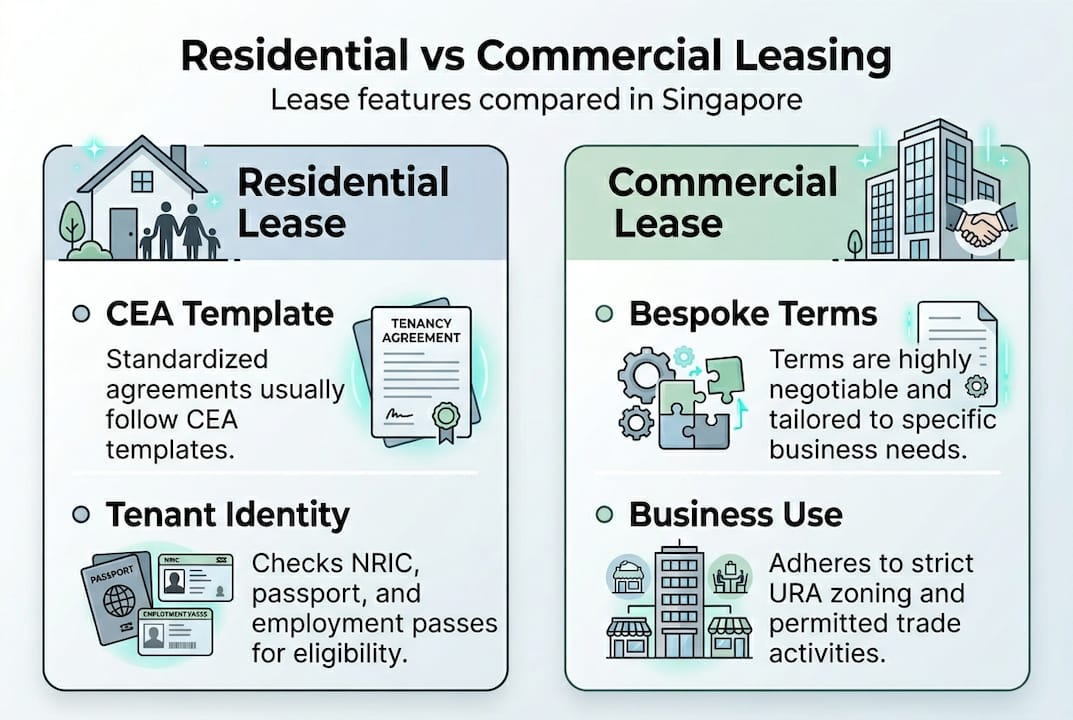
Commercial tenancies introduce more complexity. A retail space, for example, may include clauses around permitted use, gross turnover rent, and reinstatement obligations. Office leases might include rent-free periods during fit-out phases. These are not standard in residential agreements.
Key considerations when choosing between property types for leasing:
- Intended use: Is the tenant operating a business, or are they seeking a home? The intended use determines which rules apply.
- Lease flexibility: Commercial tenants often negotiate longer terms and more custom exit clauses.
- Regulatory approval: Some commercial uses require specific licenses from government bodies before a lease can commence.
Pro Tip: Always check whether the intended business use of a commercial space has been approved by the Urban Redevelopment Authority (URA) before signing. Using a space for an unauthorized purpose can void the lease and expose both parties to penalties.
If you are considering the commercial side, reviewing the specific roles in commercial leasing will clarify what each party is responsible for during the transaction process.
Key steps and compliance: How does Singapore regulate leasing?
After outlining the property types, we need to focus on what makes Singapore’s regulatory framework unique.
Singapore takes leasing compliance seriously. Missing a single step can result in financial penalties or legal complications. Here is the standard sequence every landlord and tenant should follow:
- Negotiate and sign the Tenancy Agreement. Both parties review and agree to all terms before signing.
- Pay the security deposit. This is typically held by the landlord and returned at the end of the lease, subject to deductions for damages or unpaid rent.
- E-stamp the Tenancy Agreement. This is a mandatory legal step. Landlords must e-stamp the TA and inform IRAS within 15 days unless the TA has already been e-stamped.
- Conduct a property handover. Document the condition of the property with photos and an inventory checklist before the tenant moves in.
- Report rental income. Landlords must declare rental income in their annual tax return to IRAS.
E-stamping is done through the myTax Portal on the IRAS website. The stamp duty amount is calculated based on the total rent payable over the lease period. This step is not optional. An unstamped TA is not admissible as evidence in court, which means you lose your primary legal protection if a dispute arises.
Common tax reporting mistakes include:
- Forgetting to declare rental income from overseas tenants
- Claiming disallowed deductions such as personal expenses as rental expenses
- Failing to report short-term rental arrangements
Penalties for non-compliance range from financial fines to backdated tax assessments with interest. The IRAS takes a systematic approach to identifying unreported rental income, particularly for properties flagged through utilities records and property ownership data.
Pro Tip: Keep digital records of your Tenancy Agreement, e-stamping certificate, security deposit receipts, and all rental payment records. Cloud storage organized by property makes tax season significantly easier and protects you during any audit.
For investors who want a broader understanding of how Singapore’s tax regulations for leasing interact with property ownership rules, a full overview of the property tax landscape is worth reviewing.
Investor focus: How leasing impacts returns and risks
With regulations in mind, let’s look at how they specifically impact the financial side for investors.
Rental yield is the most common metric investors use to evaluate a property’s income performance. It is calculated by dividing annual rental income by the property’s purchase price, then multiplying by 100. A 4% gross yield on a SGD 1.5 million property, for example, translates to SGD 60,000 in annual rent before expenses.
But gross yield does not tell the full story. Investor returns are shaped by both gross rent and admin and compliance costs. When you factor in stamp duties, agent commissions, property tax, maintenance costs, and income tax on rental earnings, your net yield can drop significantly.
Here is a simplified example of how compliance costs affect net returns:
| Scenario | Gross annual rent | Deductions | Net annual income |
|---|---|---|---|
| Full compliance, proactive management | SGD 60,000 | SGD 12,000 | SGD 48,000 |
| Missed e-stamping, penalty incurred | SGD 60,000 | SGD 18,000 | SGD 42,000 |
| Non-declared income, IRAS assessment | SGD 60,000 | SGD 22,000+ | SGD 38,000 or less |
Common investor pitfalls that reduce net returns:
- Underestimating vacancy periods between tenancies, which directly cuts annual income
- Ignoring lease renewal timelines, resulting in extended vacant periods
- Using verbal agreements instead of stamped TAs, which offer no legal recourse
- Overlooking permitted use clauses in commercial leases, leading to disputes
- Failing to budget for reinstatement costs at lease expiry, especially for commercial spaces
Understanding rental yield in full detail helps you model realistic returns before you commit to a property. For investors considering diversification, exploring the benefits of commercial property alongside residential options provides a more complete investment picture.
“The landlords who consistently outperform are not the ones with the best properties. They are the ones who understand their numbers and manage their obligations without gaps.”
The hidden advantages of understanding Singapore leasing rules
Stepping back, here is how a deeper understanding changes your property experience.
Most landlords treat compliance as an inconvenient checklist. They e-stamp the TA because they have to, declare income because they must, and draft a basic agreement because it is required. This box-ticking mindset is exactly why many investors underperform. They see leasing rules as friction instead of infrastructure.
Here is the counterintuitive reality: landlords who genuinely understand Singapore’s leasing framework use that knowledge as a competitive edge. They attract better tenants because their documentation is professional and clear. They avoid disputes because their TAs cover edge cases. They pay less tax because they claim all allowable deductions correctly. And they protect their portfolio because they spot compliance risks before they become penalties.
Consider a proactive landlord who reviews the landlord leasing best practices before listing a property. That landlord sets realistic rent, structures the deposit correctly, and builds a handover process that limits end-of-tenancy disputes. The result is fewer vacancies, lower legal costs, and tenants who renew. That is not compliance. That is strategy.
Think of leasing rules not as a burden but as a framework that rewards those who take the time to learn it properly.
Looking for leasing guidance or property opportunities?
If you want smart support for your next property move, consider partnering with experts.
Navigating Singapore’s leasing landscape is manageable when you have the right guidance. At Aesthetic Havens, we work with landlords, tenants, and investors across residential and commercial properties to simplify every stage of the leasing process, from agreement structuring to tax compliance and tenant matching.
Whether you are evaluating your first rental property or expanding a portfolio, understanding the full picture makes every decision sharper. Learn how working with a real estate agent in Singapore can reduce risk and improve outcomes. We also support clients exploring international property investment as part of a broader wealth strategy. Reach out to our team at Aesthetic Havens to discuss your leasing goals today.
Frequently asked questions
What is the difference between leasing and renting property in Singapore?
In Singapore, both terms describe a tenant occupying a property for payment, but leasing typically refers to a longer-term, formally documented arrangement with stronger legal protections through a signed Tenancy Agreement.
Is it mandatory to e-stamp tenancy agreements in Singapore?
Yes. Landlords must e-stamp all tenancy agreements and notify IRAS within 15 days of signing unless the agreement has already been e-stamped through the myTax Portal.
What documents are needed for property leasing in Singapore?
You need a signed Tenancy Agreement, identity documents for both landlord and tenant, an e-stamping certificate, and a record of the security deposit paid.
Can foreigners lease residential property in Singapore?
Yes, foreigners can lease most residential properties in Singapore. Landlords are permitted to rent to qualified foreigners provided the tenancy agreement is properly executed and compliant with Singapore regulations.
Recommended
- Essential landlord roles in leasing: A Singapore guide
- The Singapore Rental Market in 2025: Navigating Opportunities & Challenges | Aesthetic Havens
- Foreigner’s Guide to Buying Property in Singapore (2025 Regulations & Taxes) | Aesthetic Havens
- Singapore Commercial Property Trends: Opportunities for 2026
- Property Investment Strategies: A Comprehensive Guide – Live Rich Today


