


Short-term Airbnb stays are legal in Singapore only within narrow limits, and most listings you see advertising a weekend or a week fall outside them. Private residential properties carry a minimum stay of three consecutive months under Urban Redevelopment Authority (URA) rules, while HDB flats require six months and ban tourist rentals outright. Breach either rule and you risk fines starting at $5,000, with legal hotels and serviced apartments the safer route for anything shorter.
TL;DR:
- Short-term stays are generally illegal for private residential properties unless lasting three months or longer, with fines starting at $5,000 for violations.
- HDB flats require a minimum rental period of six months and prohibit any tourist rentals, making Airbnb hosting impossible within legal limits.
- Most violations stem from ignoring building by-laws or misinterpreting platform willingness, with repeated enforcement actions and fines common since 2019.
- Hosts must secure written approvals from HDB or MCST, review lease agreements, and disclose restrictions before listing to avoid legal penalties.
- Guests face eviction and legal risks in illegal rentals, making licensed hotels and serviced apartments the safest options for short stays in Singapore.
Table of Contents
- What URA and the Planning Act Require for Private Residential Properties
- HDB Regulations: The 6-Month Minimum and the Ban on Tourist Rentals
- Penalties and Enforcement: Fines, Court Outcomes, and Flagged Listings
- Permissions, Approvals, and Building Rules: Steps Hosts Must Take Before Listing
- Tax and Reporting: Declaring Rental Income and When Business Rules Apply
- Practical Compliance Checklist and Dos & Don’ts for Hosts
- Advice for Guests: How to Check a Listing and What to Do if a Stay Is Disrupted
- Local Expert Perspective: Practical Landlord Fixes and When to Consult
- Clarification on Short-Term Rental Rules for Foreign Property Owners
- Recent Regulatory Changes and What Might Come Next
- Distinction Between Landed Houses, Condos, and Their Short-Term Rules
- Risks and Liabilities for Guests Staying in Illegal Rentals
- When Professional Help Saves Time and Legal Risk
- How Aesthetic Havens Can Help You Get It Right
- Sources
- FAQ
What URA and the Planning Act Require for Private Residential Properties
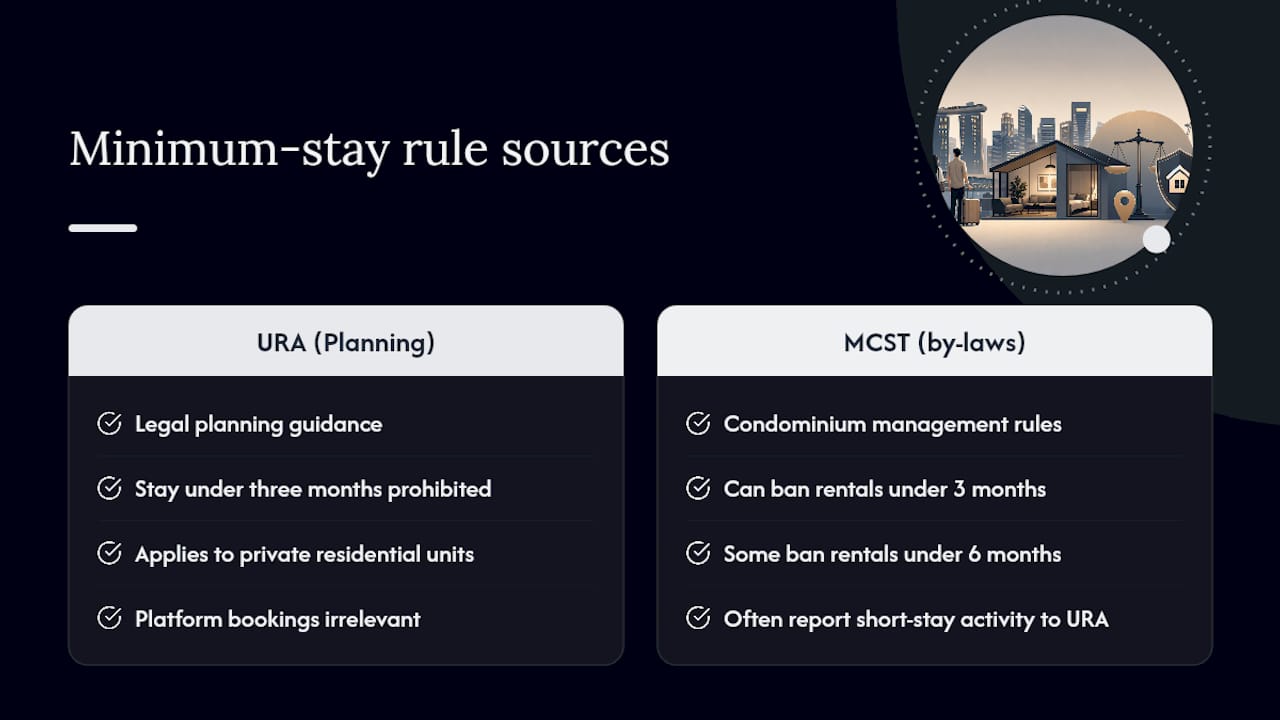
The three-month rule is not a guideline you can negotiate around. Under URA’s short-term accommodation guidance, any stay of less than three consecutive months at a private residential property counts as short-term accommodation, and that use is not permitted under the Planning Act. The rule applies to condominiums, landed houses, and any residential unit zoned for long-term living, regardless of what the listing platform allows you to book.
This is where a lot of owners get confused. Airbnb’s booking engine will happily let a guest reserve four nights in a Sentosa Cove bungalow or a River Valley condo. The platform’s willingness to process that booking has nothing to do with whether it is lawful. A legal commentary from IRB Law makes this distinction plainly: Airbnb itself is not banned in Singapore, but the specific use it enables, letting a private unit for a few days at a time, frequently violates the minimum-stay rule attached to the property.
Building by-laws add a second layer most first-time hosts overlook. Even if a unit technically sits within a zoning category that allows longer-term rental, the condominium’s Management Corporation Strathmore Title (MCST) can impose its own restrictions through house rules, and many do. It is common for MCST by-laws to explicitly forbid any rental under three months, sometimes under six, specifically because MCSTs are often the ones reporting suspicious short-stay activity to URA. A council suspecting a unit is running like a hotel, with rolling suitcases in the lobby and unfamiliar faces every few days, has both the standing and the incentive to flag it. Checking your own lease or the property’s Certificate of Statutory Discharge before listing anywhere is the only way to know where you actually stand.
HDB Regulations: The 6-Month Minimum and the Ban on Tourist Rentals
HDB flats face the strictest short-stay regime in Singapore, and there is no version of Airbnb hosting that fits inside it. The minimum rental period for an HDB flat is six consecutive months, and renting to tourists is prohibited entirely, not just discouraged. That single fact answers the frequently asked question of whether HDB flats can run an Airbnb: they cannot, for any stay under half a year, and never for a visitor on a tourist pass.
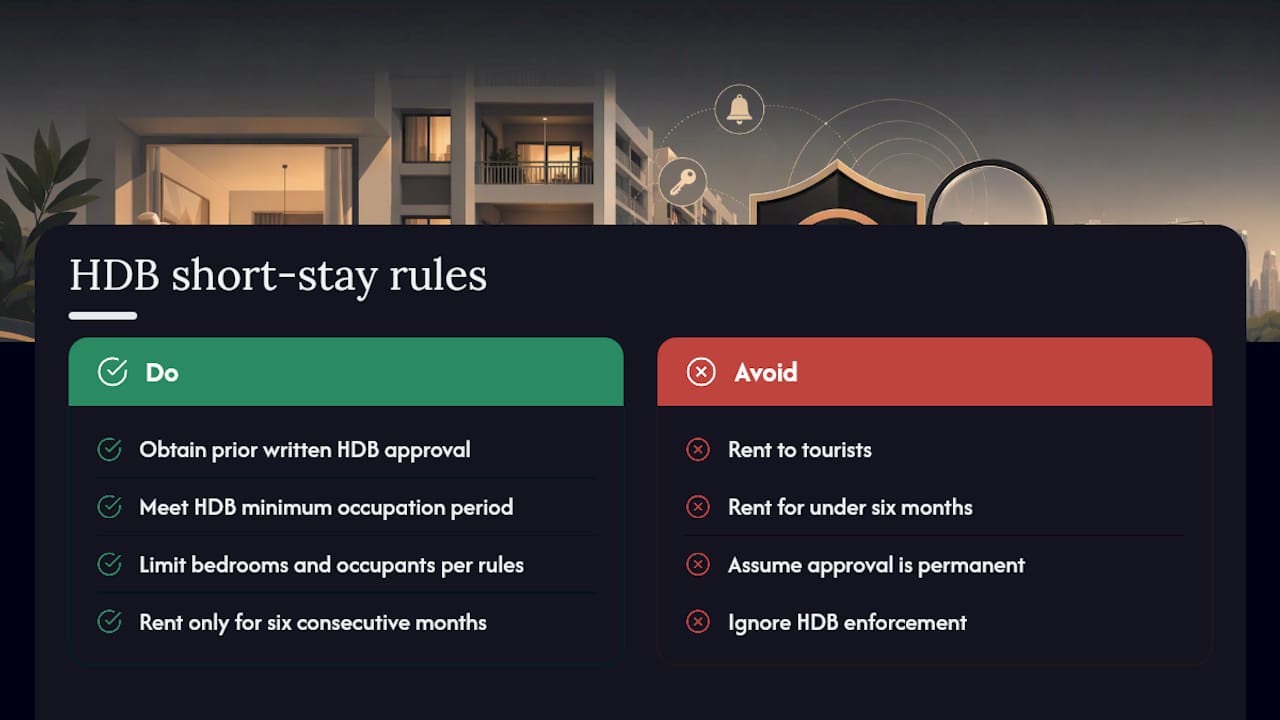
Owners renting out a whole flat need prior written HDB approval, and the flat must have been occupied by the owner for the applicable minimum occupation period before any rental is allowed. Renting individual bedrooms carries its own eligibility conditions, including caps on how many bedrooms can be rented and how many occupants can live in the flat at once, tied to the flat type and the number of bedrooms. Reapplying after approval lapses, or changing tenants, generally means going through the approval process again rather than assuming a blanket permission carries forward indefinitely.
The consequences of ignoring this run deeper than a fine. HDB’s own enforcement framework allows for administrative penalties, and in serious or repeated breach cases, compulsory acquisition of the flat is on the table. That is not a hypothetical scare tactic. It reflects how HDB treats the public housing scheme, meant for long-term residency, as fundamentally incompatible with running a de facto hotel room out of a three-room flat in Toa Payoh or Woodlands.
Penalties and Enforcement: Fines, Court Outcomes, and Flagged Listings
Getting caught is not rare, and the penalties are not symbolic. Breaching the minimum-stay rule for private residential property carries a minimum fine of $5,000 under the Planning Act, and enforcement records show much larger cumulative fines in serious or repeat cases. Courts have shown little patience for owners who treat the fine as a cost of doing business.
Most cases start the same way: a neighbor complains, an MCST council flags irregular traffic, or authorities monitor listings directly. CNA reporting found that dozens of hosts had been fined since 2019, and that illegal short-stay listings kept reappearing on platforms even after enforcement action, showing how persistent the problem is despite active policing.
Guests are not immune from the fallout either. If a listing is flagged mid-stay, guests can face sudden eviction, and in some investigations, they may be asked to give statements about the booking. A cheap week in a condo can turn into a scramble for a same-day hotel room.
Permissions, Approvals, and Building Rules: Steps Hosts Must Take Before Listing
Before a single photo goes up on any platform, confirm three things in writing. Skipping this step is the single most common reason hosts end up fined without realizing they had broken any rule at all.
- Get HDB approval in writing if the property is a flat, covering the exact rental period and occupant count you intend to allow.
- Check MCST by-laws for condominiums, since many explicitly restrict rentals under three or six months regardless of what URA’s baseline permits.
- Review your lease or title deed if you are a tenant subletting, since most tenancy agreements bar subletting entirely without landlord consent.
- Request the property’s occupancy history from the seller or landlord if you are new to the unit, to confirm no existing restriction predates your purchase.
Tenants face an extra hurdle: subletting on Airbnb without landlord permission usually breaches the head lease itself, independent of what URA or HDB says. And no, splitting one long booking into several shorter ones for different guests does not convert an unlawful short-term arrangement into a lawful one. Authorities treat repeated short bookings at the same address as continuous short-term use, not a clever workaround.
Tax and Reporting: Declaring Rental Income and When Business Rules Apply
Rental income from any legal letting arrangement must be declared to IRAS, full stop. That applies whether you are renting a spare room under HDB’s bedroom scheme or leasing out a private condo for six months at a stretch. IRAS treats rental income as taxable, though the exact tax treatment depends on scale, frequency, and whether the activity starts to look like a business rather than passive letting.
If you are renting multiple units, doing it regularly, or bundling in extra paid services like cleaning and check-in concierge, IRAS may assess whether GST registration or business income tax rules apply rather than simple rental income treatment. Keep occupancy logs, tenancy agreements, platform payout statements, and receipts for any related expenses. When your situation sits anywhere near that gray zone, a conversation with a tax adviser costs far less than an incorrect filing.
Practical Compliance Checklist and Dos & Don’ts for Hosts
Run through this before you ever accept a booking, not after a complaint lands.
- Confirm your property type and its exact minimum-stay requirement (three months private, six months HDB).
- Get written approval from HDB or your MCST, whichever applies, before listing anywhere.
- Set occupancy limits and safety equipment (smoke detectors, fire extinguishers) that match your unit’s actual capacity.
- Keep a paper trail: approvals, tenancy terms, and payout records, in case you’re ever asked to prove compliance.
- Disclose any building restrictions directly in your listing description so tenants know what they’re agreeing to.
Two habits get hosts into trouble more than anything else. First, booking the same unit to different guests back-to-back to dodge the minimum-stay threshold, which enforcement treats as continuous short-term use anyway. Second, listing an HDB flat to anyone holding a tourist pass, which is banned regardless of stay length.
Pro Tip: Introduce yourself to your immediate neighbors and your MCST council before you rent out a unit long-term. A five-minute conversation about who’s moving in and for how long heads off the complaint that would otherwise trigger an investigation.
For a fuller walk-through of documentation and approvals, the rental checklist for landlords covers the paperwork side in more depth.
Advice for Guests: How to Check a Listing and What to Do if a Stay Is Disrupted
Before booking anything under three months, ask the host directly whether the unit has HDB or MCST approval for short stays; a host who dodges the question is a warning sign. For anything shorter than the legal minimums, a licensed hotel or serviced apartment is the safer bet, since those operate under proper licenses built for short stays.
Check host verification, review history, and consistency between the listing address and photos. If a stay gets disrupted by an enforcement action, contact the platform’s support line immediately and ask about relocation assistance, since you may be asked to vacate on short notice. Guests who suspect a listing is operating illegally can report it to URA or HDB directly, which helps curb the pattern of repeat offenders documented in recent enforcement sweeps.
Local Expert Perspective: Practical Landlord Fixes and When to Consult
Owners often assume a lease clause or an old approval covers them indefinitely. It usually does not. Some real estate consultancies regularly field questions from landlords who inherited an ambiguous tenancy agreement or bought a unit without checking its rental history first.
The consultancy work that helps most in these cases is unglamorous: reviewing lease covenants line by line, walking owners through the HDB approval process step by step, and setting up a simple recordkeeping system before the first tenant moves in. One recurring pattern: an owner assumes their MCST allows six-month rentals because a neighbor does it, only to discover the by-laws were quietly tightened after a complaint. Confirming current rules before listing saves far more than it costs. If you’re unsure where your property stands, the property leasing guide is a solid starting point before any conversation with a consultant.
— Aman
Clarification on Short-Term Rental Rules for Foreign Property Owners
Foreign ownership does not change the minimum-stay math. A foreigner who owns a private condominium in Singapore is bound by the same three-month URA minimum as any citizen or permanent resident, and the same MCST by-laws apply regardless of where the owner lives. The distinction that matters more is property type, not nationality: foreigners generally cannot own HDB flats at all, so the six-month HDB rule and its tourist-rental ban are largely moot for that group, but they apply fully to any foreign-owned landed house or condo unit that falls under private residential rules.
Where foreign owners run into trouble more often is distance-related oversight. Managing a Singapore rental from overseas makes it harder to catch an MCST by-law change or notice a property agent quietly booking short stays without full disclosure. Appointing a local managing agent or consultant who checks approvals directly with the MCST and, where relevant, with URA, closes that gap. Any foreign owner planning to lease out a Singapore property, whether for one year or as a rotating short-stay unit, should treat the written approval and by-law check as mandatory before signing on with any management arrangement, not as an optional extra once problems surface. The rules protecting residential character apply exactly the same way to a unit owned in Singapore by someone based in London, Sydney, or Jakarta.
Recent Regulatory Changes and What Might Come Next
The core framework, three months for private property, six months for HDB, has held steady for years, but enforcement intensity has clearly increased. CNA’s reporting on hosts fined since 2019 shows authorities are not treating this as a one-time crackdown but as an ongoing enforcement priority, with new cases surfacing regularly even after earlier convictions.
What has shifted is the tooling behind enforcement. MCSTs are more organized about reporting irregular traffic patterns, and platform takedown requests have become a more routine part of the process rather than a last resort. Whether Singapore eventually creates a licensed short-term rental category, the way some cities have carved out limited legal Airbnb zones, remains an open question. There is no current indication that URA or HDB is moving toward that model. If anything, the persistence of illegal listings despite years of fines suggests regulators see the existing deterrents as insufficient, which raises rather than lowers the odds of tighter enforcement ahead. Hosts weighing a short-stay strategy today are better off assuming the rules get stricter, not more permissive, over the next few years.
Distinction Between Landed Houses, Condos, and Their Short-Term Rules
All private residential property shares the same baseline: a three-month minimum stay under URA. But how that rule bites in practice differs sharply between landed houses and condominiums.
A landed house, a bungalow, semi-detached, or terrace, has no MCST and no shared council imposing additional by-laws. The three-month URA rule is the only formal constraint, though residential estate management guidelines or, in some gated estates, a residents’ association charter can still create informal pressure against short stays. Condominiums carry a second layer entirely: the MCST, which can and often does impose its own stricter rules through building by-laws, sometimes banning anything under six months even though URA’s floor is three. That means two condo units in the same district can have completely different legal minimum stays, purely based on what each building’s council has voted into its house rules.
This is why checking “the Singapore rule” in isolation is not enough. A prospective host needs to check both layers, the statutory URA minimum and whatever the specific building’s MCST has layered on top, before assuming a three-month letting arrangement is automatically fine. Landed-house owners have one rulebook to satisfy; condo owners effectively have two.
Risks and Liabilities for Guests Staying in Illegal Rentals
Booking an illegal short-term rental is not just a host’s problem. Guests staying in a flagged unit can face abrupt eviction mid-stay, sometimes with little notice if enforcement action or a neighbor complaint triggers an inspection. That leaves a traveler scrambling for last-minute accommodation, often at a higher price than they would have paid for a licensed hotel in the first place.
There is also an evidentiary risk. Guests may be asked to provide statements or booking details if authorities investigate the host, which can mean lost time and an uncomfortable process even when the guest did nothing wrong beyond booking through a normal-looking listing. Insurance and liability protections that apply to licensed hotels and serviced apartments, fire safety compliance, verified emergency exits, accountable management, generally do not apply to an unlawful short-term unit in the same way, since the property was never meant to operate under those standards. Choosing a licensed hotel or serviced apartment for any stay under the legal minimums removes this risk entirely, and it is usually the more comfortable and better-insured option regardless.
When Professional Help Saves Time and Legal Risk
Hiring a consultant makes sense once your situation stops being simple. A single spare room in a flat you fully own is one thing. A multi-unit portfolio, an inherited lease with unclear subletting terms, or an HDB approval application you’re not confident about filing correctly, those are different problems entirely, and getting them wrong costs more than any consultation fee.
What a good local consultant actually delivers is unglamorous but valuable: checking your specific lease or by-laws against current rules, walking you through the HDB or MCST approval paperwork step by step, and flagging when a tax question needs a referral to a qualified adviser rather than a guess. If any of that sounds like your situation, the next section walks through how to get that kind of help directly.
How Aesthetic Havens Can Help You Get It Right
Getting Airbnb rules wrong in Singapore is rarely a knowledge problem. It is a paperwork and verification problem, and that’s exactly where a lease review or an approval walk-through earns its keep instead of a fine notice. Certain real estate consultancies offer services focused on practical compliance work: checking lease covenants, navigating HDB and MCST approvals, and helping landlords with recordkeeping that holds up if questions arise.
Beyond compliance questions, the same consultancy supports the bigger decisions that tend to follow: whether to keep renting long-term, sell into a strong market, or reposition a property entirely as part of a wider portfolio. If you’re weighing whether a unit is even worth the hassle of short-term hosting versus a straightforward long lease or sale, the real estate consultancy and valuation services page is the place to start. For landlords further along in the process, the essential landlord roles guide breaks down what ongoing management actually involves. Reach out through the site to book a consultation before you list, not after a complaint lands.
This article is general information, not a substitute for advice from a qualified lawyer. Consult a qualified legal professional about your own circumstances before acting on anything here.
Sources
- Short-Term Accommodation | Urban Redevelopment Authority (URA)
- Regulations for renting out flats | HDB
- Telescope transcript (enforcement / case example)
- Inland Revenue Authority of Singapore (IRAS)
FAQ
Why Is Airbnb Banned in Singapore?
Airbnb itself is not banned. The short-term letting it enables often breaches the minimum-stay rules attached to the property, three months for private residential units under URA and six months for HDB flats, which is why so many listings turn out to be unlawful.
What Is the 80/20 Rule for Airbnb?
There is no official rule in Singapore’s short-term rental regulations matching that description. Hosts should rely on the actual three-month and six-month minimums instead.
Can HDB Flats Do Airbnb?
No. HDB requires a minimum rental period of six consecutive months and prohibits renting to tourists entirely, so no version of a short Airbnb stay is legal in an HDB flat regardless of approval status.
What Are the Rules for Staying at an Airbnb in Singapore?
Guests should confirm the listing meets the applicable minimum stay, three months for private property, six months for HDB flats, and note that tourist stays in HDB flats are banned outright. Booking a licensed hotel or serviced apartment is the safer, fully legal option for anything shorter.
What Happens if a Host Is Caught Breaking These Rules?
Breaching the private-property minimum stay carries a fine starting at $5,000 under the Planning Act, with larger fines in serious or repeat cases. HDB breaches can lead to administrative penalties and, in extreme cases, compulsory acquisition of the flat.


