


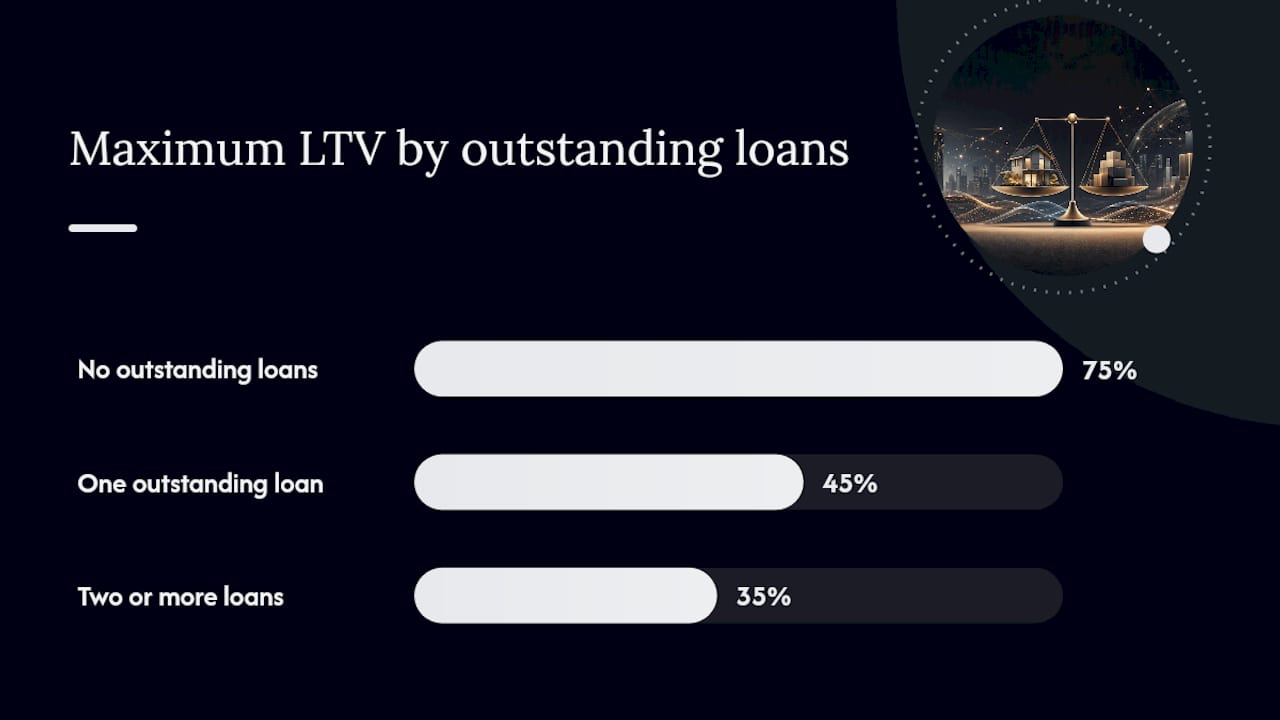
Most private property buyers with no outstanding home loan can borrow up to 75% of the purchase price or valuation, whichever is lower, while HDB loans follow the same 75% cap after HDB’s August 2024 change. That figure drops to 45% with one outstanding home loan and 35% with two or more. Loan tenure past 30 years, a borrower’s age at loan maturity past 65, and any gap between purchase price and valuation can all push your actual borrowing limit lower than the headline number.
TL;DR:
- Borrowers with no existing loans can access up to 75% LTV, but this drops to 45% with one outstanding home loan and 35% with two or more.
- Loan tenures exceeding 30 years or maturity age past 65 can lower LTV limits and increase minimum cash down payments.
- The actual loan amount is also limited by TDSR and MSR ratios, which can restrict borrowing before LTV caps are reached.
- Valuation gaps outside the agreed purchase price require buyers to cover the difference in cash, often catching overbidders unprepared.
- Knowing your loan profile and obtaining an approval-in-principle before viewing units helps avoid financing surprises and plan your budget effectively.
Table of Contents
- What Are the Current LTV Limits in Singapore?
- Which Borrower and Loan Profiles Reduce Your LTV?
- Does TDSR or MSR Cap Your Loan Before LTV Does?
- HDB Loans, Corporate Buyers, and the Valuation Gap
- Planning Your Financing Around LTV: A Consultant’s View
- What Regulatory Changes Could Affect LTV Next?
- What Happens If You Exceed the LTV Limit?
- How LTV Plays Out in Real Purchase Scenarios
- Why the LTV Conversation Usually Starts in the Wrong Place
- Planning Your Purchase Around LTV Rules
- Sources
- FAQ
What Are the Current LTV Limits in Singapore?
The loan to value ratio in Singapore sets the ceiling on how much a bank or HDB will lend against a property, with the rest coming from cash and CPF savings. The number of outstanding housing loans you already carry is the single biggest lever on which tier you land in.
Here’s how the tiers break down for individual borrowers, based on MAS’s official LTV and tenure guidance:
| Outstanding housing loans | Maximum LTV | Minimum cash downpayment |
|---|---|---|
| None | 75% | 5% |
| One | 45% | 25% |
| Two or more | 35% | 25% |
Loans with a tenure over 30 years, or where the borrower’s age at loan maturity exceeds 65, get a lower LTV band: 55% with no outstanding loan, 25% with one, and 15% with two or more. Minimum cash also rises to 10% in that lower tier for a first loan.
HDB loans historically sat below bank loans in some scenarios, but HDB’s August 2024 measures aligned the standard HDB loan LTV to 75%, closer to the bank loan ceiling, as part of a package aimed at easing pressure on first-time buyers.
One rule trips up more buyers than any other: LTV is calculated on the lower of purchase price or valuation, never the higher figure. If you agree to pay above the bank’s or HDB’s valuation, that entire gap, often called cash-over-valuation, has to be covered in cash. A $600,000 valuation on an $650,000 purchase means the $50,000 difference is your problem, not the bank’s.
Which Borrower and Loan Profiles Reduce Your LTV?
Your LTV tier isn’t fixed by property type alone. It moves with your loan history, your age, and how the loan is structured. A few patterns come up constantly in practice.
- First-time buyer, no existing home loan. You typically qualify for the top tier: 75% LTV, 5% minimum cash. This is the easiest profile to work with and the one most first-time buyers assume applies to everyone.
- Buying a second property while still servicing one loan. Your LTV on the new purchase drops to 45%, and minimum cash jumps to 25%. This catches upgraders off guard when they assume their strong income will carry the same borrowing power as before.
- Third property or more. The ceiling falls to 35%, with 25% minimum cash, regardless of income strength.
- Older borrowers or long tenures. If you’re 55 and taking a 30-year loan, you’ll hit the maturity age past 65 rule, dropping you into the lower LTV band even on a first loan.
- Joint applications with an age gap. Banks average or otherwise weight joint borrowers’ ages for the maturity calculation, so pairing a younger co-borrower can sometimes preserve tenure and keep LTV in the higher tier.
The practical takeaway: check your outstanding loan count and your age against loan maturity before you fall in love with a listing, not after.
Does TDSR or MSR Cap Your Loan Before LTV Does?
LTV tells you the maximum the bank will lend against the property’s value, but two separate income tests decide whether you can service that loan at all. Both can bind before LTV ever becomes the limiting factor.
- TDSR (Total Debt Servicing Ratio) caps all your monthly debt obligations, including the new mortgage, at 55% of gross monthly income, and banks apply a stress-test interest rate well above the actual rate you’ll pay.
- MSR (Mortgage Servicing Ratio) applies only to HDB flats and executive condominiums bought directly from developers, capping mortgage repayments alone at 30% of gross monthly income.
55% is the TDSR ceiling MAS applies across all bank housing loans in Singapore, using a stress-tested interest rate rather than your actual contracted rate.
Here’s where it gets counterintuitive: a buyer with plenty of cash for a 75% LTV loan can still get rejected if their existing car loan and credit card balances push total obligations past the 55% TDSR line. HDB concessionary loans use a different, more conservative interest assumption than bank stress tests, which is why the same buyer sometimes qualifies for an HDB loan but not a bank loan on the identical flat.
HDB Loans, Corporate Buyers, and the Valuation Gap
A few operational details change how much upfront cash a purchase actually requires, and they trip up buyers who only read the LTV percentage.
- HDB concessionary loans used a fixed interest assumption and, before August 2024, capped some cases below bank loans. The 2024 adjustment brought the standard HDB loan LTV to 75%, giving first-time flat buyers more borrowing room without raising their cash outlay.
- Corporate or shell company purchasers face a flat 15% LTV limit regardless of the buyer’s outstanding loan count, and companies cannot use CPF funds at all since CPF is a personal retirement scheme tied to individual members.
- Valuation gaps force the buyer to bridge the difference in cash. If you agree on $1.05 million for a flat valued at $1 million, that $50,000 gap sits outside the loan entirely.
- Downpayment composition for a first loan splits into 5% cash and 20% from cash or CPF Ordinary Account savings, subject to the CPF valuation limit that caps how much OA money can go toward the property.
Pro Tip: Ask your bank or HDB for the valuation before you finalize your offer price. A $30,000 to $50,000 valuation gap is common in a hot resale market, and knowing it early lets you renegotiate instead of scrambling for cash at the last minute.
Planning Your Financing Around LTV: A Consultant’s View
Getting an Approval-in-Principle or an HDB Flat Eligibility letter before you start viewing units tells you your real borrowing ceiling, not the one you assume based on a rough calculation. It also signals to sellers that you’re a serious buyer, which matters in a competitive resale market.
A few tactics that consistently help clients navigate LTV constraints:
- Get your AIP or HFE letter first, then set your search budget around the actual number, not the listing price you like.
- If you’re planning a second property, work out whether repaying or refinancing your first loan before the new purchase restores you to the higher 75% LTV tier.
- Gather income documents, CPF statements, and existing loan statements before your first bank meeting so the assessment moves faster.
- Talk to a professional early if your age, tenure, or existing loan count puts you near a tier boundary. Small timing adjustments can shift which LTV band you land in.
Our guide to Approval-in-Principle in Singapore walks through exactly what documents to prepare and how long the process typically takes.
What Regulatory Changes Could Affect LTV Next?
The August 2024 HDB adjustment wasn’t an isolated tweak. It came bundled with wider measures aimed at cooling the resale market and giving first-time buyers more room, including changes to the Enhanced CPF Housing Grant and resale flat eligibility conditions. MAS and HDB have both shown a pattern of adjusting LTV, TDSR stress-test rates, and grant amounts in response to resale price growth rather than leaving them static for years at a time.
Watch two things going forward. First, MAS periodically reviews the stress-test interest rate used in TDSR calculations, and any increase tightens borrowing capacity even if LTV percentages stay the same. Second, HDB has signaled ongoing attention to resale price trends, which means further adjustments to loan quantum, grants, or eligibility conditions for larger flats remain plausible if price growth reaccelerates.
For investors weighing timing, the practical lesson from the 2024 change is that LTV rules move in response to market conditions, not on a fixed schedule. A buyer who assumes today’s tiers will hold indefinitely risks planning a purchase around numbers that shift before they close. Our breakdown of property cooling measures and their practical effects covers how these adjustments typically ripple through financing timelines for both HDB and private buyers.
What Happens If You Exceed the LTV Limit?
You can’t actually exceed the LTV limit and still get the loan disbursed. Banks and HDB calculate your maximum loan quantum against the lower of price or valuation before approval, so an application that assumes a higher LTV than your profile allows simply gets adjusted down or rejected outright.
The real consequence shows up in cash planning, not penalties. In a resale transaction, that shortfall can mean forfeiting your option fee if you can’t complete the purchase, since the standard HDB and private resale contracts don’t excuse a buyer for miscalculating financing.
Banks also reassess LTV eligibility at valuation and again before disbursement. A change in your loan count, a new joint borrower, or a valuation that comes in lower than expected between OTP signing and completion can all shift your approved quantum downward late in the process. This is why serious buyers get an AIP or HFE letter that reflects their actual profile before making an offer, rather than relying on a general assumption about what LTV should apply to their situation.
There’s no regulatory fine for miscalculating your own LTV eligibility. The cost is entirely commercial: a lost deposit, a delayed completion, or a scramble for last-minute cash or a smaller property than planned.
How LTV Plays Out in Real Purchase Scenarios
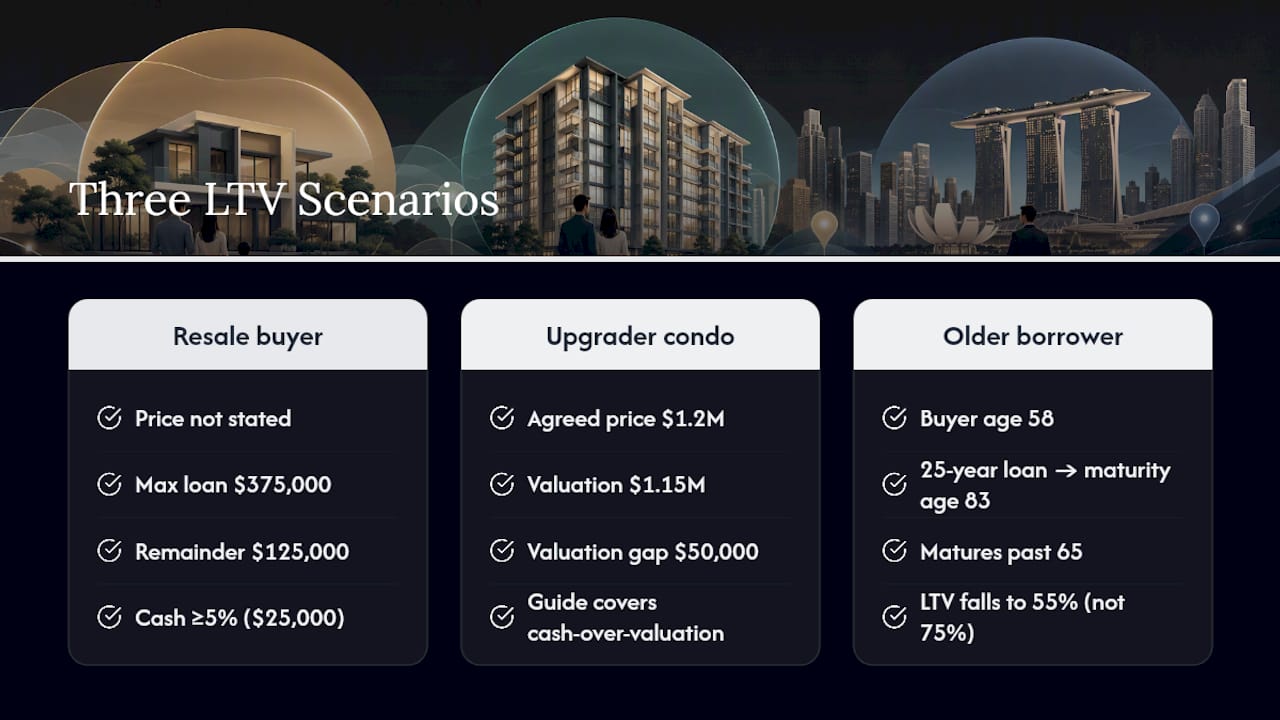
That’s a $375,000 maximum loan, leaving $125,000 to cover through cash and CPF OA, with at least 5% of the price, or $25,000, required in cash and the rest drawn from OA up to the valuation limit.
Compare that to an upgrader buying a $1.2 million condo while still servicing a loan on their current HDB flat.
Now add a valuation gap. Say that same condo is valued at $1.15 million but the buyer agrees to pay $1.2 million. This is the scenario our guide to HDB cash-over-valuation breaks down in more detail, since it’s one of the most common budgeting surprises in resale transactions.
A third scenario worth noting: a 58-year-old buyer taking a 25-year loan on a first property hits age 83 at maturity, well past 65, dropping them into the lower LTV band of 55% instead of 75%, even though it’s their first loan.
Why the LTV Conversation Usually Starts in the Wrong Place
Most people ask “what’s the maximum LTV I can get” when the more useful question is “which tier am I actually in, and can I move up.” The rules themselves are simple enough. What trips buyers up is treating LTV as a single fixed number instead of a profile-dependent outcome that shifts with loan count, age, and tenure.
The advice that circulates most, get your financing sorted before you shop, is right but incomplete. The sharper version: know which LTV tier you’re in before you even start comparing listings, because that number determines your realistic price range, not the other way around. Buyers who reverse this order end up emotionally attached to a unit they can’t actually finance at the terms they assumed.
If there’s one underrated move in this whole system, it’s the timing tactic around repaying an existing loan before buying a second property. That’s not a footnote. That’s the entire budget.
— Aman
Planning Your Purchase Around LTV Rules
Once you know your LTV tier, the next question is whether your numbers actually work, and that’s where a second set of eyes helps more than another calculator. Professional advisors often work through your loan profile, valuation expectations, and cash position before you make an offer, not after you’ve already signed an option and discovered a shortfall.

Experienced real estate consultants combine hands-on financing preparation, AIP and HFE guidance, and valuation support with portfolio thinking that matters if this isn’t your last property purchase. Whether you’re buying your first flat, upgrading with an existing loan still active, or structuring a second purchase to preserve a higher LTV tier, getting the sequence right before you shop saves you from a cash crunch at completion. Browse current listings on the residential and commercial property page or reach out through the Aesthetic Havens homepage to map out your financing plan before your next offer.
Sources
- Loan Tenure and Loan-to-Value Limits (MAS)
- Measures to cool the HDB resale market and provide more support for first-time home buyers (HDB)
- Home purchase planning (CPF)
FAQ
What Is an LTV Limit?
An LTV limit is the maximum percentage of a property’s purchase price or valuation, whichever is lower, that a bank or HDB will lend you. In Singapore, that ceiling depends mainly on how many outstanding housing loans you already have, ranging from 75% with none to 35% with two or more.
What Is the Lowest LTV You Can Get?
Corporate or shell company purchasers face an even lower flat limit of 15% regardless of how many loans they hold.
What Is the Maximum LTV Allowed?
The maximum LTV allowed in Singapore is 75%, available to individual borrowers with no outstanding housing loan, on both bank loans and HDB loans following HDB’s August 2024 adjustment.
Can I Get a Loan Up to Age 75?
You can, but it will typically reduce your LTV tier rather than block the loan outright.
How Does TDSR Affect My LTV-Approved Loan Amount?
TDSR caps your total monthly debt obligations at 55% of gross income using a stress-tested interest rate, and it can limit your actual loan quantum even when LTV would allow more. This is why two buyers with identical LTV eligibility can qualify for very different loan amounts based on their existing debt.


