


Yes, most tenancy agreements in Singapore must be stamped, and the tenant is typically the one who pays. The headline rate is 0.4% of the total rent for leases of four years or less, calculated on the Average Annual Rent, and 0.4% of four times the AAR for longer or indefinite leases. You stamp it electronically through IRAS’s myTax Portal within 14 days of signing in Singapore, or 30 days if the agreement was signed abroad.
TL;DR:
- Tenancy agreements with unusual rent structures, such as premiums or rent-free periods, require careful review to determine if duty shifts into buyer’s stamp duty territory.
- Duty is calculated on the higher of the contract rent or market rent, with duty for leases over four years based on four times the Average Annual Rent, rounded down to the nearest dollar.
- The tenant is usually responsible for stamping the agreement within 14 days in Singapore or 30 days if signed abroad, to avoid penalties and ensure enforceability in court.
- Electronic records like emails can trigger stamp duty if used to conclude the tenancy, and all related variations or amendments need separate stamping to avoid gaps.
- Landlords should verify the stamp certificate and keep copies throughout the tenancy, as unstamped agreements are legally weaker in disputes and may hinder evidence or tax deductions.
Table of Contents
- What Rental Stamp Duty Covers in Singapore
- How to Calculate Stamp Duty: Rates, AAR, and Worked Examples
- Who Actually Pays Rental Stamp Duty in Singapore
- Deadlines, Penalties, and the Property Tax Connection
- How to E-Stamp a Tenancy Agreement on myTax
- Renewals, Rent Changes, and Lease Variations
- The Practical Checklist Before You Hand Over the Keys
- Why Stamping Actually Protects You, Not Just IRAS
- Getting Your Tenancy Paperwork Right the First Time
- Sources
- FAQ
What Rental Stamp Duty Covers in Singapore
Stamp duty is a tax on specific legal documents tied to immovable property, not on the rental transaction itself. A tenancy agreement only becomes chargeable once it exists as a document, whether that’s a formal printed lease or something looser. IRAS has been explicit that electronic records like emails or WhatsApp exchanges can count as chargeable documents if the tenancy is actually concluded through that medium, which surprises a lot of first-time landlords who assume only signed PDFs matter.
Several categories of tenancy paperwork fall under this rule beyond the initial lease itself. A novation, an assignment of an existing lease, a variation agreement that changes rent or term, and a surrender of lease where money changes hands can all trigger duty separately from the original contract.
Whether a lease is “chargeable” comes down to its terms: the rent structure, the length of the term, and whether a premium (an upfront lump sum, distinct from rent) is involved. A straightforward monthly-rent lease is taxed differently from one with a large premium attached, which shifts partway into Buyer’s Stamp Duty territory rather than pure lease duty. Getting this distinction right matters before you even start computing what you owe, and it’s one reason agreements with unusual rent structures, like graduated rent or rent-free periods, deserve a second look before signing.
How to Calculate Stamp Duty: Rates, AAR, and Worked Examples
The core concept you need to understand is Average Annual Rent, or AAR. IRAS calculates duty on whichever is higher: the rent stated in your contract, or the prevailing market rent for a comparable unit. This stops landlords and tenants from under-declaring rent on paper to shrink the duty owed.
The rate table itself is short:
- If the AAR is $1,000 or less, the lease is exempt from duty entirely.
- For leases of four years or less, duty is 0.4% of the total rent for the whole lease period.
- For leases longer than four years, or with no fixed end date, duty is 0.4% of four times the AAR.
- The final figure is always rounded down to the nearest dollar, with a $1 minimum duty payable.
What counts toward AAR: service charges, maintenance fees, furniture and fittings rent, and any additional rent components baked into the agreement. What’s excluded: GST. This inclusion rule catches people off guard when a lease bundles a hefty “furniture and fittings” fee into the monthly rent to make the base rent look lower. IRAS still counts it. For readers unsure which rent components belong in the calculation, it helps to first understand how gross and net leases treat these charges differently.
Pro Tip: If your agreement bundles utilities, cleaning, or a maid’s fee into one lump “rent” figure, break it out before you calculate. Some of those components count toward AAR and some don’t, and getting this wrong is the single most common reason a self-calculated duty figure doesn’t match what myTax generates.
Here are two worked examples using IRAS’s own rate structure:
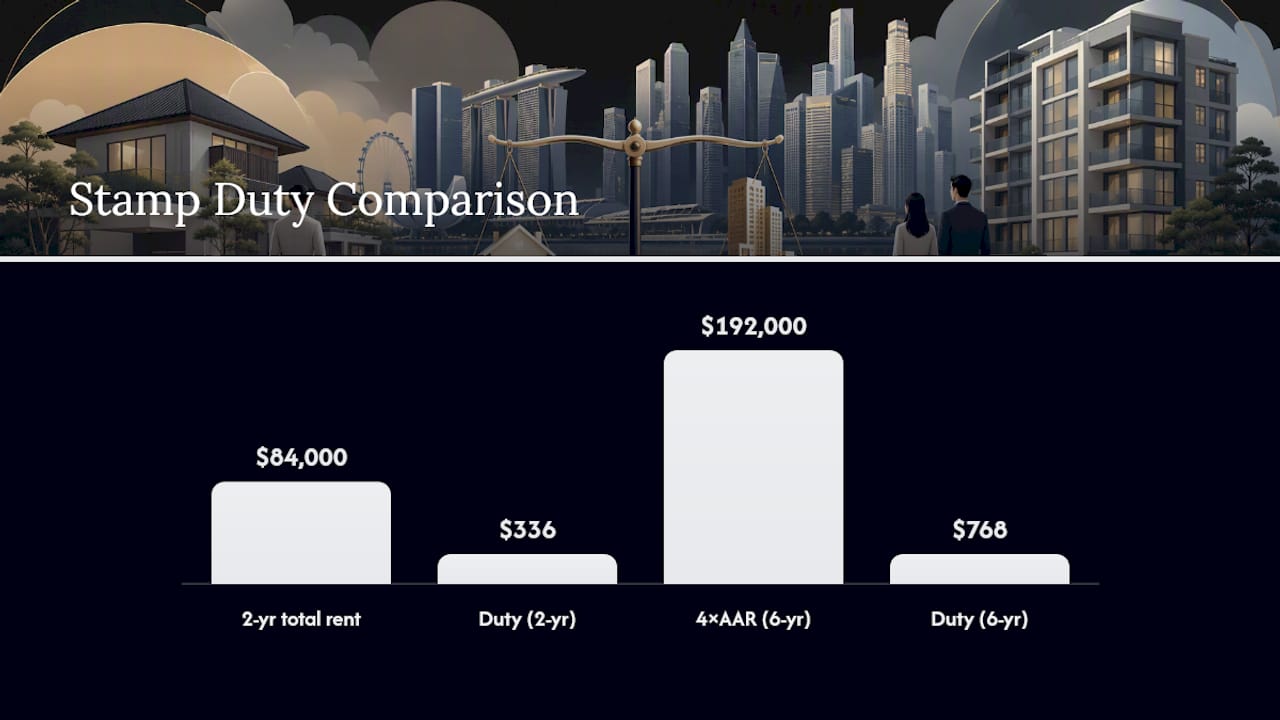
Example A: 2-year lease. Monthly rent is $3,500, with no other charges. Total rent over 24 months is $84,000. Since the lease is under four years, duty is 0.4% of $84,000, which comes to $336.
Example B: 6-year lease. Monthly rent is $4,000, and AAR works out to $48,000 (annual rent, since no premium or variable components apply). Because the lease exceeds four years, duty is 0.4% of 4 times AAR: 0.4% of $192,000, which equals $768.
If your lease has unusual terms, IRAS’s MSD Calculator on myTax handles edge cases like staggered rent or mixed-use premises far more reliably than doing it by hand.
Who Actually Pays Rental Stamp Duty in Singapore
The tenant is normally liable for stamping a tenancy agreement, though the contract can allocate the cost differently if both parties agree in writing. This is a default position, not a legal mandate carved in stone, so always check the specific clause in your lease before assuming who’s on the hook.
Because liability sits with the tenant by default, landlords have real incentive to confirm the job actually got done. An unstamped agreement is still legally binding between the parties, but it can’t be used as evidence in court proceedings until the duty (plus any penalty) is paid retroactively. That’s a real problem if a dispute over deposit deductions or early termination lands you in front of a Small Claims Tribunal.
- Landlords should request a copy of the stamp certificate from the tenant as standard onboarding practice.
- Tenants should keep their own copy of the certificate and the Document Reference Number, not just the stamped PDF.
- Both parties should retain copies for at least the duration of the tenancy plus a reasonable buffer, since disputes can surface after move-out.
Pro Tip: Don’t rely on your tenant’s word that “it’s been stamped.” Ask for the actual certificate PDF, and check the Document Reference Number matches the agreement’s terms. It takes thirty seconds and saves you from discovering a gap months later.
One overlooked detail: landlords may be able to claim stamp duty as a deductible expense against rental income when it’s incurred specifically to obtain a tenant, alongside agent’s commission and advertising costs. That’s worth flagging to your accountant at tax time.
Deadlines, Penalties, and the Property Tax Connection
Timing is not flexible. You have 14 days to stamp a tenancy agreement if it was signed in Singapore, or 30 days if it was signed overseas, counted from the date the document is received in Singapore. Miss that window and you’re exposed to penalties on top of the duty itself.
- Signed in Singapore: stamp within 14 days of execution.
- Signed overseas: stamp within 30 days of the document’s receipt in Singapore.
- Late stamping can trigger a fine of up to $5,000, plus interest on the outstanding duty.
- IRAS can and does follow up on unstamped agreements flagged through other reporting channels.
The practical upside of stamping through myTax is that it does double duty, literally. When you stamp a lease electronically, IRAS is automatically notified for property tax purposes, so landlords don’t need to separately report that a unit is now tenanted. That single action closes out both obligations at once, which is easy to miss if you’re used to thinking of stamp duty and property tax as two unrelated chores.
Pro Tip: If you’re a landlord managing several units, build the 14-day clock into your onboarding checklist the same day the lease is signed, not the day rent starts. Those two dates are rarely the same, and that gap is where late-stamping penalties quietly happen.
How to E-Stamp a Tenancy Agreement on myTax
Stamping is done entirely online, and the process itself takes minutes once you have the right details on hand.
- Sign in to myTax Portal using Singpass, Singpass Foreign user Account (SFA) for foreigners without Singpass, or an SD Account for those without either.
- Select the e-Stamping service for lease or tenancy documents and enter the property address, lease start and end dates, monthly rent, and any additional rent components (service charge, furniture, and so on).
- Review the system-generated Document Reference Number and the payable duty amount, which IRAS calculates automatically once you’ve entered the lease terms correctly.
- Make payment through the portal using the available payment methods.
- Download the stamp certificate, which is issued immediately upon successful payment and serves as your proof of stamping.
Pro Tip: Double-check the lease period field before you submit. A common error is entering the tenancy start date but forgetting to adjust for a rent-free fitting-out period, which throws off the AAR calculation and either overcharges or undercharges the duty owed.
Three mistakes trip people up repeatedly. First, under-declaring additional rent, like leaving out a furniture fee, because it makes the number look smaller, not realizing IRAS can query the figure against market rates. Second, forgetting that a variation or supplemental agreement needs its own stamping if it changes rent or term, not just the original lease. Third, using the wrong lease duration in the AAR field when a tenancy has an option to renew baked into the original contract.
Renewals, Rent Changes, and Lease Variations
Not every change to a tenancy triggers fresh duty, and knowing which ones do saves you from either overpaying or getting caught out later.
- Rent increases or lease extensions during the tenancy generally require additional duty, calculated on the incremental value.
- Rent decreases or shortened lease periods typically don’t require additional duty, though the specific circumstances matter, so check with IRAS if your situation is unusual.
- Variation or supplemental agreements that change the rent or term need to be stamped in their own right, separate from the original lease. Skipping this step is one of the most common gaps found in tenancy files during disputes.
- Premiums and lease surrenders involving payment can shift the transaction toward Buyer’s Stamp Duty territory rather than standard lease duty, since a premium functions more like a purchase price than rent.
If your lease includes a renewal option, treat the renewal as a fresh stamping event once exercised, not an automatic extension of the original certificate.
The Practical Checklist Before You Hand Over the Keys
Before keys change hands, run through a short verification pass rather than assuming everything’s in order because the lease “looks signed.”
- Confirm the stamp certificate exists and matches the correct property address and rent figures.
- Check that every rent component (furniture, service charge, parking) was declared, not just the base monthly figure.
- Verify any signed variation or renewal agreement has its own separate stamp certificate.
- Keep digital and physical copies of everything, filed by tenancy start date.
The most common error isn’t malicious, it’s casual. A tenant and landlord agree to a small rent bump over WhatsApp, shake on it, and never think to stamp that exchange. Under IRAS rules, that electronic thread can itself be a chargeable document. Another recurring slip is landlords assuming the agent handled stamping as part of the tenancy package, when in most cases it’s a separate step the tenant needs to action directly on myTax.
Pro Tip: Agents managing multiple units should keep a simple spreadsheet logging stamp dates, certificate numbers, and renewal trigger dates for every tenancy. It sounds basic, but it’s the single easiest way to catch an unstamped variation before it becomes a dispute six months down the line.
Why Stamping Actually Protects You, Not Just IRAS
Most people treat stamping as paperwork friction, something to rush through so the tenant can move in. In practice, it’s the difference between having a tenancy agreement you can actually use in a dispute and having a document that’s legally toothless in front of a tribunal. I’ve seen enough deposit disagreements and early-termination arguments to know that the party without a properly stamped agreement almost always has the weaker negotiating position, regardless of who’s actually in the right. If your situation involves an unusual rent structure or a premium payment, it’s worth checking directly with IRAS rather than guessing.
— Aman
Getting Your Tenancy Paperwork Right the First Time
Calculating AAR correctly and hitting the 14 or 30-day window sounds simple until you’re juggling a rent negotiation, a signing date, and a tenant asking when they can move in. That’s usually where landlords fall behind.

We work with landlords on tenancy matters including reviewing lease terms before signing, confirming rent components are declared correctly, and making sure supplemental agreements don’t fall through the cracks during renewal season. If you’re onboarding a new tenant or renegotiating an existing lease, our Rental Checklist for Landlords walks through exactly what to verify before handing over keys. Get in touch through Aesthetic Havens to have your tenancy documents reviewed before your next signing.
FAQ
How do I apply stamp duty as a tenant?
Sign in to myTax Portal with Singpass, enter the lease details and rent components, and the system calculates the payable amount automatically. Pay online and download your stamp certificate immediately after.
Is it compulsory to stamp a tenancy agreement in Singapore?
Yes, tenancy agreements are dutiable documents that must be stamped within 14 days of signing in Singapore, or 30 days if signed overseas. An unstamped agreement remains valid between the parties but can’t be used as evidence in court until the duty and any penalty are paid.
What is the formula to calculate stamp duty on a lease?
For leases of four years or less, duty is 0.4% of the total rent for the lease period. For leases longer than four years, duty is 0.4% of four times the Average Annual Rent, rounded down to the nearest dollar with a $1 minimum.
Who needs to pay stamp duty in Singapore?
The tenant is typically liable for lease duty by default, though the tenancy agreement can specify a different arrangement if both parties agree. Landlords should still request proof of stamping to protect their own position in any future dispute.


