


Selling Property Within 1 Year of Purchase: A Full Breakdown of SSD and Real Costs
Selling Property Within 1 Year of Purchase: A Full Breakdown of SSD and Real Costs
The landscape of the Singaporean residential real estate market remains heavily governed by an intricate and meticulously calibrated web of legislative cooling measures, transactional taxes, and punitive financing penalties that are expressly designed to deter speculative activity and completely eradicate short-term capital arbitrage opportunities.
Executing the disposal of a residential property asset within the initial twelve months of its acquisition triggers a devastating cascade of severe financial consequences, fundamentally altering the profitability equation for ambitious investors and vulnerable genuine homeowners alike.
Following the aggressive and highly anticipated recalibration of the Seller’s Stamp Duty (SSD) regulatory regime enacted precisely on the fourth of July 2025, the financial penalties imposed for a rapid market exit have reached unprecedented historical levels, establishing an almost impenetrable formidable barrier against the practice of short-term property flipping1.
This comprehensively structured and exhaustively detailed research report elucidates the complex financial architecture governing early residential property disposals, systematically analyzing the legislative intent behind the massive 16% top-tier Seller’s Stamp Duty, the hidden operational mechanisms of banking mortgage subsidy clawbacks, the steeply progressive structure of non-owner-occupier residential property taxes, and the silent, relentless wealth erosion driven by Central Provident Fund (CPF) accrued interest compounding over time.
The Legislative Evolution and Strategic Intent of Seller’s Stamp Duty (SSD)
The Seller’s Stamp Duty represents the primary and most powerful anti-speculative fiscal mechanism deployed collaboratively by the Ministry of Finance (MOF), the Monetary Authority of Singapore (MAS), and the Ministry of National Development (MND) to definitively safeguard the macroeconomic stability of the domestic residential housing sector2.
Administered efficiently by the Inland Revenue Authority of Singapore (IRAS) under the overarching statutory framework of the Stamp Duties Act 1929, the SSD functions inherently as a highly punitive transaction tax that is explicitly levied on the selling party, calculated stringently upon the higher of the actual transacted sale consideration or the official, independent market valuation of the property at the precise time of its disposal5.
The overarching purpose of this aggressive taxation strategy is to intentionally discourage any form of short-term speculation and rapid flipping within the residential property market by rendering such transactions mathematically unviable4.
The 2025 Paradigm Shift: Reverting to the Stringent Four-Year Regime
In direct response to a sharply documented escalation in the aggregate volume of private residential property transactions exhibiting highly compressed holding periods—most notably observed within the speculative sub-sale market for uncompleted condominium units—the Singapore Government instituted a profoundly aggressive tightening of the overarching SSD legislative framework2.
Becoming legally effective for all residential properties officially acquired on or precisely after the stroke of midnight on the fourth of July 2025, the mandatory statutory holding period required before a property can be sold entirely free of any SSD liability was formally extended from the previously established three years back to an extensive four years1.
Concurrently operating alongside this duration extension, the applicable taxation rates corresponding to each specific tier of the mandated holding period were uniformly elevated by precisely four percentage points across the entire chronological board4.
This surprisingly swift and decisive legislative adjustment essentially resurrected the highly stringent pre-2017 SSD taxation schedule, thereby imposing a formidable and heavily punitive 16% levy on any residential property that is divested within the first twelve months following its initial acquisition6.
The underlying strategic objective motivating this remarkably aggressive policy shift was to instantaneously and permanently neutralise the underlying financial viability of short-term property flipping, intentionally compelling all active market participants to adopt significantly extended long-term investment horizons while simultaneously diminishing the artificial price inflation historically driven by rampant speculative trading activities4.
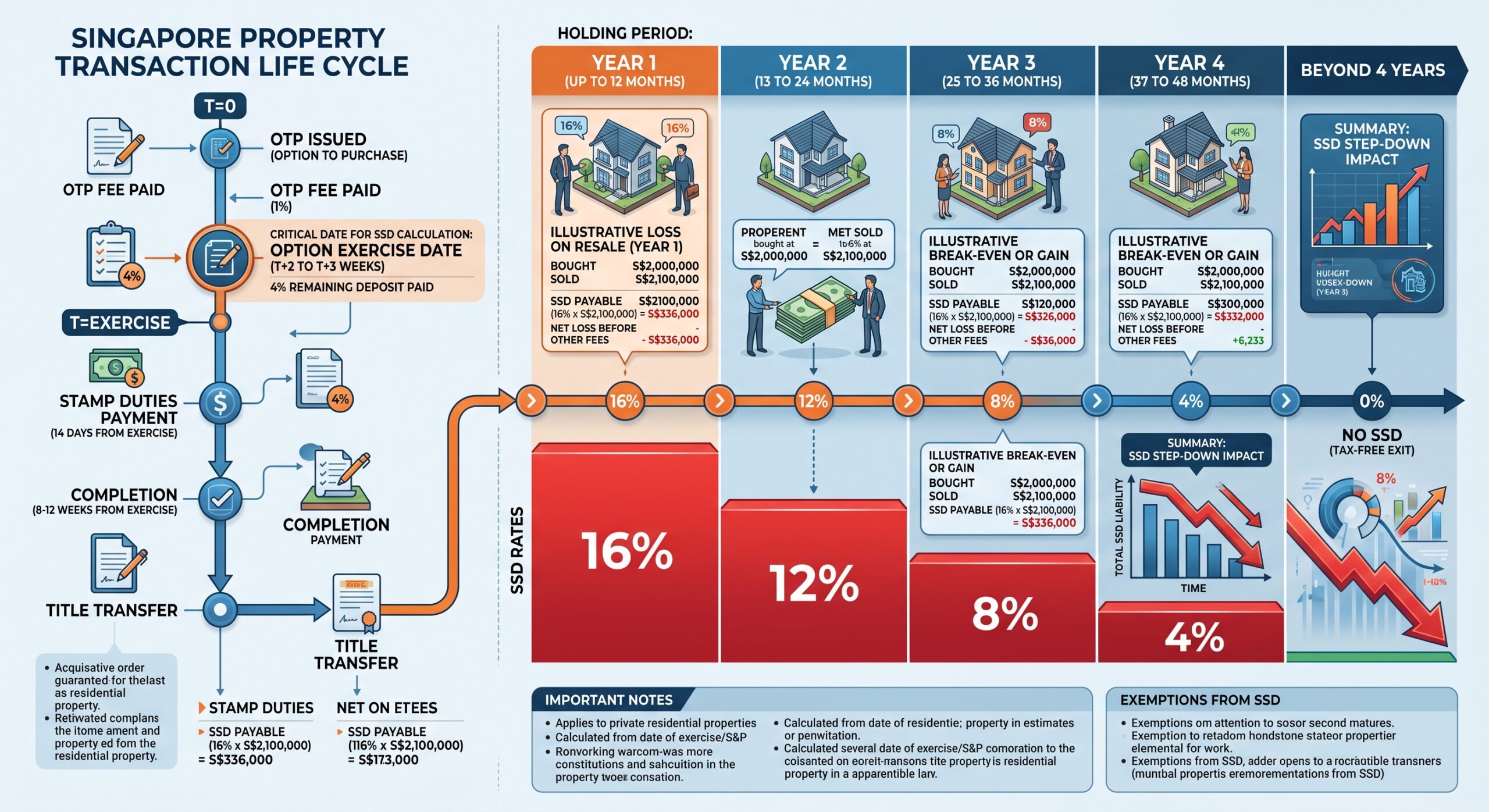
| Holding Period (Calculated accurately from the exact date of official acquisition) | Properties Acquired Between 11 March 2017 and 3 July 2025 (The Superseded 3-Year Regime) | Properties Acquired On or Strictly After 4 July 2025 (The Current Stringent 4-Year Regime) |
| Up to 1 year (Disposal within the initial 12 months) | 12% of the higher of actual sale price or official market value | 16% of the higher of actual sale price or official market value |
| More than 1 year and up to 2 years (Disposal between months 13 and 24) | 8% of the higher of actual sale price or official market value | 12% of the higher of actual sale price or official market value |
| More than 2 years and up to 3 years (Disposal between months 25 and 36) | 4% of the higher of actual sale price or official market value | 8% of the higher of actual sale price or official market value |
| More than 3 years and up to 4 years (Disposal between months 37 and 48) | 0% (Absolutely No SSD Payable under the older regulatory framework) | 4% of the higher of actual sale price or official market value |
| More than 4 years (Disposal occurring strictly after month 48) | 0% (Absolutely No SSD Payable) | 0% (Absolutely No SSD Payable) |
| Table 1: Comprehensive Comparative Analysis of Seller’s Stamp Duty (SSD) Rates detailing the significant legislative transition from the relaxed 2017 regime to the highly stringent 2025 framework.
[cite: 7, 9, 10] |
The Precise Mechanics Governing the Calculation of the Holding Period
The precise and legally binding calculation of the mandated holding period is fundamentally a matter of strict statutory definition, completely and intentionally divorced from physical property construction milestones such as the issuance of the Temporary Occupation Permit (TOP) or the highly anticipated handover of the physical residential keys6.
According to the exhaustive and definitive guidelines established directly by the Inland Revenue Authority of Singapore, the official holding period commences exactly on the recognized date of acquisition, which is legally and contractually defined as the specific date the purchasing party exercises the Option to Purchase (OTP) or formally signs the binding Sale and Purchase (S&P) Agreement6.
Conversely, the chronological holding period concludes definitively on the official date of disposal, which is consistently defined as the exact date the subsequent purchasing party exercises their respective OTP or executes the subsequent legally binding S&P Agreement10.
Executing the sale of a residential property on the 365th day of ownership versus delaying the transaction slightly to the 367th day of ownership can effortlessly result in a massive four-percentage-point differential regarding the applicable tax rate, transforming an otherwise potentially profitable divestment into an absolutely catastrophic liquidity event that destroys accumulated equity6.
Furthermore, the SSD liability is strictly assessed against the entire gross property value rather than being limited merely to the net capital gain achieved, meaning that a massive 16% levy applied to a multi-million dollar asset can easily and quickly exceed the original cash equity injected by the ambitious investor4.
The mandatory payment of the Seller’s Stamp Duty is rigidly enforced by the authorities and must invariably be settled in full cash within a severely tight window of fourteen days following the execution of the sale contract, with potentially devastating late payment penalties that can escalate to reach up to four times the original duty owed under the stringent provisions of the Stamp Duties Act4.
The Speculative Sub-Sale Market Dynamics and Additional Conveyance Duties
The highly volatile sub-sale market, which fundamentally involves the rapid transaction of uncompleted private residential properties prior to the official issuance of the Certificate of Statutory Completion (CSC) or the Temporary Occupation Permit (TOP), was expressly identified by the Ministry of Finance as the primary overarching catalyst responsible for the aggressive July 2025 SSD rate escalations2.
In a standard sub-sale transaction, the original speculative purchaser is effectively and legally selling their highly specific contractual rights embedded within the developer’s original Sale and Purchase Agreement rather than transferring ownership of a physically completed, habitable residential unit13.
During periods characterised by extremely robust market exuberance and unbridled buyer optimism, early-stage purchasers of highly anticipated new launch condominiums frequently and deliberately attempted to capitalise on the significant capital appreciation generated during the multi-year construction phase, seeking to exit their leveraged positions before ever having to assume the full financial burden of conventional, long-term monthly mortgage repayments16.
However, the forceful imposition of the draconian 16% SSD rate within the very first year of ownership, cascading only slightly to a still-punitive 12% in the second year, fundamentally and completely eradicates the lucrative arbitrage opportunities that were traditionally associated with these rapid sub-sale transactions.
An overly aggressive investor attempting to successfully execute a profitable sub-sale transaction within twelve months of the initial project launch must somehow secure an unprecedented, astronomically high price premium from the secondary buyer merely to achieve a basic break-even financial position, a theoretical scenario that remains practically impossible given the indisputable reality that the primary developer typically continues to actively market their remaining uncompleted inventory units at highly competitive and heavily subsidized benchmark prices16.
Consequently, seasoned real estate market analysts confidently project that the newly revised four-year holding period will successfully and permanently normalise the historical frequency of sub-sale transactions, forcefully reorienting the lucrative new launch sector towards attracting genuine owner-occupiers and highly capitalized institutional-grade investors possessing substantial, long-term holding power17.
The Complex Intricacies of Additional Conveyance Duties for Sellers (ACDS)
Operating in strict tandem with the highly publicized revisions applied to the standard SSD legislative framework, the government simultaneously implemented corresponding updates to the highly complex Additional Conveyance Duties for Sellers (ACDS) regime, which heavily impacts corporate entities and intricate trust structures7.
The sophisticated ACDS framework applies specifically to the qualifying sale or strategic transfer of valuable equity interests operating within property-holding entities that primarily own and manage residential properties located within the jurisdiction of Singapore7.
For massive corporate clients heavily involved in complex mergers and acquisitions or engaging in extensive corporate restructuring matters, the extension of the ACDS holding period to a full four years necessitates a fundamental reassessment of all projected transaction timelines, forcing them to meticulously consider the vastly increased stamp duty exposure when strategically planning any form of indirect residential property disposals7.
This powerful legislative maneuver successfully ensures that wealthy investors utilizing elaborate corporate holding structures cannot bypass the punitive intent of the 16% SSD by merely selling the shares of the holding company rather than directly transferring the underlying physical real estate asset itself7.
The Progressive Payment Scheme (PPS) and the OTP to Completion Timeline
Understanding the extreme financial friction associated with a rapid one-year property exit requires a deep, comprehensive comprehension of the standard legal conveyancing timeline and the unique structural mechanics of the Progressive Payment Scheme (PPS) utilized extensively for uncompleted new launch condominium developments13.
The purchasing journey initiates uniformly at Day 0, where the prospective buyer officially secures the property by paying a non-refundable 1% Option Fee directly to the seller or the project developer in exchange for the exclusive Option to Purchase13.
Following the initial securing of the property, the buyer is granted a strictly enforced 14-day chronological window to officially exercise the Option to Purchase, a critical legal action that mandates the immediate payment of the remaining 4% Exercise Fee (for resale properties) or an additional 4% booking fee (for new launches), thereby officially converting the unilateral option into a fully binding bilateral contract of sale13.
The exact date this option is formally exercised represents the single most critical chronological milestone in the entire transaction, as it simultaneously triggers the stringent 14-day countdown for the mandatory payment of all applicable Buyer’s Stamp Duties and permanently starts the ticking clock for the multi-year Seller’s Stamp Duty holding period9.
For investors acquiring uncompleted new launch condominiums directly from the project developer, the financial layout does not demand an immediate 100% upfront capital payment; rather, the payment structure is methodically staggered through the legally mandated Progressive Payment Scheme, which closely matches physical construction milestones ranging from the completion of the foundation works (requiring a 10% disbursement) to the final installation of partition walls and roofing structures13.
The inherent danger of attempting a rapid one-year exit within this highly structured framework is that the investor remains liable for the devastating 16% SSD calculated aggressively upon the entire projected final valuation of the property, despite only having disbursed a relatively small fraction of the total purchase price through the initial early stages of the Progressive Payment Scheme13.
The Exhaustive Ecosystem of Real Sunk Costs Beyond the SSD Penalty
While the top-tier 16% Seller’s Stamp Duty undeniably represents the most highly visible and financially punitive consequence of choosing to sell a residential property within one year of its initial purchase, a truly holistic and accurate financial analysis must meticulously account for the vast multitude of secondary and tertiary expenses that systematically compound the massive losses incurred during a rapid market exit.
These unavoidable real costs systematically and ruthlessly erode accumulated capital from multiple diverging directions, comprehensively encompassing upfront sunk acquisition costs, aggressively structured financing penalties, steeply progressive holding expenditures, and entirely lost opportunity costs that could have been realized in alternative asset classes.
The Irreversible Sunk Capital: Buyer’s Stamp Duty (BSD) and Additional Buyer’s Stamp Duty (ABSD)
Long before any residential property can eventually be sold on the secondary market, the extraordinarily high initial acquisition costs must be fully accounted for and recognized as entirely irreversible, permanently sunk capital outlays.
The standard Buyer’s Stamp Duty (BSD), which operates as a steeply progressive transaction tax applied universally to all property acquisitions within the country, currently reaches a remarkably high top marginal rate of precisely 6% for all residential properties possessing a calculated market valuation exceeding S$3,000,0005.
Furthermore, the heavily debated Additional Buyer’s Stamp Duty (ABSD), strategically designed by policymakers to aggressively manage foreign investment influxes and actively discourage the accumulation of multiple properties by domestic citizens, imposes truly draconian upfront financial costs that fluctuate wildly depending exclusively upon the specific demographic profile and citizenship status of the purchasing entity11.
Following the implementation of the aggressive and highly publicized regulatory recalibrations formally enacted on 27 April 2023, the applicable ABSD rates escalated significantly across the board, with local Singapore Citizens purchasing their second residential property suddenly subjected to a massive 20% levy, Permanent Residents paying an even steeper 30%, and all Foreigners facing an absolutely extraordinary and globally unprecedented 60% transactional tax11.
Crucially important to this financial analysis is the irrefutable legislative fact that absolutely neither the standard BSD nor the highly punitive ABSD is remotely refundable to the investor upon the subsequent sale of the residential property, regardless of how incredibly brief the actual chronological holding period may ultimately prove to be5.
An ambitious but misguided investor choosing to liquidate a residential property within one single year of acquisition must therefore completely and utterly absorb the total absolute loss of these massive upfront stamp duties, which, when mathematically combined with the devastating 16% SSD penalty, virtually guarantees a catastrophic and unrecoverable negative return on their initial investment unless the underlying real estate asset somehow miraculously experienced an impossibly rapid and historically unprecedented phase of hyper-appreciation5.
| Buyer Demographic Profile | ABSD Rate on 1st Residential Property | ABSD Rate on 2nd Residential Property | ABSD Rate on 3rd & Subsequent Properties |
| Singapore Citizens (SC) | 0% (Fully Exempt from ABSD) | 20% of the official purchase price or market value | 30% of the official purchase price or market value |
| Singapore Permanent Residents (SPR) | 5% of the official purchase price or market value | 30% of the official purchase price or market value | 35% of the official purchase price or market value |
| Foreigners (FR) | 60% of the official purchase price or market value | 60% of the official purchase price or market value | 60% of the official purchase price or market value |
| Entities / Corporate Trusts | 65% of the official purchase price or market value | 65% of the official purchase price or market value | 65% of the official purchase price or market value |
| Table 2: Comprehensive breakdown of the highly punitive Additional Buyer’s Stamp Duty (ABSD) rates implemented strictly on or after 27 April 2023, demonstrating the massive upfront sunk costs incurred by buyers.
[cite: 5, 13, 19] |
Severe Financing Penalties: Mortgage Lock-In Clauses and Legal Subsidy Clawbacks
The highly sophisticated architecture of residential property financing in Singapore incorporates incredibly stringent and aggressively enforced contractual mechanisms designed exclusively by financial institutions to securely protect their projected long-term interest revenue and quickly recover the substantial upfront capital costs associated with initial customer acquisition20.
Formally discharging a residential mortgage within the very first year of legal ownership universally and unavoidably triggers multiple overlapping layers of highly punitive financial consequences that severely impact the seller’s final net proceeds.
The Devastating Impact of the Early Redemption Penalty
The vast majority of highly competitive home loan packages offered in the market today, particularly those featuring attractively low fixed interest rates or heavily promotional floating rates actively pegged to the Singapore Overnight Rate Average (SORA), rigidly enforce a mandatory contractual lock-in period that typically spans anywhere from two to three full years20.
Should a property borrower choose to fully redeem the mortgage due to the execution of an early property sale within this strictly defined lock-in chronological window, the lending financial institution will invariably and without exception levy a substantial early redemption penalty23.
This specific redemption penalty is strictly standardized across the vast majority of both domestic and international banking institutions operating currently within Singapore, and it is usually calculated relentlessly at a flat 1.5% of the total outstanding loan principal remaining at the exact time of the transaction20.
To illustrate the severity of this penalty, on a highly conservative and entirely typical outstanding residential loan balance of exactly S22,500, which becomes instantly payable directly to the bank upon the final legal completion of the property sale23.
The Stealth Cost Mechanism: Legal and Valuation Subsidy Clawbacks
Perhaps the single most frequently overlooked and chronically misunderstood financial hazard buried deep within complex mortgage agreements is the highly insidious legal fee and valuation subsidy clawback clause20. In a fierce and highly competitive effort to actively incentivise potential borrowers to sign their mortgage contracts, banks routinely and generously subsidise the heavy legal conveyancing fees (which generally range significantly from S3,000) and the mandatory official valuation costs closely associated with the initial property acquisition or subsequent loan refinancing21.
However, these seemingly generous upfront financial subsidies are inextricably and legally linked to a highly rigid contractual clawback period, which very often extends ominously up to three full years regardless of the actual length of the primary mortgage lock-in period20.
It is critically and absolutely essential for borrowers to recognize that the mandated clawback period operates on a distinctly separate chronological timeline from the standard mortgage lock-in period, creating a dangerous trap for unwary investors23.
Executing the sale of a property and subsequently redeeming the underlying loan within the very first year practically guarantees that the borrower will simultaneously and violently breach both the standard lock-in clause and the separate subsidy clawback covenant, directly compelling them to immediately refund the bank the complete entirety of the original legal and valuation subsidies in cold, hard cash, which must be paid over and completely above the already painful 1.5% early redemption penalty21.
| Specific Financial Penalty Category | Typical Contractual Duration Imposed by Banks | Exact Penalty Assessment Calculation Mechanism | Estimated Cash Cost on a Standard S$1.5M Loan |
| Early Redemption Penalty | 2 to 3 Years (Strict Mortgage Lock-in Period) | 1.5% of the totally outstanding loan balance | S$22,500 |
| Legal Fee Subsidy Clawback | 3 Years (Strict Independent Clawback Period) | Full and immediate cash reimbursement of upfront legal subsidy | S3,000 |
| Valuation Fee Clawback | 3 Years (Strict Independent Clawback Period) | Full and immediate cash reimbursement of upfront valuation fee | S800 |
| Table 3: Detailed analytical breakdown of the highly standardized mortgage termination penalties and severe subsidy clawbacks that are instantly triggered by selling a residential property within the initial years of ownership.
[cite: 20, 23, 25] |
Steeply Progressive Holding Costs: Residential Property Tax and Annual Value Tiers
Maintaining the legal ownership of any residential property within the jurisdiction of Singapore inherently necessitates the mandatory and consistent payment of annual property taxes administered meticulously by IRAS, which are calculated precisely by applying steeply progressive tax rates directly to the property’s officially determined Annual Value (AV)—which represents the estimated gross annual rent the specific property could potentially command if leased out in the open competitive market29.
An ambitious investor aggressively planning a rapid one-year market exit must accurately account for these entirely non-recoverable holding costs, which fluctuate dramatically and punitively based entirely upon the property’s current occupational status32.
Differentiating Between Owner-Occupier (OO) and Non-Owner-Occupier (NOO) Tax Rates
The highly structured Singaporean property tax legislative framework strictly and fundamentally distinguishes between residential homes that are physically occupied by their legally registered owners and properties that are held exclusively for long-term investment, actively rented out to tenants, or simply left entirely vacant while awaiting a highly speculative quick flip32.
Becoming legally effective from the first of January 2025, the government officially widened the specific AV tax bands to properly account for rapidly rising rental markets across the island, although the top marginal rates remained intensely and aggressively progressive in their application29.
For officially registered owner-occupied properties, the very first S140,00031.
However, if the residential property is absolutely not physically inhabited by the registered owner—regardless of whether it is actively leased to paying tenants for rental yield or kept entirely empty and vacant by a speculative investor awaiting capital appreciation—it automatically and inescapably falls under the purview of the truly draconian Non-Owner-Occupier (NOO) progressive tax schedule29.
The heavily punitive NOO tax rates commence immediately at a punishing 12% levied directly from the very first dollar of the calculated AV (applicable up to S60,00029. Consequently, an overly optimistic investor electing to hold a standard mid-tier private condominium possessing an officially assessed AV of S6,600 in unavoidable NOO property taxes (calculated exactly as 12% on the initial S3,600, plus a hefty 20% on the subsequent S3,000)29. This specific property tax liability is absolute, rigorously enforced by the authorities, and cannot possibly be mitigated or refunded, thereby directly and permanently reducing the final net cash proceeds of any attempted early residential property disposal31.
The Silent Wealth Eroder: The Intricacies of CPF Accrued Interest Compounding
A uniquely defining and deeply systemic Singaporean financial dynamic that severely and silently impacts the ultimate profitability of all domestic property transactions is the inescapable mechanism of Central Provident Fund (CPF) accrued interest compounding36. When an ambitious property buyer enthusiastically utilises accumulated funds withdrawn directly from their CPF Ordinary Account (OA) to successfully finance the hefty initial downpayment, the massive upfront stamp duties, or the ongoing monthly mortgage instalments, they are absolutely and legally required by statutory law to fully refund the entire principal amount withdrawn directly back to their personal CPF account upon the subsequent successful sale of the residential property38.
Critically and often painfully, the homeowner must simultaneously and fully refund the substantial accumulated accrued interest that those specific withdrawn funds would have hypothetically and mathematically earned had they miraculously remained safely deposited and untouched within the secure, government-backed CPF ecosystem41. The CPF Ordinary Account currently yields a highly attractive, risk-free interest rate of precisely 2.5% per annum, which is then relentlessly compounded on a strict monthly basis by the CPF Board’s internal financial systems36. The specific mathematical formula responsible for calculating this complex compound interest (Principal × (1 + 0.025/12)^(months held) – Principal) ruthlessly dictates that the longer the funds remain actively deployed in the physical property, the exponentially larger the mandated cash refund becomes, thereby directly and unavoidably siphoning precious cash proceeds entirely away from the seller’s ultimate final payout36.
While holding the residential property for a duration of only one single year results in a relatively short and limited chronological compounding timeframe, the absolute mathematical quantum of the accrued interest can still be surprisingly substantial given the massive initial capital deployments fundamentally required to participate in modern Singaporean real estate acquisitions36. If an aggressive investor strategically utilised S7,58536. This specific, non-negotiable amount must be funnelled directly and immediately back into the CPF account alongside the principal upon the sale’s completion, effectively and securely locking away crucial cash liquidity that the seller might have otherwise intended to quickly utilise for lucrative alternative investments39.
Unavoidable Frictional Transaction Costs: Agent Commissions and Legal Conveyancing Fees
Executing any standard property transaction within the highly regulated Singaporean market inherently and unavoidably involves actively engaging various professional licensed intermediaries, whose essential services represent entirely unavoidable and heavily frictional financial costs10. Professional licensed real estate agents operating legally in Singapore typically and customarily charge a standard commission fee ranging anywhere from 1% to 2% of the final transacted sale price for expertly representing the seller’s interests in the highly competitive secondary real estate market10. On a perfectly standard and highly typical S27,000 reduction in the seller’s gross financial proceeds16.
Furthermore, the property seller must absolutely and legally retain a qualified professional conveyancing lawyer to carefully oversee the complex legal discharge of the existing bank mortgage, meticulously handle the precise settlement of the mandatory CPF financial refunds, and flawlessly execute the highly technical legal transfer of the physical property title to the new buyer10. These mandatory and highly technical legal conveyancing fees typically range somewhere between a reasonable S3,500 depending exclusively on the complexity of the specific transaction and the prestige of the chosen law firm10. When mathematically compounded with the truly devastating financial impact of the massive 16% SSD penalty, the total unrecoverable loss of upfront buyer’s stamp duties, and the previously detailed bank redemption penalties, these seemingly minor frictional transaction costs effectively and absolutely guarantee complete financial ruin for any investor attempting short-term speculative flipping endeavours within the current regulatory climate.
Comprehensive Financial Modeling: The Disastrous One-Year Exit Scenario
To empirically and indisputably demonstrate the absolutely catastrophic wealth destruction reliably generated by blindly executing a rapid property exit under the heavily revised and highly punitive post-July 2025 legislative framework, we present a highly rigorous, step-by-step financial model detailing the initial acquisition and the subsequent rapid disposal of a standard private residential property occurring strictly within a highly compressed twelve-month holding period.
Critical Assumptions Defining the Rigorous Financial Model:
- Purchaser Demographic Profile: A local Singapore Citizen confidently purchasing their second private residential property (which automatically triggers the severely punitive 20% ABSD taxation bracket).
- Target Property Type: A fully completed Private Condominium located in the OCR (officially purchased on the 1st of August 2025).
- Initial Acquisition Price: Precisely S$1,500,000.
- Subsequent Disposal Price: Precisely S$1,650,000 (successfully sold exactly 10 months later on the 1st of June 2026, supposedly representing a highly impressive gross capital appreciation of exactly 10%).
- Mortgage Financing Structure: A standard 75% Loan-to-Value (LTV) bank mortgage secured at exactly S$1,125,000, which is heavily subject to a strict 2-year early redemption lock-in clause and an entirely separate 3-year legal fee subsidy clawback covenant.
- Property Occupancy Status: Left entirely vacant by the speculative investor, automatically triggering the highly aggressive Non-Owner-Occupier (NOO) progressive property tax schedule based on an officially assessed Annual Value of exactly S$45,000.
| Specific Financial Parameter | Calculated Capital Outflow or Inflow | Detailed Calculation Methodology and Justification |
| Gross Property Disposal Price (Total Revenue) | + S$1,650,000 | The highly impressive market transaction value successfully achieved in Year 1. |
| Initial Property Purchase Price | – S$1,500,000 | The original baseline acquisition cost representing the core asset value. |
| Mandatory Buyer’s Stamp Duty (BSD) | – S$44,600 | Progressively scaled up rapidly through the 4% and 5% marginal tiers based firmly on the original purchase price. |
| Additional Buyer’s Stamp Duty (ABSD) | – S$300,000 | The extraordinarily punitive 20% ABSD explicitly levied on a Singapore Citizen acquiring their second residential property. |
| Devastating Seller’s Stamp Duty (SSD) | – S$264,000 | Precisely 16% of the S$1,650,000 disposal price (Because it was disposed of completely within 1 year of acquisition)4. |
| Bank Early Redemption Mortgage Penalty | – S$16,875 | Calculated strictly as 1.5% of the S$1,125,000 outstanding bank loan balance remaining at the time of sale23. |
| Bank Legal Subsidy Clawback Covenant | – S$2,500 | The mandatory and immediate full cash forfeiture of the original legal conveyancing subsidy previously provided by the lender21. |
| NOO Progressive Property Tax (1 Full Year) | – S$6,600 | Calculated meticulously based upon the highly aggressive 2025/2026 NOO progressive tax brackets applied to an AV of S$45,00029. |
| Real Estate Agent Commission (For Selling) | – S$24,750 | Assumed conservatively at the standard market rate of exactly 1.5% of the final S$1,650,000 disposal price16. |
| Professional Legal Conveyancing Fees | – S$3,000 | The standard professional legal processing fees required to successfully complete the sale and discharge the mortgage10. |
| Total Realised Net Financial Loss | – S$512,325 | The truly devastating and mathematically undeniable reality of attempting to flip a property within one single year. |
| Table 4: An exhaustively comprehensive financial analysis clearly illustrating the massive and completely unrecoverable capital erosion incurred when aggressively attempting to flip a residential property within the very first year, utterly obliterating a theoretical 10% market gain. |
The rigorously calculated financial model clearly reveals a chilling and mathematically undeniable reality for all overly ambitious speculative investors operating currently within the country. Despite successfully achieving a seemingly highly impressive 10% capital appreciation in a profoundly compressed and extraordinarily rapid timeframe, the sheer and overwhelming magnitude of the mandatory transactional taxes and the aggressively enforced financing penalties orchestrates a total realised net financial loss that massively exceeds half a million dollars. The brutally efficient 16% SSD penalty alone aggressively consumes a staggering S$264,000, entirely wiping out the entirety of the achieved capital gain and severely and permanently impacting the investor’s original principal equity contribution. This absolute mathematical certainty unequivocally and powerfully validates the profound efficacy of the government’s highly calibrated cooling measures in expertly engineering a residential real estate market where short-term speculative flipping is fundamentally, structurally, and financially impossible to execute profitably.
Navigating Statutory Exemptions, Legal Nuances, and the Decoupling Myth
While the formidable Seller’s Stamp Duty regime operates with truly ruthless mathematical efficiency and minimal bureaucratic hesitation, the underlying Stamp Duties Act does carefully provide a strictly defined, highly narrow, and incredibly specific spectrum of statutory exemptions explicitly designed to gently protect individuals who are suddenly facing completely unforeseen, genuinely catastrophic, or legally mandated life-altering events1. It is paramount for all market participants to clearly recognize that these rare exemptions are absolutely non-negotiable in their application and are invariably subject to immensely rigorous, invasive, and exhaustive verification procedures conducted by the vigilant auditors at the Inland Revenue Authority of Singapore5.
Genuine Life Events and Strictly Involuntary Property Disposals
The overarching legislative framework gracefully acknowledges that absolutely not all early residential property disposals are driven by malicious speculative profit motives or greedy arbitrage attempts. Consequently, IRAS compassionately grants complete and total SSD exemptions exclusively in a few highly specific scenarios involving the strictly involuntary or tragic transfer of property ownership10.
- The Sudden Demise of the Property Owner: If a residential property is legally transferred to named beneficiaries or a court-appointed administrator strictly following the tragic death of the officially registered owner, the entire transaction is strictly and permanently exempt from any SSD liability, gracefully ensuring that grieving families are not additionally financially penalised by the state during the difficult estate distribution process10.
- Tragic Matrimonial Dissolution: Property transfers that are executed strictly and exclusively pursuant to a formal, legally binding court order resulting directly from a bitter divorce or the legal annulment of a formal marriage do not trigger any punitive SSD liabilities whatsoever10.
- Financial Bankruptcy and Forced Liquidation: If an unfortunate property owner is officially and legally declared bankrupt by the courts and their residential property is subsequently forcibly liquidated by the appointed Official Assignee to urgently settle outstanding creditor debts, the resulting forced sale is completely shielded from the punitive consequences of the SSD10.
- Compulsory Government Land Acquisition: In exceptionally rare instances where the Singapore Government decides to exercise its formidable sovereign powers strictly under the Land Acquisition Act to compulsorily acquire a privately owned residential property for critical national development purposes (such as the construction of major transportation infrastructure), the resulting transaction is entirely and totally exempt from any SSD liability10.
The Impenetrable Shield of the HDB Minimum Occupation Period (MOP)
A highly interesting and strategically relevant legislative overlap occurs specifically regarding the vast supply of public housing flats meticulously developed and strictly managed by the Housing & Development Board (HDB). Technically speaking, from a purely legal perspective, the overarching SSD legislation applies completely uniformly to all residential properties located within Singapore, explicitly including all forms of HDB flats6. However, stringent HDB regulations simultaneously enforce a remarkably strict Minimum Occupation Period (MOP)—which typically lasts for five full years for standard resale flats and extends punitively up to ten exhaustive years for highly subsidized Prime Location Public Housing (PLH) models—during which the registered owner is completely and legally prohibited from selling the flat on the open competitive market under any circumstances9.
Because the rigidly enforced statutory HDB MOP substantially and mathematically exceeds the newly revised four-year SSD holding period that was forcefully implemented in July 2025, an HDB flat owner who dutifully complies with all relevant MOP regulations will inherently and automatically bypass the entire SSD liability altogether without requiring any special exemptions3. The terrifying specter of the SSD therefore remains almost exclusively a critical, high-stakes risk factor reserved solely for wealthy private residential property owners and eager purchasers of Executive Condominiums (ECs) strictly following their highly anticipated post-privatisation phase4.
The Complex Reality of Property Decoupling Strategies
A frequently discussed strategy utilized by wealthy couples aiming to aggressively avoid the crippling 20% ABSD on their second property purchase is the highly complex legal process commonly known as “decoupling,” wherein one spouse legally sells their partial share of the primary property to the other spouse, effectively freeing up their name to purchase a new property as a “first-time” buyer enjoying a 0% ABSD rate44. While decoupling remains a mathematically viable strategy exclusively within the private condominium market, it is critically important to clearly understand that decoupling an HDB flat is entirely and completely illegal and has been strictly banned by the authorities since April 2016 specifically to actively prevent this exact form of rampant ABSD-dodging44.
Furthermore, even when executing a perfectly legal decoupling transaction involving a private residential property, the seller of the partial share is absolutely still subject to the draconian SSD framework if the decoupling transaction occurs within the mandated four-year holding period12. If a husband attempts to decouple and sell his 50% share of a private condominium to his wife just two years after their initial joint purchase, he will unavoidably be slapped with an 8% SSD penalty calculated specifically on the higher of the actual selling price or the official market value of his exact transferred share, utterly destroying the financial viability of the aggressive tax-avoidance strategy5.
Strategic and Highly Calculated Alternatives to the Disastrous One-Year Exit
Given the absolute certainty of the catastrophic financial destruction virtually guaranteed by hastily disposing of a residential property within twelve short months of acquisition, ambitious property owners suddenly confronting unexpected, severe liquidity crises or dramatic shifts in the macroeconomic outlook must intelligently explore strategic alternatives that preserve their hard-earned capital while simultaneously adhering strictly to the mandated statutory timelines.
Maximizing Yield Generation via the Buoyant Rental Market
If an overleveraged investor suddenly finds themselves completely incapable of successfully holding an uncompleted sub-sale unit through to completion, they must urgently and rationally evaluate the absolute feasibility of stubbornly holding the physical property until the highly anticipated issuance of the TOP and subsequently introducing the brand new unit directly into the highly competitive domestic rental market16. While adopting this specific long-term holding strategy unquestionably subjects the property owner to the highly aggressive NOO property tax rates—which can painfully reach up to a staggering 36% of the officially assessed Annual Value—the steady stream of rental income successfully generated over the remaining three lengthy years of the mandated SSD holding period can usually partially and adequately offset the crushing weight of the monthly mortgage interest payments and the various ongoing holding costs29. According to highly detailed and widely accepted market dynamics analyzed in early 2026, the standard gross rental yields for typical private condominiums generally range somewhat modestly between 3.0% and 3.8%, which, while arguably uninspiring to aggressive investors, invariably provides a vastly superior financial outcome compared directly to blindly absorbing a catastrophic 16% capital wipeout via an immediate, panic-driven SSD-triggered sale12.
The Underutilized Strategy of Repricing in Lieu of Punitive Refinancing
In volatile economic environments heavily characterised by wildly fluctuating domestic interest rates and unpredictable monetary policies, financially stressed homeowners frequently and understandably seek to rapidly lower their crushing debt obligations by aggressively switching their mortgage facilities between competing banks20. However, as has been previously established with absolute clarity, formally refinancing an existing, relatively young mortgage within the very first three years of the loan’s inception almost certainly and unavoidably triggers both the devastatingly expensive early redemption penalty (typically 1.5% of the principal) and the infuriatingly costly legal and valuation subsidy clawbacks20.
A highly effective and frequently underutilized financial alternative is for the borrower to intelligently negotiate a highly specific repricing arrangement directly and exclusively with their current existing lending institution21. The mechanism of repricing essentially involves seamlessly transitioning to a significantly more favourable interest rate package offered entirely within the same exact bank, completely and entirely bypassing the incredibly expensive and highly tedious legal conveyancing process normally associated with moving a mortgage21. Crucially and most importantly, successfully executing a loan repricing maneuver does absolutely not trigger the dreaded and highly expensive legal subsidy clawback covenant, as the primary loan fundamentally remains safely parked with the original financial institution21. While banking institutions generally charge a relatively nominal administrative processing fee for executing a repricing request (which typically ranges affordably between S800), this specific sum is incredibly and infinitesimally small when compared directly to the multi-thousand-dollar cash penalties incurred by prematurely breaking a strict lock-in covenant merely to aggressively switch banks25.
Profound Second-Order Market Implications of the Brutal Four-Year Regime
The sudden and highly aggressive implementation of the extended four-year holding period and the corresponding elevation of the maximum SSD rate to a devastating 16% does absolutely not merely impact individual, highly leveraged sellers who made poor financial calculations; it is fundamentally and permanently restructuring the entire complex macro-psychology of the broader Singapore residential property market7.
Firstly, the presence of these incredibly stringent and highly punitive exit barriers forcefully enforces a profound and highly necessary behavioural shift among all potential property buyers, strictly requiring them to conduct significantly more rigorous, conservative, and exhaustive financial stress-testing prior to ever committing to a multi-million dollar purchase17. Knowing with absolute certainty that their invested capital will be functionally, legally, and punitively locked away behind an impenetrable tax wall for a minimum of forty-eight long months, ambitious buyers must meticulously ensure they genuinely possess the necessary, highly liquid cash reserves required to safely endure potential severe economic downturns, sudden unexpected job losses, or sustained, agonizing periods of elevated global interest rates without ever being forced into a devastating, wealth-destroying fire sale17.
Secondly, massive corporate developers attempting to successfully launch new residential projects are now entirely compelled to fundamentally adapt their core pricing strategies and their targeted marketing demographics2. Previously, in the older, more relaxed regulatory environments, aggressive developers could easily rely upon a highly active subset of wildly speculative buyers who were eagerly planning to execute rapid, highly profitable sub-sales prior to the official TOP, thereby artificially and wonderfully inflating the project’s initial critical take-up rates during the vital launch weekend2. With the lucrative sub-sale route now effectively and permanently neutralised by the horrifying threat of the 16% SSD penalty, developers must now strategically and almost exclusively appeal to cautious, genuine owner-occupiers and highly conservative, long-term asset accumulators, an entirely different demographic that rightfully demands vastly superior internal layout efficiency, proven intrinsic locational value, and extremely competitive, highly reasonable entry pricing before they will ever commit their capital17.
The Urgent Necessity of Understanding URA Realis Transaction Volume Metrics
To truly comprehend the incredible macroeconomic effectiveness of these aggressively punitive tax structures, one must carefully and analytically examine the official transactional data metrics regularly published by the Urban Redevelopment Authority (URA) through their highly detailed REALIS database system18. Following the highly publicized implementation of the draconian 2025 cooling measures, the overall volume of private residential sales undeniably began to exhibit fascinating and highly indicative structural shifts that perfectly aligned with the government’s explicitly stated policy intentions18.
While the overall private residential sales volume eventually managed to hit a highly impressive 4-year peak totaling exactly 26,492 transacted units across the entirety of 2025, the internal composition of those specific sales revealed a market deeply influenced by the terrifying specter of the massive 16% SSD penalty18. The highly speculative sub-sale volumes, which had previously hovered dangerously around 338 highly profitable units per quarter between early 2023 and the first quarter of 2025, immediately began to decline significantly as the horrifying reality of the new four-year holding period firmly took root in the collective psychology of the speculative investing public17. By the highly scrutinized fourth quarter of 2025, the total number of sub-sale volumes had fallen noticeably to a mere 230 total units, providing absolute, undeniable empirical evidence that the government’s aggressive taxation strategy was functioning exactly as intended by actively destroying the underlying financial viability of rapid property flipping45. Furthermore, despite the overall highly robust total sales figures, the actual pace of the annual price increase noticeably moderated significantly, dropping from a healthy 3.9% year-on-year growth rate recorded in 2024 down to a much more sustainable 3.3% year-on-year growth rate in 2025, clearly suggesting a profound and highly necessary return to overall buyer caution and rational, long-term financial calculation18.
Conclusion
The difficult and highly consequential decision to hastily liquidate a residential property within one single year of its initial purchase in the highly regulated and remarkably complex contemporary Singapore real estate market is fundamentally an exercise in absolute, unmitigated, and entirely avoidable extreme wealth destruction. The overarching legislative environment, which has been strictly and masterfully engineered over decades by the combined forces of the MOF, MND, and MAS, explicitly and unapologetically leverages the devastating 16% Seller’s Stamp Duty as an incredibly powerful, financially devastating blunt instrument designed to completely and utterly eradicate the deeply harmful practice of short-term residential property speculation. However, as this exhaustive report has painstakingly demonstrated, the true, hidden financial peril does not lie merely in the SSD alone, but rather in the terrifying aggregate accumulation of multiple interconnected, highly punitive liabilities: the entirely unrecoverable sunk costs associated with the mandatory Buyer’s and Additional Buyer’s Stamp Duties, the deeply punitive and inescapable nature of banking mortgage lock-ins and sneaky legal subsidy clawbacks, the highly aggressive and steeply progressive annual taxation of vacant properties via the Non-Owner-Occupier rates, and the silent, relentless, mathematically compounding drain of CPF accrued interest that securely locks away crucial liquidity.
For all active industry professionals, certified financial advisors, and highly ambitious property investors operating within this space, the aggressively revised 2025 SSD framework absolutely demands a fundamental, sweeping recalibration of all existing risk assessment models and cash flow projections. The acquisition of any residential property within the jurisdiction of Singapore must now be viewed exclusively and entirely through the highly conservative lens of a massive, long-term capital commitment, typically requiring a minimum, unshakeable time horizon of at least five to seven full years to comfortably and safely clear all mandated statutory holding periods, fully amortise the heavy initial transactional frictions, and eventually achieve genuine, untaxed, and highly profitable capital appreciation. Successfully navigating this incredibly complex, highly punitive regulatory ecosystem requires extraordinarily meticulous financial planning, a deep understanding of banking covenants, and a profound, unwavering respect for the incredibly strict legislative boundaries that forcefully govern the world’s most meticulously managed and heavily monitored residential real estate market.
Works cited
- Seller’s Stamp Duty (SSD) for Residential Property – Singapore – IRAS, https://www.iras.gov.sg/taxes/stamp-duty/for-property/selling-or-disposing-property/seller’s-stamp-duty-(ssd)-for-residential-property
- Holding period for Seller’s Stamp Duty extended for residential, https://www.allenandgledhill.com/publication/articles/30981/holding-period-for-seller-s-stamp-duty-extended-for-residential-properties-and-seller-s-stamp-duty-rates-raised
- Extension of the Holding Period of Seller’s Stamp Duty (SSD) and, https://www.mof.gov.sg/news-resources/newsroom/extension-of-the-holding-period-of-seller-s-stamp-duty-ssd-and-higher-ssd-rates-for-residential-properties/
- Seller’s Stamp Duty (SSD) Singapore 2026: New 4-Year Rules, https://res.edmundeeadvisory.com/guides/ssd-singapore-2026
- Stamp Duty in Singapore: Understanding ABSD, BSD and SSD, https://singaporelawadvisory.com/stamp-duty-framework-in-singapore-regulating-behaviour-in-the-residential-property-market/
- Seller’s Stamp Duty (SSD) Singapore 2026 – LovelyHomes, https://lovelyhomes.com.sg/seller-stamp-duty-ssd-singapore-2026/
- Changes to Stamp Duty, Additional Conveyance Duties for Sellers of, https://www.rajahtannasia.com/viewpoints/changes-to-stamp-duty-additional-conveyance-duties-for-sellers-of-residential-properties/
- Singapore tightens private housing rules with new stamp duties to, https://malaysia.news.yahoo.com/singapore-tightens-private-housing-rules-035845338.html
- A Guide to Seller’s Stamp Duty (SSD) in Singapore (2026), https://yuenlaw.com.sg/singapore-law/real-estate/seller-stamp-duty-ssd/
- Singapore Seller’s Stamp Duty (SSD) 2026: New 4-Year Holding, https://lovelyhomes.com.sg/singapore-sellers-stamp-duty-guide-2026/
- Complete Guide to Singapore Stamp Duty: Understand Property, https://sigsg.com/complete-guide-to-singapore-stamp-duty-understand-property-purchases-rentals-and-share-transfers-in-one-go/
- Seller’s Stamp Duty (SSD) Singapore 2026: When You Pay, How, https://lovelyhomes.com.sg/seller-stamp-duty-singapore-2026/
- Singapore condo purchase legal timeline OTP to completion 2026, https://lovelyhomes.com.sg/otp-to-completion-singapore-condo-purchase-timeline-2026/
- Is SSD calculated based on the OTP signed date or the completion, https://buddy.edgeprop.sg/discover/is-ssd-calculated-based-on-the-otp-signed-date-or-the-completion-date-7cef90ae-e47d-437d-ac08-5594a8bfaa8e
- Seller’s Stamp Duty (SSD) in Singapore 2026: Rules, Rates, and, https://propertynet.sg/sellers-stamp-duty-ssd-singapore-2026-rules-rates-avoid/
- Selling a Condo Before TOP: Sub-Sale Rules – Winfred Quek, https://winfredquek.com/insights/pre-sale-subsale-new-launch-singapore
- Commentary on the Extension of the Holding Period of Seller’s, https://www.cbre.com.sg/press-releases/commentary-on-extension-of-the-holding-period-of-ssd-and-higher-ssd-rates-for-residential-properties
- 4Q 2024 URA Private Residential Report – Z LIM, https://96199991.eraagent.sg/articles/309
- Stamp Duty – Singapore – IRAS, https://www.iras.gov.sg/quick-links/tax-rates/stamp-duty
- Home Loan Clawback Clauses And Lock In Periods: SG Handbook!, https://dollarbackmortgage.com/blog/home-loan-clawback-lock-in-period/
- Cash Subsidy Clawbacks in Mortgage Loans – LoanExperts, https://loanexperts.sg/resources/cash-subsidy-clawback-in-mortgage-loans-what-you-need-to-know
- Hidden Costs of Refinancing You Need to Know | Homejourney Blog, https://www.homejourney.sg/blog/hidden-costs-refinancing-singapore-homejourney-guide-202602190801
- Mortgage Lock In Period Singapore 2026 | Winfred Quek, https://winfredquek.com/insights/mortgage-lock-in-period-singapore
- What Else Are Important In A Mortgage (Besides Rate)?, https://www.mortgagewise.sg/what-else-are-important-in-a-mortgage-besides-rate/
- Refinancing Home Loan Singapore 2026: When It Pays Back, https://divedeals.sg/blog/refinancing-home-loan-singapore
- Singapore Home Loans: What does the Bank Jargon Mean?, https://www.singsaver.com.sg/blog/singapore-home-loans-bank-jargon
- What are clawbacks and when do they apply? – Cashew, https://www.cashew.sg/mortgage-guide/hdb-loan-vs-bank-loan/what-are-clawbacks-and-when-do-they-apply
- Clawbacks in Singapore Property: HDB & Mortgage Guide – Cashew, https://www.cashew.sg/mortgage-guide/additional-costs-and-fees/what-are-clawbacks-and-when-do-they-apply-1
- Residential Property Tax 2025 – Sim Mong Teck & Partners, https://www.smtplaw.com/residential-property-tax-2025/
- What You Need to Know About the 2026 Property Tax Bill in, https://usafe-ca.com/2026/01/11/what-you-need-to-know-about-the-2026-property-tax-bill-in-singapore/
- Property Tax Rates Singapore 2026: Owner-Occupier vs … – LEVR, https://www.levr.sg/articles/property-tax-rates-owner-occupier-singapore-agent-guide-2026
- How Singapore’s Property Tax Changes Affect You in 2026, https://propertynet.sg/how-can-changes-in-property-taxes-in-2023-affect-you/
- Singapore Property Tax Guide 2026: IRAS Annual Value, Owner, https://lovelyhomes.com.sg/singapore-iras-property-tax-guide-2026/
- Essential Property Tax Information for HDB Flat Owners – IRAS, https://www.iras.gov.sg/taxes/property-tax/property-owners/information-for-hdb-flat-owners
- Property Tax on Residential Property | gov.sg – Singapore Government, https://www.gov.sg/explainers/property-tax-on-residential-property/
- CPF Accrued Interest Explained: Impact on Property Sale, https://www.homejourney.sg/blog/cpf-accrued-interest-explained-impact-property-sale-homejourney-202512311500
- CPF Accrued Interest Calculator – ProperDIY, https://www.properdiy.sg/cpf-accrued
- CPF Accrued Interest Calculator – PropertyNet.SG, https://propertynet.sg/cpf-accrued-interest-calculator/
- How To Pay Off CPF Accrued Interest? | Crawfort Singapore, https://crawfort.com/sg/how-to-pay-off-cpf-accrued-interest/
- What happens to the sales proceeds after selling your home – CPF, https://www.cpf.gov.sg/member/infohub/educational-resources/sales-proceeds-after-selling-your-home
- CPF Accrued Interest Explained: Impact When Selling Property, https://www.cashew.sg/mortgage-guide/downpayment-cpf-and-cash-requirements/what-is-the-cpf-accrued-interest-and-how-does-it-affect-me-when-i-sell-my-property
- CPF Accrued Interest: 4 Scenarios of How It Can Affect Property, https://www.propertyguru.com.sg/property-guides/pgf-accrued-interest-cpf-refund-39051
- CPF Accrued Interest and Property Sales Singapore 2026, https://lovelyhomes.com.sg/cpf-accrued-interest-property-singapore-2026/
- Decoupling Property in Singapore: How It Works, Cost & When (2026), https://melvinlau.sg/blog/decoupling-property-singapore.html
- Comments on Ura Real Estate Statistics for Q4 2025 | SG, https://www.cushmanwakefield.com/en/singapore/insights/comments-on-ura-real-estate-statistics-for-q4-2025
- Private home prices rise 0.7% in 4Q2025, full-year growth slows to, https://www.edgeprop.sg/property-news/private-home-prices-rise-07-4q2025-full-year-growth-slows-34-ura-flash
- Private Residential Time Series Statistics – Property Market Information, https://eservice.ura.gov.sg/property-market-information/pmiResidentialTimeseries


