


An HDB valuation report, obtained through a Request for Value, is the official HDB assessment that fixes a resale flat’s value for CPF usage and housing-loan reference. If you’re buying with CPF savings or a bank loan, you must submit the request through My Flat Dashboard by the next working day after the Option to Purchase, along with a $120 fee. Miss that window, and your financing plans stall.
TL;DR:
- The valuation report is final once issued and cannot be negotiated upward, so buyers must understand that gap before submitting the request.
- Submitting the Request for Value via My Flat Dashboard is strictly time-sensitive, requiring submission within one working day after the Option to Purchase and payment of the US$120 fee.
- The valuation typically takes 10 working days to process and remains valid for three months, so timing coordination with loan approval and resale application is crucial.
- Sellers must allow the valuer access within three working days of notification, requiring early coordination to avoid inspection delays that could stall the transaction.
- If the valuation is lower than the sale price, buyers must cover the Cash Over Valuation difference in cash, as the bank and CPF can only finance up to the assessed value.
Table of Contents
- What the HDB Valuation Report Covers and Why It Matters
- Who Must Submit a Request for Value and Why It’s Binding
- How to Submit a Request for Value via My Flat Dashboard
- What Does the HDB Valuation Cost and How Long Does It Take?
- Flat Inspection and Seller Obligations You Can’t Skip
- How to Read the Valuation and What It Means for Your Loan
- A Practical Checklist for Timing and Negotiation
- Why Your Valuation Might Not Match the Asking Price
- Can You Appeal or Request a Review of an HDB Valuation?
- How the Valuation Shapes Your Negotiation Position
- Where the Standard Advice on HDB Valuations Falls Short
- Get Help Managing Your HDB Valuation and Resale Timeline
- Sources
What the HDB Valuation Report Covers and Why It Matters
The valuation report is not a market opinion. It’s the number your bank and CPF Board will actually use to decide what you can borrow and withdraw, which makes it the single most consequential document in your resale transaction after the Option to Purchase itself.
HDB’s Request for Value process exists specifically to stop buyers from over-borrowing against a flat that’s worth less than its asking price. That’s a real function, not bureaucratic box-checking. Plenty of buyers assume a Property Guru or 99.co estimate will do the job, but those tools only ever produce an indicative figure.
Here’s what separates the official report from every third-party estimate:
- Only an HDB-assigned valuer’s report can be used for CPF withdrawal and loan approval.
- Third-party tools draw on recent transacted prices but can’t inspect the unit or account for its condition, renovation, or exact stack.
- A valuation that lands below your agreed price creates what’s known as Cash Over Valuation, or COV. Whatever gap exists between the sale price and the valuation must be paid in cash, not CPF or loan funds.
- The valuation is fixed once issued. You can’t negotiate it upward the way you might negotiate a price with a seller.
That last point catches a lot of first-time buyers off guard. They treat the valuation as a starting point for discussion. It isn’t.
Who Must Submit a Request for Value and Why It’s Binding
Not every resale transaction needs a Request for Value. If you’re paying entirely in cash with no CPF and no loan involved, HDB may not require one. But that’s a narrow slice of the market. Most buyers rely on some combination of CPF savings and a bank or HDB loan, which makes the request mandatory.
Submitting the request isn’t a neutral administrative step. You’re agreeing to accept HDB’s process and outcome as final. A few points worth knowing before you click submit:
- HDB alone decides whether a valuation is required for your transaction.
- If one is needed, HDB assigns the valuer from its own Panel of Valuers. You don’t get to choose or request a specific firm.
- The buyer typically initiates and pays for the request, but the seller carries obligations too once it’s underway.
- Once submitted, both parties are contractually bound to accept the valuer’s report as the basis for the transaction’s financing terms.
This is worth internalizing early: you’re not shopping for a valuer the way you’d shop for a lawyer or an agent. HDB’s discretion here is close to absolute.
How to Submit a Request for Value via My Flat Dashboard
The mechanics are straightforward, but the timing is unforgiving. Here’s the sequence:
- Log in to My Flat Dashboard using your Singpass.
- Navigate to the resale transaction and select the Request for Value option.
- Upload Page 1 of your signed Option to Purchase along with any other documents HDB requests.
- Pay the processing fee (GST inclusive) online through the portal.
- Submit everything by the next working day after your Option Date. This deadline doesn’t flex, for weekends or holidays that fall awkwardly, so don’t leave it to the last hour.
Once submitted, HDB reviews the request and, if a valuation is required, assigns a valuer from its panel. You’ll get an email notification when the outcome is posted to your dashboard, and if an inspection is needed, the assigned valuer will contact the seller directly to arrange access.
Pro Tip: Submit the moment your OTP is signed rather than waiting until the deadline. A same-day submission gives you a full buffer if My Flat Dashboard has a technical hiccup or your documents get rejected for a formatting issue, both of which happen more often than HDB’s guides let on.
For a fuller walk-through of what happens around the Option to Purchase itself, our guide to the OTP process covers the surrounding paperwork in more detail.
What Does the HDB Valuation Cost and How Long Does It Take?
The processing fee is a flat $120, inclusive of GST, payable at the point of submission. That part rarely surprises anyone. The timing does.
HDB typically returns an outcome within 10 working days of submission, and that outcome stays valid for 3 months from the day it’s posted to My Flat Dashboard.
That 3 month clock matters more than most buyers realize. Both parties need to lodge their resale application within that window, or the buyer has to submit a fresh request and pay the $120 fee again.
- Your Option to Purchase is valid for 21 days, which is a much tighter window than the valuation’s 3 months.
- The practical bottleneck is usually inspection scheduling, not the valuation itself.
- Build in a buffer between valuation outcome and resale application lodgment, especially if you’re also waiting on loan approval from a bank.
Flat Inspection and Seller Obligations You Can’t Skip
When HDB decides a valuation is needed, the assigned valuer needs physical access to the flat. This is where sellers, not buyers, hold most of the responsibility, and where transactions quietly stall.
Under HDB’s terms and conditions, the seller must allow the assigned valuer entry within 3 working days after being notified of the assignment. That’s a tight window, and it assumes the seller is reachable, cooperative, and hasn’t already moved out with the keys somewhere inconvenient.
A few things worth coordinating early:
- Confirm with the seller (through your agent, if you have one) that they understand the 3 working day obligation before the request is even submitted.
- Ask the seller to flag any planned travel or unavailability during the expected inspection window.
- If the seller is renting elsewhere or the flat is tenanted, sort out access logistics before the valuer’s call comes in.
Pro Tip: Ask your agent to get the seller’s mobile number confirmed and active in HDB’s system before submission. A surprising number of delays trace back to a valuer unable to reach the seller at all, not a scheduling conflict.
How to Read the Valuation and What It Means for Your Loan
Once the outcome lands in My Flat Dashboard, you’ll see a single dollar figure representing HDB’s assessed market value for the flat. That figure does two jobs at once: it caps how much CPF you can withdraw, and it anchors the loan amount a bank or HDB will extend against the property.
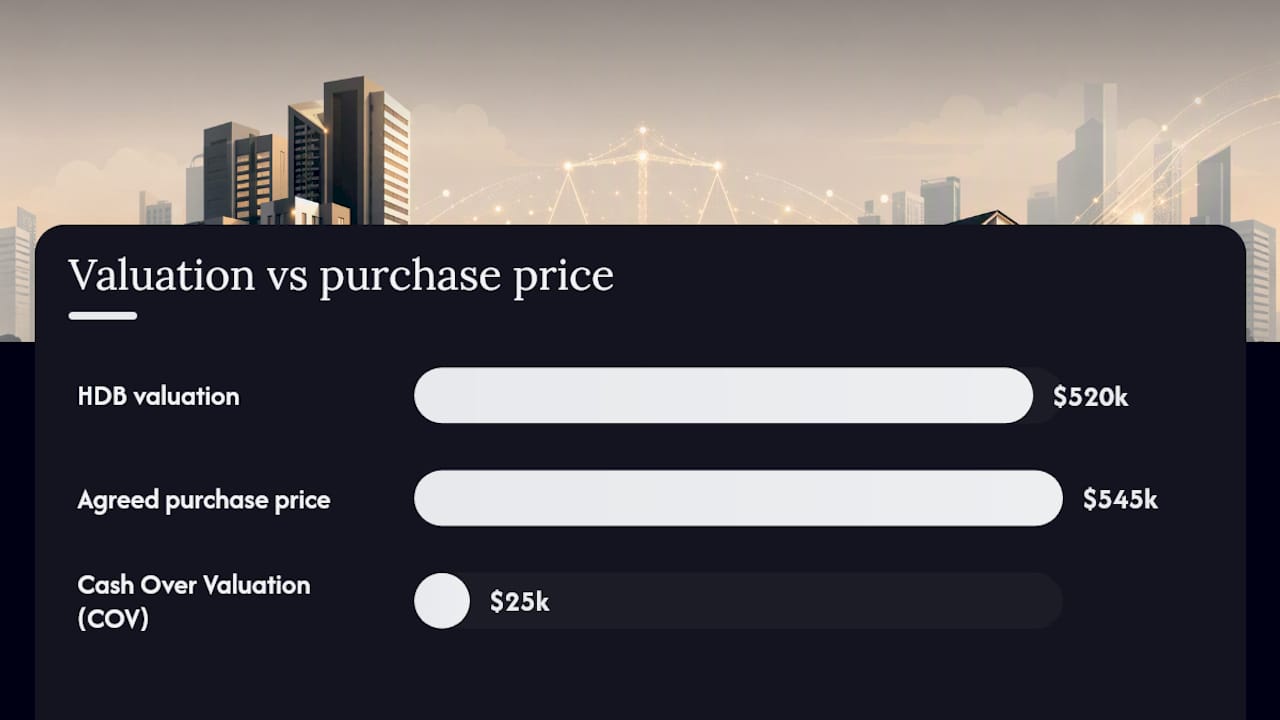
Here’s the mechanic that trips people up. If your agreed purchase price is higher than the valuation, you don’t get to borrow or withdraw CPF against the difference. That gap, the Cash Over Valuation, comes entirely out of your own pocket in cash. A flat valued at $520,000 but sold at $545,000 means $25,000 in cash on top of your down payment, on top of everything else.
- Run your numbers through the CPF housing usage calculator once you have the official figure, not before. Using an estimated number here just sets you up for a false sense of security.
- Banks generally won’t lend beyond the valuation figure either, so a loan shortfall and a CPF shortfall can hit simultaneously.
- Third-party portals can help you gauge whether a seller’s asking price is reasonable before you commit to an OTP, but they carry zero weight once financing decisions are on the table.
If you’re weighing whether a seller’s price reflects genuine market conditions or optimistic pricing, our deep dive on HDB resale price trends is a useful gut check before you sign anything.
A Practical Checklist for Timing and Negotiation
Real estate professionals recommend using third-party valuation tools early, before the OTP is even signed, purely to gauge whether a seller’s asking price is in the right neighborhood. That’s useful for negotiation prep. It’s not useful for anything financial once the deal is live.
The checklist that actually prevents costly mistakes looks like this:
- Line up your OTP date, Request for Value submission, and expected inspection window on a single calendar before you sign anything.
- Confirm the seller’s availability for inspection before the OTP is signed, not after.
- Track the 3 month validity window against your loan approval timeline, not just your resale application deadline.
- Set aside cash reserves for a possible COV gap, informed by comparable transactions rather than the seller’s asking price.
Pro Tip: Treat the 21 day OTP window and the 3 month valuation window as two separate clocks running at different speeds. Most timing failures happen because buyers only track one of them.
A consultant who’s coordinated dozens of these transactions can flag inspection risks and paperwork gaps before they become deadline problems, which is often the difference between a smooth resale and a rushed, expensive one; learn more about the role of an agent in navigating commissions and responsibilities.
Why Your Valuation Might Not Match the Asking Price
A gap between what HDB’s valuer says and what the seller is asking isn’t unusual, and it isn’t necessarily a red flag either. It usually comes down to a handful of factors the valuer weighs that a seller’s asking price doesn’t always reflect.
Remaining lease is one of the biggest drivers. Two identical units in the same block can carry different valuations if one has meaningfully less lease remaining, since lease decay affects both resale value and CPF usage eligibility down the line. Our explainer on lease decay breaks down how that erosion actually works if you want the mechanics.
Beyond lease, a few other factors routinely create the gap:
- Recent comparable transactions in the same block or estate carry more weight with valuers than a seller’s aspirational pricing.
- Renovation quality and unit condition matter to a physical inspection in ways a desktop estimate can’t capture.
- Floor level and unit orientation get factored differently by a trained valuer than by a seller pricing based on neighborhood buzz.
- Sellers sometimes price against a single standout transaction in the estate, while valuers average across a broader set of recent sales.
None of this means the seller is wrong to ask what they’re asking. It means the valuation and the asking price are answering two different questions: one is what a buyer might pay, the other is what HDB will actually finance.
Can You Appeal or Request a Review of an HDB Valuation?
There’s no formal appeal mechanism that lets you contest a valuation outcome the way you might dispute a tax assessment. HDB’s valuation, once issued by the assigned Panel of Valuers member, stands as final for that transaction.
That said, there are practical paths if the figure feels genuinely out of step with the market:
- Double-check that the valuer had accurate information about the unit’s condition and any renovations during the inspection. Missing details can lead to an understated figure.
- If the valuation has already expired past its 3 month window, you can submit a fresh Request for Value, which effectively gives the flat a new assessment, though you’ll pay the $120 fee again.
- Renegotiate the sale price with the seller directly if the valuation comes in meaningfully lower than the agreed figure. Some sellers will adjust rather than lose the deal.
- Consult an experienced agent or consultant who can advise whether the gap is typical for the estate or genuinely worth pushing back on with the seller.
Realistically, most buyers who feel a valuation is off end up negotiating with the seller rather than the valuer, since HDB’s process doesn’t build in a review channel for the figure itself.
How the Valuation Shapes Your Negotiation Position
Once the valuation lands, it becomes the fixed point every subsequent negotiation revolves around. Buyers who understand this early tend to negotiate more effectively than those who treat the number as a formality.
If the valuation comes in at or above the agreed price, you’re in a comfortable position. Your financing covers the full amount, and there’s no COV to worry about. If it lands below, you have real leverage to renegotiate, particularly if the seller is motivated to close quickly.
A few negotiation dynamics worth knowing:
- Sellers aware of a looming valuation shortfall sometimes preempt the conversation by offering a price adjustment before you even ask.
- Buyers who’ve budgeted for a possible COV going in negotiate from a stronger position than those scrambling to find cash after the fact.
- A valuation that comes in unexpectedly high can actually work against a buyer trying to negotiate a lower price, since the seller now has an official figure backing their ask.
The valuation isn’t just a financing checkpoint. It’s genuinely useful negotiating ammunition, in either direction, depending on which side of the number you land on.
Where the Standard Advice on HDB Valuations Falls Short
Most guides treat the Request for Value as a box to check somewhere between the OTP and the resale application. That framing undersells how much timing risk sits inside that process, and it’s the part I push clients to take seriously from day one.
The conventional advice says “submit it promptly and wait.” What it skips is that the 3 month validity window and the 21 day OTP window run on entirely different schedules, and buyers who don’t map both against their loan approval timeline are the ones who end up scrambling near the deadline. I’ve seen deals nearly unravel not because of a bad valuation, but because nobody tracked the calendar.
The other gap: buyers treat COV as a worst case rather than a real possibility. In a market where asking prices often run ahead of recent transacted comparables, a shortfall shouldn’t surprise anyone. Budget for it before you sign the OTP, not after the valuation outcome lands. That single habit, more than any negotiation tactic, is what separates a stressful resale from a straightforward one.
— Aman
Get Help Managing Your HDB Valuation and Resale Timeline
Coordinating a Request for Value alongside inspection scheduling, loan approval, and a 21 day OTP clock is a lot to track solo, especially if this is your first resale purchase. Aesthetic Havens works directly with buyers and sellers through this exact sequence, handling valuation timing, inspection coordination with sellers, and resale application paperwork so nothing slips past a deadline.
When you work with a consultant on this process, you get someone tracking both clocks (the OTP and the valuation window) simultaneously, flagging potential COV exposure before you’re locked into a price, and coordinating directly with the seller’s side on inspection access. That coordination is usually what separates a five week resale from a ten week one.
If you’re still deciding between resale and other paths into the market, our breakdown of why private property might suit your situation is worth a read before you commit. Otherwise, reach out to Aesthetic Havens directly to get your valuation and resale timeline mapped out before you sign an OTP.
Sources
Go straight to the source for anything financing-related. HDB’s Request for Value page and its terms and conditions cover the process in full, including edge cases this article doesn’t touch.


