


For most Singapore buyers on a 5–15 year horizon, a well-located 99-year leasehold property typically beats a freehold unit in a secondary location. Freehold makes sense when you’re buying for multi-generation legacy, have a long hold horizon, and can absorb the price premium without sacrificing location or floor quality.
Three criteria decide which tenure fits you:
- Holding period: Planning to sell within 15 years? Leasehold’s lower entry quantum usually preserves more capital efficiency. Holding multi-generationally? Freehold’s perpetual title removes lease-decay risk entirely.
- Liquidity and entry quantum: Freehold units typically carry a low double-digit PSF premium over comparable leasehold. That gap, deployed into a better floor, stack, or district, often generates stronger returns over a medium hold.
- Legacy intent: If passing property to children or grandchildren matters, freehold removes the lease-clock problem. For pure investment, the math often favors leasehold.
Pro Tip: The most common mistake Singapore buyers make is paying a freehold premium for a unit in a weaker location or on a low floor. Tenure is insurance; location is the engine. Never sacrifice one for the other.
Key Takeaways
For most Singapore buyers, leasehold wins on capital efficiency for holds under 15 years, while freehold earns its premium only when the hold horizon is long, legacy matters, and the unit quality is genuinely superior.
| Point | Details |
|---|---|
| Leasehold for medium holds | 99-year leasehold in a better location typically outperforms freehold in a weaker one on a 5–15 year hold. |
| Freehold premium range | Freehold units carry a PSF premium over comparable leasehold, varying by region (CCR to OCR). |
| CPF age-plus-lease rule | Youngest buyer’s age plus remaining lease must reach 95 for full CPF OA use; below 30 years, CPF is blocked. |
| MAS loan tenure cap | Banks cap loan tenure to the property’s remaining lease, raising monthly installments on short-lease units. |
| Lease expiry outcome | At 99-year lease expiry, land reverts to SLA with no compensation; SERS does not apply to private properties. |
Table of Contents
- What do freehold and leasehold actually mean in Singapore?
- What does the 2025–2026 Singapore market say about freehold premiums?
- Freehold vs leasehold: side-by-side comparison for Singapore buyers
- How do CPF rules and MAS financing limits affect your choice?
- What actually happens as a leasehold property ages?
- How does tenure affect resale liquidity and en-bloc potential?
- Which buyer profile fits freehold, and which fits leasehold?
- How to evaluate a specific unit: the decision checklist
- Aesthetic Havens’ framework for making the tenure call
- The tenure question most Singapore buyers are asking wrong
- Sources
What do freehold and leasehold actually mean in Singapore?
Freehold means you own the land and building in perpetuity, technically described as an “estate in fee simple.” There is no expiry date on your title. That said, “perpetual” has a legal asterisk: the Land Acquisition Act gives the Singapore government compulsory acquisition powers over all land tenures, freehold included. Owning freehold does not make you immune to state acquisition for public purposes.
99-year leasehold is the most common tenure for new private residential launches in Singapore. The lease starts from the date the government grants it, not the date you buy the unit. A 2005 project on a 99-year lease already has roughly 21 years consumed before you even sign the OTP.
999-year leasehold is a historical tenure, mostly found in older estates and landed properties. Practically speaking, 999-year titles trade nearly identically to freehold because no living buyer will see the lease expire. For financing, CPF, and resale purposes, treat 999-year as functionally equivalent to freehold.
Common lease lengths and their one-line implication for buyers:
- Freehold: No expiry; broadest buyer pool at resale; highest entry price.
- 999-year leasehold: Near-freehold in practice; older stock, often landed; financing treated similarly to freehold.
- 99-year leasehold: Most new launches; lease decay becomes material after ~40 years remaining; CPF and loan rules tighten as lease shortens.
Tenure appears on the property title and is listed in every URA caveat and listing portal. It is a legally binding characteristic of the land grant, not the building. For a deeper look at how Singapore tenure types work in practice, the distinctions matter most when you start calculating CPF eligibility and loan tenure.
What does the 2025–2026 Singapore market say about freehold premiums?
The structural reason freehold stock is scarce is simple: the government’s Government Land Sales (GLS) program issues almost all new sites on 99-year leasehold terms. New freehold supply is essentially limited to en-bloc redevelopments of existing freehold land, which are sporadic and location-dependent. This supply constraint keeps freehold prices elevated relative to leasehold, even when the underlying unit quality is comparable.
URA’s REIS transaction data shows consistent PSF differentials between freehold and 99-year leasehold across all three market regions. The premium is not uniform.
| Region | Typical Freehold PSF Premium over 99-Year Leasehold |
|---|---|
| Core Central Region (CCR) | Approximately 7–10% |
| Rest of Central Region (RCR) | Approximately 10% |
| Outside Central Region (OCR) | Approximately 12–17% |
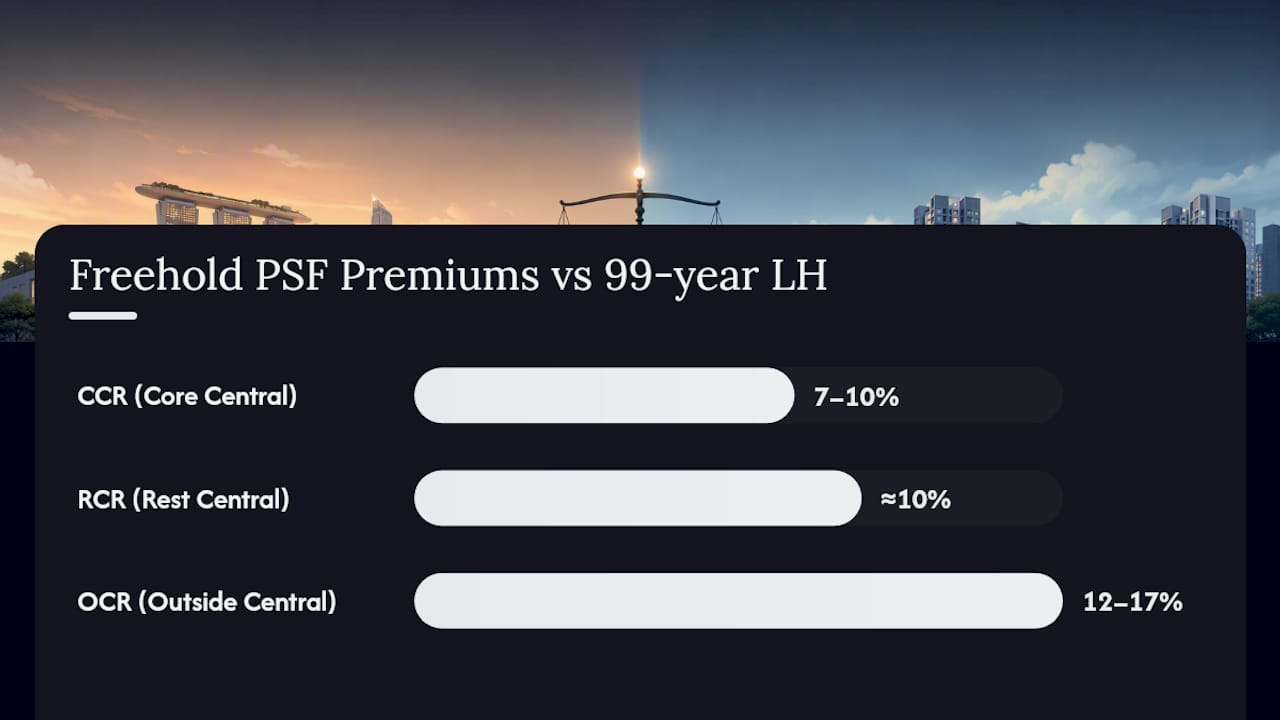
Source: Compiled market analysis based on URA/REIS transaction data and ShiokNest’s freehold vs leasehold guide.
The OCR premium is wider partly because freehold stock there is genuinely rare. In the CCR, where freehold supply is more established, the gap narrows. One counterintuitive pattern: a newer leasehold project in a prime node can transact at a higher absolute PSF than an older freehold unit in a secondary OCR location, because product quality and location dominate tenure in short-to-medium hold scenarios.
For buyers comparing new launches against resale options, the new launch vs resale guide covers how these dynamics play out across the current supply cycle.
Freehold vs leasehold: side-by-side comparison for Singapore buyers
| Dimension | Freehold | 99-Year Leasehold |
|---|---|---|
| Upfront price / premium | higher PSF depending on region | Lower entry quantum; capital freed for better location or floor |
| Best-fit holding period | 15+ years; multi-generation | 5–15 years; yield-first investors |
| CPF OA eligibility | Full use (no lease expiry concern) | Pro-rated or blocked when remaining lease + youngest buyer age falls below 95 |
| Bank LTV / loan tenure | Standard LTV; full 30-year loan tenure available | Constrained when remaining lease is short; LTV reduced below critical thresholds |
| Rental yield | Typically lower (higher purchase price) | Often higher gross yield due to lower entry cost |
| Resale buyer pool | Broadest; no lease concern for any buyer | Narrows as lease shortens; cash buyers dominate below ~30 years remaining |
| Lease decay risk | None | Accelerates after ~60 years remaining |
| En-bloc / redevelopment | Possible but no lease urgency | Lease expiry creates natural en-bloc incentive; owners often motivated sellers |
Freehold pros:
- No lease clock; value retention over very long holds
- Full CPF OA and standard loan tenure always available
- Broadest resale buyer pool regardless of hold duration
- Suitable for estate planning and property inheritance
Freehold cons:
- 7–17% PSF premium reduces yield and capital efficiency
- Older freehold stock may carry higher maintenance and renovation costs
- En-bloc is possible but owners have less urgency, so collective sales can stall
Leasehold pros:
- Lower entry quantum; more capital for location, floor, or portfolio diversification
- Higher gross rental yield relative to purchase price
- Newer product quality in most new GLS launches
- En-bloc economics are cleaner when lease shortens and owners are aligned
Leasehold cons:
- Lease decay erodes value and buyer pool after ~60 years remaining
- CPF and loan eligibility tighten as lease shortens
- No legacy value for multi-generation holds
Pro Tip: When two comparable units sit in different districts, the leasehold in the better district almost always wins on a 10-year hold. The freehold premium rarely compounds fast enough to offset a weaker location over that timeframe.
How do CPF rules and MAS financing limits affect your choice?
This is where tenure stops being philosophical and starts costing or saving real money.
The CPF Board applies a straightforward rule: the property’s remaining lease at the point of purchase must be enough to cover the youngest buyer to age 95. If it does, you get full CPF Ordinary Account usage. If it falls short, CPF usage is pro-rated based on the lease coverage ratio. Below 30 years remaining on a private property, CPF OA use is blocked entirely.
A practical example: a 35-year-old buyer purchasing a unit with 55 years remaining on the lease. The youngest buyer needs coverage to age 95, which requires 60 years of remaining lease. The shortfall of 5 years means CPF usage is pro-rated, not full. That difference can amount to hundreds of thousands of dollars in usable CPF, directly affecting how much cash you need at completion.
MAS guidance adds another layer. Banks cap mortgage tenure so the loan does not outlive the property’s remaining lease. If the remaining lease is 55 years and the standard maximum loan tenure is 30 years, the bank may allow only 25 years of loan tenure. Shorter loan tenure means higher monthly installments on the same loan quantum, which affects affordability and exit options.
Checklist every buyer must run before committing:
- What is the remaining lease at the intended purchase date?
- What is the age of the youngest buyer in the application?
- Does (youngest buyer’s age + remaining lease) equal or exceed 95?
- What loan tenure does the bank allow given the remaining lease?
- What LTV does the bank offer, and does a reduced LTV require more cash upfront?
- At your intended resale date, what will the remaining lease be, and will your future buyer face the same CPF/loan constraints?
That last question is the one most buyers skip. If you buy a unit with 62 years remaining and plan to sell in 10 years, your buyer will face a 52-year remaining lease. At that point, CPF pro-ration kicks in for many buyer profiles, which shrinks your buyer pool and compresses your exit price.
What actually happens as a leasehold property ages?
Lease decay is not a cliff; it is a slope that steepens. Here is how the typical sequence plays out:
- 99–80 years remaining: No practical difference from freehold in financing or buyer pool. Full CPF and standard LTV available to most buyers.
- 79–60 years remaining: Financing starts to tighten for younger buyers. CPF pro-ration begins to affect some buyer profiles. Resale still liquid, but the discount to comparable freehold widens slightly.
- 59–40 years remaining: CPF eligibility is pro-rated for most buyers. Banks may reduce LTV or shorten allowable loan tenure. Buyer pool narrows to cash-heavy buyers or those with large CPF balances. Price growth slows relative to freehold.
- 39–30 years remaining: Financing is significantly constrained. Most buyers need substantial cash. En-bloc interest typically peaks here as owners recognize the lease clock.
- Below 30 years remaining: CPF OA use is blocked for private properties. Banks may decline lending entirely below ~20 years remaining. Buyer pool is almost exclusively cash buyers. Prices reflect distressed liquidity.
The Selective En-bloc Redevelopment Scheme (SERS) is sometimes cited as a safety net. It is not. SERS applies only to HDB estates selected by HDB, not to private leasehold properties. Private leasehold owners approaching lease expiry have no equivalent government backstop.
The Land Acquisition Act also applies to all tenures. Even freehold owners can face compulsory acquisition for public purposes, with compensation determined under statute, not market negotiation.
Three questions buyers commonly ask about lease expiry:
What happens after 99 years? The land reverts to SLA. Owners of the building have no residual claim.
Is 999-year leasehold the same as freehold? For all practical purposes, yes. No living buyer will see a 999-year lease expire, and banks and CPF treat it comparably to freehold.
Are leasehold properties at a disadvantage? Only when the remaining lease is short enough to trigger CPF and financing restrictions. A 99-year leasehold with 85 years remaining is not at a meaningful disadvantage to freehold for a buyer with a 10-year hold horizon.
How does tenure affect resale liquidity and en-bloc potential?
Freehold properties maintain the broadest resale buyer pool because no buyer, regardless of age or CPF balance, faces a lease-related constraint. That breadth gives freehold sellers more negotiating power and faster transaction velocity in soft markets.
Leasehold resale dynamics shift as the lease shortens. A unit with 70 years remaining still attracts most buyer profiles. At 50 years, the pool narrows to buyers who can manage the CPF pro-ration. At 35 years, you are largely selling to cash buyers, which compresses both price and transaction speed.
En-bloc economics favor leasehold in one specific way: owners of aging leasehold properties share a common financial incentive to sell collectively before the lease erodes further. That alignment makes collective sales easier to organize.
URA REIS data shows that freehold premiums over comparable 99-year leasehold units tend to widen as the leasehold’s remaining lease approaches critical thresholds, reflecting the shrinking buyer pool and financing constraints rather than any intrinsic change in the freehold unit’s value.
Which buyer profile fits freehold, and which fits leasehold?
Owner-occupier upgrader (5–12 year horizon): Leasehold in a better location or newer development usually wins. The lower entry quantum means less loan, lower monthly commitment, and more flexibility to upgrade again. Freehold makes sense only if the specific unit is in a location with no comparable leasehold alternative.
Yield-first investor: Leasehold almost always wins. Lower purchase price on a comparable rental income means higher gross yield. The lease decay risk is manageable if the hold is under 10 years and the remaining lease is above 70 years at purchase.
Long-horizon legacy buyer: Freehold is the clear choice. The perpetual title removes lease-clock anxiety for children and grandchildren, and the CPF/loan resilience means future generations face no financing constraints at resale.
Cash buyer comfortable with short-term constraints: Aging leasehold with 35–50 years remaining can offer deep value if the buyer is cash-funded and the location is strong. The compressed buyer pool at purchase often means a below-market entry price.
| Expected Hold Period | Recommended Tenure | Rationale |
|---|---|---|
| Under 5 years | 99-year leasehold | Maximum capital efficiency; lease decay negligible |
| 5–15 years | 99-year leasehold (preferred) or freehold if premium is narrow | Location and product quality dominate; leasehold yield advantage is real |
| 15–30 years | Freehold preferred | Lease decay begins to matter; CPF/loan constraints emerge for future buyers |
| Multi-generation | Freehold | Perpetual title; no lease clock for heirs |
Pro Tip: In prime nodes like Districts 9, 10, and 11, a leasehold new launch often saves enough quantum to buy a higher floor or a better-facing stack. That unit-level advantage frequently outperforms the tenure premium over a 10-year hold.
How to evaluate a specific unit: the decision checklist
Run this sequence on every candidate unit before you make an offer.
- Calculate remaining lease at purchase. Subtract the lease start year from the grant year, then subtract years elapsed. Confirm with the title deed, not the listing.
- Run the CPF eligibility check. Add the youngest buyer’s age to the remaining lease. If the sum is below 95, CPF usage is pro-rated. If below 30 years remaining, CPF is blocked.
- Model the loan tenure and LTV. Ask your banker what loan tenure and LTV they will offer given the remaining lease. Compare monthly installments between the freehold and leasehold options at the same loan quantum.
- Check entry quantum vs rental yield. Divide annual gross rent by purchase price. Compare across both tenures. A 0.5% yield difference compounds significantly over a 10-year hold.
- Score micro-location and commute. MRT proximity, school proximity, and amenity density affect rental demand and resale velocity more than tenure for most buyer profiles.
- Assess layout and stack. A well-oriented, efficient layout in a leasehold building often outperforms a poorly laid-out freehold unit on both rental and resale.
- Estimate renovation and maintenance costs. Older freehold stock often needs more capital expenditure. Factor that into your total cost of ownership.
Questions to ask the seller or agent:
- What is the exact lease commencement date?
- What is the strata maintenance fee history for the last three years?
- Have there been any past en-bloc attempts, and what was the outcome?
- What have comparable units in the same development transacted for in the last 12 months?
Red flags to walk away from:
- Remaining lease below 30 years on a private property
- Strata accounts that are opaque or show deferred maintenance
- Heavy visible deferred maintenance with no sinking fund to cover it
- Financing restrictions that will apply to your most likely future buyer profile
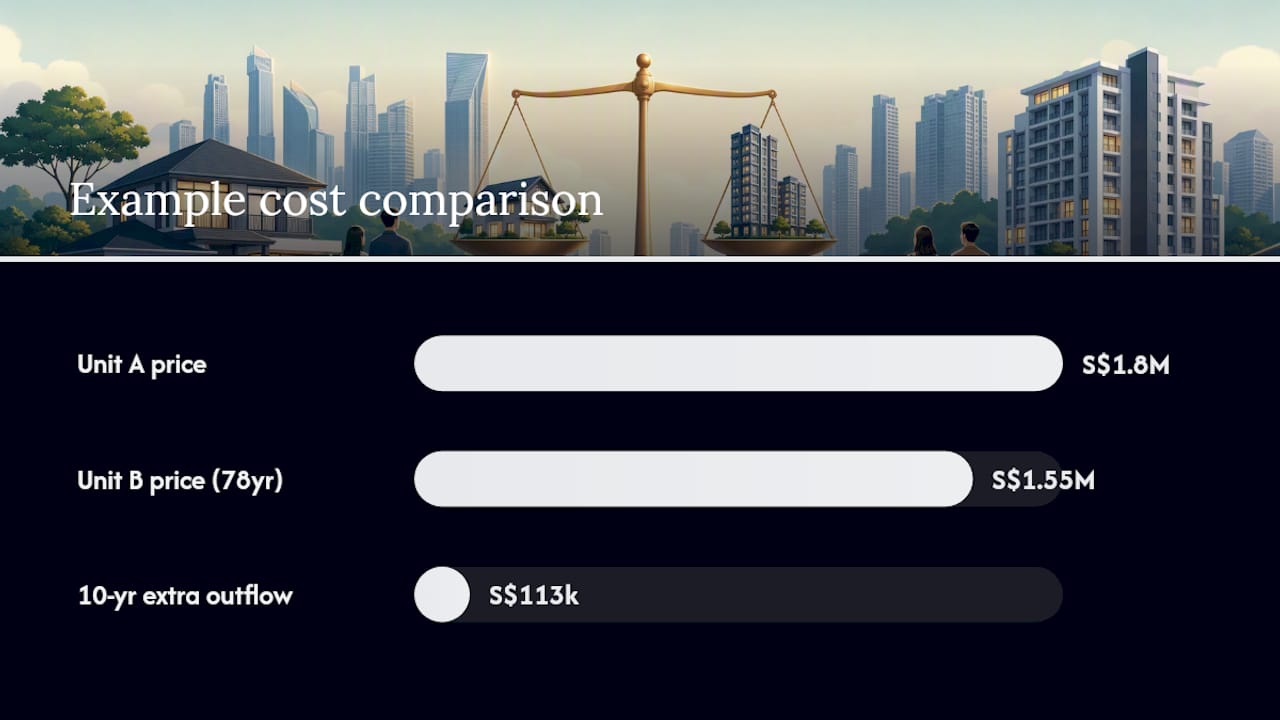
Worked example: Two comparable two-bedroom units in the same district. Unit A is freehold at S$1.8 million. Unit B is 99-year leasehold with 78 years remaining at S$1.55 million. Unit B’s PSF is approximately S$5,810. The S$940 monthly difference over 10 years is roughly S$113,000 in additional cash outflow for the freehold unit. For a 10-year hold, Unit B’s capital efficiency advantage is substantial unless the freehold unit appreciates at a meaningfully faster rate, which is not guaranteed in a stable market.
Aesthetic Havens’ framework for making the tenure call
At Aesthetic Havens, the advisory approach runs three screens before recommending a tenure for any client.
Screen 1: Holding horizon. Under 15 years, leasehold is the default unless the freehold premium is unusually narrow or the location has no leasehold equivalent. Over 15 years, freehold becomes the preferred tenure unless the leasehold’s location advantage is decisive.
Screen 2: Liquidity and buffer. If buying freehold requires stretching loan quantum to the point where the buyer holds less than six months of installments in liquid reserves, the freehold premium is a financial risk, not an asset. Capital efficiency matters more than tenure purity when the buffer is thin.
Screen 3: Unit marketability. Floor, facing, layout, and proximity to MRT are assessed independently of tenure. A freehold unit that scores poorly on these dimensions is not a better buy than a leasehold unit that scores well.
Worked advisory example: A client in their early 40s, planning to hold for 12 years before passing the property to their child, was deciding between a freehold resale unit in District 15 at S$1.9 million and a 99-year leasehold new launch in District 9 with 99 years remaining at S$1.75 million. Screen 1 (12-year hold) pointed to leasehold. Screen 2 (comfortable liquidity buffer at the lower quantum) confirmed leasehold. Screen 3 (District 9 MRT proximity, efficient layout) reinforced leasehold. Recommendation: the leasehold new launch. The S$150,000 quantum difference was redeployed into a higher floor with a better facing, which improved both rental yield and eventual resale appeal.
Understanding why a property consultant adds value in exactly this kind of decision comes down to running these screens systematically rather than defaulting to the conventional “freehold is always safer” assumption.
If you want the three-screen framework applied to a specific unit you’re considering, Aesthetic Havens offers advisory consultations for Singapore buyers at every stage of the purchase process. Reach out through Aesthetic Havens to discuss your situation directly with Aman.
The tenure question most Singapore buyers are asking wrong
The conventional framing of freehold vs leasehold treats tenure as a binary quality judgment: freehold good, leasehold risky. That framing is wrong, and it costs buyers money.
Tenure is a time-value instrument. Freehold is worth its premium only when the holding period is long enough for the perpetual title to generate returns that exceed the capital deployed in the premium. For most Singapore buyers transacting on a 5–15 year horizon, that condition is rarely met. The freehold premium is a sunk cost that the market does not reliably return over medium holds, particularly when the leasehold alternative is in a stronger location or a newer development.
What the research actually supports is a location-first, tenure-second hierarchy. A leasehold unit in District 9 with 85 years remaining will almost always outperform a freehold unit in a secondary OCR location over a 10-year hold, on both rental yield and capital appreciation.
Where conventional advice falls short is in treating CPF and loan eligibility as static. They are not. The CPF and MAS rules create a dynamic where the same property becomes progressively harder to finance and sell as the lease shortens. Buyers who model only their own purchase conditions, and not their future buyer’s conditions at resale, consistently underestimate the liquidity risk embedded in aging leasehold stock.
The practical priority order: hold horizon first, then liquidity buffer, then unit marketability, then tenure. Tenure is the last screen, not the first.
This article is general information, not a substitute for advice from a qualified financial advisor. Consult a qualified financial professional about your own circumstances before acting on anything here.
Sources
These are the primary sources to review before making any tenure-related decision:
- Using your CPF to buy a home — CPF Board
- Loan tenure and loan-to-value limits — MAS
- Land Acquisition Act (LAA) — Singapore Statutes Online
- Freehold vs Leasehold Singapore — ShiokNest detailed guide


