


For most HDB and Executive Condominium buyers, the Mortgage Servicing Ratio (MSR) at 30% is the binding limit. Both rules are set by the Monetary Authority of Singapore (MAS) and enforced by every financial institution (FI) extending a housing loan. When you are buying an HDB flat or a new EC from a developer, both ratios apply simultaneously, and whichever produces the lower monthly instalment cap is the one that controls how much you can borrow.
Key Takeaways
| Point | Details |
|---|---|
| MSR cap (30%) | Applies to HDB flats and developer ECs; caps property loan repayments at 30% of gross monthly income. |
| TDSR cap (55%) | Applies to all property loans from FIs; counts every monthly debt obligation, not just the mortgage. |
| Stress-test floor | Banks size the qualifying instalment at a MAS floor (commonly 4.0% p.a.), not the advertised rate. |
| Top action to increase borrowing | Clear credit-card balances and consumer loans 60–90 days before applying to free up TDSR headroom. |
| MAS as regulator | MAS sets and enforces both ratios; always verify current rules at the official MAS explainer page. |
| Aesthetic Havens | Runs pre-approval TDSR/MSR checks for Singapore buyers before bank submission, under ERA Realtors. |
Table of Contents
- How TDSR and MSR differ — and why the gap matters
- Which property type triggers MSR, TDSR, or both?
- How banks calculate each ratio — formulas, stress tests, and what counts
- Exceptions and edge cases you should know about
- Three scenarios that show which rule actually limits you
- How to increase how much you can borrow
- What documents to bring and which calculators to use
- What most buyers get wrong about these two ratios
- Get a clear affordability picture before you commit
- Sources
How TDSR and MSR differ — and why the gap matters
These two ratios measure different things, which is exactly why one often bites harder than the other.
TDSR (Total Debt Servicing Ratio) counts every monthly debt obligation you carry: existing mortgages, car loans, personal loans, renovation loans, student loans, and a credit-card factor based on outstanding balances.
MSR (Mortgage Servicing Ratio) is narrower. It counts only the monthly repayments on the housing loan being applied for, plus any other outstanding property loan repayments. The Housing & Development Board (HDB) applies an equivalent rule to its own concessionary loans.
| TDSR | MSR | |
|---|---|---|
| What it measures | All monthly debt obligations | Property loan repayments only |
| Cap | 55% of gross monthly income | 30% of gross monthly income |
| Regulator | MAS | MAS (HDB applies parallel rule) |
| Properties covered | All property loans from FIs | HDB flats and developer ECs only |
Variable income (commissions, bonuses) usually receives a haircut when banks compute either ratio. For joint applicants, the bank combines both incomes and both debt obligations, which helps on the income side but can hurt if one applicant carries heavy consumer debt.
Which property type triggers MSR, TDSR, or both?
The short answer: if you are buying an HDB flat or a new EC from a developer, both rules apply. For private condos and landed property, only TDSR applies.
Properties where MSR applies (alongside TDSR):
- HDB flats (resale or new BTO, financed by a bank)
- Executive Condominiums purchased directly from a developer
Properties where only TDSR applies:
- Private condominiums
- Landed residential property
- Resale ECs that have passed their Minimum Occupation Period (MOP) and are classified as private property
- Commercial and industrial property
MSR applies to HDB and EC purchases and typically acts as the binding constraint for these buyers because 30% is a much tighter ceiling than 55%.
For private property buyers, the picture flips. TDSR is the only ratio in play, but it counts everything: the new mortgage plus every other loan.
Joint applications work the same way. The bank pools both applicants’ incomes and all their combined debts. Adding a co-borrower with clean credit and steady income can materially lift the qualifying loan amount, but a co-borrower with heavy debt can drag it down just as fast.
For a broader view of how Singapore’s property cooling measures interact with these borrowing limits, that context helps frame why MAS keeps both ratios in place.
How banks calculate each ratio — formulas, stress tests, and what counts
This is where most buyers get surprised. The instalment figure banks plug into the formula is not based on the loan’s advertised rate.
The TDSR formula
“Total monthly debt obligations” includes:
- Monthly repayment on the new mortgage (sized at the stress-test rate)
- All existing mortgage repayments
- Car loan monthly repayment
- Personal loan and renovation loan repayments
- Student loan repayments
- A credit-card factor: typically a percentage of outstanding credit-card balances treated as a monthly obligation, even if you pay the card in full each month
- Guarantor obligations (at least 20% of the guaranteed loan’s monthly repayment is counted)
The MSR formula
Only property loan repayments count here. No car loans, no personal loans, no credit-card factor.
The stress-test floor
Banks do not size the qualifying instalment at the advertised rate. Per MAS guidance, they use the higher of the contractual rate and a medium-term stress-test floor.
For a deeper look at how mortgage stress tests work in Singapore, the mechanics are worth understanding before you sit down with a lender.
Worked example
Borrower profile: gross monthly income of S$8,000, car loan repayment of S$800/month, credit-card factor of S$200/month, no other debts. Buying an HDB resale flat.
Step 1: Calculate the TDSR headroom for the new mortgage.
| Item | Amount (S$/month) |
|---|---|
| Gross monthly income | 8,000 |
| TDSR cap (55%) | 4,400 |
| Existing debts (car + CC factor) | 1,000 |
| Maximum new mortgage instalment (TDSR) | 3,400 |
Step 2: Calculate the MSR cap.
| Item | Amount (S$/month) |
|---|---|
| Gross monthly income | 8,000 |
| MSR cap (30%) | 2,400 |
| Maximum new mortgage instalment (MSR) | 2,400 |
Step 3: Identify the binding rule.
TDSR allows up to S$3,400/month for the new mortgage. MSR allows only S$2,400/month. The binding constraint is MSR. The bank will size the loan so the monthly repayment (calculated at the stress-test floor) does not exceed S$2,400.
As DBS explains, the 55% TDSR cap applies across all debt obligations, but for HDB buyers the MSR cap typically bites first. The Nexus Mortgage guide notes that the credit-card factor and the stress-test floor together are the two most common reasons buyers qualify for less than they expected.
Exceptions and edge cases you should know about
The rules are consistent, but a few situations change how they apply.
- HDB concessionary loans: If you take an HDB loan (not a bank loan), the HDB applies its own income-based rules rather than the MAS TDSR framework. The MSR equivalent still applies, but the TDSR calculation is an HDB internal assessment, not a bank-run MAS TDSR check. Most buyers who qualify for an HDB loan still face a 30% housing-loan cap.
- Resale ECs past MOP: Once an EC completes its MOP and is sold on the open market, it is reclassified as private property. A buyer purchasing that resale EC faces only TDSR, not MSR. This is one reason executive condo vs private condo comparisons matter for borrowing strategy.
- Guarantor obligations: Banks count at least 20% of the guaranteed loan’s monthly repayment as part of the guarantor’s TDSR. If you are a guarantor on a family member’s loan, that obligation reduces your own borrowing capacity.
- Refinancing and top-ups: Refinancing an existing mortgage still triggers a full TDSR check. Top-up loans and renovation loans are included in TDSR calculations.
- Variable income: Bonuses and commissions receive a haircut when banks assess income for TDSR and MSR. The exact haircut varies by lender, but consistent documented variable income helps.
Pro Tip: Always verify current rules directly with MAS or your lending FI before applying. MAS published updated measures for sustainable property market conditions in 2022, and the framework can be adjusted.
Three scenarios that show which rule actually limits you
Matching your profile to a scenario is the fastest way to see which ratio will control your loan.
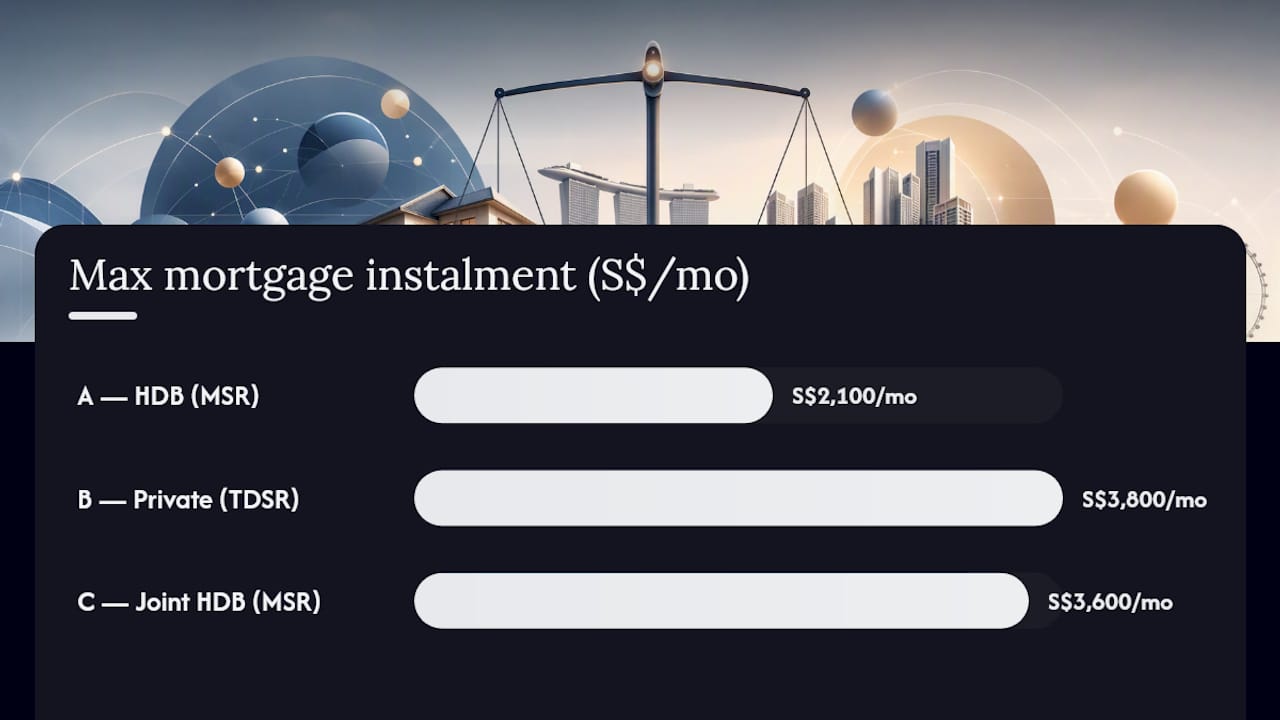
Scenario A: HDB buyer, S$7,000/month income, no other debts
With no other debts, TDSR gives plenty of room. MSR caps the mortgage at S$2,100/month regardless. This buyer’s loan size is determined entirely by MSR.
Scenario B: Private condo buyer, S$10,000/month income, car loan S$1,200/month, personal loan S$500/month
| TDSR only | |
|---|---|
| TDSR cap (55%) | S$5,500/month |
| Existing debts | S$1,700/month |
| Max mortgage instalment | S$3,800/month |
No MSR applies. But the car and personal loans consume S$1,700 of the S$5,500 TDSR allowance, leaving S$3,800 for the mortgage. A buyer with the same income but no consumer debt would qualify for S$5,500/month in mortgage repayments — a meaningful difference in loan size.
Scenario C: Joint HDB applicants, combined income S$12,000/month, one applicant has a car loan of S$900/month
The combined income lifts the MSR ceiling to S$3,600/month. TDSR headroom is larger even after the car loan. MSR still binds. The car loan does not affect the MSR calculation directly, but it would become the binding factor if this couple were buying a private property instead.
For a closer look at how new launches versus resale properties interact with these borrowing rules, property type choice has real consequences for which ratio controls your loan.
How to increase how much you can borrow
The order of these steps matters. High-impact actions taken 60–90 days before applying make the biggest difference.
High-impact steps:
- Pay down or fully clear outstanding credit-card balances before applying. Banks count a portion of your outstanding balance as a monthly obligation even if you never carry a balance. Clearing the balance removes that factor from your TDSR.
- Settle or consolidate high-interest consumer loans (personal loans, renovation loans). Each S$500/month in debt repayments you eliminate adds back S$500 of TDSR headroom for the mortgage.
- Delay taking on new car loans or personal loans until after the mortgage is approved.
- Add a co-borrower with clean credit and stable income. Combined income raises both the MSR and TDSR caps proportionally.
Medium-impact steps:
- Lengthen the loan tenure within MAS limits (up to 30 years for private property, 25 years for HDB). A longer tenure reduces the monthly instalment, which helps you qualify for a larger loan under the same ratio caps.
- Document variable income thoroughly. Provide 12 months of payslips, commission statements, and CPF contribution history. Banks are conservative with variable income, but consistent documentation can improve the assessed income figure.
- Optimize CPF Ordinary Account usage where the bank allows it to offset the cash portion of repayments.
Lower-impact or conditional steps:
- Switching from an HDB purchase to a private property removes the MSR constraint, but it introduces ABSD and higher entry prices. Understanding ABSD rates and exemptions is part of that calculation.
- Reducing guarantor obligations by being released from a guarantee before applying.
Pro Tip: The credit-card factor is the most overlooked TDSR limiter. A S$20,000 outstanding balance across all cards adds S$1,000/month to your TDSR debt count. Clear balances at least one statement cycle before applying, so the cleared balance shows on the statement the bank reviews.
What documents to bring and which calculators to use
Walking into a bank meeting without the right documents wastes everyone’s time and can delay your In-Principle Approval (IPA).
Income documents:
- Last 3 months’ payslips
- Latest 12 months’ CPF contribution history (downloadable from CPF Board)
- Latest 2 years’ IRAS Notice of Assessment (for self-employed or variable-income applicants)
- Commission or bonus statements for the past 12 months
Debt and liability documents:
- Statements for all existing loans (car, personal, renovation, other mortgages)
- Latest credit-card statements showing outstanding balances
- Guarantor paperwork if you are a guarantor on any loan
Property documents:
- Option to Purchase (OTP) or Sales and Purchase Agreement
- HDB flat details or EC developer booking form
Calculators worth using before the meeting:
- MAS’s own MSR and TDSR explainer page sets out the framework and is the authoritative reference
- Bank loan calculators (DBS, OCBC, UOB) that allow you to input a custom stress-test rate of 4.0% rather than the advertised rate
- Third-party TDSR calculators that apply the stress-test floor and credit-card factor, so the estimate matches what a bank will actually compute
Pre-meeting checklist:
- Run an online TDSR/MSR estimate using the stress-test rate (not the advertised rate).
- Collate all income and debt documents listed above.
- Clear credit-card balances and confirm the cleared balance appears on your latest statement.
- Book a consultation with a mortgage specialist or property consultant before submitting a formal application.
What most buyers get wrong about these two ratios
A buyer earning S$8,000/month has S$4,400 of TDSR allowance. A car loan at S$900/month and a personal loan at S$400/month already consume S$1,300 of that, leaving S$3,100 for the mortgage. The same buyer with no consumer debt qualifies for closer to S$835,000. That gap is not a rounding error.
The second mistake is assuming that because MSR only covers property repayments, it is the “easier” rule.
Early planning changes outcomes. Buyers who clear consumer debt 60–90 days before applying, document variable income properly, and run a realistic stress-test estimate before choosing a property tend to avoid the unpleasant surprise of a lower-than-expected IPA. The TDSR framework is not designed to be punitive — it is designed to keep borrowers from overextending. Working with it early, rather than discovering its limits at the bank counter, is the practical approach.
Get a clear affordability picture before you commit
Knowing the rules is one thing. Running the actual numbers for your specific income, debts, and target property is another.
Aesthetic Havens, operating under ERA Realtors, helps Singapore buyers run a realistic TDSR and MSR pre-check before they approach a bank. The difference between a rough online estimate and a properly structured pre-approval check is often the difference between a smooth purchase and a last-minute financing scramble. Aman works through your income profile, existing debt obligations, and target property type to identify which ratio will bind and what steps, taken now, will improve your qualifying amount. No guesswork, no surprises at the IPA stage. To see how a property consultant can run this check for you, book a short consultation through Aesthetic Havens.
Sources
These are the authoritative references for anyone who wants to go deeper on the rules or run their own calculations.
- Mortgage Servicing Ratio and Total Debt Servicing Ratio Rules
- TDSR 55% Calculator Singapore 2026: How Much Mortgage Can You Borrow?
- What you need to know about TDSR
- TDSR, MSR & Affordability: Singapore Home Loan Limits
This article is general information, not a substitute for advice from a qualified financial advisor. Consult a qualified financial professional about your own circumstances before acting on anything here.


