


A property sales workflow for business owners is a structured, phase-by-phase system that moves a commercial or residential property from listing to closing with defined tasks, owners, and deadlines at every step. Business owners in Singapore face a real estate sales process that spans regulatory compliance, multilingual documentation, and multiple stakeholder approvals. Without a repeatable workflow, deals stall, documents go missing, and follow-ups fall through the cracks. A standardized sell property workflow fixes all three problems at once.
What does a property sales workflow for business owners require?
The foundation of any effective real estate sales process is the right combination of tools and preparation. Three technology categories are non-negotiable: a CRM to track leads and buyer interactions, a transaction management platform to centralize documents and deadlines, and an AI-assisted contract intake tool to eliminate manual data entry. Without all three working together, you create gaps where tasks get lost between handoffs.
Before you configure any tool, organize your digital file system first. Create a standardized folder structure for every deal: one folder per property, with subfolders for contracts, correspondence, due diligence, and closing documents. Prepare a master contact list covering buyers, lawyers, agents, valuers, and government contacts. Build document templates for offer letters, option to purchase agreements, and disclosure forms aligned with Singapore’s Council for Estate Agencies requirements.

The table below compares manual and automated approaches across the key workflow categories:
| Category | Manual approach | Automated approach |
|---|---|---|
| Contract intake | 30–60 minutes of data entry per contract | Under 60 seconds with AI extraction |
| Deadline tracking | Spreadsheet updated by hand | Auto-generated task lists from contract dates |
| Stakeholder updates | Individual emails sent manually | Triggered messages sent on milestone completion |
| Calendar scheduling | Manually coordinated across parties | Automated invites synced to all stakeholders |
| Document storage | Shared drives with inconsistent naming | Centralized single-source folder with version control |
Integration between your CRM, transaction platform, and calendar is what turns three separate tools into one connected workflow. When a contract is signed in your transaction platform, your CRM should update the deal stage automatically, and your calendar should populate every deadline without a second manual entry.
Pro Tip: Prioritize AI-assisted contract intake above every other automation. Contract intake manually takes 30–60 minutes per deal, but AI tools complete the same task in under 60 seconds. That time saving compounds across every deal in your portfolio.
How to execute each phase of the real estate sales process
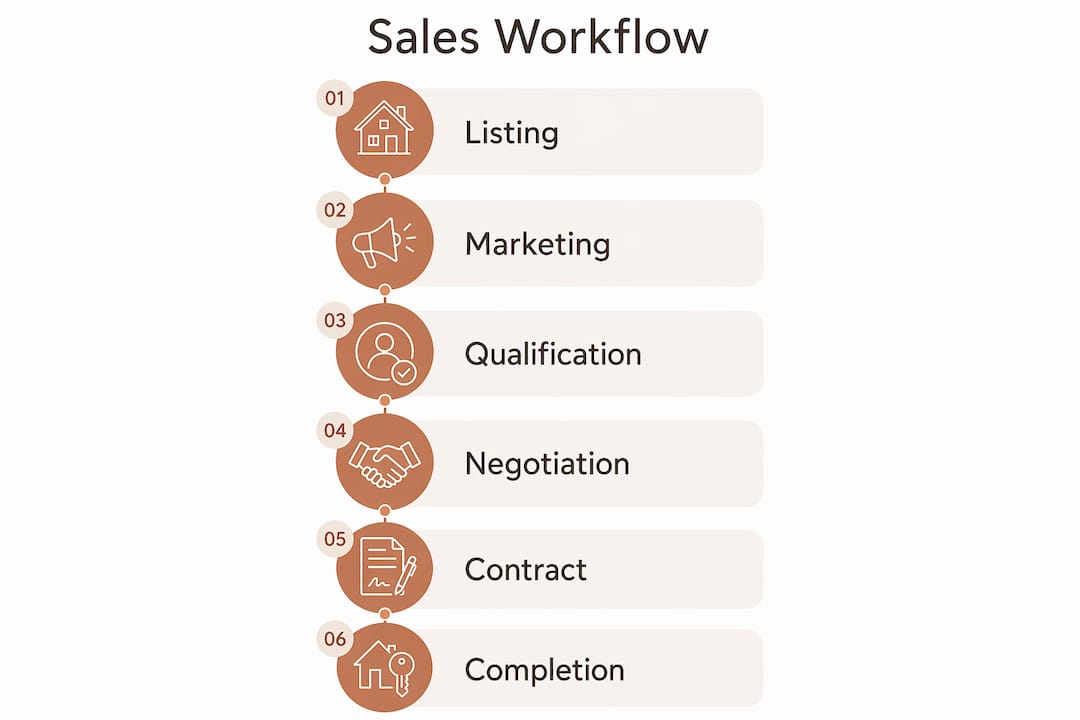
Property sales workflows typically include 7–9 core phases spanning 30 to 90 days, with over 100 individual tasks across the full transaction. Each phase has a defined owner, a clear output, and a handoff trigger that starts the next phase. Treating each deal as a project plan, not a loose sequence of calls and emails, is what separates owners who close consistently from those who lose deals at the finish line.
The nine core phases and their key actions are:
-
Listing and intake. Confirm property details, gather title documents, set the asking price using a formal valuation, and upload all materials to your centralized folder. Assign a deal owner before any marketing begins.
-
Marketing. Publish the listing across relevant platforms. Adding virtual tours to listings measurably improves lead quality and shortens the time buyers need to make a decision. Set automated follow-up triggers for every inquiry that comes in.
-
Qualifying buyers. Score every lead against defined criteria: financial capacity, purchase timeline, and property fit. Use your CRM to log every interaction and flag unqualified leads early. Unqualified leads left in the pipeline waste negotiation time.
-
Negotiation. Assign your most experienced person to lead all price and terms discussions. Automation handles scheduling and document sharing here. Human judgment drives the outcome.
-
Contract execution. Use a digital signature platform to send, track, and store the option to purchase and sale and purchase agreement. Set an automated alert for the option exercise deadline, which is a hard deadline in Singapore transactions.
-
Due diligence and inspections. Coordinate property inspections, title searches, and CPF or financing checks. Assign a checklist owner for each sub-task. Missing one item here causes closing delays.
-
Closing preparation. Confirm all financial calculations, stamp duty payments, and legal appointments. Define an escalation procedure now, before you need it. Escalation protocols for pre-closing delays in lender commitments or title issues prevent costly, rushed decisions in the final days.
-
Closing. Execute the final transfer, collect keys, and confirm receipt of funds. Document every action taken on closing day in your transaction platform.
-
Post-closing. Send completion notices to all stakeholders, archive the full deal folder, and log outcome data for workflow review. Post-closing data is how you improve the next transaction.
Pro Tip: Track milestones, not just dates. A date-only reminder tells you when something is due. A milestone-based reminder tells you what must be true before the next phase starts. That distinction prevents phases from overlapping before prerequisites are met.
What common pitfalls occur in property sales workflows?
Most deal failures trace back to unclear responsibility handoffs, not market conditions. Treating every sale as a project with defined owners and deadlines is the single most reliable way to prevent workflow breakdowns. When no one owns a task, no one completes it.
The most damaging mistakes business owners make, and their fixes, are:
- No assigned task owner. Every task in the workflow must have one named person responsible. Shared responsibility means no responsibility.
- Fragmented communication. Deals managed across WhatsApp, email, and verbal updates create gaps. Centralized digital folders prevent missed contingencies and lost documents.
- Inconsistent follow-up. Buyers who go quiet are often lost to a competitor who followed up first. Automated follow-up triggers eliminate this entirely.
- No escalation path. When a title issue or financing delay appears near closing, teams without a defined escalation procedure panic and make expensive decisions. Write the escalation path before the deal starts.
- Skipping post-closing review. Owners who skip the review repeat the same mistakes across every deal. A 30-minute post-closing debrief per transaction pays for itself within two deals.
The role of a buyer’s agent in later transaction phases is often underestimated. Responsibility handoff issues between seller and buyer representatives are a leading cause of closing delays. Defining who owns each task on both sides of the table before negotiations begin removes the ambiguity that causes last-minute failures.
How does workflow automation improve transaction efficiency in Singapore?
Standardizing workflows is the single most important move for scaling a property portfolio consistently. Without standardization, every deal depends on the individual handling it. With it, outcomes become predictable regardless of who is managing the transaction.
Automation delivers the most value in these specific areas:
- Contract intake. AI tools extract key dates, parties, and obligations from contracts automatically. This triggers the full task list for that deal without any manual setup.
- Deadline alerts. Automated reminders fire at defined intervals before each milestone. No deadline is missed because someone forgot to check a spreadsheet.
- Stakeholder communication. Triggered messages notify lawyers, buyers, and agents when a phase completes. Manual update calls are replaced by automatic status notifications.
- Calendar synchronization. Automated calendar sync invites all stakeholders to relevant appointments and deadlines, eliminating scheduling errors across multiple parties.
- Digital signatures. Platforms that integrate with your transaction management system send, track, and store executed documents without manual chasing.
Singapore’s PropTech adoption is accelerating, and business owners who integrate these tools now build a structural advantage over those still managing deals by hand. The key balance is this: automate every routine task, and reserve human attention for negotiation and relationship management. Automation frees time to focus on negotiation nuances that directly affect sale outcomes. No algorithm closes a difficult deal. A well-prepared owner does.
Key Takeaways
A structured property sales workflow, built on standardized phases, clear task ownership, and targeted automation, is the most reliable way for business owners in Singapore to close deals consistently and reduce transaction risk.
| Point | Details |
|---|---|
| Standardize before automating | Build a consistent phase structure and document templates before adding any automation tools. |
| AI contract intake saves hours | AI tools complete contract data extraction in under 60 seconds, versus 30–60 minutes manually. |
| Assign one owner per task | Every workflow task needs a named owner. Shared responsibility produces missed deadlines. |
| Escalation paths prevent panic | Define escalation procedures for pre-closing delays before the deal starts, not during the crisis. |
| Post-closing review compounds gains | A 30-minute debrief after each deal identifies repeatable improvements for the next transaction. |
What I’ve learned about workflows that most guides won’t tell you
Most articles on the real estate sales process focus on the tools. After working with business owners across Singapore’s residential and commercial markets, I’ve found the tools are rarely the problem. The problem is that owners treat workflow setup as a one-time project instead of an ongoing practice.
The owners who scale their property portfolios efficiently share one habit: they review their workflow after every single deal. Not annually. Not quarterly. After every deal. They ask what caused the last delay, who missed a handoff, and which document arrived late. That 30-minute review is worth more than any software subscription.
The second thing most guides miss is the danger of over-automating the wrong phases. Automation belongs in contract intake, deadline tracking, and stakeholder notifications. It does not belong in negotiation. I’ve seen deals fall apart because an automated message sent the wrong tone at a sensitive moment in price discussions. Human judgment in negotiation is not a gap in your workflow. It is the workflow.
Finally, the single source of truth principle is non-negotiable. One folder. One version of every document. One place where every stakeholder looks. When I see a deal in trouble, the first thing I check is whether the team is working from the same documents. They almost never are. Fix that first, and half the other problems resolve themselves.
— Aman
How Aesthetic Havens supports your property sales process
Business owners managing property transactions in Singapore benefit most from expert guidance that combines market knowledge with process discipline. Aesthetic Havens, operated under ERA Realtors, provides advisory services built around exactly that combination.
Whether you are selling a commercial unit, a residential investment property, or an industrial asset, the right consultant structures the transaction from intake to closing with defined milestones and clear accountability. The benefits of working with a property consultant go beyond market access. They include workflow discipline, documentation accuracy, and negotiation support at every critical phase. Reach out to Aesthetic Havens to discuss how a structured transaction approach can reduce your deal timeline and protect your sale outcome.
FAQ
What are the core phases of a property sales workflow?
A standard property sales workflow covers 7–9 phases: listing, marketing, buyer qualification, negotiation, contract execution, due diligence, closing preparation, closing, and post-closing review. Each phase requires a named task owner and a defined handoff trigger to the next phase.
How long does a property sales transaction take in Singapore?
Property sales workflows typically span 30 to 90 days depending on property type, financing complexity, and regulatory requirements. Commercial transactions often run longer due to additional due diligence and approval steps.
What is the biggest cause of deal failure in property sales workflows?
Unclear responsibility handoffs cause most deal failures. When no single person owns a task, deadlines are missed and documents go uncollected. Assigning one named owner to every workflow task is the most direct fix.
How does workflow automation help business owners sell property faster?
Automation handles contract intake, deadline alerts, stakeholder notifications, and calendar scheduling without manual input. This frees business owners to focus on negotiation and relationship management, which are the phases that most directly affect sale price and deal speed.
Do business owners in Singapore need a consultant to manage property sales workflows?
A consultant is not legally required, but the complexity of Singapore’s regulatory environment, including stamp duty calculations, Council for Estate Agencies compliance, and CPF coordination, makes professional support a practical advantage for most business owners managing multiple or high-value transactions.
Recommended
- How to Buy Commercial Property in Singapore: A Step-by-Step Guide | Aesthetic Havens
- Step-by-step guide: How to buy commercial property in Singapore
- Foreigner’s Guide to Buying Property in Singapore (2025 Regulations & Taxes) | Aesthetic Havens
- New Launch vs Resale 2026: Singapore Property Market Guide | Aesthetic Havens


