


Property valuation is defined as a professional opinion of a property’s market worth at a specific date, determined by a qualified valuer using recognized methods and evidence. For buyers, sellers, and investors, this process is the foundation of every sound real estate decision. Whether you are securing a mortgage, acquiring an investment property, or planning your portfolio, understanding property valuation tells you what a property is actually worth, not just what someone is asking for it. The role of property valuation extends across financing, taxation, negotiation, and wealth planning.
What are the main property valuation methods?
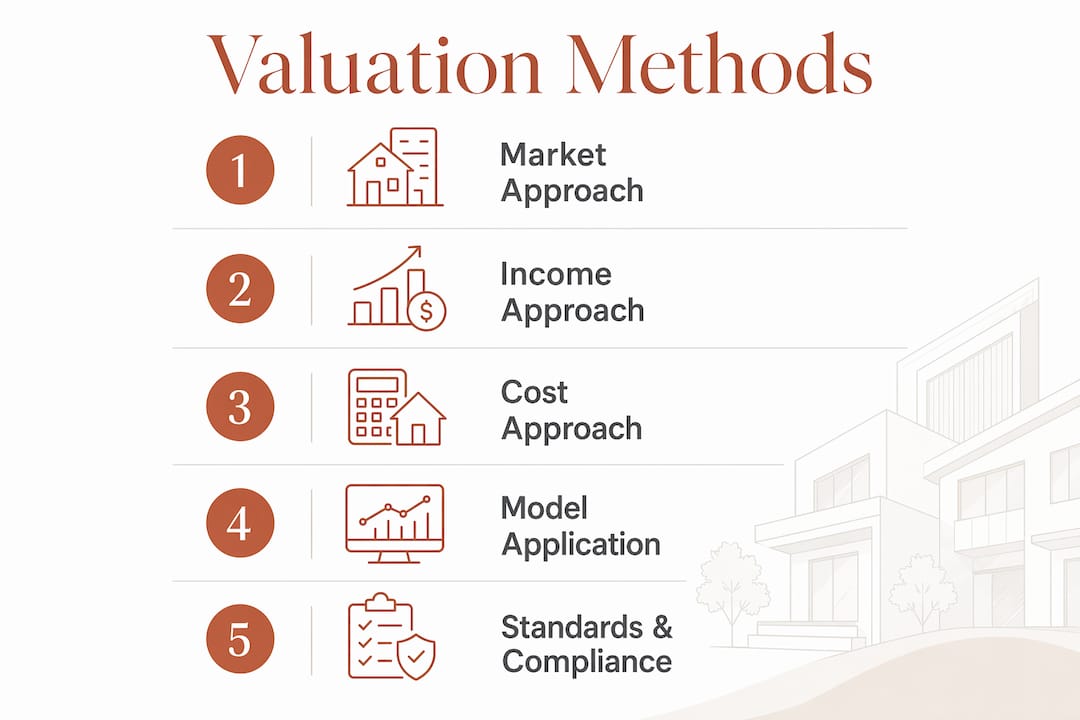
Three principal approaches define how valuers assess property: the market approach, the income approach, and the cost approach. Each serves a different purpose, and each suits different property types. Choosing the wrong approach for a given situation is one of the most common errors in real estate valuation explained to clients after a dispute.
| Approach | Core method | Best suited for |
|---|---|---|
| Market approach | Comparable sales analysis | Residential homes, standard commercial units |
| Income approach | Capitalization of net operating income | Rental properties, commercial investments |
| Cost approach | Depreciated replacement cost | Specialized assets, new builds, infrastructure |
The market approach compares the subject property against recent sales of similar properties, adjusting for differences in size, condition, location, and features. This is the most widely used method for residential real estate because transaction data is abundant and relatively transparent.

The income approach is the primary tool for investment properties. Valuers calculate net operating income (NOI) by subtracting vacancy allowances and operating expenses from gross rental income, then divide by a market-derived capitalization rate to arrive at value. Cap rate links NOI and market dynamics directly to investment worth, making it the clearest lens for assessing income-generating assets. This means a property yielding $120,000 NOI in a market with a 5% cap rate carries an implied value of $2.4 million.
The cost approach is used when comparable sales are scarce or when the property has unique characteristics. Valuers estimate the cost to replace the structure at current prices, then deduct physical depreciation and obsolescence, and add the land value separately. This method is common for schools, hospitals, and industrial facilities.
Pro Tip: Ask your valuer upfront which approach they plan to use and why. If the method does not match the property type or your purpose, request clarification before the report is finalized.
Valuation models are the mathematical tools that convert inputs from each approach into a value estimate. They are not the valuation itself. A model only becomes a valid professional opinion when a qualified valuer reviews, interprets, and adopts its output as their own conclusion.
How do RICS and IVS standards shape a reliable valuation?
Professional standards are what separate a credible valuation from a rough estimate. Two frameworks dominate the global real estate industry: the RICS Red Book (formally the RICS Valuation Global Standards) and the International Valuation Standards published by the IVSC.
The RICS Red Book frames valuation as a standards-driven, evidence-based process, requiring valuers to disclose their scope, assumptions, limitations, and the valuation date in every report. This transparency protects both the client and the valuer. A report that does not state its assumptions clearly cannot be relied upon for lending, acquisition, or legal purposes.
IVS standards cover both General Standards and Asset-specific Standards, and compliance is mandatory for valuations used in regulated contexts. These standards reduce valuation risk and bring confidence to capital markets, which is why institutional investors and lenders increasingly require IVS-compliant reports. Here is what a compliant valuation report must address:
- The purpose of the valuation and who commissioned it
- The basis of value (market value, investment value, or another defined basis)
- The valuation date and the effective date of the data used
- The methods and models applied, with reasons for their selection
- All material assumptions and any special or limiting conditions
- The valuer’s qualifications and any conflicts of interest
A critical point that many buyers overlook: an AVM output alone is not a valuation under the RICS Red Book. Automated Valuation Models generate indicative figures, but they only become a valid professional opinion when a qualified RICS member adopts and reports on the output. This distinction matters enormously when a lender or court requires a defensible valuation.
Why does the purpose and basis of value determine everything?
The same property can carry different values depending entirely on why the valuation is being conducted. Valuation is purpose-driven by design, and the IVSC is explicit that purpose determines which basis of value and which methodology is appropriate. This is not a technicality. It is the reason two valuers can produce different numbers for the same building without either being wrong.
Consider three common scenarios:
- Mortgage lending. The lender needs market value, defined as the price achievable between a willing buyer and seller in an arm’s length transaction. The valuer focuses on comparable sales and current market conditions.
- Acquisition analysis. An investor may need investment value, which reflects the property’s worth to a specific buyer given their financing costs, tax position, and strategic plans. This figure can be higher or lower than market value.
- Taxation or compulsory acquisition. Statutory bases of value apply, sometimes defined by legislation, which may differ significantly from open-market value.
Mismatch between purpose, basis, and method is the most common cause of valuation disputes. RICS is direct on this point: defining purpose and basis at the instruction stage is not optional. It is the foundation of a defensible report.
Pro Tip: Before ordering any valuation, write down exactly what decision you will make with the result. Share that context with your valuer. The more specific you are about purpose, the more useful the report will be.
Valuers apply different methods depending on the purpose, and a purpose-first approach produces a valuation that is tailored, defensible, and fit for use. Skipping this step is how investors end up with reports that cannot be used for their intended purpose, wasting both time and money.
How investors apply valuation insights for smarter decisions
Understanding how to value property is only useful if you can translate the report into a decision. For investors, the income approach is the most directly applicable tool. Here is how to read and use it:
- Verify the NOI inputs. Valuers incorporate forward-looking market expectations, vacancy rates, and operating expenses rather than simply applying a cap rate to current rent. Check whether the assumed vacancy rate reflects actual market conditions in the submarket, not just the building’s current occupancy.
- Benchmark the cap rate. A cap rate derived from comparable sales in the same submarket tells you whether the market is pricing risk aggressively or conservatively. A lower cap rate means the market assigns lower risk and higher value to the income stream.
- Read the assumptions section carefully. Valuation reports communicate not only the methods used but also the assumptions and interpretive choices that shaped the conclusion. An assumption that the property will achieve full occupancy within 12 months, for example, is a risk you are accepting when you rely on that value.
- Use the report in negotiation. If the valuation comes in below the asking price, you have an evidence-based position. If it comes in above, you understand the upside embedded in the deal.
- Apply it to portfolio analysis. Tracking valuations across multiple assets over time reveals which properties are appreciating, which are stagnating, and where to redeploy capital. For investors building wealth through property, this is the commercial property value intelligence that separates reactive decisions from strategic ones.
For residential buyers, the market approach valuation tells you whether the asking price is supported by evidence. If comparable sales in the same district are consistently 8% below the listing price, the valuation gives you the data to negotiate with confidence rather than instinct.
Key takeaways
Property valuation is a professional, standards-driven process that determines market worth through recognized methods, and its accuracy depends entirely on aligning purpose, basis, and methodology from the start.
| Point | Details |
|---|---|
| Three core approaches | Market, income, and cost approaches each suit different property types and purposes. |
| Standards matter | RICS Red Book and IVS compliance makes valuations defensible for lenders, courts, and investors. |
| Purpose drives value | The same property can carry different values depending on whether the purpose is lending, acquisition, or taxation. |
| AVM outputs are not valuations | Automated figures only become valid professional opinions when adopted by a qualified RICS member. |
| Use reports actively | Read assumptions, benchmark cap rates, and apply valuation findings directly to negotiation and portfolio decisions. |
What I have learned from watching valuations go wrong
After years of working with buyers and investors across Singapore and international markets, the pattern I see most often is not a bad valuation. It is a valuation that was ordered for the wrong purpose or without a clear brief. A client gets a desktop estimate, assumes it is a full market valuation, and then discovers the lender will not accept it. Or an investor receives a market value report when they needed an investment value analysis, and the two figures are far enough apart to change the deal economics entirely.
Automated Valuation Models have made this problem worse, not better. They are fast, cheap, and confidently wrong in thin markets, new developments, and any property with unusual characteristics. I tell every client the same thing: an AVM is a starting point for a conversation, not a number to transact on. The property appraisal process requires human judgment, local knowledge, and professional accountability that no algorithm currently replicates.
Choosing a qualified valuer matters as much as choosing the right method. Look for RICS membership or equivalent professional accreditation, and ask specifically about their experience with the property type and submarket you are dealing with. A residential specialist valuing a mixed-use commercial asset is a risk you do not need to take.
The investors I have seen build real wealth through property treat valuations as a recurring discipline, not a one-time checkbox. They commission reports at acquisition, at refinancing, and periodically through the hold period. That discipline is what lets them make decisions based on evidence rather than market sentiment.
— Aman
Work with Aesthetic Havens for expert property guidance

Aesthetic Havens, operated by Aman Aboobucker under ERA Realtors in Singapore, provides professional advisory across residential, commercial, industrial, and international property transactions. Whether you are buying your first home, expanding an investment portfolio, or assessing a commercial asset, the team brings structured valuation knowledge and market intelligence to every engagement. Clients receive guidance on investment property selection grounded in real valuation data, not speculation. For tailored advice on property worth and real estate strategy in Singapore and beyond, connect with Aesthetic Havens today.
FAQ
What is property valuation in simple terms?
Property valuation is a professional assessment of a property’s market worth at a specific date, conducted by a qualified valuer using recognized methods such as comparable sales, income capitalization, or replacement cost analysis.
Why conduct a property valuation before buying?
A valuation confirms whether the asking price reflects actual market evidence, giving buyers a defensible basis for negotiation and protecting them from overpaying in a transaction.
What is the difference between market value and investment value?
Market value is the price achievable between a willing buyer and seller in an open market. Investment value reflects what a specific buyer would pay given their own financial position, tax situation, and strategic objectives, and the two figures can differ significantly.
Are online property valuations reliable?
Online Automated Valuation Models provide indicative figures only. Under RICS Red Book standards, an AVM output is not a valid professional valuation until a qualified member adopts and reports on it as their own opinion.
How often should investors get a property valuation?
Investors benefit from commissioning valuations at acquisition, at refinancing, and periodically through the hold period to track performance, support lending decisions, and identify when to redeploy capital.


