


Many investors in Singapore believe that property wealth requires owning a physical unit, paying stamp duties, securing bank financing, and managing tenants. That belief leaves a massive opportunity on the table. Real estate investment trusts, commonly called REITs, let you participate in income-generating properties ranging from Orchard Road malls to industrial logistics parks, with the cost of a single stock trade. Singapore’s REIT market is one of the largest in Asia, governed by strict Monetary Authority of Singapore (MAS) rules that protect everyday investors. This guide breaks down everything you need to know, from structure and payouts to tax treatment and smart selection.
Table of Contents
- What are real estate investment trusts (REITs)?
- How REITs work: Structure, payouts, and management
- Singapore REIT taxation and incentives explained
- What to look out for: Risks, conflicts, and REIT selection
- Practical steps to start investing in Singapore REITs
- Our take: What most guides miss about Singapore REITs
- Looking to maximize your real estate returns in Singapore?
- Frequently asked questions
Key Takeaways
| Point | Details |
|---|---|
| REITs make property investing accessible | You can invest in diversified real estate portfolios in Singapore with low capital. |
| Singapore REIT dividends are tax-friendly | Most individual investors receive distributions free from dividend tax, boosting overall returns. |
| Investor safeguards are strong | Mandatory MAS licensing and independent trustees protect REIT unitholders’ interests. |
| Risk analysis is crucial | Choosing the right REIT means balancing yield potential with sector risks and sponsor integrity. |
| Getting started is simple | Opening a brokerage account and buying REIT units is quick and affordable for most investors. |
What are real estate investment trusts (REITs)?
A REIT is a collective investment scheme that pools money from many investors to buy, own, and operate income-generating real estate. Think of it like a shared ownership vehicle where you buy units rather than bricks. Each unit you hold represents a proportional interest in a portfolio of properties, and you earn income when those properties generate rent.
Singapore’s property market has embraced REITs enthusiastically, and for good reason. The city-state’s transparency, rule of law, and deep capital markets create ideal conditions for trust-based structures. Today, Singapore hosts more than 40 listed REITs and property trusts on the Singapore Exchange (SGX), making it one of the most REIT-dense markets in Asia.
The assets held inside Singapore REITs vary widely:
- Office buildings such as Grade A commercial towers in the Central Business District
- Retail malls including neighborhood and regional shopping centers
- Industrial and logistics properties such as warehouses, data centers, and business parks
- Hospitality assets including hotels and serviced residences
- Healthcare facilities such as hospitals and medical office buildings
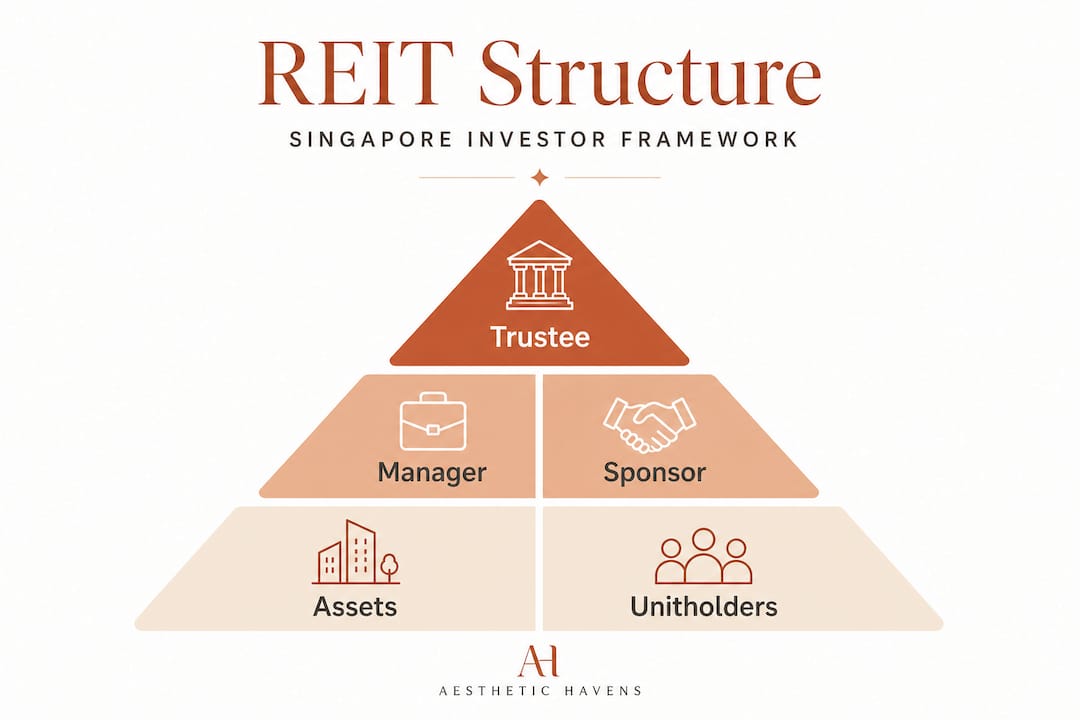
Here is what makes Singapore REITs structurally safe for investors. MAS-licensed managers run each REIT, while all assets are held by an independent trustee specifically to protect unitholders. This dual-layer governance means the fund manager cannot simply walk away with your money. The trustee oversees asset custody, and the manager handles day-to-day property operations and acquisitions.
If you are new to Singapore property investment, REITs offer a low-barrier entry point that removes the complexity of direct ownership. You don’t need to worry about tenant negotiations or maintenance. Those tasks fall on the professional management team. Understanding real estate agent roles also helps you see how REITs simplify the investing process by removing several traditional intermediary steps for the investor.

Pro Tip: Look for REITs with a strong sponsor, such as a large developer or financial institution, because sponsors often provide a pipeline of quality assets for the REIT to acquire over time.
How REITs work: Structure, payouts, and management
Understanding the mechanics of how REITs operate helps you evaluate them more confidently. The process follows a relatively clean loop: assets are acquired, tenants pay rent, income is collected, expenses are deducted, and the remainder is distributed to unitholders.
Here is a step-by-step view of that process:
- Asset acquisition: The REIT manager identifies and purchases income-generating properties using equity raised from investors and debt financing.
- Rental income generation: Tenants sign leases and pay rent, creating a steady cash flow stream into the REIT.
- Expense deduction: Property management costs, financing costs, and manager fees are deducted from gross income.
- Distribution to unitholders: Most Singapore REITs distribute at least 90% of taxable income to qualify for tax transparency treatment, typically on a quarterly basis.
- Reinvestment and growth: Managers may raise fresh equity or take on new debt to acquire additional assets and grow the distribution per unit over time.
The REIT governance structure assigns clear, separate responsibilities to the manager and trustee, which limits conflicts of interest and ensures investor protection at every stage.
| REIT component | Role | Benefit to investor |
|---|---|---|
| MAS-licensed manager | Asset management and strategy | Professional expertise |
| Independent trustee | Asset custody and oversight | Investor protection |
| SGX listing | Market transparency and liquidity | Easy entry and exit |
| Quarterly distributions | Regular income payouts | Predictable cash flow |
Getting proper real estate advisory before committing to any REIT is valuable because not all REITs distribute income equally. Some sectors, like industrial real estate, tend to produce more stable, long-term leases compared to retail, which can experience higher tenant turnover and vacancy.
Pro Tip: Always check the weighted average lease expiry (WALE) of a REIT’s portfolio. A longer WALE means income is locked in for more years ahead, reducing short-term distribution risk.
Singapore REIT taxation and incentives explained
Tax treatment is one of the most compelling reasons to consider Singapore REITs seriously. The structure offers distinct advantages, especially for individual investors based in Singapore, and understanding exactly how it works allows you to optimize your after-tax returns.
Here is how REIT distributions are taxed in Singapore:
- Individual Singapore investors receive tax-free dividends on distributions, meaning you keep the full payout without paying income tax on it.
- Foreign non-individual investors (corporations, funds) face a 10% withholding tax on rental income distributions under certain qualifying conditions.
- Singapore corporate investors may be subject to corporate income tax on distributions at the prevailing rate, though specific exemptions can apply.
| Investor type | Tax on distributions | Notes |
|---|---|---|
| Singapore individual | 0% (tax-free) | Maximum advantage |
| Singapore corporation | Standard corporate rate | Depends on specific conditions |
| Foreign individual | Generally 10% | On rental income distributions |
| Foreign non-individual | 10% withholding | Qualifying conditions apply |
This tax transparency structure is a deliberate government incentive designed to deepen Singapore’s capital markets and encourage property investment without the friction of direct ownership. If you are considering Singapore commercial property as an alternative, the REIT route removes stamp duties, legal fees, and the administrative burden of owning a physical asset while still giving you exposure to the same types of properties.
For investors looking to maximize property returns, REIT distributions can generate yields that are broadly comparable to direct rental income, often in the range of 4% to 7% annually, without the headaches of property management. For foreigners buying property in Singapore, REITs are particularly attractive because they bypass the Additional Buyer’s Stamp Duty (ABSD) that applies to direct residential property purchases.
Key insight: Singapore’s tax framework for REITs is one of the most investor-friendly in Asia. Unlike direct property ownership, REIT income for local individual investors flows completely free of personal income tax, making gross yield essentially equal to net yield for this class of investor.
What to look out for: Risks, conflicts, and REIT selection
REITs are not risk-free, and chasing high yields without understanding the underlying risks is a common mistake. Informed selection is what separates a productive REIT portfolio from a disappointing one.
Conflicts of interest and disclosure requirements are real concerns in REIT investing. For example, some REITs have arrangements where the sponsor holds a Right of First Refusal (ROFR) to sell properties to the REIT. This can lead to situations where the REIT acquires properties at prices that favor the sponsor rather than the unitholder. SGX requires disclosure of such conflicts, but disclosure alone does not neutralize them. Hospitality REITs can also be volatile but often deliver high income during peak travel periods, while industrial REITs tend to be steadier but may offer slightly lower yields.
Key risks and selection factors to evaluate:
- Distribution volatility: Hospitality and retail REITs can see income swing significantly during economic downturns or pandemics
- Gearing ratio: Singapore REITs have a regulatory leverage limit of 50% of total assets. REITs operating close to that ceiling have less room to raise debt for acquisitions
- Sponsor quality: A strong sponsor with a large property portfolio gives the REIT a reliable pipeline of future assets
- Manager track record: Review the distribution per unit history over five or more years to assess management quality
- Sector concentration: A REIT heavily exposed to one property type or geography carries more concentrated risk
- Currency risk: Many Singapore REITs own overseas assets, which means exchange rate movements can affect distributions
A useful check when reviewing the Singapore commercial real estate market is to compare REIT sector performance cycles against broader economic trends. Industrial and logistics REITs, for example, benefited enormously from e-commerce growth, while retail-focused REITs faced significant pressure during lockdown periods.
“Informed investors treat REIT selection like building a small property portfolio, balancing sector, geography, lease duration, and sponsor strength rather than chasing the single highest yield number.”
Practical steps to start investing in Singapore REITs
Getting started is simpler than most investors expect. Here is a practical roadmap to add REITs to your investment portfolio.
- Open a brokerage account: You need a Central Depository (CDP) account linked to a brokerage to buy SGX-listed REIT units. Many local and international brokers offer this service online.
- Set your investment budget: The minimum purchase is typically one board lot of 100 units, making the minimum investment for many REITs just a few hundred Singapore dollars.
- Screen for REIT type: Decide which property sector fits your income goals and risk tolerance. Industrial for stability, hospitality for higher potential yield, or a diversified REIT for balanced exposure.
- Analyze distribution yield: Calculate the distribution yield by dividing the annual distribution per unit by the current unit price. Compare this across several REITs in the same sector.
- Review the prospectus and annual report: Check occupancy rates, lease expiry schedules, gearing ratio, and recent acquisitions to assess quality.
- Monitor quarterly: REIT distributions and announcements come quarterly, so build a habit of reviewing manager updates when they are released.
MAS-licensed managers are required to publish regular disclosure documents, which makes the due diligence process more structured than evaluating unlisted property funds. This transparency is a genuine advantage for individual investors.
If you are unsure where to begin, getting real estate advisory from a professional familiar with both direct property and REIT investing can sharpen your strategy considerably.
Pro Tip: Consider dollar-cost averaging into REITs rather than investing a lump sum. Buying units regularly over six to twelve months smooths out price volatility and lowers your average entry cost over time.
Our take: What most guides miss about Singapore REITs
Most REIT guides stop at yield numbers and move on. That is exactly where many investors make their biggest mistakes.
The single most common error we see from investors entering Singapore’s REIT market is fixating on the highest advertised yield and treating it as the primary selection criterion. A REIT yielding 8% is not automatically better than one yielding 5%. The 8% yield might reflect a market perception that distributions are fragile, that the gearing ratio is stretched, or that the underlying property sector is structurally declining. Yield is an output, not a quality signal.
What genuinely matters is the consistency and resilience of distributions over full market cycles. A REIT that sustained or grew its distribution per unit through the 2020 economic shock and the 2022 interest rate cycle demonstrates real operational quality. That discipline in management cannot be captured by looking at a single year’s yield figure.
Singapore’s regulatory framework does a remarkable job of protecting investors through mandatory licensing, independent trustees, gearing caps, and SGX disclosure rules. But investors sometimes assume that regulatory protection means all risk is eliminated. It does not. The framework reduces certain risks significantly, especially fraud and mismanagement, but it cannot protect against sector downturns, overleveraged balance sheets, or poor acquisition decisions.
The broader point is that global property investment diversification matters even within the REIT space. Investors who spread exposure across REITs holding Singapore assets, Australian assets, Japanese properties, and European logistics parks reduce their geographic concentration risk meaningfully. Singapore-listed REITs with overseas portfolios offer this built-in diversification, but you need to account for currency effects on your actual distributions.
Our perspective is that the most successful REIT investors we work with treat their REIT holdings the same way a disciplined direct property investor approaches a physical portfolio. They think about long-term income sustainability, sponsor strength, sector fundamentals, and management quality before they look at yield. That mindset consistently produces better outcomes than screen-filtering for the highest number.
Looking to maximize your real estate returns in Singapore?
Whether you are just discovering REITs or ready to build a more structured real estate investment strategy, having expert guidance makes the difference between average results and optimized returns.

At Aesthetic Havens, we provide tailored advice for investors navigating both direct property and REIT strategies in Singapore and internationally. If you want to understand how REITs fit alongside direct property ownership in your portfolio, explore our real estate advisory services for personalized guidance. You can also connect with our experienced agents to explore specific property opportunities. Ready to take the next step? Reach out to us directly and let’s build a strategy that works for your goals.
Frequently asked questions
Are Singapore REIT dividends really tax-free for individuals?
Yes, individual investors receive tax-free distributions from most Singapore REITs, which means your gross yield is effectively your net yield, a significant advantage over many other income investments.
How much do I need to start investing in a Singapore REIT?
You can start with just one board lot of 100 units, often making the minimum investment just a few hundred Singapore dollars, which makes REITs one of the most accessible property investment vehicles available.
Can foreigners invest in Singapore REITs?
Yes, foreigners can invest in SGX-listed REITs, though they may face a 10% withholding tax on distributions depending on their investor classification and the source of the income.
How do Singapore REITs protect investors?
Singapore REITs must have all assets held by an independent trustee for unitholder protection and must be managed by MAS-licensed professionals, creating a dual-layer governance structure that significantly limits mismanagement risk.
What type of properties do Singapore REITs invest in?
Singapore REITs cover a wide range of sectors including commercial offices, retail malls, industrial and logistics facilities, hospitality properties, and healthcare assets, offering investors broad sector diversification within a single listed vehicle.


