


Most people assume “residential property” simply means any place where people live. In Singapore, that assumption can cost you real money. The legal and tax frameworks governing residential property here are far more specific than most buyers, renters, or investors expect. Whether you’re purchasing your first home, expanding a portfolio, or renting out a unit, the official classification of a property determines which rules apply, how much stamp duty you pay, and whether you’re even eligible to own it. This guide unpacks everything you need to know, clearly and practically.
Table of Contents
- What does ‘residential property’ mean in Singapore?
- Types of residential property in Singapore
- Legal and regulatory frameworks: Ownership and eligibility
- Renting and leasing residential property: What every tenant and landlord must know
- Why property classification matters: Taxes, investment, and your next steps
- What most guides miss about residential property in Singapore
- Take the next step with a trusted property advisor
- Frequently asked questions
Key Takeaways
| Point | Details |
|---|---|
| Legal meaning matters | Residential property isn’t just about where people live but how the law and tax code define the asset. |
| Classification impacts costs | Property classification can raise or lower stamp duties, affect who can own, and govern rental rules. |
| Different rules for HDB and private | HDB flats and private residences have distinct eligibility and rental regulations impacting tenants and owners. |
| Always check permitted use and zoning | Never assume a property is residential—verify classifications with the latest IRAS and URA information. |
What does ‘residential property’ mean in Singapore?
The term “residential property” is not just a casual label in Singapore. It carries precise legal weight, and different agencies use slightly different frameworks to define it, depending on the purpose.
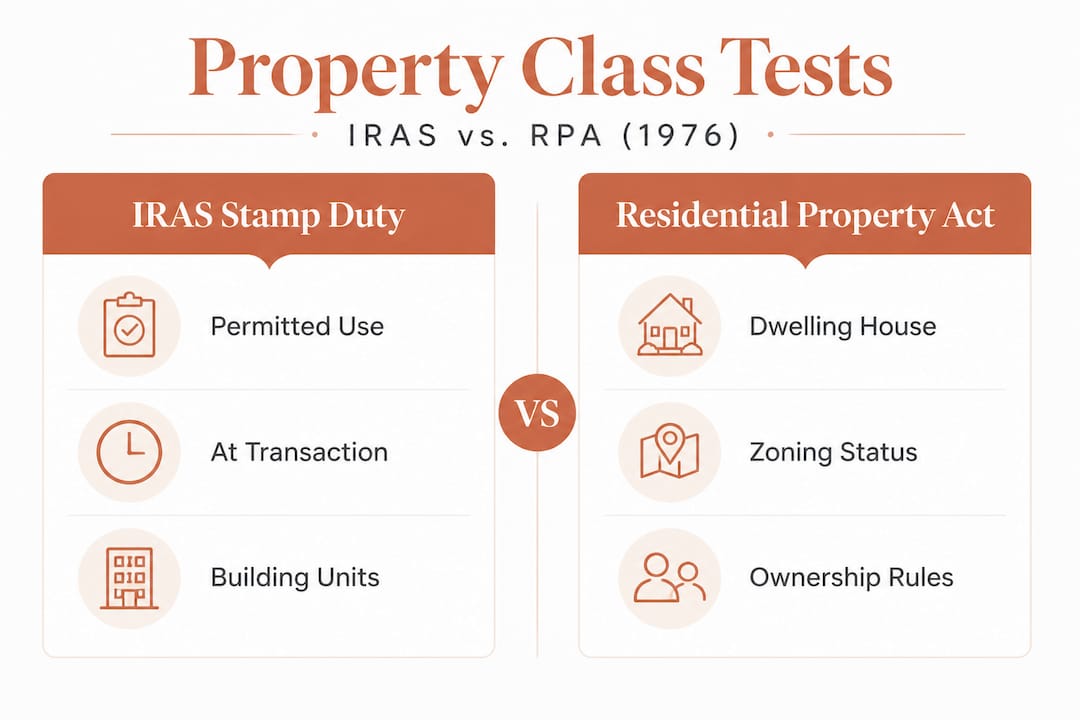
For stamp duty, IRAS determines residential status based on two factors. For a unit within a building, the relevant test is “permitted use,” meaning the approved use of that unit at the date of acquisition or disposal. If the permitted use is residential, or if it includes a residential component in a mixed-use setup, the property qualifies as residential for stamp duty purposes. For vacant land or an entire building sold with its land, the classification depends on the zoning under the Master Plan, Singapore’s statutory land use plan.
Meanwhile, the Residential Property Act 1976 defines “dwelling house” as any building, tenement, or part thereof that is used, constructed, or adapted for human habitation. It also sets out specific categories of “residential property” for restriction purposes, including houses and premises lawfully permitted for use as a dwelling house, and land zoned for residential purposes under the Master Plan.
| Framework | Applies to | Key test |
|---|---|---|
| IRAS stamp duty | Building units | Permitted use at date of transaction |
| IRAS stamp duty | Land and entire buildings | Master Plan zoning |
| Residential Property Act | Ownership restrictions | Statutory definitions and zoning |
Why does this matter so much? Because the URA Master Plan’s influence on zoning decisions can change what tax rates apply and whether a buyer is even eligible to purchase. A property marketed as “residential” may actually have a commercial permitted use on record, and that distinction has real financial consequences.
Edge cases are more common than you think. Mixed-use developments, strata units within commercial buildings, and serviced apartments can fall into gray areas where the residential classification is not automatic. If you’re a foreigner considering a purchase, understanding these details is foundational, and you can learn more in our buying property as a foreigner guide.
“Permitted use” at the date of acquisition is the decisive factor for stamp duty on building units, not what the property looks like or how it is currently being used.
Types of residential property in Singapore
Once you understand the legal definition, it becomes clearer why different property types are treated so differently in Singapore’s market.
The Residential Property Act 1976 defines categories of residential property used specifically for ownership restrictions and permitted transfers. These categories shape how buyers interact with each property type at every stage.

Here’s a breakdown of the major asset types:
| Property type | Ownership eligibility | Classification | Rental rules |
|---|---|---|---|
| HDB flat | Singapore citizens; PRs with restrictions | Public residential | Strict eligibility and quotas |
| Private condominium | Citizens, PRs, foreigners | Private residential | More flexible, tenancy law applies |
| Landed house (detached/semi-detached/terrace) | Mainly citizens; foreigners need approval | Restricted residential | Standard tenancy law |
| Shophouse (residential component) | Varies by use classification | Mixed-use or residential | Depends on permitted use |
| SoHo/dual-key units | Citizens, PRs, foreigners | May be non-residential | Subject to permitted use |
| Vacant land (residential-zoned) | Restricted for foreigners | Residential (by Master Plan) | Not applicable |
A few points deserve special attention. Shophouses are among the most misunderstood. Their classification depends heavily on their permitted use. A shophouse with a residential upper floor may qualify as mixed-use with a residential component, but only the residential portion attracts residential stamp duty rates.
SoHo units, marketed as Small Office/Home Office, are another area where buyers regularly get surprised. Many SoHo developments are classified as non-residential for stamp duty purposes, even though people live in them. That means buyers do not pay the same stamp duty rates as for a standard condominium, which can actually reduce upfront costs but also affects resale markets and mortgage eligibility.
Key points to remember across all types:
- HDB flats are public housing and operate under a completely separate legislative framework, the Housing and Development Act
- Private condominiums are the most accessible form of private residential property for foreigners in Singapore
- Landed homes carry the most restrictions and are a segment largely preserved for Singapore citizens
- Vacant land zoned residential under the Master Plan counts as residential property under the Act even before construction begins
If you’re weighing your options, exploring best property neighborhoods can help you understand where each property type tends to be concentrated. For a closer look at a high-end development in the private market, our coverage of private condominiums gives you a real example to reference.
Legal and regulatory frameworks: Ownership and eligibility
Singapore has one of the most structured property ownership frameworks in Asia. Eligibility rules are tied directly to the residential classification of the property and your legal status in Singapore.
- Singapore citizens have the broadest access. Citizens can own HDB flats, private condominiums, and most landed property without special approval.
- Singapore Permanent Residents (PRs) can buy resale HDB flats after three years of PR status. They can also own private condominiums freely. For landed property, they generally need approval from the Singapore Land Authority (SLA).
- Foreigners are barred from buying HDB flats under any circumstances. They can own private condominiums without restriction. For landed homes, the Residential Property Act restricts ownership, and foreigners must apply for SLA approval, which is granted only in exceptional cases, typically to those who have made significant economic contributions to Singapore.
- Companies and trusts face their own complexity. A Singapore-incorporated company may not automatically qualify to own residential property. Trusts holding residential property may trigger additional stamp duty obligations depending on how the trust is structured and who the beneficiaries are.
A common misconception is that incorporating a company gives buyers more flexibility to get around ownership rules. In reality, companies and trusts owning residential property face an Additional Conveyance Duty (ACD) regime, and the beneficial ownership tests are strict.
Pro Tip: If you’re in a situation that doesn’t fit standard categories, such as a foreigner married to a Singaporean citizen, or a trust with mixed beneficiaries, you may need to file an application with SLA or seek a formal legal opinion before transacting. Acting on assumptions here is genuinely risky.
For a detailed breakdown of what foreign buyers can and cannot do, our foreign ownership guide goes into the specifics. If you’re also considering non-residential assets as part of a diversified strategy, the guide on buying commercial property is worth reviewing alongside this one.
Renting and leasing residential property: What every tenant and landlord must know
The rental market in Singapore is regulated differently depending on whether the property is HDB or private. Both landlords and tenants should understand these differences before signing anything.
For HDB rentals, the rules are detailed and strictly enforced. CEA outlines eligibility conditions for renting including citizenship, residency status, and valid pass categories. Tourists are explicitly not permitted to rent HDB flats or bedrooms. Key rules include:
- Tenants must hold a valid Singapore citizenship, PR status, or an eligible work pass
- A Non-Citizen Quota (NC Quota) limits how many non-Malaysian non-citizens can rent in a given HDB block and neighborhood
- The minimum rental period for a full HDB flat is six months
- Tenants cannot be existing public rental flat tenants or owners of another HDB flat without meeting specific exception criteria
For private property rentals, the rules are more flexible but not lawless. The Residential Tenancies Act governs most tenancy disputes. Private landlords must comply with tenancy terms and cannot unilaterally terminate leases. The minimum rental period for short-term stays (under three months) is restricted under planning law, which is why platforms like Airbnb operate in a legally gray zone in Singapore’s private residential market.
Pro Tip: For landlords renting out HDB units, always get written HDB approval before advertising the flat for rent. Renting without HDB’s approval is an offense that can result in financial penalties and, in serious cases, the compulsory sale of your flat.
Important compliance areas for both parties:
- Landlords must ensure the tenant type matches HDB or URA rules
- Tenants should confirm the landlord’s eligibility to rent before committing to a lease
- Both parties should have a clear tenancy agreement in writing, ideally reviewed by a lawyer or experienced agent
For a fuller picture of how leasing works across both HDB and private markets, our complete guide to leasing walks through the process step by step.
Why property classification matters: Taxes, investment, and your next steps
Once you grasp how Singapore classifies residential property, you start to see why every investment decision begins with checking that classification first.
For stamp duty, the IRAS residential property definition is the trigger for residential-rate Buyer’s Stamp Duty (BSD) and Additional Buyer’s Stamp Duty (ABSD). Residential properties attract higher ABSD rates than non-residential properties. A foreigner buying a residential condominium pays 60% ABSD on top of BSD. The same foreigner buying a commercial shophouse with a non-residential permitted use pays zero ABSD. That is a massive financial difference driven entirely by classification.
Mixed-use or rezoned properties can catch investors off guard. A building that was previously zoned commercial but is being converted to a mixed-use development may shift into residential territory, changing the stamp duty treatment mid-transaction. Always confirm the classification at the exact date of purchase.
Practical action steps every buyer should take:
- Check the URA Master Plan zoning for the land parcel, not just the marketing materials
- Verify the permitted use listed in the title documents or with the developer
- Ask your solicitor to confirm the stamp duty classification before committing
- Clarify ABSD liability based on your residency status and number of existing properties
Pro Tip: Always review both the URA Master Plan zoning and the current permitted use before making any investment decision. These are two separate checks, and a mismatch between them can lead to unexpected costs, ineligibility, or even a failed purchase.
The leasing and investment guide on our site provides a practical framework for structuring your residential property investment with these classification realities in mind.
What most guides miss about residential property in Singapore
Here’s something most property guides won’t tell you directly: the word “residential” on a developer’s brochure means far less than the permitted use stamped in the official land register.
We’ve seen buyers purchase SoHo units expecting to pay residential stamp duty rates, only to discover at the point of sale that the permitted use is “commercial” or “office.” The result is a non-residential BSD rate, which sounds cheaper initially but then creates financing problems, since banks apply different loan-to-value limits for non-residential properties under MAS rules.
We’ve also seen the reverse. Buyers have acquired what they thought was a commercial shophouse, planning to rent the ground floor for retail, only to find the permitted use listed as residential. Suddenly the property doesn’t qualify for a commercial loan product, and the rental strategy falls apart.
The uncomfortable truth is that Singapore’s property classification system is genuinely sophisticated, and it is designed to serve tax and planning policy goals, not to make buying decisions easy. IRAS uses distinct methodologies for building units versus land parcels, and neither methodology is intuitive until you’ve seen it applied in practice.
What we always recommend: treat property classification verification as a non-negotiable step, not an afterthought. Understanding Master Plan complexities is especially important if you’re targeting investment-grade assets, where zoning changes can dramatically affect long-term value and permitted use.
The buyers who get the best outcomes are not necessarily those with the biggest budgets. They are the ones who verify classification first and negotiate with confidence because they understand exactly what they’re buying.
Take the next step with a trusted property advisor
Navigating Singapore’s residential property framework is genuinely complex, and the stakes are high. A misclassified purchase can trigger unexpected stamp duties, failed mortgage applications, or rental compliance issues that take months to untangle.
At Aesthetic Havens, we specialize in helping buyers, sellers, landlords, and tenants understand exactly what they’re working with before they commit. Whether you need a zoning and permitted use check, guidance on ABSD implications, or a complete real estate advisory solution tailored to your goals, our team is ready to support you. Working with a trusted real estate agent who understands Singapore’s classification framework can save you far more than the cost of professional advice. Connect with us at Aesthetic Havens and make your next property move with clarity and confidence.
Frequently asked questions
How do I know if the property I’m looking at counts as residential in Singapore?
Check both the URA Master Plan zoning and the property’s permitted use as stated in IRAS guidelines, since for building units the permitted use at the date of acquisition is decisive, while for land parcels the Master Plan zoning applies.
Can foreigners own residential property in Singapore?
Foreigners can buy private condominiums without restriction, but the Residential Property Act restricts ownership of landed homes, and foreigners cannot purchase HDB flats under any circumstances.
What are key differences between HDB and private property rentals?
HDB rental rules enforce strict eligibility criteria, a Non-Citizen Quota, and a minimum rental period of six months, while private property rentals are more flexible but still governed by Singapore’s Residential Tenancies Act and planning regulations.
How does property classification affect stamp duty?
Properties classified as residential attract higher BSD tiers and ABSD rates compared to non-residential properties, so misidentifying a property’s classification can lead to significantly different upfront costs or unexpected liabilities at the point of purchase.
Recommended
- Property leasing in Singapore: A complete 2026 guide
- Step-by-step guide: How to buy commercial property in Singapore
- Foreigner’s Guide to Buying Property in Singapore (2025 Regulations & Taxes) | Aesthetic Havens
- Singapore commercial real estate: Market guide for smart investors
- What is residential appraisal? A 2026 guide for NJ homeowners


