

Introduction
Your HDB resale price in 2026 directly determines how much condo you can afford – and for the first time in nearly seven years, that number may be lower than you expect. If you’re planning to sell your HDB in 2026 and upgrade to a condo, understanding how net sale proceeds translate into a realistic condo budget is the single most important financial exercise you can do before listing your flat.
This article is for Singapore HDB owners who have passed or are approaching their minimum occupation period and want to move from public to private residential property. Whether you’re eyeing a compact two-bedder in the Outside Central Region or a family-sized unit in the Rest of Central Region, the mechanics are the same: your achievable HDB resale price – after deducting your outstanding HDB loan, CPF refund with accrued interest, and selling costs – caps your condo budget. The gap between HDB selling price and private property cost matters enormously, and 2026’s softer resale market makes this gap harder to bridge than it was during the years of uninterrupted growth from 2019 to 2025.
The direct answer: Cash and CPF proceeds from the sale of an HDB flat directly impact the maximum condo purchase price. In 2026, with HDB resale prices plateauing and private home prices still elevated, most upgraders should plan for a condo budget that is 1.5× to 2× their net sale proceeds, depending on loan eligibility and cash reserves.
By the end of this article, you will be able to:
-
Estimate your HDB resale flat’s likely 2026 selling price using actual transaction data
-
Calculate net cash and CPF ordinary account balances after your sale
-
Convert those figures into a maximum condo purchase price under current financing rules
-
Understand how additional buyer’s stamp duty, buyer’s stamp duty, and renovation costs shrink your real budget
-
Know when and how to engage AESTHETIC HAVENS for a data-backed asset progression consultation
This guide includes worked examples, budget scenario tables, and suggested visual aids to make every step concrete.
Understanding How Your HDB Sale Funds Your Condo Upgrade
Your HDB flat is effectively your equity bank. The proceeds from selling it – split between cash on hand and CPF savings refunded to your account – form the foundation of your downpayment, stamp duty payments, and emergency buffer for your next home purchase. In 2026, this equation has shifted. The HDB resale price index dipped 0.1% in Q1 2026, marking the first decline since Q2 2019, while private prices have moderated to roughly 1.4% growth in the first half of 2026. That means your equity position may be thinner than you assumed, and financing rules haven’t loosened to compensate.
Understanding precisely what you walk away with after selling – and how banks and MAS rules constrain what you can borrow next – is the difference between a smooth upgrade and a financially stressful one.
What Counts as “Net Proceeds” When You Sell Your HDB
Net sale proceeds represent the actual money you have after every obligation is settled. The formula is straightforward:
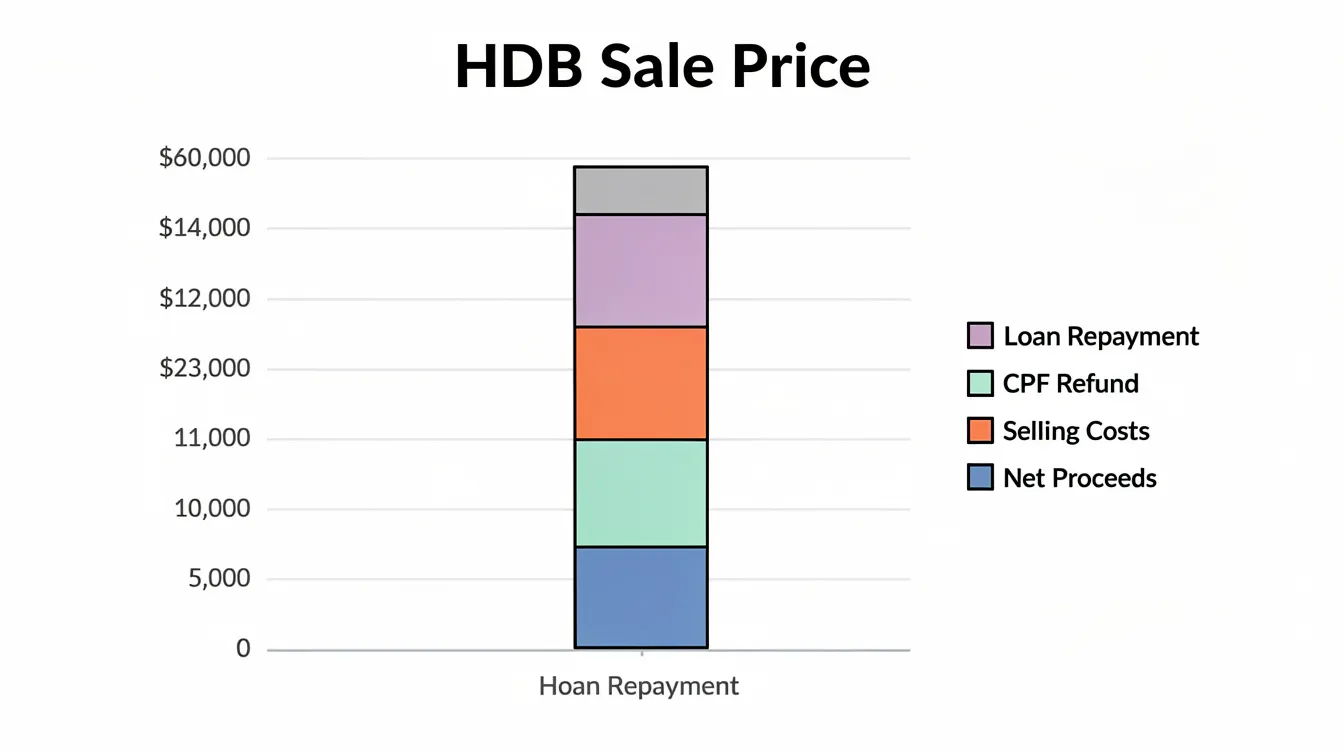
Resale price – outstanding HDB loan – CPF refund (principal + accrued interest + CPF housing grants) – selling costs (agent commission, legal fees, minor repairs) = net proceeds
Net sale proceeds from an HDB sale must deduct outstanding loans and CPF refunds to determine available cash. The CPF refund component is critical to understand: when you sell your HDB resale flat, the CPF Board requires that all CPF funds used for the flat – including principal, accrued interest, and any seller grants or housing grants – be refunded to your CPF account. If you are under 55, these funds return to your CPF ordinary account. If you are 55 or older, they first top up your Retirement Account to the Full Retirement Sum before any remainder flows to your OA.
Net Realisable Equity is calculated as cash proceeds plus CPF ordinary account refund. These two pools – cash and CPF OA – are what you deploy toward your condo.
Worked Example:
HDB resale price: S$750,000
Outstanding HDB loan: S$220,000
CPF used (principal + accrued interest + grants): S$300,000
Selling costs (agent, legal fees, minor works): S$10,000
Result: S$750,000 minus S$220,000 minus S$300,000 minus S$10,000 = S$220,000 in cash proceeds. The S$300,000 minus CPF refund returns to your CPF ordinary account and is available for your next home purchase. Total deployable equity: ~S$520,000.
How much cash versus CPF you end up with shapes everything that follows – from how much you can pay cash for stamp duty to whether you meet minimum cash downpayment requirements.
How Banks and MAS Rules Tie Your Proceeds to Condo Affordability
Your net proceeds alone don’t determine your condo budget. The total debt servicing ratio (TDSR) and Loan-to-Value (LTV) rules set hard ceilings on what you can borrow. Loan-to-Value limits for a private condo are capped at 75% for first-time buyers without existing loans. That means your downpayment must cover at least 25% of the purchase price, of which a minimum of 5% must be paid in cash (not CPF).
The TDSR framework caps total monthly debt obligations – including your new loan, any existing mortgage, car loans, and credit card debt – at 55% of gross monthly income. A bank assesses your maximum loan quantum based on this ratio, your age (which affects maximum loan tenure), and prevailing interest rates. Current bank loan rates are at a 3-year low of 1.4% to 1.6%, which increases buyer purchasing power significantly – but a 1% increase in interest rates can reduce loan eligibility by S$60,000, a sobering reminder to build in margin.
For a Singapore citizen buying a first private property (having sold the HDB), additional buyer’s stamp duty is 0%. But if you purchase the condo before selling your HDB flat, ABSD of 20% applies upfront for residents buying a second property. Singapore Citizens can apply for ABSD remission if they sell their HDB within 6 months of condo purchase – but you must have the cash to pay it first.
Because net proceeds and loan rules are so deeply intertwined, the next step is understanding what HDB resale price you can realistically achieve in 2026.
The 2026 HDB Resale Landscape: What Price Can You Realistically Get?
Your condo budget starts with a realistic HDB resale price – not the highest asking price on a property portal, not the million-dollar headline transaction from a penthouse unit in Bishan. In 2026, the resale market has entered a new phase. After years of strong gains, the HDB resale price index has flattened, and supply dynamics are shifting. This section helps you anchor your expectations by flat type, remaining lease, and estate – grounded in data, not wishful thinking.
Macro Signals: 2026 HDB Resale Price Index and Supply
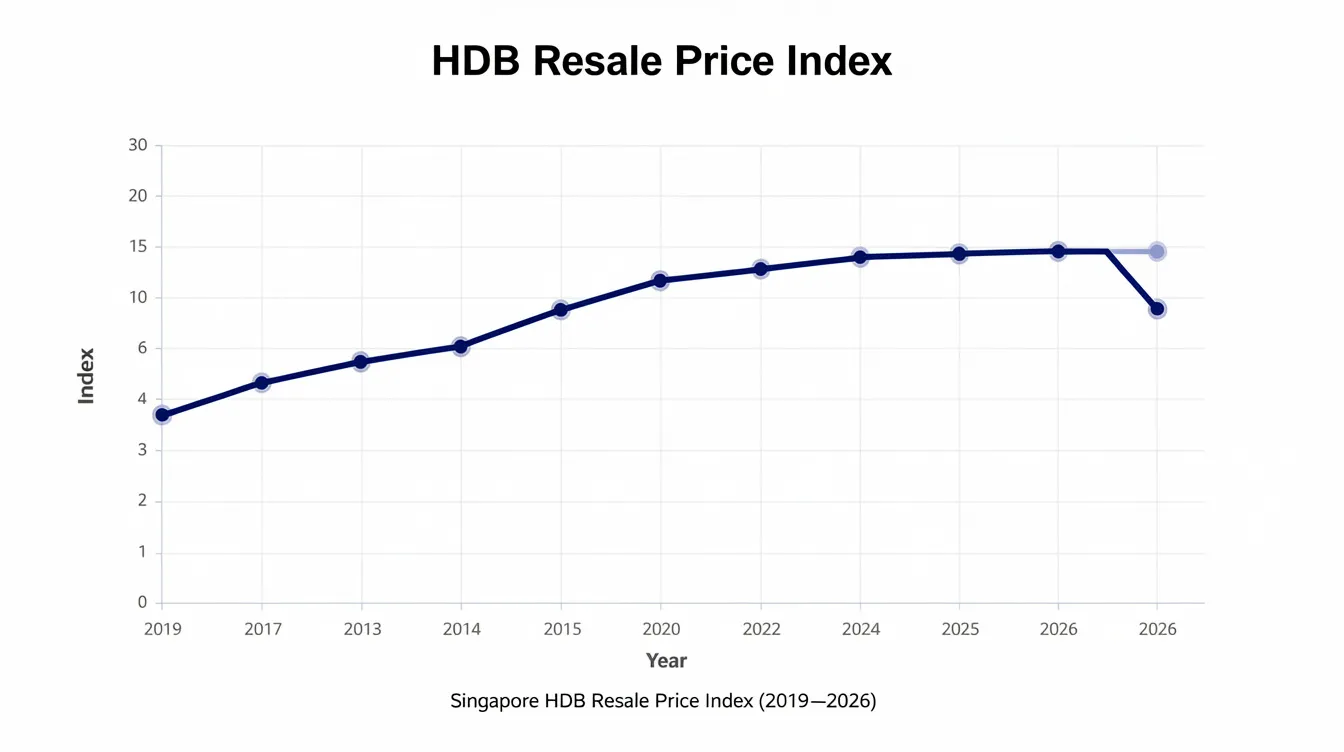
The HDB Resale Price Index fell 0.1% in Q1 2026, the first decline since Q2 2019. Year-on-year, HDB resale prices are still roughly 1.2% higher than Q1 2025, but the quarterly trajectory signals a plateau rather than continued growth. HDB resale prices in 2026 have experienced slight quarterly declines of approximately 0.6% in some segments.
Supply is the primary driver. Approximately 13,480 HDB units will reach MOP in 2026 – roughly double the number from previous years. This flood of newly resale-eligible flats expands the buyer pool’s options and reduces the urgency that drove bidding wars in 2021–2023. On top of that, around 6,900 new BTO flats will be launched in June 2026, and BTO waiting times have shortened to as low as 3 years. Shorter waits make BTO more attractive relative to resale, siphoning demand from the resale market.
For HDB owners planning to sell, the implication is clear: do not project 2020–2023 growth rates into your 2026 plans. HDB values in most estates are stable, not rising.
Estate, Flat Type, and Lease: How They Change Your 2026 Selling Price
Not all HDB resale flats are equal. A 4-room flat in Queenstown (mature estate, strong MRT access, central location) will command a materially different market price than the same flat type in Punggol. Mature HDB estates like Bukit Merah, Toa Payoh, and Bishan consistently trade at premiums due to established amenities, school catchments, and proximity to the city centre.
Remaining lease is another critical variable. Older resale flats with fewer than 60–65 years of lease remaining face a shrinking buyer pool because loan and CPF usage restrictions kick in. A flat with 50 years remaining will struggle to attract buyers who need maximum financing, which directly depresses the resale price. Conversely, newer resale flats with 80+ years of lease in non-mature estates may still command reasonable prices despite less central locations.
Indicative 2026 price ranges (estimates based on recent transactions):
-
4-room in Punggol/Sengkang (non-mature, 85+ years lease): ~S$520,000–S$600,000
-
4-room in Queenstown/Bukit Merah (mature, 55–70 years lease): ~S$650,000–S$800,000
-
5-room in Tampines (non-mature, 80+ years lease): ~S$620,000–S$720,000
-
Executive flat in Pasir Ris (non-mature, 70+ years lease): ~S$700,000–S$850,000
Around 6% of HDB resale transactions crossed the million-dollar mark in 2025, but these are outliers – typically large units in prime mature estates with high remaining lease. Most sellers should benchmark against the median for their flat type and block, not the headlines.
Using Transaction Data to Pin Down Your Own HDB’s Likely 2026 Price
The most reliable way to estimate your flat’s 2026 selling price is to use actual transacted data, not asking prices. Here’s a simple approach:
-
Access the HDB resale transaction portal and filter by your town, block or precinct, and flat type for the past 6–12 months.
-
Identify 3–5 comparable transactions – same flat type, similar floor range, similar remaining lease.
-
Adjust for differences: higher floors typically add S$3,000–S$8,000 per storey; recently renovated units may command S$10,000–S$20,000 more; unblocked views or park-facing units attract premiums.
-
Take the mid-point of your adjusted range as your base-case estimate – not the top.
HDB valuation is revealed after agreeing on a price, and valuation is based on recent transacted prices and flat condition. HDB valuation affects loan ceilings and CPF usage limits for your buyer, which means overpricing your flat beyond what data supports will result in either no offers or a Cash Over Valuation gap that your buyer must pay cash for – narrowing your buyer pool further.
Once you have a narrower price band (say, S$720,000–S$760,000), you can translate that into concrete condo affordability numbers.
From HDB Resale Price to Condo Budget: Step-by-Step in 2026
You now have a realistic HDB value range. This section turns it into a condo budget – a practical walkthrough from gross sale price to maximum safe condo purchase price, accounting for every deduction and financing constraint.
Step 1: Build Your HDB Sale Pro Forma for 2026
A “pro forma” is simply a forecast of your sale outcome. Use the mid-point of your estimated price range – not the optimistic end – as your starting figure. Then subtract, line by line:
-
Outstanding HDB loan or bank loan balance (check your latest loan statement or HDB portal)
-
CPF refund: total CPF funds used for the flat, including principal, accrued interest, and any CPF housing grants (verify via the CPF Board’s My CPF portal under “Property” section)
-
Transaction costs: agent commission (~1–2%), legal fees (~S$2,000–S$3,000), option fee administration, and any minor repairs or staging costs
Separate your final numbers into two categories:
-
(a) Cash on hand – this is your liquid capital for downpayment (cash portion), stamp duty, renovation, and cash buffer
-
(b) CPF OA balance – available for downpayment (CPF portion) and monthly mortgage payments on the next property
Resale levies range from S$15,000 to S$55,000 for HDB flats, depending on flat type. If you purchased a subsidised flat, factor in this levy – it is deducted from sale proceeds upon resale and reduces both your cash and overall equity.
Step 2: Determine Your Condo Downpayment and Maximum Loan in 2026
With your net proceeds established, the next question is: what is the maximum condo purchase price you can support?
Under 2026 rules, assuming no other outstanding housing loan:
-
LTV cap: 75% (meaning 25% downpayment required)
-
Minimum cash portion: 5% of purchase price
-
Remaining 20%: payable via cash or CPF ordinary account funds
-
TDSR: monthly repayments on all debts (including your new loan) cannot exceed 55% of gross monthly income
Low interest rates increase buyer purchasing power significantly. At current rates of 1.4%–1.6%, a household earning S$10,000 gross monthly income with no other debts could potentially service a loan of roughly S$900,000–S$950,000 over 25–30 years. But interest rates influence how much buyers can afford to pay – if rates rise even 1%, that ceiling drops meaningfully.
Continuing the earlier example:
-
Cash on hand: S$220,000
-
CPF OA balance (after refund): S$300,000
-
Total deployable equity: S$520,000
-
If this covers 25% downpayment: maximum purchase price = S$520,000 ÷ 0.25 = S$2,080,000 (theoretical maximum)
-
But TDSR may cap you lower. If household income is S$12,000/month and you have no other debts, maximum monthly repayment at 55% = S$6,600. At 2.5% interest over 25 years, that supports a loan of ~S$1,450,000 → purchase price ~S$1,930,000.
-
After reserving S$80,000–S$120,000 for buyer’s stamp duty, renovation costs, and cash buffer, realistic ceiling drops to ~S$1.5M–S$1.7M.
The point: theoretical maximums are always higher than practical, safe budgets.
Step 3: Model Three Condo Budget Scenarios Based on Different HDB Selling Prices
Small changes in your HDB resale price can shift your condo budget by S$100,000–S$200,000. Higher HDB resale prices can enhance financial conditions for upgrading to a private condo, while even a modest shortfall compresses your options.
|
Scenario |
HDB Selling Price |
Net Cash Proceeds |
CPF OA Refund |
Est. Condo Budget (incl. loan) |
|---|---|---|---|---|
|
Optimistic (+3%) |
S$780,000 |
S$250,000 |
S$300,000 |
~S$1.55M–S$1.65M |
|
Base case |
S$750,000 |
S$220,000 |
S$300,000 |
~S$1.40M–S$1.50M |
|
Conservative (–3%) |
S$725,000 |
S$195,000 |
S$300,000 |
~S$1.25M–S$1.35M |
Assumptions: no other debt, S$12,000 household income, first private property purchase, S$80,000–S$100,000 reserved for BSD, legal fees, renovation, and emergency savings.
The conservative scenario isn’t pessimistic – it’s prudent. In a market where HDB prices are no longer reliably rising quarter-on-quarter, anchoring to the mid-to-lower range prevents the painful scenario of committing to a condo you can’t comfortably finance.
The next section maps these budget bands to actual condo options – resale vs new launch, OCR vs RCR vs CCR – and addresses options for business owners who need to allocate capital across residential and commercial property.
Translating Your Condo Budget into Real Options in 2026
Having a budget number means nothing until you understand what it buys. In 2026, the property market dynamics in Singapore show a cooling trend for HDB resale prices and moderated growth for private properties, making it a relatively buyer-friendly environment in certain segments – particularly resale condos in the OCR. But your choices must align with financing comfort, lifestyle needs, and any business or investment plans.
Matching Budget Bands to Condo Segments (OCR, RCR, CCR)
Singapore’s private residential market is divided into three pricing tiers by geography. Current median resale condo prices per square foot (trailing 12 months to late 2026):
-
OCR (Outside Central Region): ~S$1,781 psf – estates like Tampines, Jurong, Pasir Ris, Hougang
-
RCR (Rest of Central Region): ~S$2,224 psf – estates like Queenstown, Geylang, Redhill
-
CCR (Core Central Region): ~S$2,566 psf – Districts 9, 10, 11 (Orchard, Newton, Bukit Timah)
|
Budget Band |
OCR Options |
RCR Options |
CCR Options |
|---|---|---|---|
|
S$1.1M–S$1.3M |
2–3 bed resale, ~700–900 sf (Tampines, Jurong) |
Compact 2-bed resale, ~550–650 sf |
Out of range for most units |
|
S$1.3M–S$1.6M |
Spacious 3-bed resale, ~1,000–1,200 sf; small new launch 2-bed |
2–3 bed resale, ~700–900 sf |
Studio or compact 1-bed resale only |
|
S$1.6M–S$2.0M |
Large 3-bed or 4-bed resale; new launch 3-bed |
3-bed resale, ~900–1,100 sf |
2-bed resale, ~650–800 sf |
Remember to factor in monthly fees beyond the mortgage: condo owners pay monthly maintenance (S$250–S$600 depending on unit size and facilities), property tax, and conservancy charges differ from HDB rates. These recurring costs effectively reduce the monthly repayment headroom you have for your new loan.
New Launch vs Resale Condo: Which Makes More Sense for 2026 Upgraders?
The new-launch premium over resale condos runs approximately 40–44% across all regions in 2026. That premium buys newer finishes, developer warranty, and potentially stronger capital appreciation – but it also means higher psf, smaller unit size for the same quantum, and a wait of 3–5 years before you can move in.
|
Criterion |
New Launch Condo |
Resale Condo |
|---|---|---|
|
Initial Cash Needed |
Lower (progressive payment scheme) |
Higher (full downpayment upfront) |
|
Total Quantum (same size) |
~40% higher |
Lower absolute terms |
|
Timeline to Move-In |
3–5 years from launch |
Immediate (weeks to months) |
|
Renovation Costs |
Minimal (ID-ready) |
S$45,000–S$75,000+ for a 3-room unit |
|
Rental Potential |
Only after TOP |
Immediate |
|
Unit Size at Same Budget |
Smaller |
Larger |
For HDB sellers who must vacate before the condo is ready, new launches mean arranging temporary accommodation or interim housing – which adds tens of thousands to the overall cost. Resale condos eliminate this gap but may require substantial renovation. Renovation costs for a 3-room flat range from S$45,000 to S$75,000, and a larger resale unit could easily exceed this.
Additional buyer’s stamp duty is applicable if a condo is purchased before selling an HDB flat. If you buy a new launch while still holding your HDB, you will need to pay ABSD of 20% upfront. Even with the 6-month remission window for Singapore citizens, you must have the liquidity to front that amount – which for a S$1.5M condo means S$300,000 in cash.
Considering Mixed-Use and Industrial-Adjacent Options for Business Owners
For SME owners and self-employed professionals, upgrading from HDB to condo isn’t just a lifestyle decision – it’s a capital allocation question. Committing all sale proceeds into a large residential property may leave insufficient capital for business premises, equipment, or growth.
AESTHETIC HAVENS specialises in advising business owners who need to balance residential upgrades with commercial or industrial property needs. A practical approach might look like this:
-
Example 1: Sell 5-room HDB for S$720,000 → buy compact 2-bed OCR condo at S$1.1M → allocate remaining capital toward a small B1 industrial unit for business operations.
-
Example 2: Sell executive flat for S$850,000 → purchase 3-bed RCR resale condo at S$1.5M → defer industrial space acquisition by 12–18 months while business cashflow stabilises.
The key insight: your condo budget shouldn’t consume your entire financial capacity if you also have business property needs. Structuring ownership correctly – and understanding that ABSD doesn’t apply to non-residential property – can unlock more efficient capital deployment.
Advanced Implementation: Timing, Financing Structures, and Risk Management
Beyond basic calculations, the sequence of your transactions, your financing structure, and your risk management strategy determine whether the upgrade goes smoothly or becomes a source of financial strain. This section provides frameworks rather than exhaustive legal advice – consult qualified professionals for your specific situation.
Choosing Between Sell-Then-Buy vs Buy-Then-Sell in 2026
This is the highest-stakes timing decision for every HDB upgrader.
Sell-then-buy advantages:
-
Full certainty of sale proceeds before committing to a condo
-
No ABSD exposure (you won’t own two residential properties simultaneously)
-
Stronger bargaining power when making offers – you’re a confirmed buyer with funds ready
Sell-then-buy drawbacks:
-
Need for temporary accommodation or interim housing between sale completion and condo move-in (rental cost: S$2,500–S$5,000/month for 3–6 months)
-
Risk that private prices climb while you’re searching
-
Emotional and logistical stress of two moves
Buy-then-sell advantages:
-
Seamless transition – no interim housing needed
-
Lock in condo price before HDB sale
-
More time to sell HDB at optimal price without desperation
Buy-then-sell drawbacks:
-
ABSD of 20% payable upfront on condo purchase (for residents buying a second property, ABSD can be as high as 20%)
-
Servicing two loans simultaneously strains TDSR
-
If HDB doesn’t sell within 6 months, ABSD remission is forfeited
Decision flow:
-
Can you comfortably pay 20% ABSD upfront and still meet condo downpayment? → If no, sell first.
-
Does your TDSR allow carrying two mortgage payments? → If no, sell first.
-
Is your HDB in a high-demand estate likely to sell quickly? → If yes, buy-then-sell becomes more viable.
-
Can you tolerate 3–6 months of temporary accommodation? → If yes, sell first is lower risk.
Optimising Cash, CPF, and Loan Mix for Long-Term Safety
Many upgraders stretch to the absolute maximum condo budget that calculators suggest. This is dangerous. Rising interest rates may lead buyers to exit the market entirely if they’ve overcommitted, and business owners with volatile income face particular risk.
Recommended guardrails:
-
Maintain a 6–12 month cash buffer after paying downpayment, stamp duty, and all upfront costs
-
Potential buyers should factor in upfront costs such as legal fees, renovation expenses, and emergency savings after purchasing a condo
-
For business owners: consider keeping more cash liquid and using CPF funds more aggressively for the property portion, preserving operational flexibility
-
Avoid using CPF savings earmarked for retirement unless you have alternative retirement planning
A healthy financing profile might look like: 25% downpayment (split 5% cash, 20% CPF), 75% bank loan, with 6 months of repayments in reserve plus S$50,000–S$80,000 for renovation and moving costs.
AESTHETIC HAVENS’ 4-Step Advisory Process for 2026 HDB Upgraders
AESTHETIC HAVENS uses a structured, data-driven process for clients moving from HDB to private property – and often integrating commercial or industrial property into the plan:
-
Diagnose: Review your existing HDB flat, outstanding loan, CPF usage, income profile, and any business property needs. Identify constraints (age, existing debts, ABSD exposure, income ceiling considerations).
-
Model: Build conservative, base, and optimistic 2026 sale and condo budget scenarios using current transaction data – not projections from the boom years.
-
Design: Shortlist condo options (and optional industrial/commercial units) aligned with your budget band, lifestyle requirements, and long-term asset progression goals.
-
Execute: Coordinate sale timeline, loan pre-approvals, legal conveyancing, and completion sequence to minimise financial risk, ABSD exposure, and downtime between homes.
This approach positions your upgrade as a strategic financial move, not a reactive lifestyle decision.
Common Challenges When Selling Your HDB for a Condo Upgrade in 2026
Even meticulous planners encounter recurring pitfalls. Each challenge below is paired with a concrete solution.
Overestimating HDB Resale Price and Underpricing the Condo Budget Risk
The risk: Anchoring your condo budget to the highest recent transaction in your block – or to an agent’s optimistic quote – rather than the median of recent comparable sales. In a flat or softening resale market, this can leave you with tens of thousands less than expected.
Solution: Use the conservative mid-point of your estimated range. Stress-test your budget against a 3–5% lower HDB selling price. Always have a “Plan B” condo tier: if your flat sells for S$720,000 instead of S$760,000, which condo options remain viable?
Ignoring Renovation, Buyer’s Stamp Duty, and Moving Costs in Condo Budget
The risk: Many HDB owners calculate their condo budget as if the purchase price is the only cost. Buyer’s Stamp Duty is calculated on the higher of purchase price or valuation and scales up to 6% depending on the purchase price. Add renovation costs (S$45,000–S$75,000 for a 3-room equivalent), legal fees (S$2,500–S$4,000), moving expenses, and temporary accommodation if applicable – you could be S$100,000–S$150,000 short.
Solution: Add a separate “upfront non-purchase costs” line to your budget worksheet. Cap your condo search at a purchase price that still leaves room for these expenses within your total capital.
Underestimating Impact of Interest Rate Changes on Monthly Repayments
The risk: Current bank loan rates at 1.4%–1.6% are attractive, but rates can normalise upward. A 1% increase in interest rates can reduce loan eligibility by S$60,000 and increase your monthly repayment by S$400–S$500 on a S$1M loan.
Solution: Model your monthly repayment at current rates plus a 1–1.5% stress buffer. If the stressed repayment exceeds 40% of your take-home income (not gross), consider a smaller loan or a lower-priced condo. This protects you from repayment shock if rates rise during your loan tenure.
Not Aligning Home Upgrade with Business or Investment Strategy
The risk: Business owners sometimes commit all sale proceeds into a large condo, leaving no capital for business premises, inventory, or growth. Private property owners who are also entrepreneurs need their residential property to complement – not compete with – their business capital needs.
Solution: Integrate your residential upgrade planning with commercial or industrial space strategy from the start. AESTHETIC HAVENS’ advisory process explicitly addresses this overlap, helping clients allocate capital across residential, commercial, and industrial property in a way that supports both lifestyle and business objectives.
A holistic view of your HDB sale and condo budget avoids short-term wins that hurt long-term financial flexibility.
Conclusion and Next Steps
Your 2026 condo budget is a function of four variables: the realistic resale price of your HDB flat, your net proceeds after loan and CPF refund deductions, the financing rules that govern your maximum loan, and your personal risk tolerance. In a year where HDB resale prices have plateaued and private residential growth has moderated, precision matters more than optimism.
Modelling three scenarios – optimistic, base, and conservative – before you list your flat gives you clarity and prevents the dangerous situation of being “trapped” mid-upgrade: HDB sold, condo out of reach.
Your next steps:
-
Pull your latest HDB loan and CPF usage statements – log in to the HDB and CPF portals to get exact outstanding loan and CPF usage figures.
-
Benchmark your likely 2026 resale price using the HDB resale transaction portal, filtering by your block, flat type, and the past 6–12 months.
-
Draft your own net proceeds and condo budget worksheet using the pro forma method in this article.
-
Shortlist realistic condo segments (OCR/RCR, new vs resale, executive condominium vs private) that fit your budget band – not your aspirational band.
-
Book a data-backed consultation with AESTHETIC HAVENS to refine your scenarios, stress-test your numbers, and incorporate any business or investment property needs into your upgrade plan.
Related topics worth exploring next: industrial property options for SME owners upgrading from HDB, refinancing strategies after purchasing a condo, and the long-term asset progression path from condo to landed property.
FAQs About Selling Your HDB in 2026 and Planning Your Condo Budget
How early before 2026 should I start planning my HDB sale and condo budget?
Start 12–18 months before your target move date. This allows time to check your HDB’s likely resale price against recent transactions, obtain loan pre-approval, settle any outstanding renovations or defects, and market the flat properly. Rushing the process often means accepting a lower selling price or overpaying for a condo due to time pressure.
Can I buy a condo before selling my HDB without blowing my budget?
You can, but it’s expensive. Additional buyer’s stamp duty of 20% applies to Singapore citizens buying a second residential property. You’ll need substantial cash reserves to cover ABSD upfront, plus the ability to service two loans simultaneously under TDSR limits. Singapore Citizens can apply for ABSD remission if they sell their HDB within 6 months of condo purchase – but if the sale takes longer, that ABSD is gone. This route is feasible only for buyers with strong cashflow and significant net worth.
How does my age in 2026 affect my maximum condo loan and budget?
Banks impose a cap where your age plus loan tenure generally cannot exceed 65 years. If you’re 45, your maximum tenure is 20 years; if you’re 55, it drops to 10 years. Shorter tenure means higher monthly repayments for the same loan amount – or a smaller maximum loan quantum to stay within TDSR. If your age plus tenure exceeds 65, LTV drops from 75% to as low as 55%, further shrinking your borrowing capacity and condo budget. The youngest buyer in a joint application determines the maximum tenure.
Should I wait for HDB prices to recover after the 2026 dip before selling?
This is a timing-versus-opportunity-cost decision. Waiting for higher HDB prices means potentially paying higher private prices and higher interest rates later. In 2026, the gap between HDB and condo pricing is relatively stable – if both markets move together, delaying rarely produces a net gain. The exception: if you have a non-mature estate flat with a long remaining lease and clear catalysts for price recovery (new MRT station, estate rejuvenation), a 6–12 month wait may be justified. But for most owners, executing at the right point in their personal financial cycle matters more than timing the market.
What if my HDB valuation in 2026 comes in lower than expected?
If valuation comes in below the agreed selling price, Cash Over Valuation must be paid entirely in cash by your buyer – which narrows the buyer pool and may require you to renegotiate. Your options: accept a lower selling price, inject more of your own funds into the next property, adjust your condo expectations downward, or delay the upgrade until market conditions improve. The critical rule: never commit to a condo purchase before you have valuation clarity on your HDB sale.
Can I use proceeds from my HDB sale to also buy an industrial unit for my business?
Yes, if your total capital allows it. Industrial property does not trigger ABSD, and financing is assessed separately from residential loans. However, banks may apply different LTV limits and interest rates for commercial or industrial property, and your TDSR still applies across all borrowings. This requires careful planning to ensure you don’t overextend. AESTHETIC HAVENS advises business owners on structuring residential and industrial property acquisitions within a unified capital budget – an approach that avoids the common mistake of optimising one purchase at the expense of the other.
How do I account for an executive condominium in my upgrade planning?
An executive condominium that has passed its 10-year MOP is treated as private property for resale purposes. If you’re selling an HDB to buy a resale EC, the same ABSD, LTV, and TDSR rules as a private condo apply. New ECs have an income ceiling of S$16,000 gross monthly household income and are only available to Singapore citizens – but they offer a lower entry point than fully private launches. Factor in the same stamp duty, renovation costs, and financing considerations as any other private residential purchase.

