

Introduction
If you own an HDB flat approaching its 5-year minimum occupation period (MOP), the path from MOP to first condo requires a concrete, month-by-month plan covering valuation, HDB sale, condo purchase, CPF refund sequencing, and stamp duty payments. This article maps out a step-by-step upgrade timeline from 5-year MOP to first condo, giving you clear milestones from 12 months before MOP through to collecting your new condo keys.
The core question behind every HDB to condo upgrade is sequencing: when do you sell your HDB flat, when do you commit to a private property purchase, and how do you manage the cash and CPF flows between those two events? Getting the order wrong can cost you 20% of your condo price in additional buyer’s stamp duty (ABSD), force you into an expensive bridging loan, or leave you without enough cash for your condo downpayment.
Start 12 months before MOP with affordability checks and bank pre-approval, lock in your upgrade route 3 to 6 months before MOP, and aim to collect condo keys 9 to 18 months after MOP depending on whether you choose a resale condo or new launch condo.
This guide is written for Singapore HDB owners hitting their 5-year MOP between 2026 and 2028, aiming to upgrade from HDB to a condo as owner-occupiers. We focus on residential property here; AESTHETIC HAVENS typically works with investors and businesses on commercial and industrial property, but this article zooms in on the first step of asset progression.
By the end of this article, you will have:
-
A month-by-month plan from 12 months pre-MOP to condo key collection
-
A clear picture of how HDB sale proceeds, CPF refunds, and stamp duties flow across the timeline
-
A side-by-side comparison of three upgrade routes (sell-first, buy-first, new launch)
-
Concrete numbers showing how much cash you need and where it comes from
-
Awareness of the four most common pitfalls that derail HDB upgraders
Understanding Your 5-Year MOP and Why It Matters for Your First Condo
The minimum occupation period is the regulatory gate that controls when you can sell your HDB flat, buy private residential property, or rent out your entire unit. For standard BTOs and resale HDB flats purchased before the 2024 classification changes, the MOP is 5 years. Your exact MOP date is “Day 0” of this entire upgrade timeline; every financial and contractual step anchors to it.
If you collected keys to your 4-room BTO in Punggol on 10 March 2021, your 5-year MOP ends on 9 March 2026. That date determines when you can list your flat, sign a sale and purchase agreement for a private condominium, and start the chain of transactions that leads to your condo upgrade.
What Exactly Is the 5-Year MOP for HDB Flats?
The minimum occupation period (MOP) is 5 years of physical occupation counted from your key collection date, not from the ballot date or the date you signed your Agreement for Lease. MOP starts from the key collection date, not purchase date. During this period, all owners and listed occupiers must live in the flat; subletting the entire unit or extended non-occupation can reset or extend the clock.
This article covers standard resale HDB flats and BTOs launched before the 2024 reclassification. Plus or Prime BTO flats have a 10-year MOP requirement, which puts them on a different timeline entirely and outside this guide’s scope.
After MOP, you can sell, rent, or buy private property. For a Singapore citizen, that means you can retain your existing HDB flat while purchasing a private condominium, or sell your HDB flat and use the sale proceeds toward a condo purchase. You cannot buy private property before completing the MOP.
By the time 5-year MOP is reached, Seller’s Stamp Duty (SSD) on the HDB has also expired (SSD applies only within the first 3 years for HDB resale), so that cost does not feature in this upgrade path.
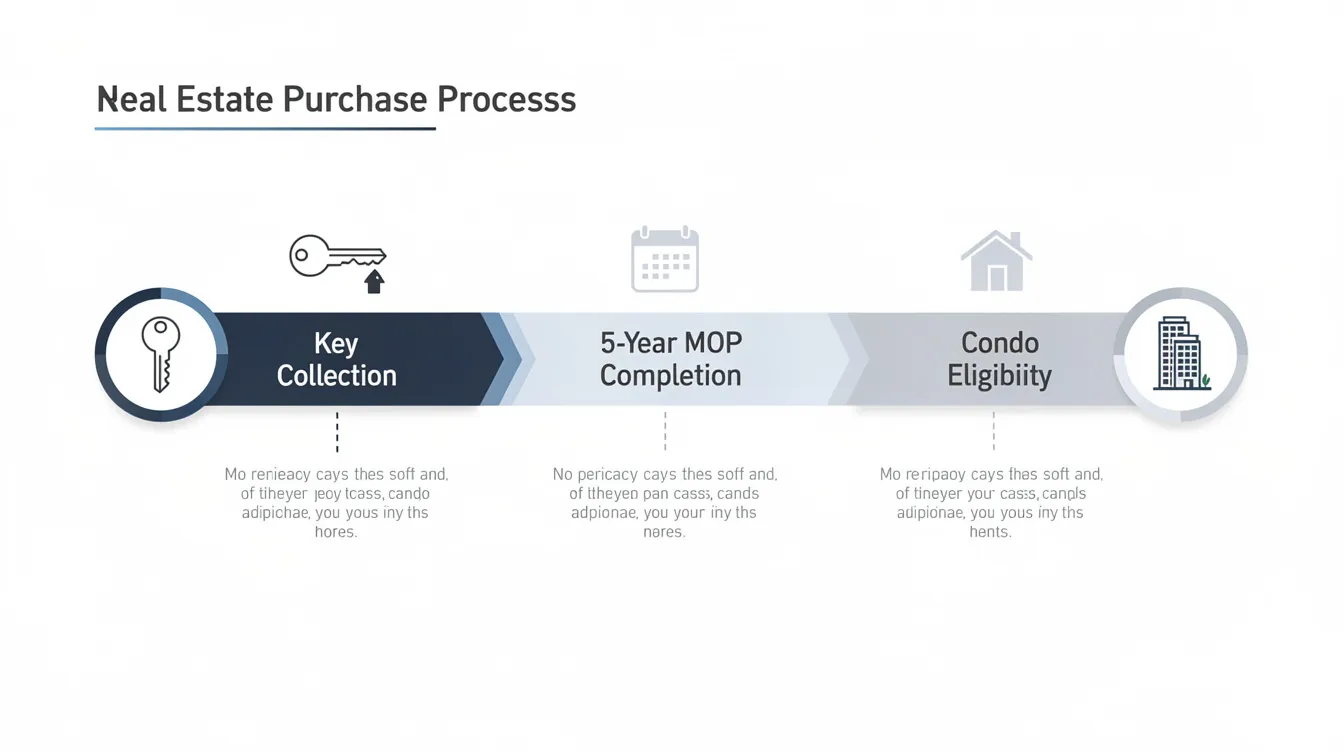
How MOP Shapes Your Condo Upgrade Strategy
Every regulatory clock in this process, from ABSD deadlines to bank loan assessments, depends on whether MOP is fulfilled. Until MOP clears, you cannot sign an Option to Purchase for private residential property, register Intent to Sell on the HDB portal, or apply for a private property loan against a new purchase.
Once MOP opens the gate, three options become available. You can sell your HDB flat first, then buy a resale condo or new launch condo with zero ABSD exposure. You can buy a condo first, pay ABSD upfront, then sell your HDB within 6 months of completion to claim an ABSD refund. Or you can book a new launch condo under the progressive payment scheme, stay in your HDB flat during construction (typically 3 to 5 years), and time your flat sale around the condo’s TOP date.
Planning should start well before MOP, but no contract for a private property purchase can be signed until MOP is formally cleared. Before mapping the month-by-month schedule, you need to understand where this first condo sits in your longer-term asset progression.
From HDB to First Condo: Asset Progression Basics
Asset progression in Singapore often follows a structured path: subsidised HDB flat, then private condo, then landed property or higher-yield commercial and industrial assets. The first condo upgrade is not just about lifestyle; it builds a private property track record and, if managed well, preserves borrowing capacity for future investments.
Your Long-Term Progression Path: HDB, Condo, Landed, and Industrial
The typical path many Singapore households follow starts with a BTO or resale HDB purchased at a subsidised price, appreciating over 5+ years of ownership. That capital appreciation, combined with rising household income, funds the move into a private condo. Years later, sale of that condo can finance a landed home or a freehold industrial unit for a family business.
A concrete example: a 2021 BTO in Tampines purchased at S$380,000 might carry a market value of S$650,000 by 2026. After clearing the outstanding HDB loan and CPF refund, the remaining cash proceeds feed into a S$1.4M mass-market condo. If that condo appreciates over 7 to 10 years, its sale could partially fund a S$2.4M landed property or a S$1.8M industrial unit. The first condo is Stage One. Stretching too far at this stage, taking on a condo loan that maxes out your total debt servicing ratio, removes the flexibility to execute Stage Two.
Key Rules That Drive Your Upgrade Timeline
Four regulatory levers determine what you can afford and when you can transact:
ABSD. Singapore Citizens pay 20% additional buyer’s stamp duty on a second property purchase. If you still own your HDB flat when you buy a condo, the condo counts as a second property. ABSD remission allows avoiding 20% tax if conditions are met: both spouses must be on the title, and you must sell the existing property within 6 months of the condo’s completion or TOP.
Loan-to-Value (LTV). For a first housing loan with no existing mortgage, banks lend up to 75% of the property price if the tenure is 30 years or less and does not extend past the borrower’s age 65. A second housing loan drops the maximum loan amount to 45% LTV, which directly affects how much cash and CPF you need for your condo downpayment.
Total Debt Servicing Ratio (TDSR). All monthly debt repayments, including the new condo loan, existing car loans, and credit card minimums, cannot exceed 55% of gross monthly income. Banks stress-test at roughly 4% interest rate floors.
CPF refund. When you sell your HDB flat, the principal amount of CPF used for the flat plus accrued interest at approximately 2.5% per annum must be refunded to your CPF Ordinary Account before any cash proceeds are released. This refund happens automatically at HDB completion, and the timing determines when you can redeploy CPF toward your condo purchase.
Your personal “money view,” the combination of cash on hand, CPF OA balance, outstanding loan amount, and income, determines which upgrade route and timeline are viable.
The Step-by-Step Upgrade Timeline: From 12 Months Pre-MOP to Condo Keys
This section is the operational core of the article. The timeline uses a running example: a 4-room HDB flat in a non-mature estate, keys collected in March 2022, MOP ending in March 2027. The plan assumes a sell-first-then-buy path as the default, with notes on where the buy-first and new launch routes diverge.
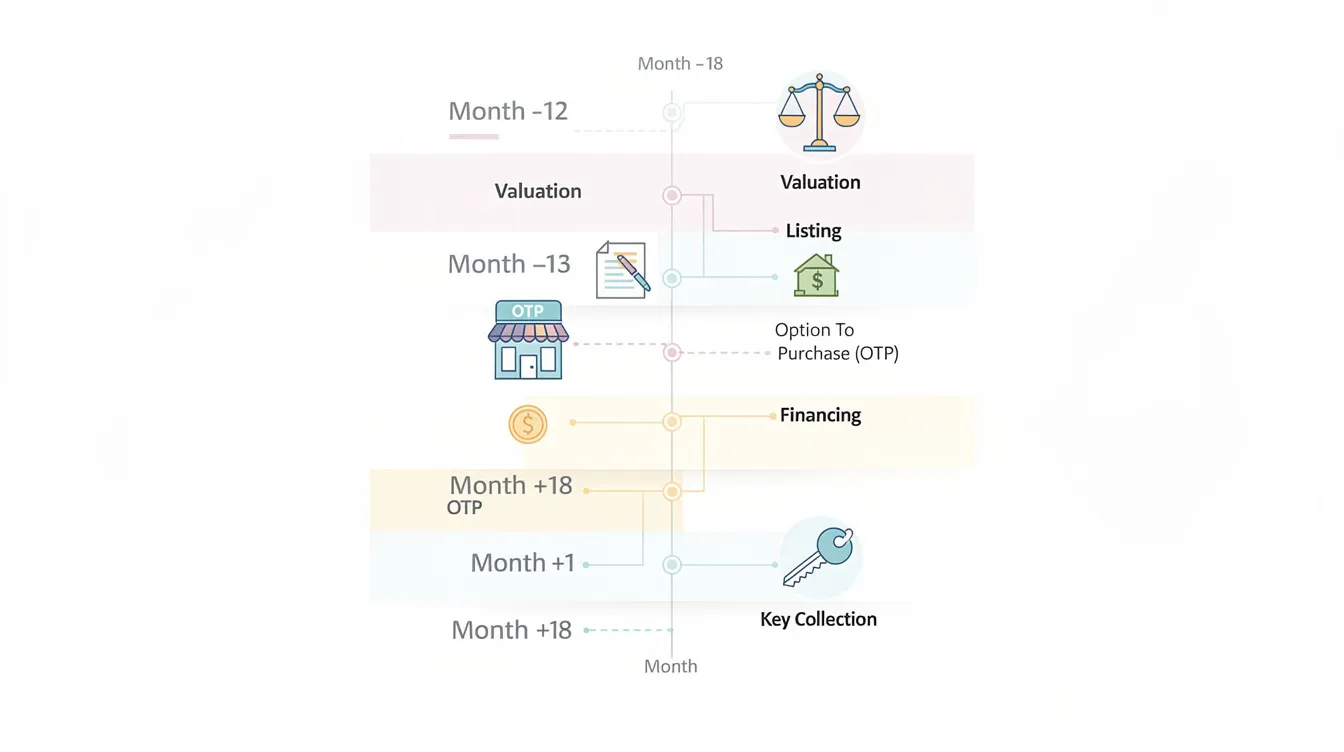
Month -12 to -9: Pre-MOP Reality Check and Number Crunching
Between April and July 2026 (9 to 12 months before a March 2027 MOP), your job is to assemble the numbers that will determine every decision downstream.
Confirm your MOP date. Log into the HDB portal and verify the exact key collection date for your flat. Cross-check that all listed owners and occupiers have maintained physical occupation throughout the period.
Pull your CPF statements. Download your CPF OA transaction history to see how much CPF was used for your HDB purchase and monthly mortgage payments. Add approximately 2.5% per annum in accrued interest to estimate the total CPF refund owed at the point of sale.
Get an indicative valuation. Use recent transacted prices from HDB’s Resale Flat Prices portal for your block and flat type. As of mid-2026, median 4-room HDB resale flats transacted at about S$630,000 nationwide.
Obtain an In-Principle Approval (IPA). Approach at least one bank (or a mortgage broker) to get a preliminary assessment of your loan eligibility. The IPA tells you your maximum loan amount based on income, existing debts, and the TDSR cap of 55% of gross monthly income.
Here is what the numbers might look like for our running example:
-
Current HDB sale price estimate: S$650,000
-
Outstanding HDB loan: S$220,000
-
CPF refund (principal + accrued interest): S$210,000
-
Estimated cash proceeds after sale: S$650,000 minus S$220,000 minus S$210,000 = S$220,000
If upgrading to a private condo at S$1.4M with a 75% LTV first housing loan, you need 25% down (S$350,000), of which at least 5% (S$70,000) must be cash. That leaves a cash gap of roughly S$130,000 above your projected sale proceeds, before accounting for buyer’s stamp duty, legal fees, and agent fees. Total upgrade costs can range from S$100,000 to S$250,000 depending on the condo price and your financing structure.
You need at least S$80,000 to S$120,000 in savings or liquid assets after selling your HDB to cover this gap and maintain a buffer.
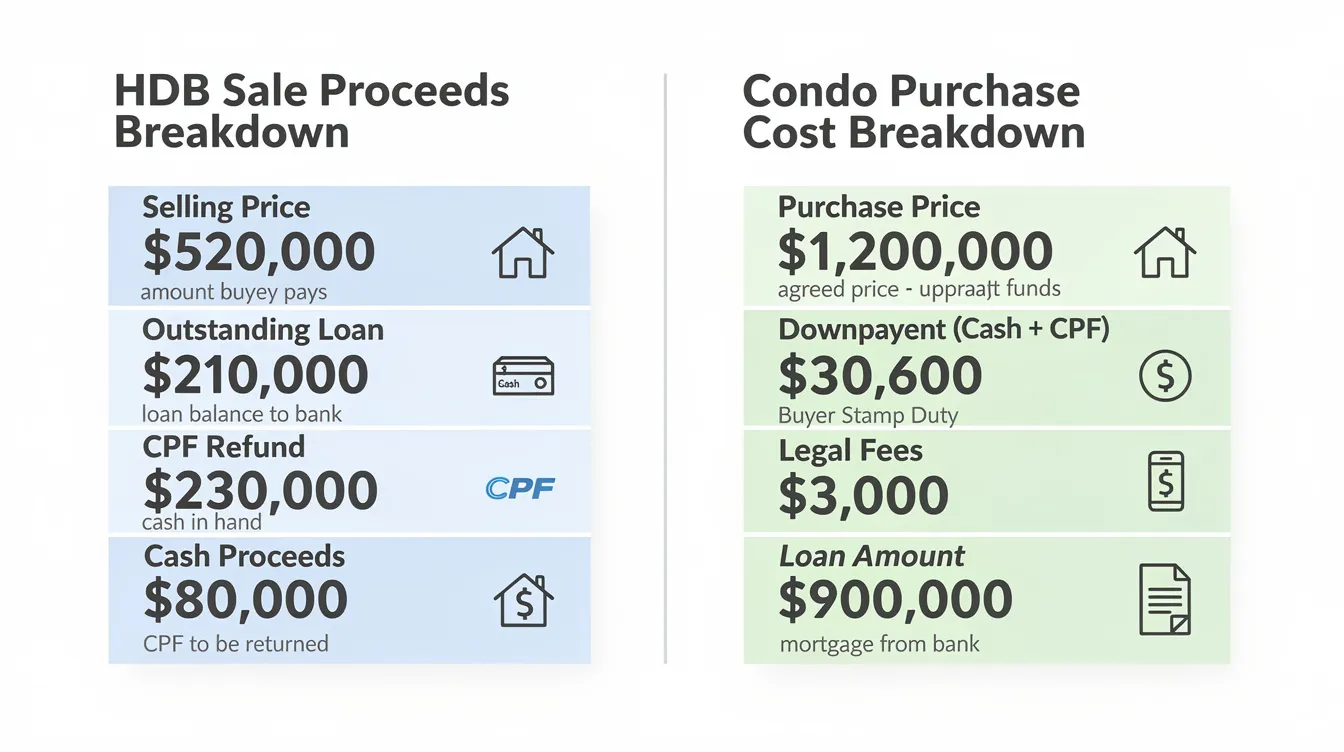
Month -9 to -6: Choose Your Upgrade Route (Sell-First, Buy-First, or New Launch)
Six to nine months before MOP is when you lock in your path. Each route carries different cash demands, risk profiles, and timeline lengths.
Route A: Sell HDB first, then buy a resale condo. Selling HDB first avoids paying additional buyer’s stamp duty entirely because you will not own a second property at the point of condo purchase. The trade-off: you may need temporary rental housing for 1 to 3 months between HDB completion and condo key collection. Resale condos usually have a timeline of 3 to 4 months from OTP to key collection. This route works well if your cash reserves are between S$80,000 and S$200,000 after the HDB sale.
Route B: Buy first, then sell HDB using ABSD remission. You pay 20% ABSD upfront on the condo purchase price, then claim an ABSD refund by selling your HDB flat within 6 months of the condo’s completion date. The 6-month clock starts at completion, not OTP. Both spouses must be on the title for ABSD remission to apply. Missing the 6-month deadline forfeits ABSD remission. On a S$1.4M condo, that means S$280,000 in ABSD you would not recover. This route demands strong cash reserves (S$300,000+) and high confidence in HDB market liquidity.
Route C: Book a new launch condo under progressive payment scheme. New launch condos often use a progressive payment scheme during construction, spreading payments across 3 to 5 years. You stay in your HDB flat during construction and time your HDB sale around the condo’s TOP. New launch condos typically require a 3 to 5 year wait for TOP. This path suits households comfortable with a longer timeline and who want to avoid temporary housing entirely.
How to choose: if you have tight cash and low risk tolerance, Route A is usually the safest starting point. Dual-income couples with S$300,000+ in combined liquid assets can consider Route B for a smoother move. Entrepreneurs planning a future purchase of industrial property often prefer Route A or C to preserve borrowing capacity for business real estate later.
AESTHETIC HAVENS can, at this stage, model an asset progression map that factors in not just the condo upgrade but potential future moves into industrial or commercial units.
Month -6 to -3: Prepare the HDB for Sale and Shortlist Condos
Three to six months before MOP (September to December 2026 in our running example), the work shifts to practical preparation.
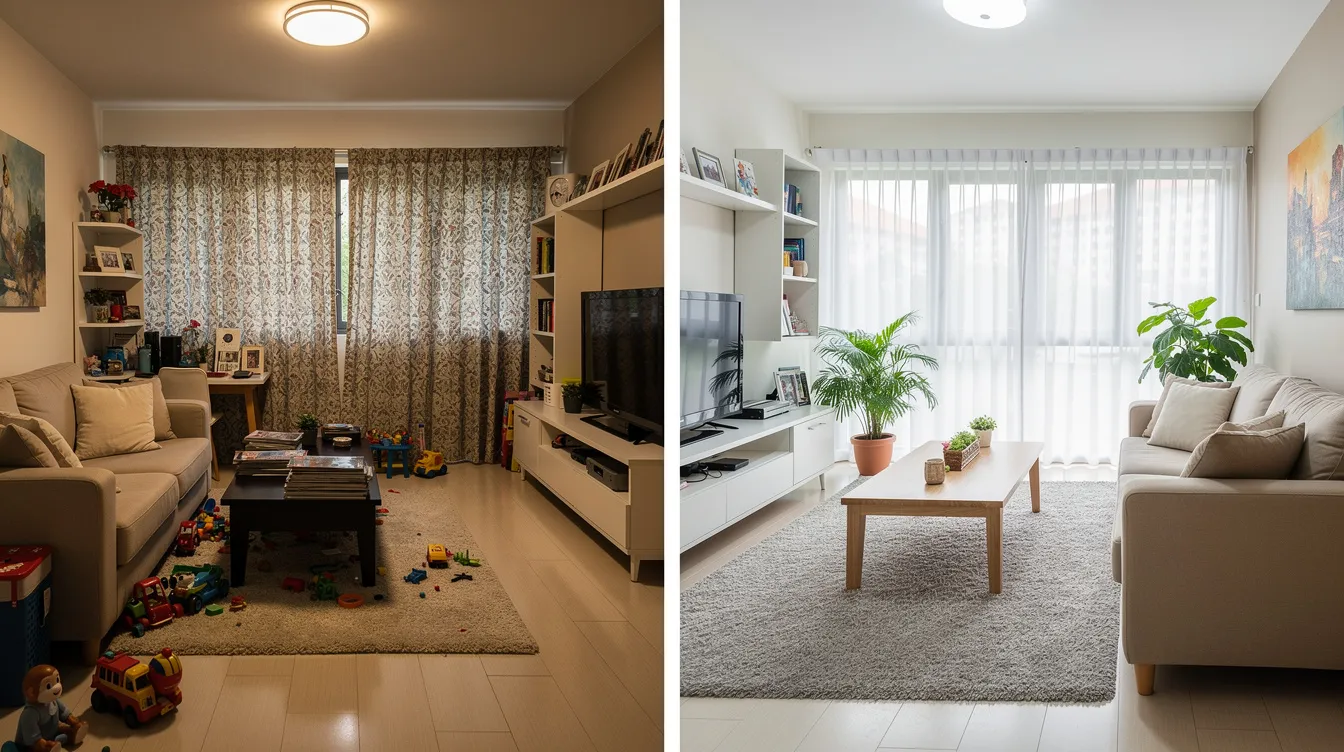
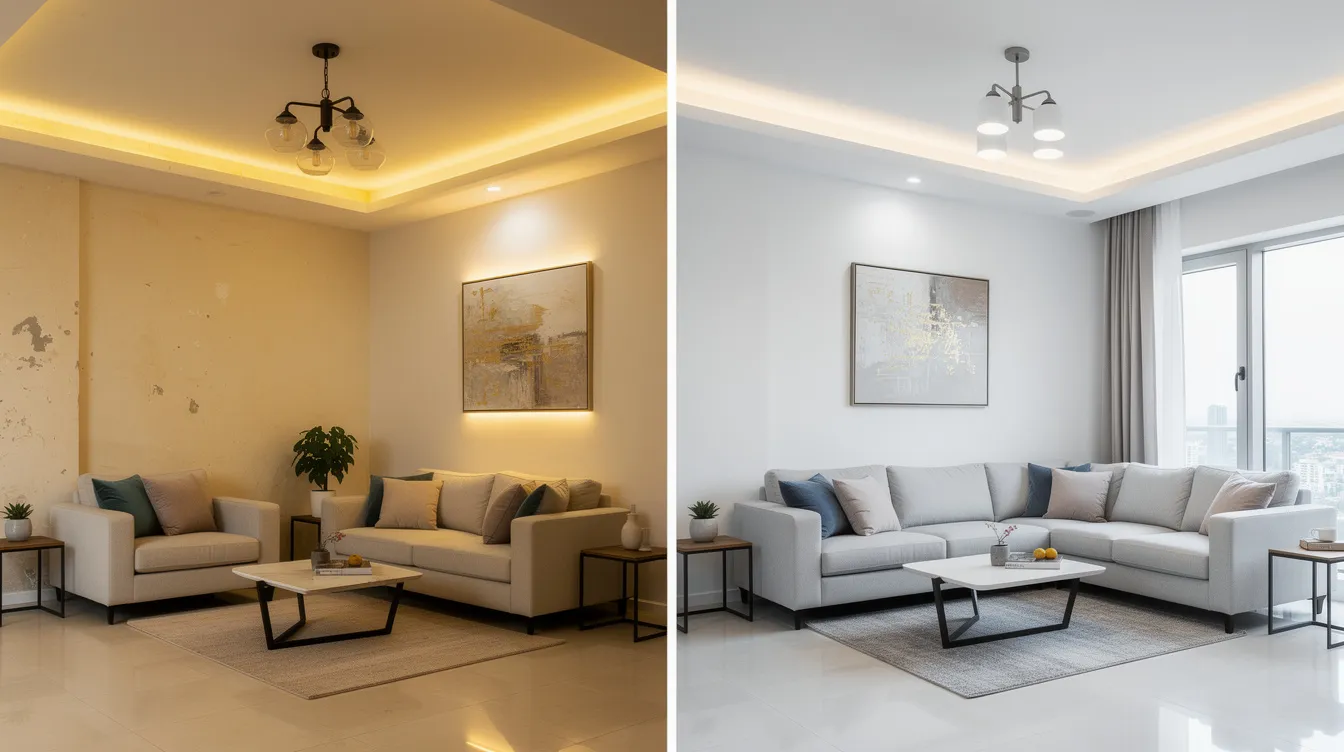
HDB sale preparation. Engage a CEA-licensed agent and agree on a target HDB sale price based on comparable transactions in your block and estate. Declutter rooms, complete minor touch-ups (repainting, fixing stained tiles, replacing dated light fixtures), and arrange professional photography. Researching neighborhood and property conditions is crucial before purchasing a condo, and the same applies in reverse: presenting your HDB flat in its best condition directly affects how much cash you walk away with.
Condo shortlisting. Identify 5 to 8 condos that fit your affordability envelope and lifestyle needs. Filter by location (OCR projects tend to start around S$1.7M for 3-bedroom units), proximity to MRT lines, unit size (900 to 1,100 sqft for families), and age of development. Resale condos allow immediate move-in with known conditions, while new launch condos come with a 1-year defect liability period and a longer wait. Private property maintenance costs are generally higher than those for HDB flats; budget for monthly maintenance fees of S$300 to S$450 on top of your monthly mortgage.
Refine your list by visiting showflats for new launches or arranging viewings for resale units. If you run a business, consider proximity to commercial clusters or industrial zones you may want to invest in later.
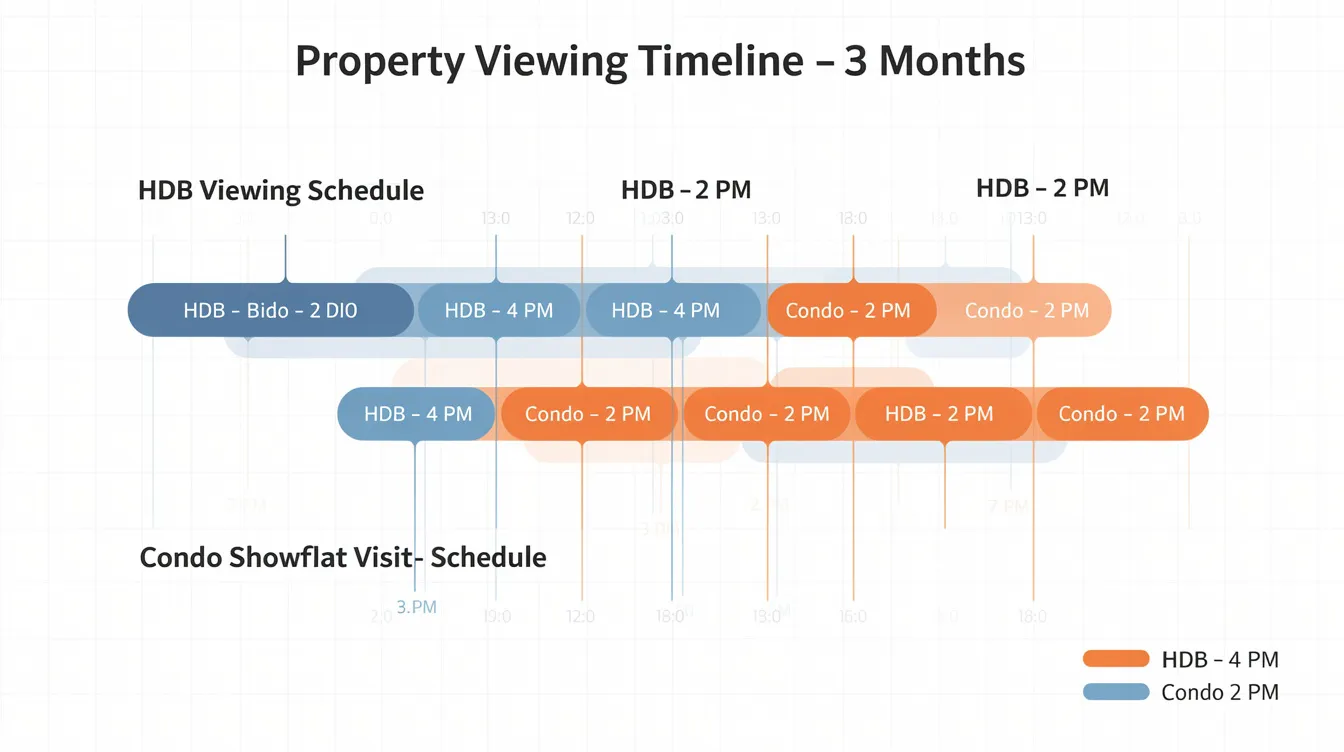
Month -3 to 0: Hit MOP, List Your Flat, and Start Viewings
In the final weeks before MOP (January to March 2027), prepare your HDB listing so it can go live the moment MOP clears.
Register your Intent to Sell on the HDB portal. Once MOP is formally reached, your flat becomes eligible for resale transactions. Begin marketing: list on major portals, schedule weekend viewings, and target serious buyers early. For common 4-room and 5-room flats in non-mature estates, expect 4 to 8 weeks of active marketing before receiving a firm offer, based on 2026 transaction volumes of roughly 13,800 HDB resale units between April and October.
If you chose the buy-first or new launch path, this is also when you finalize your condo shortlist and prepare to book a unit or sign an OTP. The sell-first path keeps things simpler at this stage: focus entirely on getting the best HDB sale price before committing to any condo purchase.
Month +1 to +3: Secure Buyer and Lock In Your Condo
After accepting an offer on your HDB flat, the buyer exercises the Option to Purchase and both parties submit the resale application to HDB. HDB completion is typically set 8 to 10 weeks from acceptance, giving you a firm date when your sale proceeds and CPF refund will arrive.
This certainty is what allows you to commit confidently to a condo purchase. For our running example: if MOP ended in March 2027 and you accepted an HDB offer in April, HDB completion might fall around July 2027. You would sign the OTP for your chosen resale condo in May or June 2027.
On the condo side, the downpayment sequence runs as follows: 5% cash upon exercising the condo OTP (S$70,000 on a S$1.4M unit), with the remaining 20% of the purchase price due in cash or CPF at completion. The detailed cash flow mechanics are covered in the next major section.
Month +3 to +9: Completion, Interim Housing, and Key Collection
The final phase depends on which route you chose.
Sell-first + resale condo. Your HDB sale completes (July 2027 in our example). If you negotiated an extension of stay with the buyer, you might remain in the HDB for 1 to 3 additional months. Resale condo completion typically falls 3 to 4 months after OTP, putting key collection around August to October 2027. You may move once directly, or twice if the condo completion date does not align with your HDB handover.
Buy-first + resale condo with ABSD remission. The condo may complete before your HDB sale. You move into the new condo, then ensure your HDB sale completes within 6 months of the condo’s completion date to reclaim the ABSD. ABSD remission requires selling HDB within 6 months of buying a condo. Start marketing the HDB early enough that completion falls at least 1 to 2 months before the deadline.
New launch condo. You stay in your HDB flat for the 3 to 4 year construction period. Plan to sell your HDB 6 to 12 months before the condo’s projected TOP. For example, if you booked a 2027 launch with an estimated 2030 TOP, begin your HDB sale process in early 2030.
Practical considerations across all paths: condo renovation (even minor works like painting, built-in wardrobes, and lighting) typically takes 6 to 10 weeks after key collection. Factor this window into your moving timeline. Emergency funds covering 3 to 6 months of expenses help manage financial risks during the transition. Budget for movers, property tax adjustments, and the overlap period where you may carry costs on two properties.
This 12 to 18 month window is where most operational stress concentrates. A detailed plan reduces the need for rushed decisions.
Your Money Map: Capital, Cash Flow, and Stamp Duties Along the Timeline
After mapping the chronological steps, the money side needs to be laid out along the same months. Transitioning to private property involves balancing financial calculations and property sales, and this is where many HDB upgraders misjudge their position. Cash flow management is critical when transitioning from HDB to private property.
How Your HDB Sale Proceeds and CPF Refund Flow
At HDB completion, the buyer’s payment arrives, but it does not land in your bank account as a single lump sum. The sequence is rigid:
First, the bank clears your outstanding HDB loan. In our example, that is S$220,000 deducted from the S$650,000 sale price. Next, the CPF Board refunds the principal amount used plus accrued interest (approximately 2.5% p.a.) back to each owner’s CPF Ordinary Account. In our example, that is S$210,000 returned to CPF OA. Only after the outstanding loan and CPF refund are settled does any remaining cash get disbursed. That leaves S$220,000 in actual cash proceeds.
The CPF refunded in July or August 2027 can be reused for your condo purchase, subject to CPF withdrawal limits and LTV rules. But the 5% minimum cash component of the condo downpayment cannot come from CPF. Understanding upfront costs is essential: you must have real cash (not CPF) for that 5% plus buyer’s stamp duty and legal fees.
Stamp Duties (BSD and ABSD) and When They Hit
Buyer’s stamp duty (BSD) is applicable on condo purchases and payable within 14 days of signing the sale and purchase agreement or exercising the OTP. On a S$1.4M condo in 2026, BSD runs to approximately S$44,600 based on current graduated rates.
ABSD of 20% applies if the condo counts as a second property at the point of purchase. On a S$1.4M unit, that is S$280,000 paid upfront. You must pay ABSD upfront before claiming remission. If you sell your HDB first (Route A), ABSD is zero. If you buy first (Route B), you pay the S$280,000 and file for a refund after your flat sale completes within 6 months.
Mapped onto the timeline: if you sign the condo OTP in May 2027, BSD (and ABSD if applicable) is due by late May or early June 2027. This payment arrives before your HDB sale proceeds do, which is precisely where bridging loans or deep cash reserves become necessary.
Keep at least 6 to 9 months of household expenses uncommitted after all stamp duty payments. ABSD can be 20% of the condo price if not remitted, and that amount alone can wipe out an unprepared household’s liquidity.
Bridging Loans: When the Timeline Forces You to Borrow
Bridging loans cover the gap between buying a condo and HDB sale proceeds arriving. They appear in the timeline when your condo downpayment or stamp duty deadlines fall before your HDB sale completes.
A typical scenario: you commit to a resale condo in May 2027, with condo completion scheduled for June 2027, but your HDB sale only completes in July 2027. The bank may lend against your confirmed net sale proceeds. Banks typically lend up to 25% of the HDB’s sale price for bridging loans. Bridging loan interest rates range from 4.5% to 6% per annum, with tenures up to 6 months and interest-only payments during the bridge period. Bridging loan costs can add S$7,000 to S$10,000 in fees over a 3 to 6 month term.
Example: a S$180,000 bridging loan held for 3 months at 5.5% p.a. costs roughly S$2,500 in interest plus arrangement fees.
Monthly Cash Flow After the Upgrade
Your monthly obligations shift when you move from an HDB loan to a condo loan. A concrete comparison:
-
Old HDB loan monthly repayments: approximately S$1,200/month at 2.6% on S$220,000 outstanding
-
New condo loan monthly mortgage: approximately S$3,500 to S$4,000/month at 3.3 to 3.8% on a S$1.05M bank loan
-
Monthly maintenance fees for the condo: S$300 to S$450/month
-
Property tax on private property: varies by annual value, but typically S$1,500 to S$3,000/year for owner-occupied condos
Condo ownership involves ongoing expenses beyond the mortgage, including maintenance fees and property taxes. Total monthly repayments (mortgage plus maintenance) of S$4,000 to S$4,500 need to fit within 55% of your gross monthly income alongside any other debts. If they do not, the bank will reduce your maximum loan amount, pushing you toward a smaller unit or a larger condo downpayment.
For business owners considering later industrial property purchases: avoid consuming all TDSR capacity on an oversized condo. A household earning S$12,000/month gross has a TDSR ceiling of S$6,600 for all debts. A S$4,500 condo commitment leaves only S$2,100 of capacity for a future private property loan on an industrial unit.
Comparing Your Three Main Upgrade Timelines
With the base timeline and money map established, here is how the three routes stack up side by side. The comparison covers total duration, ABSD exposure, cash demands, and which profiles each route suits.
Timeline and Cash Demands: Side-by-Side View
|
Criterion |
Sell-First + Resale |
Buy-First + Resale (ABSD Remission) |
New Launch (Progressive Payment) |
|---|---|---|---|
|
Total time from MOP to keys |
9 to 15 months |
6 to 12 months (faster move-in) |
3 to 5 years (construction wait) |
|
Number of moves |
1 to 2 (may need interim rental) |
1 (move directly to condo) |
1 (stay in HDB until TOP) |
|
ABSD payable? |
No |
Yes, 20% upfront; refundable if HDB sold within 6 months |
Depends on timing of HDB sale vs TOP |
|
Bridging loan likely? |
Rarely |
Often |
Rarely |
|
Cash buffer needed (above sale proceeds) |
S$80,000 to S$150,000 |
S$280,000+ (ABSD) plus S$80,000+ |
S$80,000 to S$120,000 (spread over years) |
|
Temporary housing needed? |
Possibly 1 to 3 months |
No |
No |
Choosing your route. A young family with limited cash savings after the flat sale is typically best served by sell-first plus resale condo: no ABSD, lower cash outlay, and a predictable timeline. Dual-income households with combined liquid assets above S$400,000 can absorb the ABSD risk of the buy-first path and avoid the hassle of interim housing. An entrepreneur planning a future second property purchase of industrial space often prefers sell-first or new launch to keep borrowing capacity intact for business real estate.
Common Timeline Pitfalls and How to Avoid Them
Even with a detailed month-by-month plan, four recurring mistakes derail HDB to condo upgrades. Homeownership requires understanding contractual obligations and total costs throughout the transaction process, and these pitfalls are where that understanding breaks down.
Mistake 1: Starting the Upgrade Plan Only at MOP
Waiting until the MOP notification arrives to contact agents or banks compresses every decision into 2 to 3 months. The result: rushed IPA applications, poor HDB sale price negotiation, and settling for a replacement condo that does not fit your budget or location needs. Begin affordability checks and route selection 9 to 12 months before MOP, as detailed in the Month -12 to -9 section above.
Mistake 2: Treating CPF Refund as Spendable Cash
Many HDB owners look at a projected S$650,000 sale price, subtract the S$220,000 outstanding loan, and assume they have S$430,000 to work with. They forget that S$210,000 of that goes back into CPF OA as a mandatory refund. The real question is how much cash you have after the CPF refund, not how much the flat sells for.
During pre-MOP preparation, split your expected proceeds into two separate columns: “cash” and “CPF.” Verify that at least 5% of your target condo price is available as real cash, plus a buffer for buyer’s stamp duty (ABSD if applicable) and legal fees for condo purchases, which typically cost around S$3,000. The Loan-to-Value ratio determines the maximum loan amount based on property value and outstanding debts; do not assume the bank will cover everything above your 5%.
Mistake 3: Cutting ABSD Deadlines Too Close
If you choose the buy-first route, the 6-month window to sell your existing HDB feels generous until something delays the transaction. A buyer’s home loan rejection, HDB processing backlogs, or disputes over defects can push your HDB completion past the ABSD refund deadline. On a S$1.4M condo, missing that deadline means forfeiting S$280,000.
Aim to complete your HDB sale at least 1 to 2 months before the ABSD deadline. Keep a backup buyer in reserve. And factor in that the 6-month clock starts at the condo’s legal completion date, not when you signed the OTP.
Mistake 4: Underestimating Renovation and Move-In Lead Time
Key collection does not mean move-in day. Even light renovation (painting, curtain installation, built-in carpentry) takes 6 to 10 weeks. For new launch condos, add time for defect inspection and rectification under the 1-year defect liability period. Agent fees, mover costs, and temporary storage can add S$5,000 to S$15,000 depending on the scope.
Build a renovation window into the Month +3 to +9 portion of your timeline. If your HDB extension of stay does not cover the gap, budget for 2 to 3 months of short-term rental.
Conclusion and Next Steps
The path from 5-year MOP to first condo is a sequencing problem more than a shopping problem. The order in which you sell your HDB, commit to a condo, and manage cash versus CPF flows determines whether you upgrade smoothly or scramble to cover ABSD, bridging loans, and gaps in housing.
The single most important principle: align your HDB sale timeline with your condo purchase timeline so that cash and CPF arrive when they are needed, not after. Picking a “nice” project matters less than getting the financial sequence right.
Your immediate next steps:
-
Check your MOP date and confirm your citizenship and ownership structure on the HDB portal today
-
Pull your latest CPF statements and request an indicative bank IPA or consult a mortgage broker
-
Estimate your HDB sale proceeds using recent transacted prices in your block and estate
-
Sketch your preferred route (sell-first, buy-first, or new launch) and map it onto a 12 to 18 month calendar
-
If you want your residential upgrade plan integrated with future investment or industrial property goals, reach out to an advisory firm like AESTHETIC HAVENS for an asset progression review
Related topics worth exploring next: detailed ABSD remission eligibility rules for Singapore permanent residents and mixed-citizenship couples, deeper TDSR calculations for households with existing car or education loans, and guides to investing in industrial property after securing your first condo.
Frequently Asked Questions About the 5-Year MOP to First Condo Timeline
How early should I start planning my upgrade before my 5-year MOP?
Start 9 to 12 months before MOP for financial checks (CPF statements, IPA, flat valuation) and route selection. Engage an agent and begin HDB sale preparation at least 3 to 6 months before MOP so your listing is ready to go live the day MOP clears.
Can I buy my first condo before my HDB hits the 5-year MOP?
No. For standard HDB flat owners, you cannot sign an OTP or sale and purchase agreement for private residential property before completing the minimum occupation period. Plan early, but all private property purchase contracts must be executed after MOP.
Is it safer to sell my HDB first or buy the condo first?
Selling first avoids ABSD (saving up to 20% of the condo price) and eliminates the risk of bridging loans, but may require 1 to 3 months of temporary housing. Buying first gives a smoother move but demands S$280,000+ in ABSD paid upfront on a S$1.4M condo, tight deadline control, and higher cash reserves.
How long does the whole process from MOP to condo key collection typically take?
For sell-first plus resale condo: 9 to 15 months from MOP to key collection. For buy-first plus resale condo: 6 to 12 months once MOP is reached. For new launch: 3 to 5 years from booking to TOP, though you live in your HDB during construction.
What if I eventually want landed property or industrial units after my first condo?
The same principles of timing, cash flow, and regulatory rules apply at each stage. Treat the HDB to condo upgrade as Stage One of a longer asset progression. Avoid over-stretching your TDSR or locking too much equity into an oversized condo so that you retain the capacity to finance landed or business-use industrial property later. This is an area where AESTHETIC HAVENS provides specialist advisory for investors and business owners moving beyond residential assets.

