

Introduction
If you’re planning a property upgrade – from HDB to condo, or condo to landed – while your child is approaching primary school age, P1 registration move house timing is one of the most consequential variables you’ll need to get right. Upgrading with kids in primary school demands more than financial planning; it requires precise alignment between your move-in date, your NRIC address update, and the Ministry of Education (MOE) registration calendar.
This guide is written for Singapore citizens and permanent residents who are owner-occupiers considering an upgrade along the asset progression ladder (HDB → condo → landed) and who have children born between roughly 2020 and 2023 – the cohorts entering Primary 1 between 2027 and 2030. International students and pure investment buyers fall outside the scope of this article.
Here is the direct answer: you should time your property move so that your new address is reflected on your NRIC before the P1 registration exercise opens for your child’s cohort (typically late June of the year before P1 entry), and you must be prepared to remain at that address for a minimum of 30 months from the exercise’s start date. Failing either condition can mean losing the home school distance advantage you moved for – or worse, having your child’s school place revoked.
By the end of this article, you will:
-
Understand exactly how the 30-month stay requirement works and when the clock starts
-
Know the key dates for P1 cohorts entering in 2027, 2028, and beyond – and what each means for your move timeline
-
See how typical upgrade timelines (selling HDB, buying resale condo, waiting for new-launch TOP) intersect with registration windows
-
Recognise the most common and costly mistakes families make when combining a property upgrade with P1 planning
-
Learn a step-by-step process to plan ahead and design a move that supports both education goals and long-term asset progression
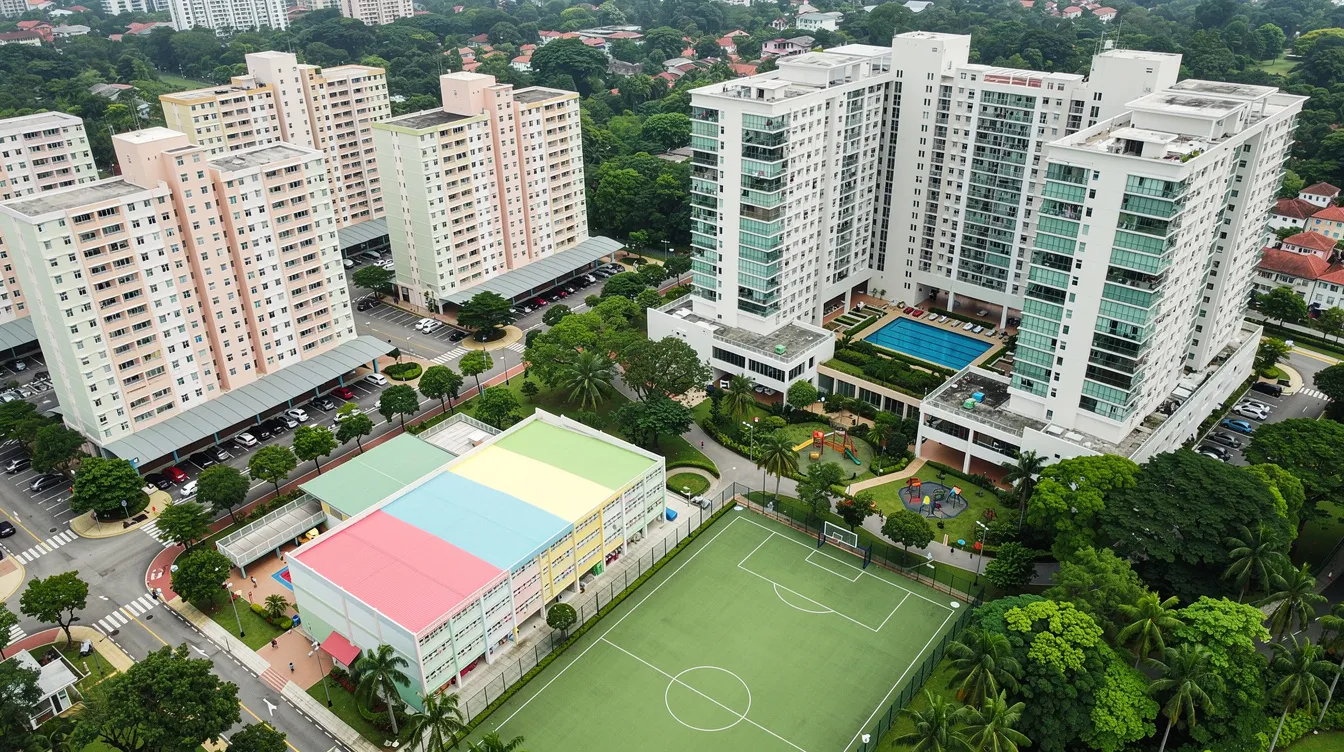
Understanding P1 Registration, Address Rules, and Distance Priority
The primary 1 registration exercise is an annual process run by the Ministry of Education (MOE), typically held from late June to mid-August in the year before a child enters Primary 1. Registration is conducted online through a government portal for Singapore Citizens and PRs. It proceeds through a sequence of phases – Phase 1, Phase 2A, Phase 2B, Phase 2C, Phase 2C Supplementary, and Phase 3 – each with distinct eligibility criteria that determine who can register and in what order.
For families planning a property upgrade, the reason this matters is straightforward: in the later and more open phases (particularly Phase 2C and Phase 2C Supplementary), when schools required balloting because more applicants applied than places available, admission priority is heavily influenced by how close you live to the school. Your home address – specifically, the registering parent’s NRIC address – determines which distance band you fall into, and that band can make or break your child’s chances at a preferred school.
Phase 1 is for children with an older sibling already enrolled in the school – no distance consideration applies. Phase 2A covers children whose parents are alumni members of the school’s alumni association, staff, or those connected to the school advisory or management committee. Phase 2B is for children of parents who have completed voluntary service (parents must volunteer at least 40 hours by June 30 to qualify for Phase 2B), those connected to a clan directly connected to the school, or children from an MOE kindergarten located within the school or co-located with it. By the time you reach Phase 2C, prior ties and prior connections have been exhausted. This is where distance priority becomes the primary differentiator for most families – and it’s precisely the phase where your property upgrade decision has the greatest impact.
Balloting occurs when applicants exceed available places in any phase. Within each school phase, Singapore citizens are prioritised before permanent residents, and within each citizenship group, applicants living closer to the school are given priority. So a family that upgraded from a flat beyond 2 km to a condo within 1 km of their target school could see a dramatic improvement in balloting odds – or vice versa, if they move away without realising the consequence.
The 30‑Month Stay Requirement and What It Really Means
The 30-month stay requirement is MOE’s mechanism for ensuring that families genuinely live where they claim to live, rather than using a temporary address to secure distance priority and then moving away. The Ministry of Education enforces a strict 30-month minimum stay requirement. In plain terms: if your child gains a place at a school partly because of home school distance priority, you must continue living at the address used for registration for at least 30 months.
The 30-month rule starts counting from the official start date of the P1 Registration Exercise – not from the date you move in, and not from the date your child starts school. For example, P1 registration for 2027 starts on 30 June 2026. If your child is born between 2 January 2020 and 1 January 2021, entering P1 in January 2027, the 30-month clock begins on 30 June 2026 and runs until approximately the end of December 2028 – well into your child’s P2 year.
For the next cohort – children born between 2 January 2021 and 1 January 2022, entering P1 in January 2028 – registration will take place around mid-2027, and the 30-month period would extend to roughly the end of 2029.
Moving away before the 30-month period ends can result in school transfer. MOE reserves the right to transfer your child to another school with available vacancies. This is not a theoretical risk: address discrepancies during registration may lead to the loss of school place, and MOE has increasingly investigated and penalised cases involving false address declarations. Using a “temporary” address – whether a short-term rental or a relative’s home – purely to gain distance priority while planning to move again soon is one of the riskiest strategies a family can pursue.
Families do not need to live at the address for a specific period before registration. What matters is that the address is reflected on your NRIC at the time of registration and that you commit to the 30-month residency from that point forward.
Home-School Distance Bands: 1km, 2km, and Beyond
MOE categorises home school distance into three bands:
-
Within 1 km of the school
-
1–2 km from the school
-
Beyond 2 km
Priority is given to children living within 1km of schools, followed by the 1–2 km band, and then beyond 2 km. This distance priority affects school admission during oversubscribed registration – it applies in Phases 2A to 2C Supplementary whenever balloting is required.
Distance is not measured by road or walking route. Home-school distance is calculated using the OneMap School Query tool, which measures the shortest straight-line distance from the school land boundary to the residential address. Home-school distance is based on the parent’s NRIC address – specifically, the address of whichever parent is the registering parent. Parents can also use MOE’s SchoolFinder to check which distance band their address falls into relative to specific schools.
Consider a concrete example: a family living in a 4-room HDB flat in Tampines might be beyond 2 km from a popular school in Bedok. If they upgrade to a resale condo in upper Bedok, they could shift into the 1–2 km band – or even within 1 km – for that same school. This single shift in distance band can transform their balloting odds from marginal to strong, particularly in Phase 2C where distance is the primary tiebreaker after citizenship status.
Property prices in certain estates reflect this reality. Resale condos and landed homes within the 1 km ring of popular schools like Anglo Chinese School, Tao Nan School, or Margaret’s School consistently attract premiums. Whether that premium is justified depends on your family’s full financial picture – a point we return to in the challenges section below.
Which Address Counts for P1 Registration?
The address used for registration must be reflected on the parents’ NRICs. If spouses hold different NRIC addresses, they must select which parent’s address to use – but the child must genuinely reside at that address, and the 30-month requirement applies to it. You must update your NRIC address within 28 days of moving, as required by Singapore law (National Registration Act).
For families purchasing a resale property (HDB flat or private), the key requirement is evidence that the purchase is in progress (Option to Purchase exercised, stamp duty paid) and that the family will physically move in and occupy the home. Specific timing rules apply for the 30-month commitment of a resale property – the clock generally starts from the commencement of the registration exercise if you are already living there, or from your actual move-in date if occupancy begins later.
For new launch properties (condo or landed under construction), MOE permits using that address only if the vacant possession date of the new property must be within 2 years of the child’s entry into P1. This is the legally binding Vacant Possession Date (VPD) or Delivery Possession Date (DPD) stated in your Sale & Purchase Agreement – not the developer’s estimated or expected TOP. If your new launch condo has a VPD of 2030 but your child enters P1 in 2027, MOE will not accept that address.
There is also the caregiver’s address option: if both parents work full time and the child is cared for by a grandparent or parent’s sibling, that caregiver’s address may be used – but only after a formal declaration to MOE before Phase 2C, and the same stay requirements apply. This is not a casual workaround; MOE scrutinises these declarations.
Edge cases to be aware of: registering under a grandparent’s address without the child actually residing there is treated as a false declaration. Similarly, renting a flat near a school for 6–12 months just to register, with the intention of moving out afterward, puts you at real risk of losing the school place.

How P1 Registration Timelines Interact With Your Property Upgrade
With the foundational rules established, the practical question becomes: how do you map your property upgrade timeline onto the P1 registration calendar so that everything aligns?
The concept is simple but the execution is not. You need to “back-plan” from your child’s P1 year to determine the latest safe dates to change your NRIC address, exercise your Option to Purchase, complete your renovation, and physically move in. The best time to move is ideally 18–24 months before registration – giving you enough buffer for transaction delays, renovation, and NRIC updates, while still fitting comfortably within the 30-month stay window.
For most families pursuing the HDB → condo → landed asset progression, the property transaction itself takes months. Layering P1 registration timing on top of that means starting serious planning far earlier than many parents expect.
Key Dates by Cohort: When Registration Happens vs When You Move
The annual P1 registration window typically runs from late June to mid-August. For the 2026 exercise (covering P1 entry in January 2027), registration ran from 30 June to 18 August 2026, with phases proceeding sequentially: Phase 1 (30 June–2 July), Phase 2A (9–10 July), Phase 2B (20–21 July), Phase 2C (28–30 July), and Phase 2C Supplementary shortly after. Results for the final supplementary phase were published on 27 August.
Here’s how this maps to specific cohorts:
Cohort 1: Children born 2 Jan 2020 – 1 Jan 2021 → P1 in January 2027 Registration exercise opened 30 June 2026. To use a new home’s address for distance priority, NRIC should have been updated before that date. The 30-month stay requirement runs from 30 June 2026 to approximately end of December 2028. If you bought a new property and moved in after June 2026, you may have missed the address deadline for this cohort.
Cohort 2: Children born 2 Jan 2021 – 1 Jan 2022 → P1 in January 2028 Registration exercise will be held around mid-2027 (exact dates not yet published as of late 2026). The 30-month period would run from approximately June 2027 to end of 2029. For new-launch properties, VPD must be by end of 2029 (within 2 years of January 2028 entry). Families targeting this cohort should aim to have their property move completed and NRIC updated by mid-2027 at the latest.
Cohort 3: Children born 2 Jan 2022 – 1 Jan 2023 → P1 in January 2029 Registration around mid-2028. Families still have substantial runway to plan an upgrade, including potentially purchasing a new launch with a realistic VPD.
The critical takeaway: your NRIC address must already reflect your new home before registration opens. If it doesn’t, MOE uses your old address – and any distance advantage from your upgrade is lost.
Typical Upgrade Timelines (HDB → Condo → Landed)
Understanding how long each property transaction takes is essential for back-planning:
-
Selling an HDB flat: Typically 3–6 months from listing to completion, depending on market conditions and buyer financing. Add time for HDB’s resale approval process.
-
Buying a resale condo: From viewing to legal completion usually takes 3–4 months (Option to Purchase → exercise → completion). Renovation may add another 1–3 months before move-in.
-
New launch condo: From purchase to TOP/VPD is typically 2–5 years for private projects. This long lead time makes new launches suitable only for families whose child’s P1 entry is still several years away.
-
Landed property (new build or A&A): Highly variable – 1–3 years depending on scope. Resale landed with immediate vacancy is faster but may still require significant renovation.
The contrast is stark: a resale condo purchase can be completed and occupied within 4–7 months. A new launch purchase made today might not deliver vacant possession for 3–4 years. If your child’s P1 registration is 18 months away, a new launch is almost certainly too late – you’d need to target resale or remain at your current address.
For families whose child is entering P1 in 2028 (registration mid-2027), serious property marketing and shortlisting should ideally begin by early 2026, with the aim of completing the purchase, moving in, and updating NRIC by Q1 2027. Waiting until late 2026 or early 2027 to start the process risks missing the registration window.
Scenario Mapping: Upgrade Timing for Different Child Ages
Scenario A: K1 in 2025, P1 in 2028 This family has roughly two years before the 2027 registration exercise. They are upgrading from a 4-room HDB flat to an OCR condo near a popular primary school in Marine Parade or a similar mature estate. Timeline is workable: sell HDB in mid-2026, buy and complete resale condo by late 2026 or early 2027, renovate and move in by Q1 2027, update NRIC immediately. The 30-month clock starts around June 2027 and runs to end-2029. This scenario is realistic and achievable with disciplined planning.
Scenario B: K2 in 2025, P1 in 2027 This family’s registration exercise was in mid-2026. If they haven’t already moved, it’s too late to rely on a new launch. Their options are: (a) pursue a resale purchase and complete it before June 2026, which is extremely tight; (b) remain at their current address and register from there, accepting whatever distance band that provides; or (c) if they’ve already secured an offer on a resale condo, accelerate completion. Rushing a purchase purely for P1 registration is financially risky if it means overpaying or compromising on due diligence.
Scenario C: Child in P2/P3 now, planning upgrade to landed before younger sibling’s P1 This family has more time and more complexity. The elder child’s school is set, but the younger sibling’s cohort (say P1 in 2029 or 2030) gives them a 3–4 year window. They can consider a landed property purchase – even a new build – provided the VPD falls within 2 years of the younger child’s P1 entry. The key risk is focusing solely on the younger child’s P1 needs while disrupting the elder child’s commute or routine. Multi-child planning over an 8–10 year horizon is essential.
Designing a Property Upgrade Plan Around P1 Registration
This section moves from understanding to execution. In practice, the families who navigate this most successfully are those who treat the property upgrade and P1 registration as a single integrated plan – not two separate projects running in parallel. The goal is balancing education goals with financial prudence (ABSD, MSR/TDSR constraints, cash flow) and operational realities like renovation timelines, children’s commutes, and caregiving arrangements.
Step‑by‑Step Planning Process
-
Fix your child’s cohort and target schools. Identify your child’s P1 entry year based on their birth date, then shortlist 3–5 realistic schools. Don’t fixate on a single “good school” – cast a wider net to give yourself more flexibility in where you choose to live.
-
Check distance from current home vs potential new estates. Use the OneMap School Query Service and MOE SchoolFinder to determine which distance band your current and potential addresses fall into for each target school. Even a few hundred metres can shift you between bands.
-
Work out latest “safe-by” dates for address change. Count backward from the registration exercise start date (typically late June). Your NRIC must reflect the new address by then. Allow at least 2–3 months of buffer for completion delays.
-
Assess finances and loan eligibility. Factor in HDB resale proceeds, CPF refunds, Additional Buyer’s Stamp Duty (ABSD) if applicable, and your loan-to-value and Total Debt Servicing Ratio (TDSR) limits. An upgrade that stretches you financially to breaking point is counterproductive regardless of school outcomes.
-
Decide between resale vs new launch. If P1 registration is less than 2 years away, a resale property is almost always the only viable option. New launches only work if VPD is within 2 years of your child’s P1 entry – confirm this with the actual Sale & Purchase Agreement, not marketing brochures.
-
Sequence sale and purchase carefully. Decide whether to sell first (lower risk, possible interim rental) or buy first (bridging loan, higher carrying cost). If interim rental is needed, ensure it’s at the address you intend to register under and that you can commit to 30 months there.
-
Lock in address change and document trail. Update your NRIC within 28 days of moving (legal requirement). Keep documentation – tenancy agreements, utility bills, renovation contracts – to demonstrate genuine residence if ever queried by MOE.
Comparing Address Strategies for P1 and Asset Progression
|
Criterion |
Strategy A: Stay Put Until After P1 |
Strategy B: Move Just Before P1 for Distance |
Strategy C: Move Early and Hold Through Lower Primary |
|---|---|---|---|
|
P1 distance priority |
Limited to current address band; no change |
Potentially significant improvement |
Best possible alignment if target estate chosen well |
|
Financial flexibility |
Maximum – no rushed transactions |
Moderate – tight timeline may limit negotiation |
Good – more time to find value |
|
Disruption to child |
Minimal |
Moderate – move during kindergarten |
Low – child settles before P1 |
|
Risk of breaching 30‑month rule |
None (not moving) |
Higher – tight margins for move-in and stay |
Lowest – ample time built in |
|
Impact on long‑term asset progression |
May miss optimal buying window |
Acceptable if purchase is sound |
Best – property held longer, more appreciation potential |
Which strategy fits which family? Families with strong existing distance advantages or more children approaching P1 in coming years may benefit from Strategy A – staying put reduces risk. Families with equity built up over years and a clear target estate should consider Strategy C if timeline allows. Strategy B is the most common but also the most stressful; it works best for families with a single child and a clear, nearby resale target.
When Interim Rental Makes Sense (and When It Doesn’t)
Some families consider renting near a desired school to establish an address for Phase 2C registration. This can be legitimate – tenants can use their rental address for registration – but the 30-month stay requirement applies equally. Families must reside at the registered address for at least 30 months for distance priority. That means committing to at least 2.5 years of rent, which at current market rates for a 3-bedroom unit near popular schools could easily exceed $90,000–$120,000.
Interim rental makes financial sense in narrow circumstances: when you’ve sold your existing property, are waiting for a new home to complete, and the rental happens to be near your target school. It makes less sense when the rental is purely to game the system – short-term leases of 6–12 months entered into specifically for registration and abandoned afterward. MOE actively investigates such cases, and enforcement has tightened. If a rental strategy costs more than the property premium of simply buying in the right estate, the maths doesn’t work.
Common Challenges and How to Avoid Costly Mistakes
Combining a major property upgrade with P1 registration planning is one of the most stressful intersections of family life and financial decision-making. The stakes feel high on both fronts – and the emotional pressure can lead to rushed decisions. Below are the patterns that trip families up most often, along with practical solutions.
Problem 1: Upgrading Too Late for the Intended P1 Cohort
The symptom: OTP exercised close to or after the registration window opens. TOP dates slip. NRIC address not updated in time. The family discovers – too late – that their new address won’t count for this year’s registration exercise.
The solution: Map out timelines at least 24–30 months ahead of your target registration exercise. If you’ve already missed the window, adjust expectations: register using your current address, broaden your school list to include strong neighbourhood schools within range, and plan ahead for any subsequent upgrade after P1 is secured. Rushing a purchase under time pressure almost always means overpaying or compromising on due diligence.
Problem 2: Over-Stretching Finances for a “Brand-Name” School
The symptom: Buying an expensive condo or landed property solely to live within 1 km of a “brand-name” school such as Anglo Chinese School, Tao Nan School, or Methodist Girls School – even when the price premium is disproportionate and cash flow becomes dangerously tight.
The solution: Stress-test your finances under MAS’s TDSR and MSR rules at higher interest rate scenarios. Consider that many schools – including strong neighbourhood schools that don’t carry the same cachet – produce excellent educational outcomes. A good school is one where your child thrives, not necessarily one where balloting pressure is most intense. The premium paid for proximity to such school may not translate into proportional educational advantage. Weigh the premium against alternative options: buying in a slightly less “branded” estate that’s still within 2 km, or upgrading after P1 when the time pressure is removed.
Problem 3: Misunderstanding Address and 30‑Month Rules
The symptom: Assuming you can move out shortly after P1 starts. Registering under grandparents’ address without the child actually living there. Not counting the 30-month period correctly (e.g., counting from P1 start date instead of from the registration exercise start date).
The solution: The 30-month stay requirement begins from the start of the P1 registration exercise – not from the first day of school. Confirm the exact start date for your child’s cohort. If you plan to use a caregiver’s address, ensure the formal declaration is made before Phase 2C and that the arrangement is genuine and ongoing. In borderline cases, maintain documentation of actual residence: utility bills, internet subscriptions, children’s enrichment class addresses, and similar evidence.
Problem 4: Forgetting About Siblings and Future Upgrades
The symptom: Optimising everything around the first child’s P1 registration, then realising that a second upgrade (or the 30-month stay commitment) creates complications for a younger sibling’s P1 cohort or the family’s broader asset progression plans.
The solution: If you have more children who will enter primary school in subsequent years, plan across a multi-child horizon of 8–10 years. Remember that Phase 1 gives automatic priority to children with an older sibling already in the school – so once your first child secures a place, younger siblings benefit from that connection rather than distance priority. Factor this sibling advantage into your decision about whether to stay or move. Also consider that new rules – like the two track scheme being introduced for the 2027 registration exercise – may change the calculus for later cohorts.
Conclusion and Actionable Next Steps
Smart P1 registration move house timing is fundamentally about alignment: aligning your property transaction timeline with the registration calendar, your NRIC update with the exercise start date, and your 30-month residency commitment with your broader financial and family plans. When done well, it supports both your child’s education and your long-term asset progression. When done poorly, it can mean overpaying for property, losing a school place, or being locked into a home longer than intended.
Here are the immediate actions you can take this month:
-
Confirm your child’s cohort: Determine their P1 entry year based on birth date, and identify the corresponding registration exercise year.
-
Check distance bands: Use OneMap and MOE SchoolFinder to see where your current address and any target addresses fall relative to your shortlisted schools.
-
Sketch a rough move timeline: Count backward from the registration exercise start date (late June of the year before P1 entry) by at least 18 months to set your “start the upgrade process” date.
-
Review your financial position: Assess CPF balances, outstanding mortgage, potential ABSD exposure, and TDSR headroom before committing to an upgrade.
-
Consult with a property adviser: If you also own commercial or industrial property, your loan capacity and ABSD obligations may be more complex than for a straightforward HDB-to-condo upgrader.
Related topics worth exploring as you plan: understanding ABSD implications for upgraders, financing strategies for the HDB → condo → landed transition, and evaluating neighbourhood vs “brand-name” schools when choosing where to live.
Additional Resources and Visual Aids
Useful official links for parents planning around P1 registration:
-
MOE P1 Registration Portal – official registration site with cohort dates and phase details
-
OneMap School Query Service – check distance from any address to any primary school
-
MOE SchoolFinder – browse schools by location, programme, and distance band
-
HDB Resale Portal – for families selling HDB as part of their upgrade
Suggested visual elements for this article:
-
Timeline infographic showing the progression: child’s birth year → P1 entry year → registration window → 30-month stay period, mapped against property transaction milestones (OTP, completion, move-in, NRIC update)
-
Distance band map illustrating how a family upgrading from one estate to another shifts between the 1 km, 1–2 km, and beyond 2 km bands for a sample school
-
Planning flowchart summarising the step-by-step process from “Confirm cohort” through “Lock in address and document trail”
All visuals should be clean, mobile-friendly, and use Singapore-specific imagery (HDB blocks, condos, landed houses, school buildings) with clear labelling for parents scanning on their phones.
Frequently Asked Questions (FAQ)
Below are the specific timing and address questions families most frequently ask when planning a property upgrade around P1 registration.
If My Child Is Entering P1 in 2027, When Is the Latest I Should Move?
Your NRIC address should ideally be updated before 30 June 2026, which is when the registration exercise for the 2027 P1 intake commenced. If you want distance priority at a new address, the address must be reflected on your NRIC by the time your relevant phase opens. You must then remain at that address for at least 30 months – until approximately end of December 2028. If your child is entering P1 in 2028, the same logic applies: aim to have your move completed and NRIC updated before the 2027 registration exercise opens (expected mid-2027).
Can I Register Using a New Launch Condo Address Before It TOPs?
Yes, but only if the vacant possession date of the new property is within 2 years of your child’s entry into P1. MOE requires the actual Vacant Possession Date or Delivery Possession Date from your Sale & Purchase Agreement – not the developer’s estimated or projected TOP. You must also commit to moving in when the property is ready and submit supporting documents during registration. If your new launch won’t deliver possession within that 2-year window, you cannot use that address.
What Happens If We Sell Our Home Before Completing the 30 Months?
MOE has the stated right to transfer your child to another school with available vacancies if the 30-month stay requirement is not fulfilled. In practice, this means your child could be moved from your preferred school to whichever school has openings – potentially far from both your old and new addresses. The risk is real and has been enforced. If you must sell before the 30 months are up, understand that you are accepting this risk.
Should I Delay Upgrading Until After My Child Secures a Primary School Place?
This is a trade-off between certainty on the education front and potentially missing a favourable window for asset progression. Delaying gives you full flexibility to register from your current address without time pressure, then upgrade at your own pace afterward. However, property markets don’t pause for P1 registration – if prices in your target estate are rising or if loan conditions are favourable now, waiting 1–2 years could cost more than the stress saved. The strongest approach is to evaluate both scenarios with concrete numbers: what does waiting cost financially, and what does rushing cost in terms of risk? Many families benefit from discussing both paths with a property adviser who understands the full picture – including any commercial or industrial holdings that affect loan capacity.
How Do the 2027 Registration Exercise Changes Affect My Planning?
Several significant changes take effect from the 2027 P1 registration exercise (for children entering P1 in 2028). Phase 2C reserved places will increase from 40 to 60 at most schools with intakes of 180 or more students, giving families without prior ties to a school slightly more room. Additionally, twelve schools will implement a two-track system for Phase 2C: thirty spots are reserved for applicants living within 2km, with the remaining spots for those beyond 2km. Critically, the two-track system will not prioritize distance within tracks – meaning that within each track, being at 0.5 km offers no advantage over being at 1.8 km. These changes aim to improve social mixing in primary schools and to widen access for families from different backgrounds, including areas where public housing makes up less than 40% of residences within 2 km. For upgrading families, this means getting within the 2 km boundary becomes the key threshold at those 12 schools, rather than obsessing over being inside 1 km. The new rules apply to the 2027 registration exercise, so families with children entering P1 in 2028 should factor these structural changes into their planning immediately.

