

Introduction
When you sell your property in Singapore, the sale proceeds must first refund the CPF principal you withdrew plus 2.5% per annum compounded accrued interest back to your CPF account – and this mandatory CPF refund is exactly why your CPF account appears to “owe money” at the point of sale. Many homeowners are caught off guard when they realise that after clearing the outstanding mortgage and restoring their CPF savings, they walk away with far less cash than expected, or sometimes none at all.
This article focuses on Singapore’s CPF Ordinary Account (OA) housing usage, the 2.5% compounded accrued interest mechanism, and how these rules play out when you sell your property – whether it is an HDB flat or a private condominium. It does not cover CPF Special Account or Retirement Account investing, CPF Investment Scheme matters, or foreign property transactions. If you are a homeowner planning to upgrade, a business owner balancing residential housing with industrial or commercial investments, or simply trying to understand why your net cash proceeds look so low, this guide is written for you.
In short: accrued interest is not a penalty but a mechanism to restore retirement savings. Every dollar of CPF funds withdrawn for your home purchase – from downpayment to monthly instalments – accumulates notional interest at 2.5% per annum, compounded annually. When you eventually sell, refunding CPF includes principal and accrued interest upon sale, which can significantly reduce or even eliminate your cash proceeds.
By reading this article, you will learn:
-
What CPF accrued interest is and why the CPF Board requires it
-
How 2.5% compounding works in practice across 10, 20, and 30-year holding periods
-
Why selling your property can result in zero or negative cash proceeds
-
How to check your own accrued interest and refund amount using CPF’s online tools
-
Strategies to reduce accrued interest and plan your next property purchase – including industrial or commercial acquisitions
Understanding CPF Accrued Interest on Housing
CPF accrued interest is the notional interest your Ordinary Account savings would have earned at 2.5% per annum had you not withdrawn them for housing. Because CPF savings are designed primarily to fund retirement, the system tracks this “would-have-earned” interest so that when you sell your property, your retirement funds are restored to roughly where they would have been. Refunding CPF preserves funds for retirement needs – it is not a fee or fine, but a safeguard built into Singapore’s social security framework.
Once you use CPF OA money for a property purchase, those specific funds leave your account and stop earning interest. The CPF Board then calculates accrued interest on every dollar withdrawn from the CPF for property-related expenses – including downpayment, monthly mortgage instalments, stamp duties, legal fees, Home Protection Scheme (HPS) premiums, and even housing grants received for the property.
How the 2.5% CPF OA Interest Rate Works
CPF accrued interest is currently 2.5% per annum – the floor rate for the Ordinary Account. This rate is reviewed quarterly but has remained stable through 2026. For accrued interest calculations on housing, only the standard 2.5% OA rate applies; the extra interest earned on the first $60,000 of combined CPF balances relates to different account mechanics and does not affect the housing refund computation.
The compounding works as follows: interest is computed monthly on each withdrawal from its own withdrawal date, then compounded annually. In simple terms, each year’s interest is added back to the principal amount, so the following year’s interest is calculated on a larger base. This is the compound effect that makes early CPF usage particularly costly over long holding periods.
Consider a straightforward example. If you used $100,000 from your CPF OA for a home purchase in 2016, by 2026 your accrued interest at 2.5% per annum compounded over 10 years would be approximately $28,000. That means you must refund about $128,000 – the CPF principal plus all the interest it would have earned – when you sell your property.
What Exactly Is “CPF Accrued Interest” on Your Property?
Accrued interest in CPF is the interest your withdrawn savings would have earned, calculated at 2.5% per annum from each withdrawal date until the date the property sale is completed. It applies to every dollar withdrawn from the CPF for property-related expenses, and the total across all such withdrawals forms your accrued interest obligation.
Critically, accrued interest is not a penalty but a mechanism to restore retirement savings. The refund amount – principal plus accrued interest – goes back into your own CPF account. No money is paid to the CPF Board as a charge; you are simply replenishing your retirement pot.
The common components included in the principal amount on which accrued interest is calculated are:
-
Purchase downpayment paid from CPF OA
-
Monthly mortgage instalments funded from CPF OA
-
Buyer’s Stamp Duty and legal fees paid via CPF
-
Housing grants credited to your CPF for the property
-
Home Protection Scheme premiums deducted from OA
Every month you use more CPF monies for instalments, the base on which interest compounds increases. This growing base is why accrued interest compounds over time, increasing the total refund obligation – especially for owners who have been paying instalments via CPF for a decade or more.
Why CPF Requires a Refund When You Sell
The CPF system is designed so that OA and Special Account savings serve retirement, healthcare, and old-age income needs first. While CPF allows housing usage, the policy ensures that retirement savings are not permanently eroded by property transactions. At age 55, your OA and SA balances combine to form the Retirement Account, funding your Full Retirement Sum and eventually your CPF LIFE payouts.
Many CPF members do not meet even the Basic Retirement Sum without the refund from housing. Restoration of CPF balance prevents permanent erosion of retirement savings – if there were no refund requirement, a homeowner who used $300,000 of CPF funds over 25 years could permanently lose hundreds of thousands in retirement income.
You must refund the CPF principal and accrued interest when selling. This obligation ensures your retirement account is “made whole” as if the funds were never withdrawn. With this concept clear, the next step is to see exactly how 2.5% compounded CPF accrued interest grows over time – and how dramatically it can affect your sale proceeds.
How 2.5% Compounded CPF Accrued Interest Grows Over Time
Now that you understand what accrued interest is and why it exists, this section puts real numbers to the 2.5% compounding effect. The longer you hold a property, the larger the accrued interest becomes, because interest is calculated on principal plus all previously accrued interest. This growth directly determines how much cash you see when you eventually sell your property and plan your next home or industrial purchase.
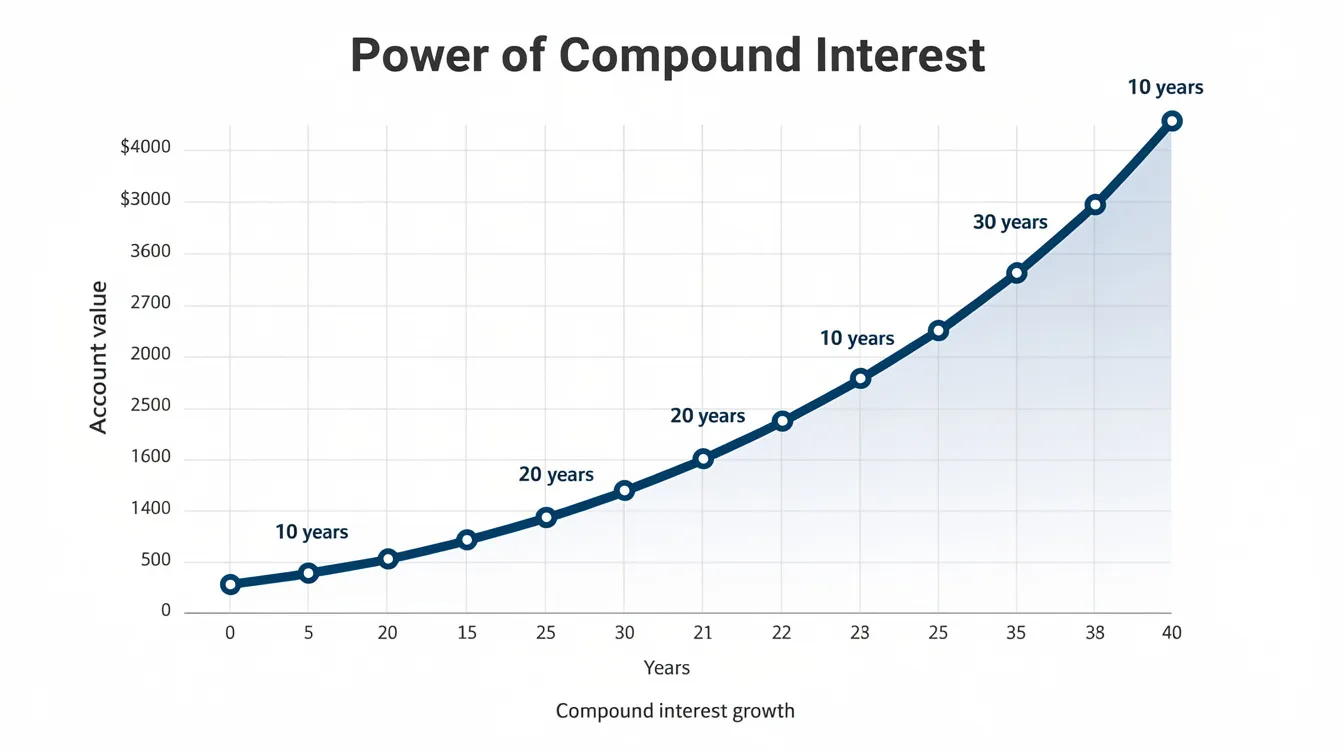
Step-by-Step Example: 10, 20 and 30-Year Holding Periods
In 2016, Mr Tan used $200,000 from his CPF OA to buy a 4-room HDB flat in Sengkang. Assuming no additional CPF usage after the initial withdrawal, here is what his refund obligation looks like at different sale dates:
-
After 10 years (sale in 2026): Refund = $200,000 × (1.025)^10 ≈ $256,000 – accrued interest of roughly $56,000
-
After 20 years (sale in 2036): Refund = $200,000 × (1.025)^20 ≈ $327,700 – accrued interest of roughly $127,700
-
After 30 years (sale in 2046): Refund = $200,000 × (1.025)^30 ≈ $418,760 – accrued interest of roughly $218,760
Each successive decade adds progressively more accrued interest because the base – principal plus prior interest – keeps growing. After 30 years, the total refund is more than double the original CPF amount used. For owners who used CPF heavily from early years, the accrued interest alone can exceed a hundred thousand dollars, potentially swamping any modest property appreciation.
Monthly Instalments: Why Accrued Interest Keeps Climbing
In practice, most homeowners do not withdraw CPF in a single lump sum. A couple purchasing a $500,000 HDB flat or a $900,000 condo in 2020 typically uses CPF OA for both the downpayment and ongoing monthly instalments. Each monthly withdrawal adds to the CPF savings used for housing, and each new withdrawal starts accruing interest from its own date.
The effect is cumulative: early instalments accrue interest for nearly the entire holding period, while later ones accrue for shorter spans. If total instalments contributed via CPF OA reach $150,000 over 10 years, the weighted accrued interest across all those monthly withdrawals can easily amount to tens of thousands of dollars – on top of whatever interest has accumulated on the initial downpayment.
You can monitor this growing figure by logging in to CPF’s online services via Singpass and navigating to “My Statement” → “Section B: Housing,” which shows cumulative principal and accrued interest updated monthly.
Visualising It: Before-and-After CPF Balances
Your CPF OA statement under “Section B: Housing” (or the Home Ownership Dashboard) displays three critical fields for each property:
-
Total amount withdrawn from OA for housing – the principal amount
-
Total accrued interest to date – the 2.5% compounded figure
-
Total housing refund due if property disposed today – principal + accrued interest
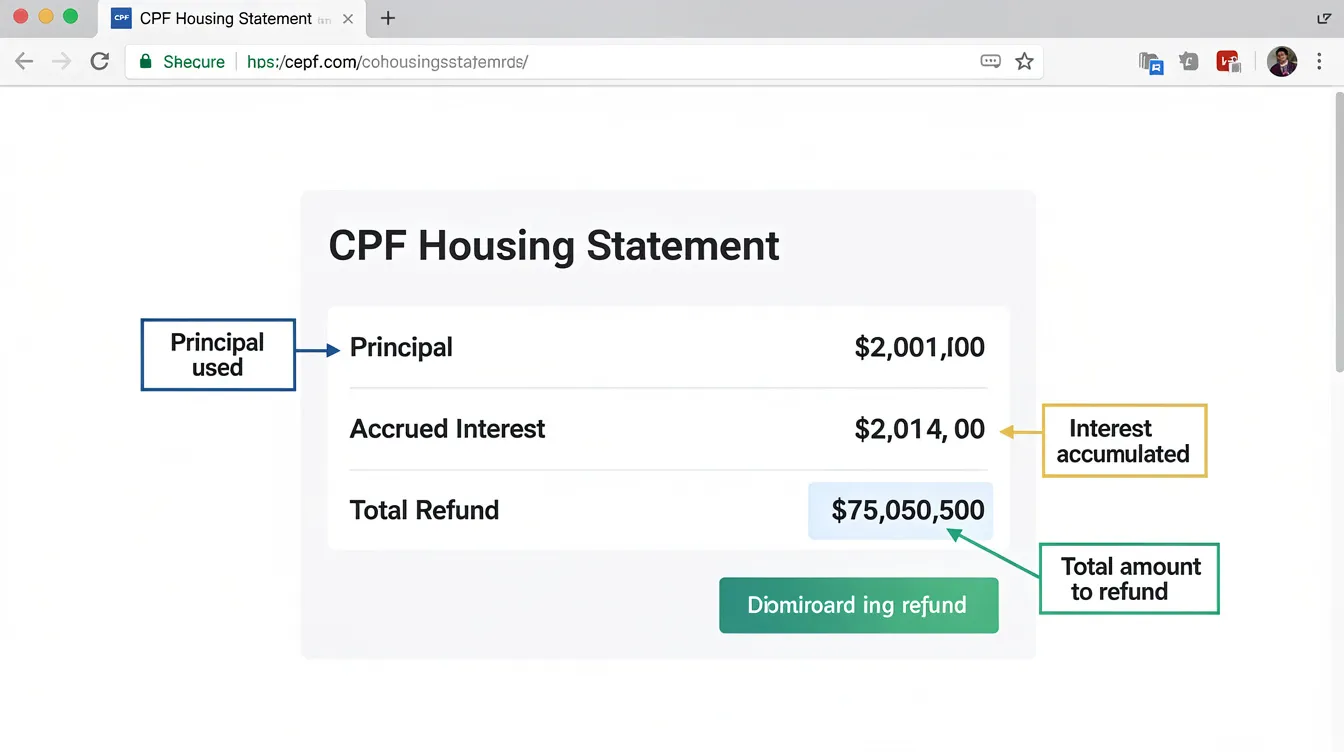
When reading your own statement, look at the “as at” date to know how current the figures are. The accrued interest line is the one most owners overlook – and it is often the reason their expected cash proceeds fall short.
Key observations from typical CPF statements:
-
After 10 years, accrued interest is often 25–35% of the principal used
-
After 20 years, it can reach 60–70% of the principal withdrawn
-
For long-held flats with slow price appreciation, accrued interest may rival or exceed the property’s capital gain
Why Your CPF Account Can “Owe Money” When You Sell Property
When homeowners say their CPF “owes money” upon a property sale, they typically mean that the selling price – after clearing the outstanding mortgage – is not enough to fully cover the required CPF refund of principal plus accrued interest. The result is little or zero cash in hand, which feels as though the CPF Board has “taken” their money. In reality, the sale proceeds are simply being redirected back into their own CPF account.
This outcome surprises many first-time sellers, especially those who focused only on market value minus loan without factoring in the large and growing accrued interest obligation.
How Sale Proceeds Are Distributed in Order
Under CPF rules for properties purchased or refinanced on or after 1 September 2002, cash proceeds from a property sale must first cover the mortgage loan and CPF refund in a strict priority order:
-
Outstanding mortgage – the remaining bank loan or HDB loan is fully repaid
-
CPF refund – principal amount plus accrued interest is refunded to your CPF accounts (OA, or RA if aged 55+)
-
Sale expenses – agent commissions, legal fees, and other transaction costs
-
Cash to seller – whatever remains after the above deductions
Option money and deposits received in cash count as part of the selling price and flow into this same sequence. Refunds are credited to your Ordinary Account or Retirement Account depending on your age.
Consider a simple illustration: you sell at $600,000 with a $300,000 loan outstanding and a $320,000 CPF refund obligation. After repaying the loan, only $300,000 remains – insufficient to cover the full $320,000 CPF refund. Your cash proceeds: approximately zero.
Negative Cash Sale vs No Need to Top Up
Two terms often confuse sellers:
-
Zero-cash sale: All sale proceeds after loan repayment go towards the CPF refund, leaving you with no cash in hand – but no cash top-up is required if the property was sold at market value.
-
Negative cash sale: Sale proceeds after loan are insufficient to fully refund CPF, and in certain scenarios (such as selling below market value to a related party), the seller may need to top up the shortfall in cash.
If property sells at market value, you do not need to top up cash for CPF refund shortfalls. The CPF Board recognises that property values can fluctuate and does not penalise you when the market simply did not deliver enough appreciation to cover both the loan and refund.
Picture a couple selling their HDB flat in 2026 for $580,000. After clearing their $280,000 loan and facing a $310,000 CPF refund obligation, they end up with $0 cash – yet their combined CPF OA balances jump by $290,000 (the amount actually refunded to your CPF from the remaining proceeds). It feels like “my CPF took all my money,” but it is their own retirement savings being replenished.
Impact on Your Next Home or Industrial Property Purchase
A large CPF refund means your OA balance increases significantly, giving you more CPF funds available for your next property purchase – whether it is a condo upgrade or an HDB resale. However, your immediate cash position may be tight, affecting your ability to cover:
-
The minimum 5% cash downpayment required for private property
-
Renovation and fitting-out costs
-
Stamp duties, legal fees, and moving expenses
For business owners planning to upgrade their home while also acquiring an industrial B2 unit or commercial space, this cash squeeze can be especially problematic. Lenders for industrial properties often require a higher cash component, and fit-out costs are typically paid entirely in cash. A seller whose CPF refund leaves them with strong OA balances but insufficient liquid cash may find their next property purchase timeline pushed back by months.
Practical Steps: How to Check Your Own CPF Accrued Interest and Refund Amount
Checking your numbers takes just 5–10 minutes and can be done via CPF’s website or mobile app. Knowing your exact CPF amount used, accrued interest, and total refund obligation before you list your property helps you avoid nasty surprises and plan your next move with clarity.
Using CPF Online Services (Desktop)
-
Log in at cpf.gov.sg using your Singpass credentials
-
Navigate to “My CPF” → “My Statement” → “Section B: My Housing”
-
Locate the following fields for your property:
-
Total CPF used for housing (principal)
-
Total accrued interest to date
-
Total housing refund due if property is disposed today
-
-
Check the “as at” date on the statement to confirm how current the figures are
-
Download or print the statement so you can share it with your property agent or financial advisor
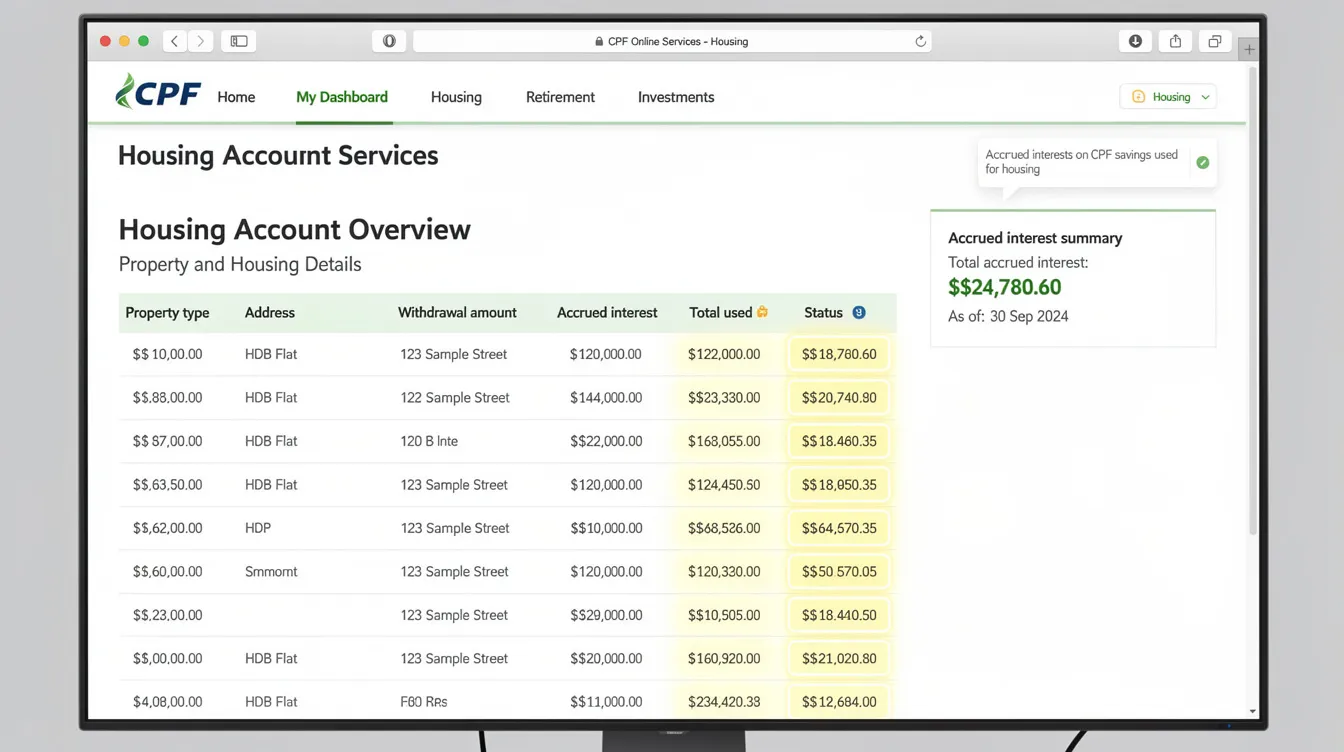
If you are aged 55 or above, also check whether any CPF amount has been pledged against your property to meet the Full Retirement Sum, as that pledged amount and its interest must also be refunded upon sale.
Using the CPF Mobile App
The same information is accessible on the go:
-
Open the CPF mobile app and log in via Singpass
-
Tap “Services” or “My Info” (the mobile search and navigation icon may vary by app version)
-
Navigate to the Housing or Home Ownership section
-
View your total principal withdrawn, accrued interest, and refund amount
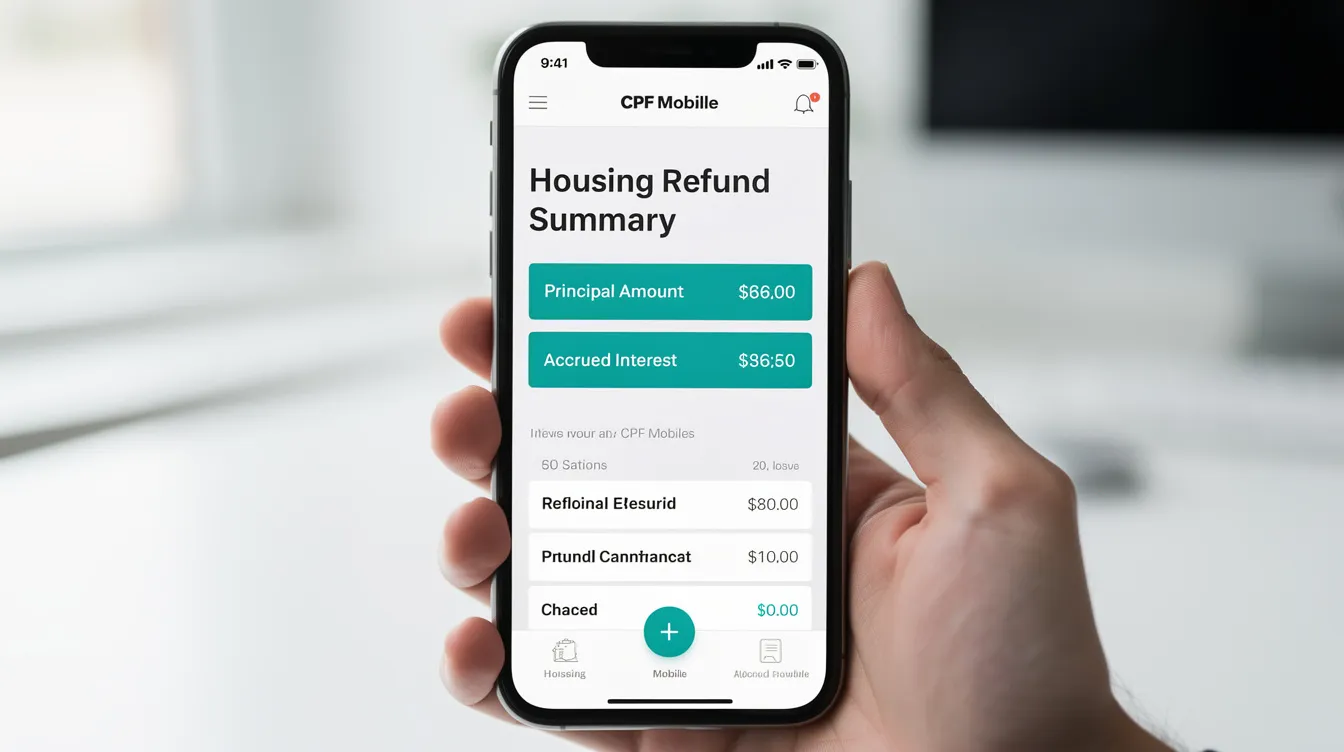
Figures update monthly, so check close to your planned sale completion date for the most accurate numbers.
Estimating Net Cash Proceeds from a Future Sale
Run this quick back-of-envelope calculation before you decide to sell:
|
Line Item |
Example Amount |
|---|---|
|
Target selling price |
$700,000 |
|
Less: Outstanding mortgage |
−$250,000 |
|
Less: CPF principal withdrawn (all owners) |
−$200,000 |
|
Less: CPF accrued interest (all owners) |
−$50,000 |
|
Less: Agent commission + legal fees + expenses |
−$20,000 |
|
Approximate cash in hand |
$180,000 |
Without accounting for the CPF refund, many sellers mistakenly expect to walk away with $430,000 in cash ($700,000 minus loan minus fees). The $250,000 CPF refund – principal plus accrued interest – changes the picture dramatically.
For HDB sellers, the HDB Resale Portal offers a proceeds estimator. Private property sellers can request a net proceeds worksheet from their property agent or bank.
Strategies to Reduce CPF Accrued Interest and Improve Cash Proceeds
You cannot avoid refunding CPF, but you can manage how much CPF you use and how quickly accrued interest grows. Less CPF usage during purchase leads to lower refund amounts later. These strategies should be balanced against your cashflow needs and any plans for industrial or commercial property investments.
Using More Cash, Less CPF for Instalments
Splitting your monthly mortgage payment – for example, 70% from CPF OA and 30% in cash – slows the accumulation of CPF savings used for housing. Over five years, this could mean tens of thousands less in CPF principal withdrawn, and correspondingly less accrued interest when you eventually sell.
Using cash for home loan payments reduces CPF principal and interest. Compare two scenarios over five years with $2,000 monthly instalments:
-
Full CPF: $120,000 withdrawn → accrued interest begins compounding on each instalment immediately
-
50/50 split: $60,000 withdrawn from CPF, $60,000 paid in cash → roughly half the accrued interest exposure
The trade-off is real: over-committing to cash instalments can strain business or personal reserves, particularly for business owners with variable income. Weigh the opportunity cost carefully.
Voluntary Housing Refunds to CPF OA
A voluntary housing refund lets you repay some or all of the CPF used for housing – plus accrued interest to date – back into your CPF OA before selling. Voluntary refunds can reduce future CPF accrued interest because they shrink the outstanding principal on which compounding continues.
Refunding cash periodically reduces total CPF refund amount at the eventual sale. Here is the typical process:
-
Log in to CPF online services via Singpass
-
Navigate to “Voluntary Housing Refund”
-
Select your property and enter the amount to refund
-
Confirm payment via PayNow, eNETS, or bank transfer
-
Verify the refund receipt and updated housing statement
Note that refunded amounts become locked back into CPF and are subject to the usual withdrawal rules. This strategy suits those who prioritise building retirement savings and expect to hold their property for many more years.
Keeping a Cash Buffer for Upgrades and Investments
Maintain at least 6–12 months of mortgage payments and transaction costs in cash, separate from CPF. This buffer protects you when:
-
You face a zero-cash sale and need funds for your next home’s downpayment
-
You need the 5% cash component for a private property, commercial unit, or industrial property
-
Renovation, fit-out, and relocation costs must be covered immediately
For clients balancing a residential upgrade with an industrial acquisition, this cash buffer is not optional – it is essential. Mapping out how much cash versus CPF to commit across both transactions ensures neither purchase stalls due to a liquidity gap.
Common Challenges and Misconceptions About CPF Accrued Interest
Even experienced property owners fall prey to misconceptions about how CPF accrued interest works. Here are the most common myths – and the facts that correct them.
“CPF Is Taking My Money When I Sell”
Your sale proceeds are not being confiscated. The money is simply being moved from property equity back into your CPF account – it remains yours. The disappointment typically arises when sellers expect high cash proceeds without accounting for the large CPF amount plus more accrued interest that has built up over years of instalments. A helpful mindset shift: treat CPF as your long-term, bond-like retirement allocation, not short-term spending cash.
“I Can Avoid CPF Refund by Selling Below Market Value”
Selling under market value does not remove the obligation to refund CPF. In fact, if the CPF Board determines the sale was not conducted at market value – for example, a transaction between related parties – you may be required to top up the shortfall in cash. Before agreeing to any below-market selling price, involve a professional valuer or property advisor to ensure compliance with CPF rules and avoid unexpected cash demands.
“Negative Sale Means I Cannot Sell My Flat or Condo”
A negative sale in CPF terms means the proceeds after loan repayment are insufficient to cover the full CPF refund. However, the transaction can still proceed. As long as the selling price is at or above market value and the loan is repaid, the CPF Board typically waives the need to top up the remaining shortfall. The key is to check your CPF figures, bank loan redemption amounts, and engage advisors early if you suspect a negative sale scenario – waiting until completion day is too late to plan effectively.
Conclusion and Next Steps
CPF accrued interest at 2.5% per annum compounded is simply the growth your Ordinary Account balance would have enjoyed had you never withdrawn it for housing. When you sell your property, refunding both the principal and accrued interest restores your retirement savings – ensuring your CPF account is not permanently depleted by a single property transaction. Your actual cash proceeds depend on the interplay between your loan balance, the total CPF savings used, and the accrued interest that has built up over the holding period.
Here is your actionable checklist:
-
Log in to CPF and screenshot your current accrued interest and total refund obligation
-
Run a sale-proceeds estimate using the formula or calculators described above
-
Review your instalment split – consider paying more cash and less CPF going forward
-
Explore voluntary housing refunds if you have surplus cash and plan to hold for several more years
-
Consult a property advisor before committing to your next purchase, especially if you are balancing a residential upgrade with an industrial or commercial acquisition
Understanding these mechanics is the first step. Planning around them – structuring your cash, CPF usage, and timing across residential and investment properties – is where informed decisions translate into stronger financial outcomes for both your property portfolio and your retirement.
Frequently Asked Questions About CPF Accrued Interest When Selling Property
These FAQs address the most common queries about 2.5% compounded CPF accrued interest, negative sales, and how refunds affect your retirement – based on current rules as of 2026.
Do I always have to refund CPF principal and accrued interest when I sell?
Yes. By default, you must refund all CPF OA funds used for the property plus accrued interest, up to the available sale proceeds after loan repayment. You do not need to top up cash if sold at market value and the proceeds are insufficient to cover the full refund – the shortfall is simply not restored to your CPF, but you are not asked to pay out of pocket.
Where does my refunded CPF money go after the sale?
If you are below 55, the refund amount is deposited back into your CPF Ordinary Account. If you are 55 or above, refunds first top up your Retirement Account to the Full Retirement Sum; any excess remains in or returns to your OA. These balances can then be used for your next property purchase, kept to earn interest, or withdrawn subject to CPF withdrawal rules.
Can CPF accrued interest ever be written off?
Accrued interest is typically only written off upon the member’s death or in certain narrow legal scenarios – not simply because the property was sold at a loss. For living members who sell their property, the accrued interest remains part of the refund obligation. There is no general waiver mechanism for sellers who experience negative equity.
How does CPF accrued interest affect my retirement payouts later?
Higher CPF refunds increase your OA balance (if below 55) or your Retirement Account balance (if 55 and above), which in turn boosts future CPF LIFE payouts and the interest earned on those balances. What feels like less cash now can translate into more secure monthly retirement income in your 60s and beyond – the system is working as intended to protect your long-term financial security.
How can AESTHETIC HAVENS help me plan around CPF when buying or selling property?
AESTHETIC HAVENS assists clients by reviewing CPF and loan data, simulating sale and purchase scenarios with accrued interest projections, and aligning residential moves with industrial or commercial investments. The firm coordinates with banks and lawyers to ensure CPF rules are met without derailing business plans or leaving clients cash-strapped at the worst possible moment. If you are considering listing your property or committing to a new unit, reach out for tailored CPF-and-property planning before you make your next move.


