

Introduction
Singapore investors building a multi‑property portfolio face a defining capital allocation decision: should you pledge funds – CPF, fixed deposits, or securities – to preserve liquidity, or pay Additional Buyer’s Stamp Duty (ABSD) upfront in cash and absorb the hit? The choice between pledging funds vs paying ABSD upfront leveraging cash reserves for multi property growth determines how quickly you can scale, how much risk you carry, and whether your cash flow survives vacancy or rate shocks. Getting this wrong can leave you asset‑rich and dangerously cash‑poor at exactly the wrong moment.
This article focuses on Singapore’s 2024–2026 ABSD regime, residential and commercial and industrial properties, and the mechanics of pledging, TDSR compliance, CPF accrued interest refunds, and portfolio sequencing. It does not cover foreign jurisdictions in detail. The target audience is Singapore‑based property buyers – citizens, permanent residents, SME owners, and upgraders – who already hold at least one property and want a realistic roadmap for subsequent property purchases without draining every dollar of liquidity.
The short answer: pledging funds (instead of fully deploying them) can preserve liquidity and accelerate property portfolio growth, but paying ABSD upfront is strategically superior when projected capital appreciation, holding period, and rental income clearly outweigh the tax drag and the opportunity cost of locked capital.
By the end of this article you will understand:
-
How pledging works for property loans and how it differs mechanically from using cash or CPF to pay ABSD.
-
A practical framework to decide when to pledge funds vs pay ABSD outright for a second or subsequent property.
-
How to structure cash reserves and CPF so they support – not limit – multi‑property growth.
-
How industrial properties and commercial properties fit into a plan that minimises ABSD drag.
-
Common pitfalls (over‑pledging, underestimating CPF refund interest, IRAS scrutiny) and how to sidestep them.
Understanding Pledging, ABSD and Cash Reserves in Singapore Property
Before comparing investment strategy paths, you need clarity on three foundational pillars: what pledging actually does inside a bank’s credit assessment, what ABSD costs you on each residential property purchase, and why cash reserves – not headline property value – determine whether your portfolio survives or stalls.
What “Pledging Funds” Really Means in Property Financing
In Singapore’s property financing context, pledging means offering liquid or near‑liquid assets – CPF OA balances, fixed deposits (FDs), or investment portfolios – as collateral to a bank without withdrawing or liquidating them. The bank earmarks the pledged sum, applies a valuation haircut (typically 10–30% depending on asset type and volatility), and factors the remainder into its internal credit assessment.
Crucially, pledging funds allows for leveraging cash reserves to increase borrowing capacity. It does not pay down the housing loan or cover buyer’s stamp duty ABSD; it strengthens the borrower’s profile under the total debt servicing ratio (TDSR) framework and loan to value (LTV) criteria. Pledging cash allows higher loan amounts without the need for immediate cash outflow for taxes. Pledging assets reduces the complexity of financing while retaining access to your cash – at least on paper.
Typical use cases include:
-
High‑income investors wanting to preserve CPF for retirement while using bank financing for an investment property.
-
SME and business owners with lumpy cash flow who need stronger perceived security to secure a larger bank loan.
-
Portfolio diversifiers who want to keep securities invested rather than liquidating at an inopportune time.
Pledging is a way to boost perceived income for loan approval without increasing salary. However, pledging funds incurs a liquidity cost as those funds cannot be immediately used for other investments. Different banks impose different haircuts and documentation requirements. A fixed deposit pledged at one institution might be valued at 90% of face value; a portfolio of equities at a different bank might count for only 50–60%. Investors must assess the trade-off between liquidity and security when pledging assets, and understand that pledged funds are effectively frozen – banks can restrict release during downturns or enforce collateral covenants.
What is ABSD and How It Interacts with Multi‑Property Growth
Additional Buyer’s Stamp Duty (ABSD) is a tax on residential property purchases in Singapore, levied on top of buyer’s stamp duty (BSD). It is calculated on the higher of purchase price or market value, and – critically – ABSD represents a significant cash outflow that cannot be financed via a mortgage. ABSD must be paid in cash or CPF within 14 days of signing the sales agreement. Each buyer’s ABSD rate is determined by their profile on the date of purchase.
Current headline rates for individuals (effective since 27 April 2023, unchanged through mid‑2026):
-
Singapore citizens: 0% ABSD on their first property, 20% on their second property, 30% on third and subsequent properties.
-
Singapore permanent residents: 5% ABSD on their first residential property, 30% on their second, 35% on third and subsequent.
-
Foreigners: 60% ABSD on all residential property purchases.
-
Entities: a flat 65% ABSD on property purchases, though trusts incur a 65% ABSD but may allow for refunds under certain conditions.
The numbers are punishing for portfolio builders. Singapore citizens pay 20% ABSD on their second property – so ABSD on a $1.5 million second property is $300,000. That is pure cash out before you count BSD, legal fees, or down payment. Paying ABSD upfront results in a permanent reduction of available liquid assets and paying ABSD reduces the cash available for further property acquisitions immediately after payment.
Every additional residential property locks a large chunk of capital into tax instead of equity, rental‑generating assets, or reserves. This is the core tension: property cooling measures like ABSD deliberately slow speculative multi‑property accumulation. Your job as an investor is to decide whether the expected return justifies that drag – or whether an alternative path preserves more capital for compounding.
Why Cash Reserves Matter More Than Headline Property Value
“Cash reserves” in this context means liquid cash and near‑cash that is not pledged or encumbered – money you can deploy within days for:
-
6–12 months of mortgage payments across all properties, covering vacancies and tenant defaults.
-
Repairs, maintenance, and compliance costs – especially lumpy for industrial properties.
-
Future down payments or opportunities in the property market that appear on short timelines.
Over‑allocating to ABSD and down payment can leave private property owners “asset‑rich, cash‑poor.” This is especially dangerous for SME owners whose business cash flow fluctuates. If your car loan, existing mortgages, and personal expenses already consume a large share of gross monthly income, a depleted reserve after paying ABSD can cascade into forced sales or refinancing under unfavourable conditions.
The real decision is not theoretical. Investors must numerically compare what happens to their cash reserves, equity positions, and CPF under each route – which is exactly what the next section models.
Applying the Concept: How Pledging and ABSD Shape Your Second and Third Property
With the foundations in place, let’s see how these mechanisms play out when you are making a concrete second property purchase – whether that is a second residential property or a first commercial or industrial property.
Scenario 1: Paying ABSD Upfront for a Second Residential Property
Consider a Singapore citizen couple who own an HDB flat (their first property) and want to buy a S$1.5 million private property – a second condo – purely as an investment property in 2026.
Day‑one cash outlay:
-
ABSD at 20%: S$300,000
-
Buyer’s stamp duty (BSD) on S$1.5M: approximately S$44,600
-
Down payment: The LTV ratio for second housing loans is capped at 45%, meaning a minimum 55% equity. Of that, at least 25% must be cash, with the remainder payable via CPF. Cash down payment ≈ S$375,000; CPF portion up to ~S$450,000 (subject to limits).
-
Legal fees and miscellaneous: ~S$3,000–S$5,000
Total upfront: roughly S$720,000–S$1,170,000 (depending on CPF deployment). Even at the lower end, this is an enormous capital commitment.
Monthly cash flow impact: The remaining property loan of ~S$675,000 at a conservative 4% interest over 25‑year loan tenure produces mortgage payments of roughly S$3,560/month. Expected residential rental income on a S$1.5M condo might be S$3,500–S$4,500/month – residential properties often yield around 2% to 3% returns, so positive cash flow is marginal or negative after property taxes, maintenance, and management.
Growth impact: With S$300,000+ consumed by ABSD alone, the couple’s ability to purchase properties again within 3–5 years is severely constrained. If their starting cash reserves were S$500,000, they may have under S$100,000 of unencumbered liquidity left – below the 6–12 month mortgage buffer for multiple properties.
When this still makes financial sense: If the residential property is in a high‑appreciation corridor (e.g., near a new MRT line or within a prime district with strong demand), and the couple plans a 15–20 year hold, the capital growth could significantly outweigh the ABSD drag. Selling your first property can help avoid ABSD on the second – if the couple disposes of the HDB within 6 months, they may qualify for an ABSD remission/refund.
Scenario 2: Pledging Funds to Improve Loan Eligibility While Preserving Cash
Now contrast this with an alternative path. The same investor keeps S$250,000 in fixed deposits and pledges them to a bank to secure a larger loan quantum on a first industrial unit costing S$1.5 million – no ABSD, because commercial properties are generally not subject to ABSD like residential properties.
Mechanics:
-
The pledged FD supports a higher internal credit assessment. Even though MAS LTV caps still apply, the bank’s willingness to lend at or near the cap improves.
-
Pledging keeps cash available for other investments while securing a loan – the investor still technically owns the FD and may still earn interest, though withdrawal is restricted.
-
Industrial purchase incurs BSD and legal fees but zero ABSD.
Day‑one cash outlay:
-
BSD on S$1.5M industrial: ~S$44,600
-
Down payment (assuming 70–75% LTV for industrial, depending on bank): S$375,000–S$450,000 in cash
-
Legal fees: ~S$3,000–S$5,000
-
No ABSD: S$0
Total upfront: roughly S$420,000–S$500,000 – approximately S$300,000 less than the residential path.
Net rental yield: Commercial properties typically yield 5% to 7% returns. At 5% on S$1.5M, gross rental income is ~S$75,000/year or ~S$6,250/month, substantially above typical residential yields on the same property price.
Cash reserves post‑purchase: The investor retains the pledged S$250,000 (frozen but owned) plus whatever unencumbered cash remains. Portfolio cash flow is meaningfully stronger than the ABSD‑heavy residential path.
Risk flag: Pledged funds are not truly emergency cash. If the business needs liquidity or the property market shifts, un‑pledging may require refinancing or full loan repayment. Commercial properties require different management considerations than residential properties – longer vacancy cycles, operational risk, and zoning dependency.
Scenario 3: Combining Residential, Industrial and Pledging for Staged Growth
The most resilient multi‑property strategy often blends both asset classes across time. Here is a three‑step, time‑based example for a working couple or SME owner (2024–2030):
-
Step 1 (2024–2025): Optimise first property – refinance the existing property (e.g., HDB flat or first condo) to a lower interest rate, free up CPF and cash equity. Ensure sufficient income margin under TDSR for future borrowing.
-
Step 2 (2025–2027): Deploy cash for an ABSD‑free industrial unit. Pledge a portion of savings (FD or portfolio) to strengthen the bank loan application. Begin collecting higher‑yield rental income. The property count for ABSD purposes does not increase on the residential side.
-
Step 3 (2028–2030): With industrial rental income boosting gross monthly income and cash reserves rebuilt, decide whether to pay ABSD for a second residential property (if capital appreciation thesis is strong) or acquire a second industrial or commercial property to keep compounding ABSD‑free.
Staggering purchases and alternating between ABSD‑heavy and ABSD‑free assets improves liquidity, diversifies risk, and increases return on equity over time. Investing in commercial properties can diversify your portfolio effectively while keeping the ABSD burden manageable.
Key takeaways from all three scenarios:
-
ABSD is a non‑recoverable day‑one cost that directly competes with your cash reserves and future purchasing power.
-
Pledging preserves surface liquidity but introduces collateral lock‑up risk.
-
Industrial and commercial properties offer higher yields and zero ABSD, but carry different operational and market risks.
-
The optimal path depends on your property investment goals, income stability, and time horizon.
To use any of these paths effectively, you need a structured decision process that integrates TDSR limits, LTV, CPF rules, and risk buffers.
Designing a Practical Framework: Choosing Between Pledging and Paying ABSD
The following step‑by‑step decision process reflects how multi‑property expansion should be approached: systematically, with numbers, not gut feel.
Step‑by‑Step Decision Process
-
Map current assets and liabilities. List existing property value, outstanding property loan balances, CPF OA balance, cash and FDs, investment portfolios, and business cash flow. Identify what is pledgeable vs what must stay liquid. TDSR includes all existing debts like mortgages and loans – including any car loan or personal credit lines. Existing debts reduce borrowing capacity for new property loans.
-
Clarify your goal for the next purchase. Is it income‑focused (industrial/co‑living), capital appreciation (residential), or operational use for your business? This determines whether ABSD applies and how you should weight yield vs growth.
-
Calculate ABSD and total cash outlay if the next purchase is residential. Test worst‑case cash position after purchase: if remaining liquid reserves fall below 6 months of total mortgage payments across all properties, the plan is too aggressive.
-
Model the alternative ABSD‑free path. Price out an industrial or commercial property of comparable value. Estimate BSD, down payment, and projected rental income. Compare cash retained and projected income against the residential option.
-
Stress‑test TDSR and interest‑rate shocks on both options. TDSR limits total monthly debt repayments to 55% of gross income (with banks applying a floor rate of 4% for TDSR calculations). Run scenarios at current rates and at +1.5% above current SORA rates. The maximum TDSR is typically 60% for most borrowers, but exceeding 55% significantly narrows your margin of safety.
-
Decide based on which path leaves at least 6–12 months of mortgage coverage and sufficient capital for the next opportunity. If neither path clears this bar, delay the purchase or restructure existing property ownership first.
Quantitative Comparison: Pledging vs Paying ABSD on the Same Capital Base
Assume an investor with S$500,000 cash and S$180,000 in CPF OA, targeting a S$1.5 million property:
|
Criteria |
Pay ABSD for 2nd Condo (Residential) |
Pledge Funds & Buy Industrial Unit |
|---|---|---|
|
ABSD |
S$300,000 (20%) |
S$0 |
|
BSD |
~S$44,600 |
~S$44,600 |
|
Down payment (cash + CPF) |
~S$375,000 cash + CPF |
~S$375,000–S$450,000 cash |
|
Legal fees |
~S$4,000 |
~S$4,000 |
|
Total day‑one outlay |
~S$720,000+ |
~S$425,000–S$500,000 |
|
Cash reserves remaining |
<S$80,000 (danger zone) |
S$200,000–S$275,000 (includes pledged FD) |
|
Projected net annual rental |
S$36,000–S$54,000 (2–3% yield) |
S$75,000–S$105,000 (5–7% yield) |
|
Cash‑on‑cash return (Year 5, illustrative) |
~4–6% (including appreciation) |
~8–12% (yield‑driven) |
|
Ability to finance next property in 3–5 years |
Low – depleted reserves, ABSD on third property rises to 30% |
Medium–High – reserves intact, no incremental ABSD on next industrial |
Synthesis: For risk‑tolerant, high‑income investors with strong capital appreciation conviction, paying ABSD for a prime residential property can still generate outsized long‑term returns. For cash‑conservative SME owners or investors prioritising positive cash flow and portfolio velocity, the pledge‑and‑industrial path preserves significantly more firepower for subsequent properties.
Even the best plan fails if investors fall into common structural or regulatory traps – which is what the next section addresses.
Common Challenges and How to Avoid Them
Misjudging ABSD obligations, misusing pledging, or underestimating liquidity needs are the three main reasons multi‑property plans stall or collapse.
Challenge 1: Over‑Optimistic Cash Flow Projections
Many property buyers assume 100% occupancy, static interest rates, and ignore sinking funds – especially for industrial maintenance or refurbishment cycles.
Solution:
-
Use conservative rental assumptions: 10–15% vacancy allowance and realistic industrial rent cycles.
-
Stress‑test property loan repayments at +1.5% above current rates.
-
Maintain a 6–12 month reserve per property, not in aggregate.
Challenge 2: Treating Pledged Funds as “Emergency Cash”
Investors often mentally count pledged FDs or CPF as available liquidity. In a downturn, banks can restrict release, refuse un‑pledging without refinancing, or deepen haircuts – directly impacting business operations or personal financial planning.
Solution:
-
Only pledge funds that you genuinely do not need for at least 3–5 years.
-
Maintain a separate, unpledged cash buffer for business and personal emergencies.
-
Review bank covenants on pledged assets carefully before signing – understand margin call triggers and release conditions.
Challenge 3: Mis‑Timing CPF Usage and ABSD, Including CPF Refund Interest
This is one of the most under‑appreciated costs in property investing. When you use CPF OA funds for a property purchase – whether for ABSD, down payment, or monthly mortgage – those funds stop earning the OA’s guaranteed minimum 2.5% per annum interest. Upon sale of the property, you must refund both the principal amount used and all accrued interest at 2.5% compounding annually to your CPF account.
How CPF accrued interest compounds over time:
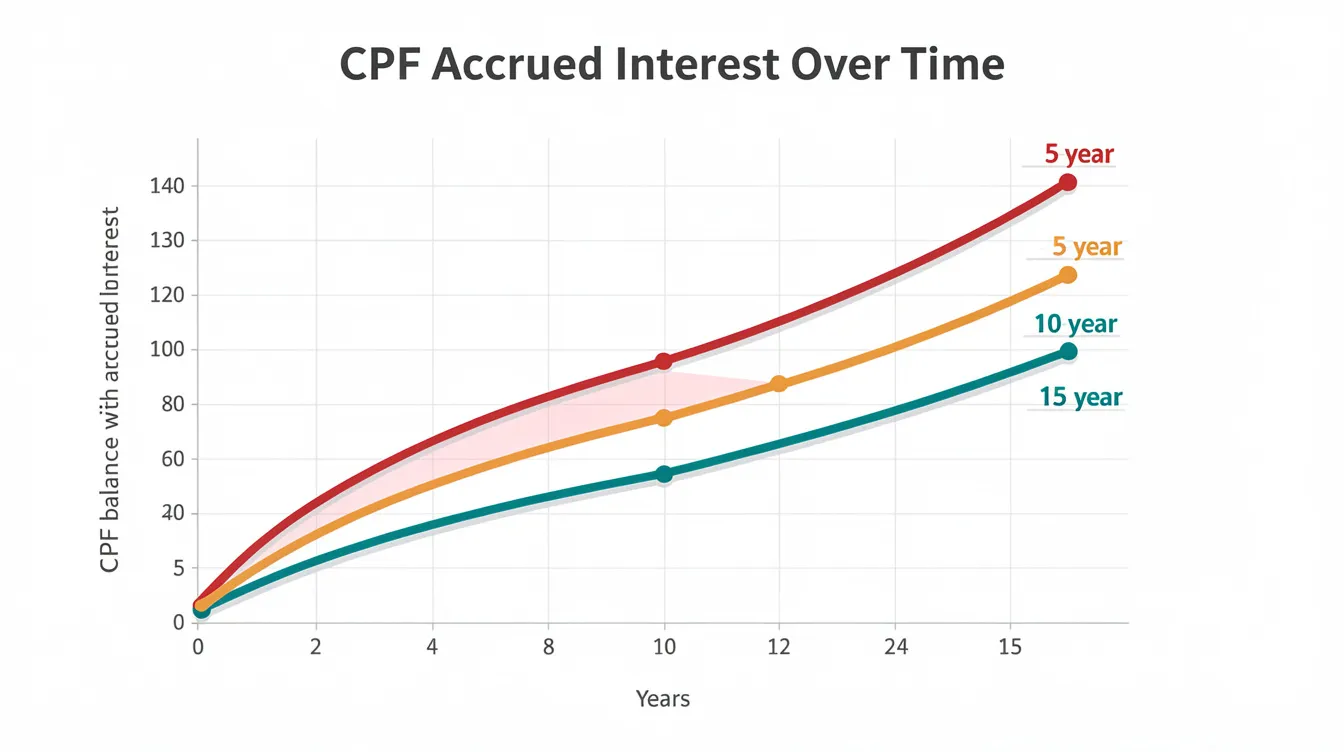
For example, if you use S$200,000 from CPF OA and hold the property for 10 years:
-
Year 0: S$200,000 used
-
Year 5: Accrued interest ≈ S$26,300 → refund obligation = S$226,300
-
Year 10: Accrued interest ≈ S$56,000 → refund obligation = S$256,000
-
Year 15: Accrued interest ≈ S$90,000 → refund obligation = S$290,000
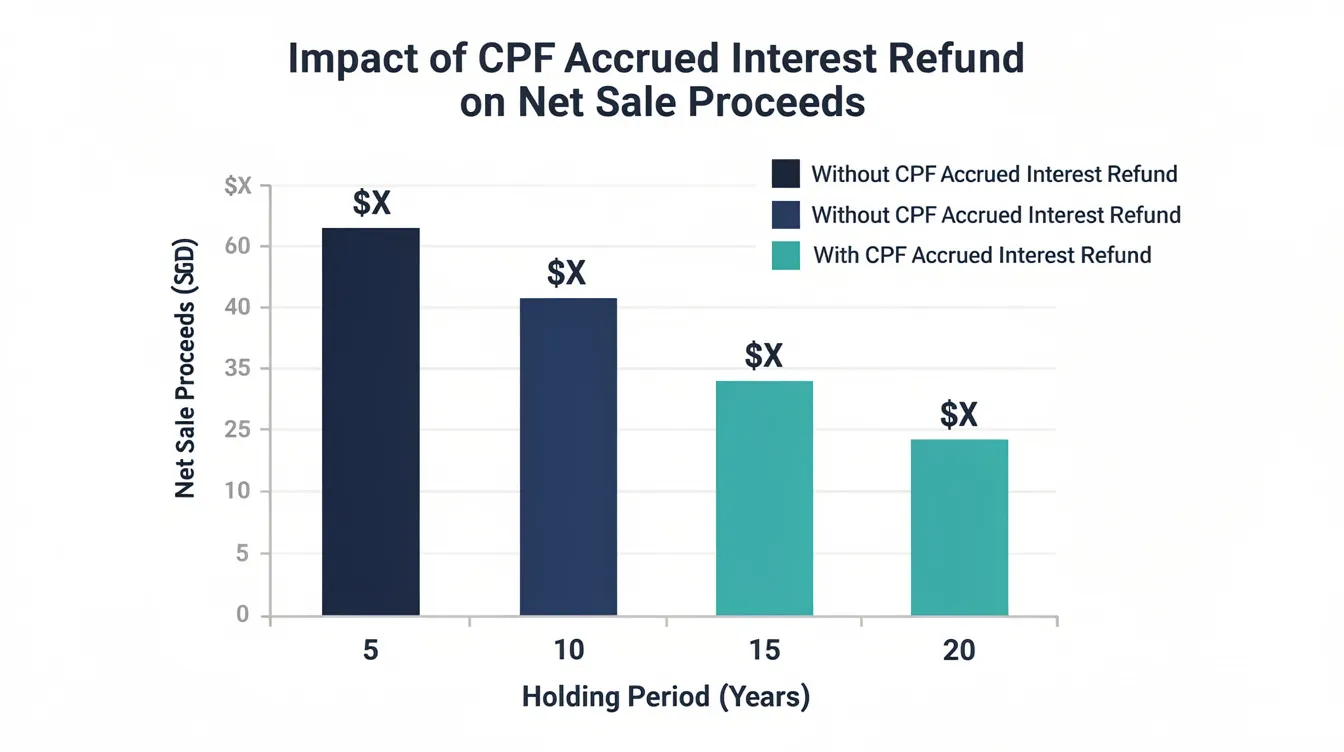
This refund comes directly out of your sale proceeds, materially reducing the capital available for your next first property purchase or reinvestment. For a long hold of 15 years, the interest alone can approach half the original principal used.
Solution:
-
Include CPF accrued interest (2.5% compounding) in all projections for sale 5–15 years later.
-
Consider partial‑cash, partial‑CPF strategies to balance current liquidity vs future refund obligation.
-
If you plan to hold for more than 10 years, weigh whether using cash instead of CPF for ABSD makes more financial sense despite the short‑term liquidity hit.
Challenge 4: IRAS Scrutiny on Aggressive ABSD Avoidance
Some property strategies marketed online – such as the 99‑to‑1 ownership scheme, artificial share transfers, or rapid jointly owned property restructuring – attempt to circumvent ABSD. The 99-to-1 scheme was targeted by IRAS for tax avoidance. IRAS has the power to impose additional duty, penalties, and interest on arrangements it deems abusive.
Decoupling allows one co owner to buy a property as a first-time buyer, but decoupling can incur legal fees and potential penalties if not structured properly. Buying under a child’s name can avoid ABSD if they are a first-time buyer, but this introduces property ownership, estate, and control risks.
Solution:
-
Emphasise legitimate planning: timing of purchases, mixing residential with ABSD‑free commercial or industrial property, and sizing purchases to sufficient income levels.
-
Consult qualified tax and legal professionals before any complex restructuring involving property ownership changes.
-
Focus on strategies that create genuine economic substance, not paper reshuffling.
Sustainable multi‑property growth is built on compliance, liquidity, and realistic modelling – not loopholes.
Conclusion and Next Steps
The core trade‑off is straightforward: paying ABSD upfront locks capital into a non‑recoverable tax, shrinking your reserves and slowing the compounding cycle. Pledging preserves surface liquidity and lets you redirect capital into ABSD‑free industrial properties or future opportunities – but it introduces collateral constraints and the illusion of available cash. Neither path is universally superior; the right choice depends on your income stability, time horizon, risk tolerance, and whether your next target is residential or commercial.
Immediate next steps:
-
Calculate your current ABSD exposure and projected CPF refund obligation (with 2.5% compounded interest) on your existing property.
-
Map your true liquid reserves vs pledged or illiquid assets – be honest about what is genuinely accessible.
-
Model at least two alternative paths: an ABSD‑heavy second residential property vs an ABSD‑light industrial/commercial property strategy.
-
Stress‑test property loan scenarios under higher interest rates (+1.5%) and partial vacancy (10–15%).
-
Speak with a qualified advisor to validate numbers before committing to a second or third property.
Related topics worth exploring:
-
Co‑living and room‑rental strategies to boost rental income from an existing property without triggering additional ABSD on a new purchase.
-
Using industrial property for both business operations and investment yield – particularly relevant for sole owner SME operators.
-
Refinancing strategies to unlock equity safely after 3–5 years and redeploy into subsequent property purchases.
Additional Resources and FAQs
Quick‑reference answers to the most common questions around pledging, ABSD, and multi‑property financial planning in Singapore.
FAQ: Can I Use CPF to Pay ABSD, and How Does That Affect Future Purchases?
CPF OA can generally be used to pay ABSD for eligible residential property purchases, subject to prevailing CPF rules and withdrawal limits. However, every dollar of CPF used – whether for ABSD, down payment, or monthly mortgage – must be refunded with 2.5% p.a. compounded interest upon sale of the same property. Over a 10–15 year hold, this significantly reduces net sale proceeds available for the next down payment. If you anticipate a long holding period and strong appreciation, using cash instead of CPF for ABSD may preserve more capital for reinvestment.
FAQ: When Does It Make Sense to “Just Pay the ABSD”?
Paying ABSD upfront is rational in specific situations:
-
Strong, evidence‑backed capital growth potential in the target residential property – where expected appreciation materially exceeds the ABSD drag over the holding period.
-
Strategic owner‑occupation plus long horizon (e.g., 15–20 years) where the property serves dual lifestyle and investment purposes.
-
Ultra‑high cash reserves where ABSD does not compromise liquidity, mortgage servicing ratio safety margins, or business operations.
FAQ: Is Pledging Safer Than Using Cash or CPF?
Pledging is not inherently safer – it is a leverage tool that preserves surface liquidity but increases exposure if income falls or markets decline.
-
Pro: Preserves cash for other investments or emergencies; may improve loan approval without liquidating assets.
-
Pro: Pledging helps navigate Total Debt Servicing Ratio (TDSR) caps set by banks.
-
Con: Pledged assets are frozen; un‑pledging may be impossible without refinancing.
-
Con: In market downturns, banks may demand additional collateral or invoke margin calls on pledged securities.
Joint ownership can maximize borrowing capacity for couples, but both spouses’ debts count against TDSR. Weigh carefully whether pledging or deploying cash gives you a stronger net position over 5–10 years.
FAQ: How Do Industrial and Commercial Properties Help Me Manage ABSD?
Commercial and industrial properties are typically exempt from ABSD in Singapore, making them powerful tools for:
-
Growing multiple properties without serial ABSD payments that erode your capital base.
-
Diversifying income away from the residential property market cycle – commercial properties typically yield 5% to 7% returns vs residential’s 2% to 3%.
-
Aligning space needs with business operations for SME owners who can use the property operationally while building equity.
However, industrial properties carry different risks: zoning changes, longer vacancy cycles, higher maintenance, and sometimes lower capital appreciation compared to prime residential properties located in central districts.
Where AESTHETIC HAVENS Can Help
AESTHETIC HAVENS supports investors and business owners navigating multi‑property growth through:
-
Industrial and commercial site selection for both business use and property investment yield.
-
Portfolio structuring that balances ABSD exposure, pledging mechanics, and liquidity across private property purchases.
-
Data‑driven scenario analysis for second, third, and subsequent property decisions – including stress‑testing TDSR, interest costs, and CPF refund projections before you commit capital.


