


Yes, GST applies to most commercial property transactions in Singapore. The sale and lease of non-residential property is a taxable supply, currently charged at 9% under IRAS rules/specific-business-sectors/real-estate). Before you sign anything, confirm the vendor or landlord is GST-registered and check that the invoice or Option to Purchase clearly states whether the price is GST-inclusive.
TL;DR:
- The GST rate for commercial property transactions is 9%, applicable when the seller or landlord is GST-registered, and the invoice must clearly state whether prices are inclusive or exclusive of GST.
- Mixed-use buildings require precise apportionment of sale or lease prices between commercial and residential parts, with documentation needed to justify the division.
- Buyers and tenants registered for GST can claim input tax credits on GST paid, but only if the property is used for taxable business activities and proper invoices are obtained.
- Incorrect invoicing, misclassification of supplies, or failure to include GST details in documents can trigger IRAS audits and penalties.
- Confirm GST registration status, invoice details, and the treatment of fittings before signing contracts, and consider consulting a tax advisor for complex deals involving nominee clauses or mixed use.
Table of Contents
- What Counts as a Taxable Supply: Sale, Lease, and Mixed-Use Deals
- Who Pays, Who Reclaims: Input Tax Credit Rules for Buyers and Tenants
- Time of Supply Rules and the Mistakes That Trigger IRAS Scrutiny
- A Practical Checklist and a Worked Example
- When a Consultant Earns Their Fee on GST Questions
- How Singapore Law Defines Commercial Property for GST Purposes
- GST’s Effect on Developers Building New Commercial Space
- Zero-Rated vs Standard-Rated: Why the Distinction Matters
- GST Rules for Overseas Buyers and Lessors
- How to Register for GST When Buying or Leasing Commercial Property
- Penalties for Getting GST Wrong on a Commercial Deal
- GST as a Negotiating Chip, Not Just a Compliance Line
- Get GST-Ready Support Before You Sign Your Next Commercial Deal
- Where to Verify These Rules Yourself
- Sources
- FAQ
What Counts as a Taxable Supply: Sale, Lease, and Mixed-Use Deals
Commercial property in Singapore means non-residential space: offices, retail shops, warehouses, factories, and most hotel or serviced accommodation. IRAS treats the sale or lease of these properties as a standard-rated supply, taxed at 9% when the seller or landlord is GST-registered. Residential property, by contrast, is generally exempt from GST, which is why the classification of a building matters more than its address or size.
Mixed-use buildings complicate this. A shophouse with a retail unit on the ground floor and an apartment above requires apportionment. The commercial portion attracts GST; the residential portion typically does not. Landlords and buyers need to split the purchase price or rent based on floor area or valuation, and get that apportionment documented, because IRAS will expect a defensible method if the transaction is ever reviewed.
Furniture, fittings, and packaged extras add another wrinkle. IRAS has flagged that movable furniture and fittings supplied with a property are taxable in their own right, even in cases where the underlying property itself would otherwise be exempt. Practically, that means:
- A fully furnished office lease often has the furniture component subject to GST regardless of how the base rent is treated.
- Landlords who bundle air-conditioning units, built-in cabinetry, or loose furniture into a lease should itemize these clearly on the invoice.
- Under IRAS guidance, most landlords simplify matters by charging GST on the full gross rent rather than splitting out the furniture value, which cuts down on accounting headaches but demands precise invoice wording.
If your lease or sale agreement is silent on how fittings are treated, ask before you sign. It is a five-minute conversation that prevents a much longer dispute later.
Who Pays, Who Reclaims: Input Tax Credit Rules for Buyers and Tenants
GST is charged by whichever party is registered and making the supply. That means the seller charges GST on a commercial sale, and the landlord charges GST on rent, but only if they are GST-registered themselves. A private individual selling a single shophouse who has never crossed the registration threshold generally does not charge GST at all. This is the first thing to verify in any deal: ask for the vendor’s or landlord’s GST registration number and cross-check it against their invoice.
If you are GST-registered and buying or leasing the property for use in your own taxable business, you can typically claim the GST paid back as input tax credit. The core conditions:
- The property must be used to make taxable supplies, not exempt ones (a GST-registered retailer renting a shop qualifies; a residential landlord renting out flats does not).
- You need a proper tax invoice from a GST-registered supplier showing the GST amount separately.
- Where the property serves mixed purposes, taxable and exempt, you can only claim the taxable portion, apportioned fairly.
There is also a lesser-known allowance: pre-registration input tax claims. If you incurred GST on property-related costs before your own GST registration took effect, you may claim it back within a defined window, generally covering the six months before registration, provided the goods or services were used for your taxable business.
Pro Tip: GST on a commercial purchase is a cash outlay at completion, not something you can fold into a mortgage or pay through CPF. Even if you plan to reclaim it later, budget for the full 9% in liquid cash on transaction day, since reclaim timelines can run to weeks after filing.
Time of Supply Rules and the Mistakes That Trigger IRAS Scrutiny
GST liability is not tied to when a deal closes; it is tied to whichever comes first between payment and invoice. Under IRAS’s time-of-supply rules, the moment you issue a tax invoice or receive payment, whichever happens earlier, is the point you must account for GST. A landlord who invoices a tenant for a full year’s rent in advance triggers the GST obligation on that invoice date, not spread across the twelve months the rent covers.
This trips up more property owners than you’d expect. The recurring errors:
- Invoicing before confirming GST treatment. A seller issues a sale invoice without stating whether GST is included, then discovers post-sale that the buyer disputes the amount owed.
- Excluding property tax from the GST base. When rent includes a property tax component built into the monthly charge, GST still applies to the full rental figure. Carving out property tax before calculating GST is a documented compliance error IRAS has called out.
- Misallocating furniture and fittings. Treating a furnished unit’s fittings as part of an exempt residential supply, when the fittings themselves are separately taxable, understates the GST payable.
- Weak invoice wording. Invoices that say “rent: $10,000” with no GST breakdown leave both parties exposed if IRAS later asks for supporting documentation.
The fix is unglamorous but effective: every invoice should state the GST rate, the GST amount in dollars, and whether the figure quoted is inclusive or exclusive of GST. Keep copies of every tax invoice for at least five years, since that is the standard period IRAS can review during an audit.
A Practical Checklist and a Worked Example
Before signing an Option to Purchase or a lease, run through this list:
- Confirm the vendor or landlord’s GST registration status in writing, not just verbally.
- Request a proper tax invoice showing GST separately, not folded into a single lump sum.
- Get fittings, furniture, and equipment itemized rather than bundled into “as is” wording.
- Check the OTP or lease for nominee clauses, since these can shift GST treatment unexpectedly.
- Document any pre-registration purchases if you plan to claim input tax once registered.
Here’s how the math plays out. Say a commercial unit is priced at $2,000,000 before GST. If you are GST-registered and the property will be used entirely for taxable business activity, that $180,000 is generally reclaimable as input tax, but you still need the cash on hand upfront while the claim is processed.
Red flags worth raising with a lawyer before signing: OTPs that reference a nominee without addressing GST consequences, invoices marked “no GST” from a seller you suspect is registered, and any clause that shifts GST liability onto the buyer without stating the amount.
When a Consultant Earns Their Fee on GST Questions
Most straightforward leases don’t need a tax specialist. Complex deals do, especially anything involving nominee purchases, mixed-use apportionment, or a corporate buyer structuring multiple entities around one transaction. That is the point where a property consultant or a tax advisor pays for themselves several times over by catching an error before it becomes a dispute with IRAS.
Aman and the team at Aesthetic Havens typically get involved at the document stage: reviewing draft OTPs and leases for GST wording, checking that invoices itemize fittings correctly, and flagging nominee clauses before they get buried in legal boilerplate.
A surprising number of commercial disputes trace back to one missing line on an invoice: whether the quoted price already includes GST. Getting that sentence right before signing saves both sides a much harder conversation after completion.
How Singapore Law Defines Commercial Property for GST Purposes
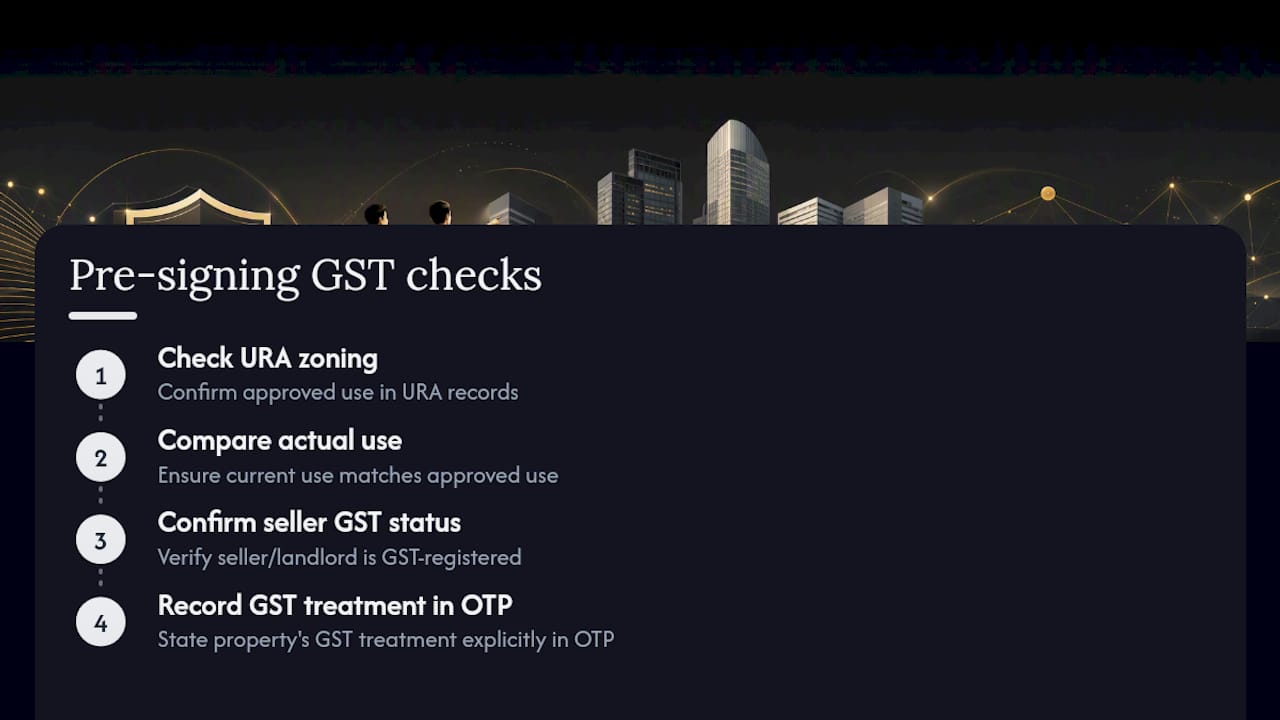
IRAS does not classify property by what a listing calls it. Classification depends on actual use and approved zoning. A unit approved for retail, office, industrial, or warehouse use is non-residential, and its sale or lease is a standard-rated supply once the seller or landlord is GST-registered. Hotels and serviced apartments generally fall into this taxable category too, since their supply resembles a commercial service rather than long-term residential occupation.
The line gets blurry with a few property types. A shophouse zoned for both commercial and residential use needs its GST treatment split by actual usage, not by the building’s overall label. An industrial unit converted informally into living quarters, without proper approval, does not become GST-exempt just because someone lives there; its legal classification for tax purposes still follows its approved use.
This matters most at the point of sale, when the Option to Purchase should state the property’s approved use explicitly. Buyers who assume a property is residential because it “feels” residential, and skip verifying its actual zoning, sometimes discover post-purchase that GST was owed on the transaction all along. Checking the URA zoning classification alongside the OTP is a five-minute step that prevents a costly surprise.
GST’s Effect on Developers Building New Commercial Space
Property developers face GST exposure at nearly every stage of a project. Construction materials, contractor fees, and professional services like architecture and engineering all carry GST, which a GST-registered developer can generally claim back as input tax, provided the completed project will be used to make taxable supplies.
The complication arrives when a development mixes commercial and residential units, which is common in Singapore’s integrated projects. A developer building a tower with retail podiums and residential units above must apportion input tax claims between the taxable commercial component and the exempt residential component. Get that apportionment wrong, and IRAS can disallow claims retroactively, which is a costly correction to make after a project has already sold out.
Developers also need to time their GST accounting around progress payments. Since GST follows the earlier of invoice or payment, a developer collecting staged payments from commercial buyers during construction must account for GST on each payment as it is invoiced, not in one lump sum at project completion. This creates a recurring compliance workload that smaller developers sometimes underestimate when budgeting for a project’s finance team.
For business owners buying pre-completion commercial units, this also means checking whether GST is charged progressively alongside each payment installment, since that affects both cash flow planning and the timing of any input tax claim.
Zero-Rated vs Standard-Rated: Why the Distinction Matters
Standard-rated supplies are the norm for commercial property. Sale and lease of non-residential property, agent commissions, and most professional fees tied to a transaction fall into this category, taxed at the current 9% rate. Zero-rated supplies, by contrast, are technically taxable but charged at 0%, and they apply in narrower circumstances, most commonly involving exports of goods or international services rather than domestic property transactions.
For most Singapore-based commercial property buyers, zero-rating rarely comes into play directly. Where it can matter is in adjacent services: if a business provides international consultancy or arranges services for an overseas client connected to a property deal, portions of that service might qualify for zero-rating under separate IRAS rules governing international services. This is a narrow exception, not a general feature of commercial property transactions, and it should not be assumed without checking the specific service against IRAS’s criteria.
The practical distinction that matters more for most readers is standard-rated versus exempt. Exempt supplies, primarily residential property sales and leases, and certain financial services, carry no GST and generate no input tax claim. Standard-rated supplies carry GST both ways: you pay it, and if registered, you can generally claim it back. Mistaking an exempt supply for a zero-rated one, or vice versa, changes both your pricing and your ability to recover GST, so confirm the correct category with a tax advisor rather than assuming based on how a competitor structured a similar deal.
GST Rules for Overseas Buyers and Lessors
Singapore’s GST framework applies based on where the supply occurs, not the buyer’s nationality or residency. An overseas investor buying a Singapore commercial unit from a GST-registered seller pays the same 9% GST as a local buyer would, since the property itself is located in Singapore regardless of who owns it.
Where it gets more involved is on the leasing side. An overseas landlord who owns Singapore commercial property and rents it out is generally required to register for GST once their taxable turnover crosses the registration threshold, the same rule that applies to local landlords. Foreign ownership does not exempt a landlord from Singapore’s GST obligations if the property and the rental income are based here.
Overseas buyers also need to factor in that GST is a cash payment due at completion, and financing arrangements from foreign banks do not always account for this local requirement cleanly. It is worth flagging early with both a local lawyer and the financing bank, since a shortfall discovered close to completion date creates unnecessary pressure on the deal.
How to Register for GST When Buying or Leasing Commercial Property
Registration becomes compulsory once your taxable turnover, including rental income from commercial property, exceeds the threshold IRAS sets, tracked either historically over the past twelve months or prospectively if you expect to cross it in the next twelve. Business owners planning to acquire multiple commercial units for leasing should model their expected rental income against this threshold before the first purchase, not after.
The registration process itself runs through IRAS’s myTax Portal, where applicants submit business details, projected turnover, and supporting documents such as tenancy agreements or sale contracts. Approval typically triggers an effective registration date, and everything invoiced from that date forward must include GST at the prevailing rate.
Voluntary registration is also an option for smaller landlords who haven’t hit the threshold but want to claim input tax on renovation, fit-out, or professional fees tied to a commercial purchase. This carries a tradeoff: once registered, you must charge GST on your own rental income and maintain the same invoicing and filing discipline as a larger, compulsorily registered business. For a landlord with one small retail unit, that additional administrative load sometimes outweighs the input tax benefit, so it is worth running the numbers before opting in voluntarily.
Penalties for Getting GST Wrong on a Commercial Deal
IRAS treats GST non-compliance seriously, and errors on commercial property transactions are a recurring audit target given the size of the amounts involved. Late GST registration, once a business has crossed the threshold, can result in penalties calculated on the tax that should have been charged from the date registration was due, plus additional fines for the delay itself.
Incorrect GST filings, whether from misclassifying a supply as exempt when it should be standard-rated, or from claiming input tax on a blocked or ineligible expense, can trigger both a demand for the underpaid tax and separate penalties for the inaccuracy. IRAS conducts periodic audits of property transactions specifically because the dollar amounts involved make errors expensive to miss, and repeated or willful misreporting escalates to more severe financial penalties.
The safest posture is straightforward: register on time, invoice clearly, keep every tax invoice on file, and get professional review on any transaction involving nominee clauses, mixed-use apportionment, or overseas parties. Catching a classification error before filing costs a consultation fee. Catching it after an IRAS audit costs considerably more, both in penalties and in the time spent responding to review requests.
GST as a Negotiating Chip, Not Just a Compliance Line
Most buyers treat GST as an afterthought bolted onto the purchase price at the last minute. That’s backwards. GST affects your total cash requirement at completion, which affects how aggressively you can negotiate on the base price itself.
The habit worth building is simple: never sign an OTP or lease without confirming in writing whether the quoted figure includes GST, and whether you will be able to reclaim it. That single confirmation changes how you read every other number in the deal. If you’re evaluating a broader commercial property opportunity, fold the GST cash requirement into your budget from day one rather than treating it as a closing-week surprise.
— Aman
Get GST-Ready Support Before You Sign Your Next Commercial Deal
GST clauses buried in an OTP or lease agreement are exactly the kind of detail that turns into an expensive dispute months after signing. Real estate consultants work directly with buyers, investors, and business owners on the contract side of commercial deals, reviewing invoicing language, checking vendor GST registration status, and flagging nominee clauses before they create classification headaches.
Ahead of a consultation, bring your draft OTP or lease, any correspondence on GST treatment from the vendor or landlord, and a rough budget showing your available cash for completion. That lets Com’s team spot GST exposure early, whether it’s an unclear furniture clause or a mismatched invoice, rather than after you’ve already committed. If you’re weighing a purchase for long-term rental income or resale, the wealth creation through real estate guide walks through how GST-aware budgeting fits into a broader investment plan. Reach out to schedule a review of your next commercial deal before you sign.
Where to Verify These Rules Yourself
- IRAS stamp duty and tax rates: confirms current GST rates and registration thresholds.
- IRAS’s myTax Portal: the official channel for GST registration and filing once you cross the threshold.
This article is general information, not a substitute for advice from a qualified financial advisor. Consult a qualified financial professional about your own circumstances before acting on anything here.
FAQ
Do I need to pay GST for commercial property?
Yes. The sale and lease of non-residential property in Singapore is a taxable supply under IRAS rules, so long as the seller or landlord is GST-registered.
What is the commercial property tax rate in Singapore?
Property tax is separate from GST and is charged annually based on the property’s annual value, not the transaction price; when property tax is bundled into rent, GST still applies to the full rental amount, not the rent minus property tax.
Do I need to pay ABSD for commercial property?
Additional Buyer’s Stamp Duty (ABSD) generally applies to residential property purchases, not commercial or industrial property. Buyers should always confirm current stamp duty rules for their specific transaction before completion.


