


If you’re eligible for it, the HDB loan is usually the safer starting point for first-time buyers, even though it carries a higher headline rate. As of June 2026, the HDB concessionary rate sits at 2.6% per year, against bank fixed packages running roughly 1.35% to 1.80%. The catch: banks demand at least 5% in cash upfront, and you need a clean income profile and credit history to lock in that lower rate.
TL;DR:
- The HDB loan offers a fixed 2.6% rate with no refinancing restrictions, making payment predictable over the loan term.
- Bank fixed-rate packages currently range from 1.35% to 1.80%, but revert to floating rates after the lock-in period, risking higher payments if rates rise.
- To minimize cash upfront, HDB loans allow full 25% downpayment via CPF, while bank loans require at least 5% in cash, plus cash for resale flat COV.
- Borrowing limits depend on MSR and TDSR ratios, capping housing payments at 30% of income and total debt at 55%, regardless of loan rate differences.
- Refinancing from HDB to a bank is straightforward, but switching back is not allowed once a bank loan is taken, affecting flexibility for future financial planning.
Table of Contents
- HDB Vs Bank Loan: The Key Differences At A Glance
- How Do HDB And Bank Interest Rates Actually Compare?
- Downpayment And CPF: How Much Cash Do You Actually Need?
- Who Qualifies For Each Loan Type?
- Why MSR And TDSR Matter More Than The Headline Rate
- Lock-Ins, Refinancing Costs, And The One-Way Switch Rule
- What Do The Numbers Look Like Over 25 Years?
- How Should You Actually Decide?
- A Word On Author And Firm Background
- What Most First-Time Buyers Get Wrong
- How Aesthetic Havens Helps You Run The Numbers
- Where To Verify These Numbers Yourself
- Sources
HDB Vs Bank Loan: The Key Differences At A Glance
Every buyer weighing a bank loan vs HDB loan is really comparing six things: rate structure, cash requirements, eligibility, borrowing limits, and the rules around switching later. Here’s where they split:
- Interest rate: HDB charges a fixed 2.6% (CPF OA + 0.1%); banks offer fixed promos around 1.35% to 1.80%, or SORA-pegged floating packages.
- Downpayment: HDB lets you fund the full 25% from CPF Ordinary Account savings; banks require a minimum 5% in cash.
- Eligibility: HDB loans are capped by income ceilings and citizenship rules; bank loans have no income ceiling but run credit checks.
- Loan-to-value (LTV): Both now cap at 75% of the flat’s value, following the 2024 parity change.
- Switching: You can refinance from HDB to a bank loan any time, but not the other way around.
How Do HDB And Bank Interest Rates Actually Compare?
The HDB concessionary rate isn’t set by market forces. It’s pegged to the CPF Ordinary Account rate plus 0.1%, which is why it has held at 2.6% for years even as bank rates swing with market conditions. That stability is the entire selling point: your monthly payment doesn’t move for the life of the loan.
Rate snapshot, June 2026: HDB concessionary rate: 2.6% (fixed). Representative bank fixed packages: 1.35% to 1.80%, depending on lock-in length. Floating bank packages track SORA, the benchmark that replaced older interbank rates.
Bank packages come in two flavors. Fixed-rate deals lock your rate for one to five years, after which you typically revert to a floating rate pegged to SORA plus a bank margin. Floating packages track SORA from day one, meaning your payment rises or falls as the benchmark moves.
- Fixed bank packages look cheap upfront but expose you to repricing risk once the lock-in ends.
- Floating packages can undercut HDB’s rate in calm periods but spike when SORA climbs, as it did during past rate cycles.
- HDB’s 2.6% never changes, which makes budgeting predictable even if it costs more in good years.
Downpayment And CPF: How Much Cash Do You Actually Need?
This is where the two loans diverge most sharply for someone with limited savings. An HDB loan lets you pay the entire 25% downpayment using CPF Ordinary Account funds, provided your CPF retention sum requirements are met. A bank loan requires a minimum 5% in cash, with the remaining 20% payable via CPF OA or cash.
Resale flat buyers face an added wrinkle: cash-over-valuation (COV), the amount a seller asks above the flat’s valuation. COV must be paid entirely in cash, which stacks on top of whatever downpayment structure you choose and hits bank-loan buyers with thinner cash reserves the hardest.
Before you commit to either route, run through this:
- Check your CPF OA balance against the retention sum before assuming it covers your full downpayment.
- Set aside cash for COV separately. It cannot be paid with CPF funds.
- Factor in legal fees and valuation costs, which are cash items regardless of loan type.
- Confirm whether your resale flat purchase has any COV before signing the Option to Purchase.
Who Qualifies For Each Loan Type?
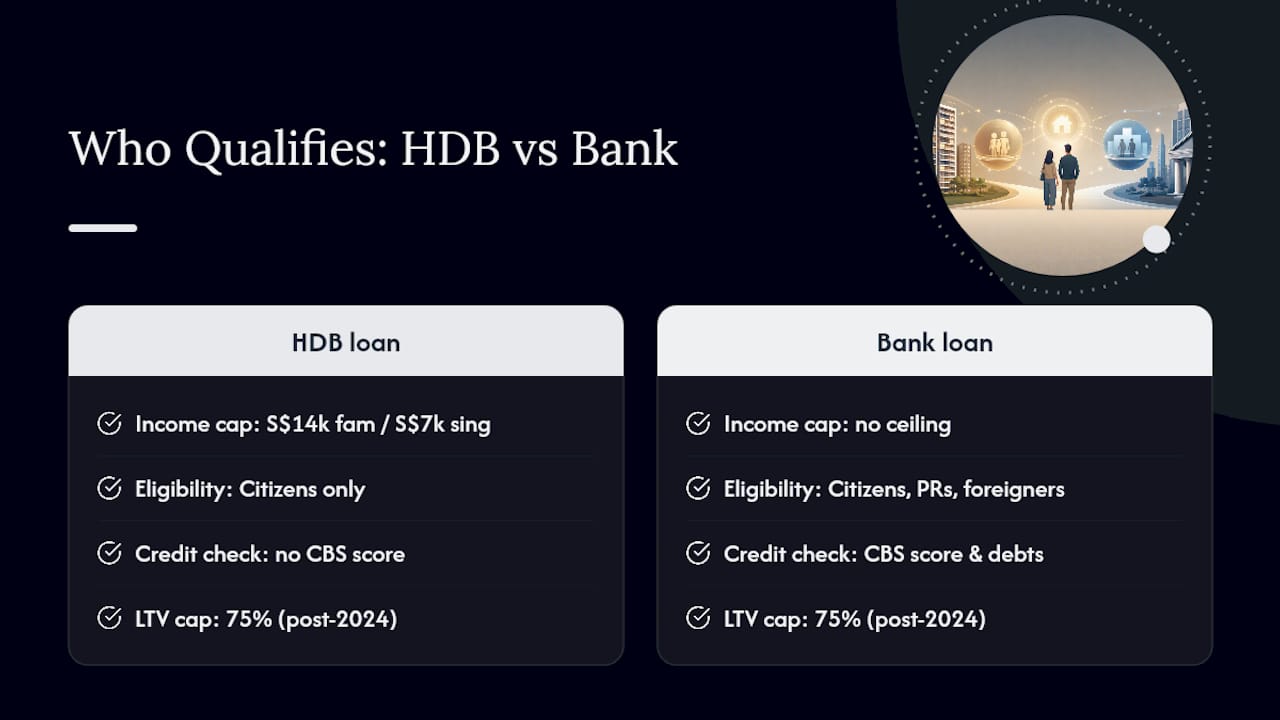
HDB loans are gated by two hard rules. Your household income cannot exceed S$14,000 a month for families or S$7,000 for singles, and the loan is restricted to Singapore Citizen households. Permanent residents and mixed-citizenship households generally need to go the bank route.
Bank loans have no income ceiling, and permanent residents and foreigners buying HDB resale flats (where eligible) can apply. What banks do check closely is credit history through the Credit Bureau Singapore score, employment stability, and existing debt obligations. A thin or poor credit file can mean a higher quoted rate or an outright decline, something HDB’s income-based assessment doesn’t factor in the same way.
On borrowing limits, both loan types now cap at 75% loan-to-value following the 2024 policy alignment. Tenure caps differ slightly by remaining lease and borrower age, but the practical ceiling on how much you can borrow is now nearly identical between the two.
Why MSR And TDSR Matter More Than The Headline Rate
Two ratios decide your actual borrowing power, and neither is the interest rate. The Mortgage Servicing Ratio (MSR) caps housing loan repayments at 30% of gross monthly income for HDB flat purchases, whether the loan comes from HDB or a bank. The Total Debt Servicing Ratio (TDSR) caps all debt obligations, including the mortgage, at 55% of gross monthly income.
Here’s why that matters more than the rate you’re quoted:
- A household earning S$8,000 a month has an MSR ceiling of S$2,400 in monthly mortgage repayment, regardless of whether the loan is priced at 1.6% or 2.6%.
- If that same household is also servicing a car loan and credit card balances, TDSR might cut their usable repayment room below the MSR ceiling entirely.
- Two households with identical income can end up with different loan approvals purely because of existing debt, not the mortgage rate on offer.
Read the full breakdown of TDSR vs MSR if you want to model your own ceiling before approaching a bank.
Lock-Ins, Refinancing Costs, And The One-Way Switch Rule
Refinancing outside the lock-in still costs money: legal fees, a fresh valuation, and administrative charges typically add up to a few thousand dollars.
- Lock-in periods run one to three years for most bank packages.
- Early-exit penalties usually apply as a percentage of the outstanding loan, varying by lender.
- Refinancing costs (legal, valuation, admin) should be weighed against projected interest savings before you switch.
- You can move from an HDB loan to a bank loan at any point, but you cannot move back from a bank loan to HDB once you’ve switched.
Pro Tip: Before refinancing, divide your total switching cost by your monthly interest savings. If the payback period is longer than your remaining lock-in or your planned holding period for the flat, the switch usually isn’t worth it.
What Do The Numbers Look Like Over 25 Years?
They’re illustrative, not a quote for your specific situation.
- HDB loan, 2.6% fixed for 25 years: Monthly repayment is roughly S$1,700. Total interest paid over the full term lands near S$135,000. Payments never change.
- Bank loan, 1.6% fixed for 3 years, then floating at a moderate rate: Monthly repayment starts around S$1,510 for the first three years, then adjusts based on where SORA sits when the fixed period ends.
- Bank loan, 1.6% fixed for 3 years, then a higher floating scenario: If SORA climbs meaningfully after the fixed period, monthly payments can exceed the HDB equivalent, and total interest over 25 years can end up higher than the HDB loan despite the lower starting rate.
The gap between scenario 2 and scenario 3 isn’t a rounding error. It’s the entire risk a bank loan asks you to carry once the fixed period ends, based on market fixed-rate ranges observed in mid-2026.
Scale these figures up or down proportionally for a bigger or smaller loan. The mechanics don’t change, just the dollar amounts.
How Should You Actually Decide?
Work through this in order rather than jumping straight to comparing rates:
- Confirm your HDB Flat Eligibility (HFE) letter and check whether you meet the income ceiling and citizenship requirement.
- Tally your cash reserves against likely COV exposure if you’re buying resale.
- Compare current bank fixed rates against 2.6%, factoring in refinancing costs if you plan to start with HDB and switch later.
- Run your numbers against MSR and TDSR to see your real borrowing ceiling, not just what a bank quotes you.
- Decide: start with HDB if cash is tight or you value payment stability; start with a bank loan if you have strong credit, cash for the 5% downpayment, and a fixed rate that’s comfortably below 2.6% even after fees.
Next steps: apply for your HFE letter, request an In-Principle Approval or Letter of Offer from two or three banks to compare, and speak with a mortgage adviser before signing anything, and consider scheduling HDB painting services to prepare your new home for move-in.
A Word On Author And Firm Background
This guidance draws on official HDB, CPF, and MAS sources, cross-checked against current market rate data. Aesthetic Havens, led by Aman Aboobucker under ERA Realtors, helps buyers model these scenarios against their actual income and CPF position, liaise with banks, and navigate the paperwork that follows a financing decision.
What Most First-Time Buyers Get Wrong
Buyers fixate on the headline rate and underplan their cash buffer. If you’re unsure which way to go, start with the HDB loan. It’s the more forgiving choice while you build certainty. Run the decision checklist above before locking in anything.
— Aman
How Aesthetic Havens Helps You Run The Numbers
Choosing between an HDB loan and a bank loan is only half the decision. The other half is understanding what you’re actually buying into: the flat’s title type, its lease profile, and how the financing choice affects your resale position later. Aesthetic Havens works through that fuller picture with buyers rather than just pointing you to a calculator.
Aman and the team at Aesthetic Havens help first-time buyers model MSR and TDSR scenarios against real income figures, compare bank offers against the HDB rate, and connect the financing decision to what happens after you own the flat, including title structure and future resale value. If you’re weighing your options right now, a good next step is reading through property title types explained to understand how your purchase structure interacts with financing, then reach out to get your specific numbers reviewed before you commit to either loan.
Where To Verify These Numbers Yourself
Check the HDB interest rate page for the current concessionary rate, CPF’s member resources for OA usage calculators, and MAS’s SORA page for the benchmark behind floating bank packages. All three update regularly and should be your first stop before finalizing any loan decision.
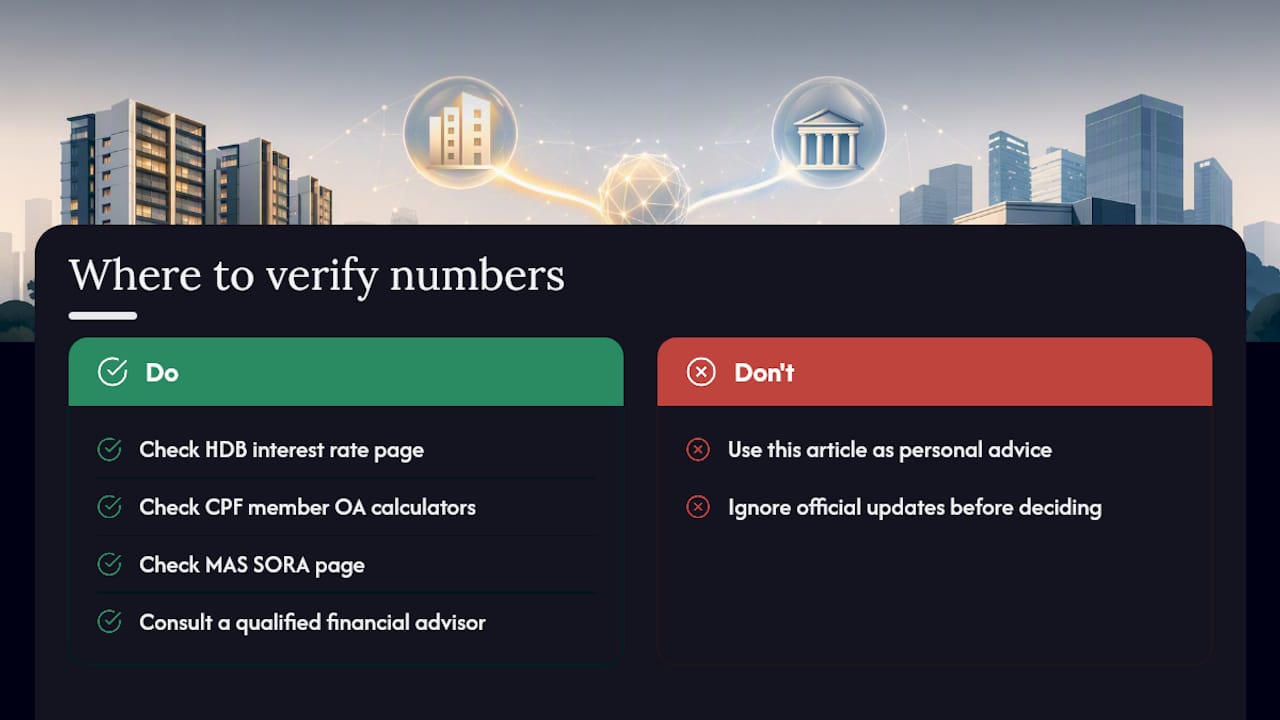
This article is general information, not a substitute for advice from a qualified financial advisor. Consult a qualified financial professional about your own circumstances before acting on anything here.
Sources
- HDB | Loan matters: interest rate
- CPF | HDB loan or bank loan? 3 differences you should know
- HDB | Housing loan from HDB (eligibility details)
- HDB | Housing loan from Financial Institutions (FI)


