


A gross lease means you pay one fixed rent and the landlord handles the rest. A net lease means you pay a lower base rent, then get billed separately for some or all of the building’s operating costs. For most startups and small tenants in Singapore, a gross or modified gross lease is the safer starting point because it caps your monthly exposure. Established operators with accounting capacity and longer lease terms often come out ahead on a triple net structure, provided they negotiate caps and audit rights. The catch: the label on the lease document means almost nothing. Contract language determines your actual liability, not the heading at the top of the page.
Key Takeaways
The most important principle in any gross vs net lease comparison is this: never evaluate a lease by its headline rent alone; model the total occupancy cost over the full lease term, including realistic operating expense escalation.
| Point | Details |
|---|---|
| Labels do not determine liability | The lease document’s definitions and exclusions set your actual cost, not the gross or net label. |
| Gross rents carry a predictability premium | Gross rents typically run 25–40% above equivalent NNN base rent; that gap narrows as pass-throughs compound. |
| Model five years, not Year 1 | NNN all-in cost can exceed gross rent by Year 3 when operating expenses escalate faster than the gross rent clause. |
| Negotiate caps and audit rights | CAM caps (3–5% on controllable expenses) and audit rights are the two most valuable protections in any net lease. |
| Aesthetic Havens offers lease review support | The firm benchmarks operating expenses, negotiates CAM terms, and advises on lease structure for Singapore commercial tenants and landlords. |
Table of Contents
- How gross vs net leases compare at a glance
- What is a gross lease, and when does the label mislead you?
- What is a net lease, and what does each “N” actually shift to you?
- How pass-throughs, estimates, and annual reconciliations actually work
- Pros and cons of each lease structure, for both sides of the table
- How to choose and negotiate lease structure in Singapore
- Worked numeric examples: converting headline rent to all-in cost
- Which lease type is right for your situation?
- A Singapore leasing advisor’s perspective
- Aesthetic Havens can help you negotiate the right lease in Singapore
- Sources
How gross vs net leases compare at a glance
The fastest way to understand the difference is to look at who writes the check for each operating expense category.
| Expense Category | Full-Service Gross | Modified Gross | Single Net (N) | Double Net (NN) | Triple Net (NNN) |
|---|---|---|---|---|---|
| Property tax | Landlord | Landlord (base year) | Tenant | Tenant | Tenant |
| Building insurance | Landlord | Landlord (base year) | Landlord | Tenant | Tenant |
| CAM / maintenance | Landlord | Shared (above base) | Landlord | Landlord | Tenant |
| Utilities | Landlord | Often tenant | Tenant | Tenant | Tenant |
| Major structural repairs | Landlord | Landlord | Landlord | Landlord | Tenant (absolute net) |
| Predictability for tenant | High | Medium | Medium | Low | Low |
| Headline rent level | Highest | Mid-high | Mid | Mid-low | Lowest |
Worked example: 2,000 sq ft office, Year 1
Suppose a landlord offers you two options on the same space:
- Gross rent: SGD 8.00 psf/month = SGD 16,000/month all-in
- NNN base rent: SGD 5.50 psf/month = SGD 11,000/month, plus estimated operating expenses of SGD 2.20 psf = SGD 4,400/month
Year 1 all-in: Gross = SGD 16,000. NNN = SGD 15,400. The gap looks small. But gross rents typically run 25–40% above equivalent NNN base rent because landlords price in the predictability buffer. Run the five-year model before you decide.
Numbers to collect before comparing any two lease offers:
- Two to three years of actual operating expense statements (not landlord estimates)
- Historic CAM growth rate and any capital items charged through CAM
- Property tax assessment history and any pending reassessments
- Building insurance premium trend
- Whether a CAM cap applies and how “controllable” expenses are defined
- Reconciliation frequency and whether audit rights are included
Pro Tip: Ask the landlord for the prior two years’ reconciliation statements, not just the current-year estimate. The reconciliation shows what tenants actually paid versus what was estimated, and that gap tells you more than any headline figure.
What is a gross lease, and when does the label mislead you?
A full-service gross lease bundles every operating cost into one monthly rent. The landlord pays property tax, building insurance, common-area maintenance, utilities, and structural repairs from that single payment. You know your number on Day 1 and it does not change unless the lease has an escalation clause.
The modified gross lease is where things get complicated. It starts from a defined “base year,” typically the first year of the lease. The landlord absorbs operating costs at that base-year level. Any increases above that baseline get passed through to the tenant proportionally. So if property tax rises SGD 0.30 psf in Year 2, you pay that increment. Modified gross leases commonly use a defined base year, and the allocation in the lease document determines which party bears expense increases, not the label on the cover page.
Common carve-outs that turn a “gross” lease into a partial net:
- Utilities metered separately to your space (nearly universal in Singapore multi-tenant buildings)
- After-hours air conditioning charges (a significant cost in Singapore’s climate)
- Merchant association or marketing fees in retail leases
- Percentage rent clauses tied to your gross revenue
- Separately contracted services like dedicated security or supplemental cleaning
Pro Tip: Before signing any lease described as “gross,” request a written list of every expense excluded from the quoted rent. If the landlord cannot produce one, treat the lease as a modified gross at best and price accordingly.
The practical implication: a lease labeled “gross” in Singapore may still leave you paying utilities, after-hours HVAC, and marketing levies. Those three items alone can add SGD 1.00–1.50 psf/month to your real occupancy cost in a retail or office setting.
What is a net lease, and what does each “N” actually shift to you?
Net leases come in four variants, each shifting a different set of operating costs to the tenant. Triple net leases shift the three primary operating categories, property taxes, building insurance, and maintenance/CAM, to the tenant, while full-service gross bundles them into one rent number.
The four net-lease variants:
- Single net (N): Tenant pays base rent plus property tax. Landlord retains insurance and maintenance. Rare in Singapore commercial practice.
- Double net (NN): Tenant pays base rent, property tax, and building insurance. Landlord handles structural maintenance. Common in some industrial sub-leases.
- Triple net (NNN): Tenant pays base rent, property tax, insurance, and all CAM/maintenance. The landlord’s only retained obligation is typically major structural repairs. Standard for freestanding retail and single-tenant industrial in many markets; increasingly negotiated in Singapore for longer-term leases.
- Absolute net: Tenant pays everything, including structural repairs and roof replacement. Used almost exclusively for sale-leaseback transactions or long-term single-tenant freestanding assets.
How pro-rata shares work in multi-tenant buildings:
Your share of CAM is calculated as your leased area divided by the total leasable area of the building (or the relevant floor or wing, depending on the lease).
Tenant implications by variant:
- NNN requires you to budget for cost volatility. Property tax reassessments and insurance premium spikes are real and can arrive in the same year.
- CAM gross-up clauses allow landlords to bill you as if the building were 95–100% occupied even when it is not. This protects the landlord’s cost recovery but inflates your share.
- CAM definitions, gross-up clauses, audit rights, and caps on controllable expenses are the main levers tenants use to limit NNN exposure.
- Absolute net is rarely appropriate for an operating business unless you have the maintenance infrastructure of a large retailer or logistics operator.
For Singapore tenants considering a triple net lease, the most common structure in single-tenant industrial and some retail assets, the key question is whether you have the operational bandwidth to manage building-level costs or whether you need the landlord to absorb that function.
How pass-throughs, estimates, and annual reconciliations actually work
Understanding the reconciliation cycle is what separates tenants who budget accurately from those who get hit with a large year-end bill.
- Lease execution: The landlord estimates annual operating expenses for the coming year and calculates your monthly pass-through amount based on your pro-rata share.
- Monthly payments: You pay base rent plus the estimated pass-through amount each month. This estimate is a forecast, not a final number.
- Year-end reconciliation: The landlord compiles actual operating costs for the calendar or lease year. Your actual share is calculated against what you paid in monthly estimates.
- Settlement: If actual costs exceeded estimates, you owe the difference. If estimates ran high, you receive a credit or refund. In Singapore, this settlement typically occurs within 90–120 days of the lease year end, though the lease should specify the deadline.
- Audit window: If your lease grants audit rights, you have a defined period (typically 90 days after receiving the reconciliation statement) to request documentation and dispute line items.
Common pass-through line items:
- Property tax (based on IRAS annual value assessments in Singapore)
- Building insurance premiums
- Common area maintenance: cleaning, landscaping, security, pest control
- Utilities for common areas
- Building management fees
- Elevator and mechanical system maintenance
- Capital expenditures, where the lease permits amortization through CAM
Pitfalls that cost tenants money:
- No audit rights in the lease, leaving you unable to verify the landlord’s numbers
- Vague CAM definitions that allow the landlord to include items you did not anticipate
- Gross-up clauses that inflate your share when occupancy is low
- Capital expenditures buried in operating expense line items
- No cap on controllable expenses, so management fee increases pass through unchecked
- Reconciliation deadlines that are ambiguous, making it hard to dispute late statements
Pros and cons of each lease structure, for both sides of the table
Tenant perspective:
Gross leases offer budget certainty. You know your monthly cost, you can model three years forward without assumptions about tax or insurance trends, and you avoid the administrative overhead of reviewing CAM statements. The trade-off is that you pay a premium for that certainty. Landlords price the operating-cost buffer into the headline rent, and in years when actual costs come in below the buffer, you have effectively subsidized the landlord’s margin.

Net leases offer a lower base rent, which matters for cash-flow-constrained businesses. But the variability is real. A property tax reassessment or a spike in building insurance can add thousands of dollars to your annual occupancy cost with no warning. You also need the accounting capacity to review reconciliation statements and exercise audit rights.
Landlord perspective:
A gross lease simplifies administration. One rent, no reconciliation cycle, no tenant disputes over CAM line items. The risk is that operating costs rise faster than the rent escalation clause allows, compressing net operating income. In Singapore’s environment, where property tax and insurance costs can shift meaningfully, that risk is not trivial.
A net lease transfers cost volatility to the tenant and protects the landlord’s net income. The administrative burden is higher: annual reconciliations, audit responses, and the occasional dispute over CAM definitions. Landlords with large portfolios typically have the systems to manage this; smaller landlords sometimes underestimate the overhead.
Which business profiles suit each structure:
- Startups and SMEs: Gross or modified gross. Predictability matters more than the premium.
- Restaurants and F&B: Modified gross with utilities carved out. Utilities are too variable to bundle.
- Freestanding retail (large format): NNN is standard. These operators have the scale to manage building costs.
- Corporate office occupiers: Modified gross with a well-defined base year and a cap on controllable expense increases.
- Logistics and industrial: NNN or absolute net, particularly for single-tenant facilities where the tenant effectively controls the building.
Lease term length also matters. On a two-year lease, the compounding effect of pass-through escalations is limited. On a five-year or longer lease, the difference between a gross and an NNN all-in cost can be substantial, which is why the five-year model is worth building before you sign.
How to choose and negotiate lease structure in Singapore
Singapore’s commercial leasing market operates under a relatively landlord-favorable framework, particularly in prime districts and Grade A office buildings. That said, tenants with strong covenants and longer lease commitments have real negotiating leverage. Here is what to insist on.
Tenant negotiation checklist:
- Request two to three years of actual operating expense statements, not projections
- Insist on a CAM cap, typically 3–5% annual increase on controllable expenses
- Require audit rights with a minimum 90-day window after receiving the reconciliation statement
- Define CAM exclusions explicitly: management fees above a stated percentage, capital expenditures, leasing commissions, and costs specific to other tenants
- If using a modified gross structure, define the base year precisely, including which expense categories are included and how partial-year costs are handled
- Clarify whether the sinking fund or major repair reserve is a pass-through item or a landlord obligation. In Singapore strata-titled commercial buildings, the sinking fund is a statutory reserve for major repairs, distinct from monthly maintenance fees. Tenants should confirm whether either is passed through under the lease.
- Confirm IRAS property tax treatment: in Singapore, property tax is assessed on the annual value of the property and is technically a landlord obligation, but many commercial leases pass it through to tenants as a net lease item. Verify this in the lease and model it into your all-in cost.
Landlord checklist:
- Expect tenants to request CAM caps and audit rights on any lease over two years
- Reasonable counteroffers: escrowed reconciliation reserves, audited annual statements, and service-level commitments for building maintenance
- Provide clear CAM definitions upfront to reduce dispute risk at reconciliation
Singapore-specific red flags:
- Leases that reference “service charges” without defining what is included (a common local ambiguity)
- Utility pass-throughs that are not metered separately, leaving you exposed to whole-building consumption
- Sinking fund contributions bundled into CAM without disclosure
- Leases in strata commercial buildings where the management corporation’s (MCST) decisions on major repairs can create unexpected pass-through costs
Pro Tip: When negotiating a modified gross lease in Singapore, ask the landlord to attach the prior year’s operating expense ledger as a schedule to the lease. This creates a documented baseline and makes base-year disputes far easier to resolve.
For a detailed walkthrough of commercial leasing negotiation tactics specific to Singapore, including PSF benchmarks by district, the Aesthetic Havens blog covers the mechanics in depth.
Worked numeric examples: converting headline rent to all-in cost
Scenario: 2,000 sq ft office space, five-year lease

By Year 3, the NNN all-in cost exceeds the gross rent. Over the full five years, the cumulative difference is meaningful. This is exactly the compounding effect that total occupancy cost modeling over the lease term is designed to surface. Never compare base rent alone.
Sensitivity check: what a tax spike does
If property tax increases by SGD 0.40 psf in Year 3 (a realistic scenario following an IRAS annual value reassessment), the NNN tenant’s Year 3 all-in jumps by SGD 800/month. The gross tenant pays nothing extra. Over a five-year lease, two such reassessments could add SGD 15,000–20,000 in cumulative additional cost to the NNN tenant.
Budgeting tip: Build three scenarios: base case (operating expenses escalate at historical average), upside (flat costs), and stress case (tax spike plus insurance premium increase in the same year). The stress case is what your cash-flow model needs to survive.
Understanding how PSF figures translate into total occupancy cost is a prerequisite for running this model accurately.
Which lease type is right for your situation?
Decision guide by tenant profile:
- Startup or SME with limited accounting resources: Choose gross or modified gross. The premium is worth the budget certainty and the absence of reconciliation overhead.
- Established operator with finance and facilities teams: NNN with negotiated CAM caps and audit rights. You can manage the variability and the lower base rent improves your unit economics.
- Single-tenant freestanding retail or logistics: Absolute net or NNN is standard. You control the building, so you should control the costs.
- Restaurant or F&B operator: Modified gross with utilities metered and excluded. Your utility consumption is too variable to bundle into a landlord-managed gross rent.
- Corporate HQ with a five-year-plus commitment: Modified gross with a precisely defined base year, a cap on controllable expense increases, and full audit rights.
When to get expert help: any lease above SGD 50,000/year in total annual rent, any lease with a term of three years or more, or any lease where CAM definitions run longer than two paragraphs. At that scale, a lease review by an experienced advisor typically saves more than it costs.
One reminder that applies to every scenario: the lease label is a starting point, not a contract. Read the definitions, the exclusions, and the reconciliation mechanics before you sign anything. The allocation in the lease document determines actual liability, not the label.
A Singapore leasing advisor’s perspective
The single most common mistake I see from small tenants in Singapore is comparing two lease offers by their headline psf number. A tenant will look at SGD 8.00 psf gross and SGD 5.80 psf NNN and assume the NNN is cheaper. It often is not, and by Year 3 it frequently costs more.
The second mistake is skipping the audit rights clause because the landlord says “we’ve never had a dispute.” That may be true. It may also mean no tenant has ever checked. In one case I reviewed, a reconciliation statement included a capital expenditure item, a lift motor replacement, amortized over five years and charged through CAM. The tenant had no audit rights and no recourse.
Singapore landlords in prime districts are generally sophisticated and their leases are well-drafted. But “well-drafted for the landlord” is not the same as “fair to the tenant.” The base-year definition in a modified gross lease, the CAM gross-up clause, and the definition of “controllable” versus “uncontrollable” expenses are the three places where the economics can shift significantly against you without a single word looking unusual on the page.
My advice: get the prior two years of actual operating expense statements before you negotiate rent. That data tells you what the building actually costs to run, and it gives you a factual basis for your CAM cap request. Landlords who refuse to provide it are telling you something.
For tenants who want to understand how agent support in Singapore commercial leasing can add negotiating leverage, the process of engaging a tenant’s representative is straightforward and typically costs you nothing directly.
Aesthetic Havens can help you negotiate the right lease in Singapore
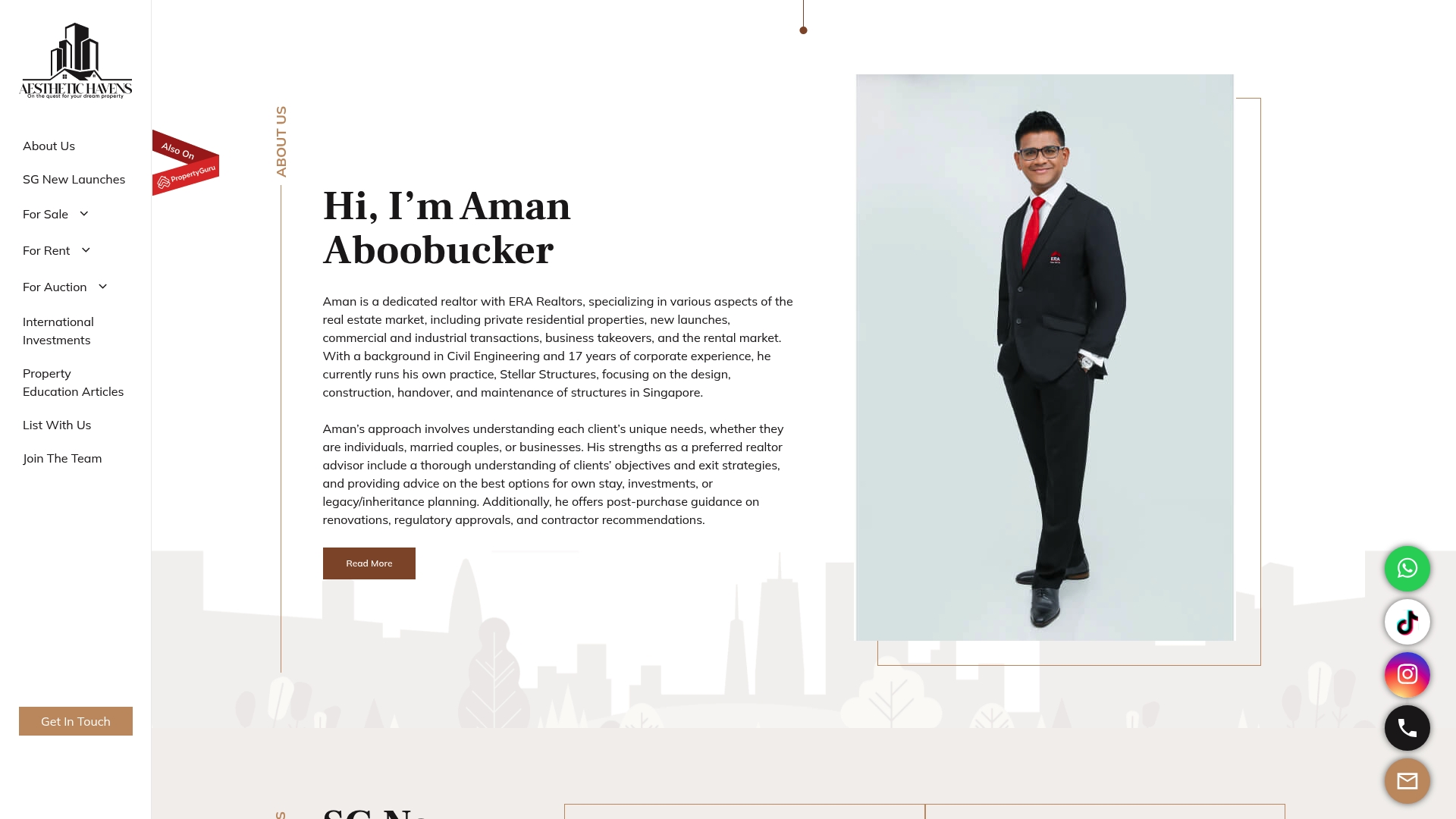
Signing a commercial lease without a clear picture of your all-in cost is one of the most expensive mistakes a business can make in Singapore. Aesthetic Havens, operating under ERA Realtors, offers lease review and negotiation support that goes beyond finding a space.
The firm’s commercial leasing services include operating expense benchmarking against current Singapore market rates, CAM cap and audit-rights negotiation, base-year clause structuring for modified gross leases, landlord engagement on reconciliation mechanics, and post-signing advisory when disputes arise. For landlords, the rental checklist and landlord advisory service helps structure lease terms that attract strong tenants while protecting net operating income.
Whether you are a first-time commercial tenant or an investor evaluating a commercial property acquisition, the starting point is a lease review conversation. Contact Aesthetic Havens at Aesthetichavens to request a consultation.
Sources
Singapore-specific references:
- Who Pays for What? Understanding Key Differences in Triple Net, Gross and Modified Gross
- NNN Lease vs. Gross Lease: Which Is Better for Tenants? | LeaseLens
Lease structure definitions and mechanics:


