


Yes, a Singapore Citizen can buy a second residential property, but the Additional Buyer’s Stamp Duty) alone adds 20% of the purchase price to your upfront cash bill. On a $1.5 million condo, that means a substantial amount in ABSD before you count Buyer’s Stamp Duty, the minimum cash downpayment, legal fees, or the reduced loan you qualify for with an existing mortgage. The numbers are not a deterrent for every buyer, but they do mean you need to know your exact cash position before you sign anything.
Quick items to budget on purchase day:
- ABSD: 20% (SC), 30% (PR), or 60% (foreigner) of the higher of purchase price or market value
- Buyer’s Stamp Duty (BSD): tiered on the first $180,000 at 1%, next $180,000 at 2%, next $640,000 at 3%, and above $1 million at 4% (with higher bands for very high-value properties)
- Minimum cash downpayment: a significant portion of the purchase price when you have an existing housing loan, with a required cash component (the rest can come from CPF)
- Legal and transaction costs: conveyancing fees, valuation, and agent commission which vary depending on property price
Where to verify: IRAS for ABSD and BSD rates, HDB for MOP and eligibility, and MAS for LTV and TDSR rules. Married couples may qualify for an ABSD remission if they sell their first property within six months of buying the second jointly. HDB flat owners must check their Minimum Occupation Period before committing to any private purchase.
Key Takeaways
| Point | Details |
|---|---|
| ABSD rates by profile | SC pays 20% on a second property; PR pays 30%; foreigners pay 60% on any purchase (IRAS, effective April 27, 2023). |
| LTV and downpayment | With one existing housing loan, max LTV drops to 45%; minimum 25% of purchase price must come from cash and CPF. |
| TDSR cap | All monthly debt obligations including the new mortgage cannot exceed 55% of gross monthly income, stress-tested at approximately 4%. |
| Married-couple remission | SC couples buying jointly can claim a full ABSD refund if they sell their first property within six months of the second purchase. |
| Practical next step | Get an IPA from a bank (or HFE letter from HDB) before exercising any OTP, and engage a conveyancing lawyer early. |
| Aesthetic Havens | Provides numbers-first affordability modeling, ABSD remission guidance, and full transaction support for second-property buyers in Singapore. |
Table of Contents
- What does buying a second property in Singapore actually cost in ABSD?
- Who is eligible to buy a second property, and what do HDB rules require?
- How does affordability change for a second property: LTV, TDSR, and downpayment?
- How do you secure financing for a second property in Singapore?
- What are all the upfront and ongoing costs to budget?
- What are the lawful ways to reduce or recover ABSD?
- Two worked examples showing the real cash required
- A step-by-step checklist for executing a second-property purchase
- What are the key risks to stress-test before you commit?
- Sources
What does buying a second property in Singapore actually cost in ABSD?
IRAS sets ABSD rates effective from April 27, 2023. The rates below apply to residential properties only.
ABSD is calculated on the higher of the purchase price or the market value of the property. If you negotiate a purchase price of $950,000 but the IRAS-assessed market value is $1,000,000, your ABSD is computed on $1,000,000. That gap matters most in a rising market where sellers price below valuation to close quickly.
Worked computation example (Singapore Citizen, second property):
- Purchase price: $1,000,000
- Market value: $1,000,000 (assume equal)
- BSD: 1% × $180,000 + 2% × $180,000 + 3% × $640,000 = $1,800 + $3,600 + $19,200 = $24,600
- ABSD at 20%: $1,000,000 × 20% = $200,000
- Total stamp duty: $224,600
Both BSD and ABSD must be paid within 14 days of signing the Sale and Purchase Agreement (or within 14 days of exercising the Option to Purchase if earlier). Late payment attracts penalties.
A few additional rules worth knowing:
- Entities (companies and trusts) pay 65% ABSD on any residential purchase. Buying through a company is not a workaround.
- ABSD on trusts is payable upfront at 65% and a remission may apply in limited circumstances, but IRAS scrutinizes these closely.
- For foreigners, the 60% rate applies regardless of whether it is a first or fifth purchase. The only narrow exception is nationals of countries with Free Trade Agreement provisions (currently the United States, Switzerland, Iceland, Liechtenstein, and Norway under specific treaty terms).
- IRAS remission and refund pathways exist for qualifying married couples and a small set of other scenarios. Check the IRAS ABSD page directly for the current list.
For a deeper breakdown of ABSD rules and exemptions, the ABSD rates and exemptions guide provides the full picture.
Who is eligible to buy a second property, and what do HDB rules require?
Eligibility depends on your citizenship status and whether you currently own an HDB flat. The rules are not symmetric between Singapore Citizens and Permanent Residents.
Singapore Citizens can own an HDB flat and a private property simultaneously, but only after satisfying the HDB Minimum Occupation Period. The MOP is typically five years from the date you collect the keys to your flat (the date of possession, not the date of purchase). During that five-year window, you cannot buy a private residential property in Singapore. Once MOP is met, you can hold both.
Permanent Residents face a stricter rule. A PR who buys a private residential property must dispose of their HDB flat within six months of the private property’s completion (or within six months of the private purchase, if resale). They cannot hold both long-term.
Foreigners can buy private residential properties (condominiums, apartments) without restriction on the number, subject to ABSD. They cannot buy HDB flats, executive condominiums within the first 10 years of completion, or landed properties without specific approval from the Singapore Land Authority.
Practical checks before you commit:
- Confirm your HDB flat’s MOP date via the HDB portal or your original lease documentation.
- If you own the flat jointly, all owners must have met MOP before any owner can purchase a private property.
- Subletting your HDB flat during the MOP period does not reset or extend the MOP, but you must have HDB’s approval to sublet and must comply with occupancy rules throughout.
- Developer TOP (Temporary Occupation Permit) and CSC (Certificate of Statutory Completion) timing matters for new launches: your ABSD clock and MOP interaction depends on when legal completion occurs, not when you move in.
- For a detailed comparison of HDB versus private property ownership rules, the HDB vs private property guide covers eligibility, loan tenure, and LTV differences side by side.
How does affordability change for a second property: LTV, TDSR, and downpayment?
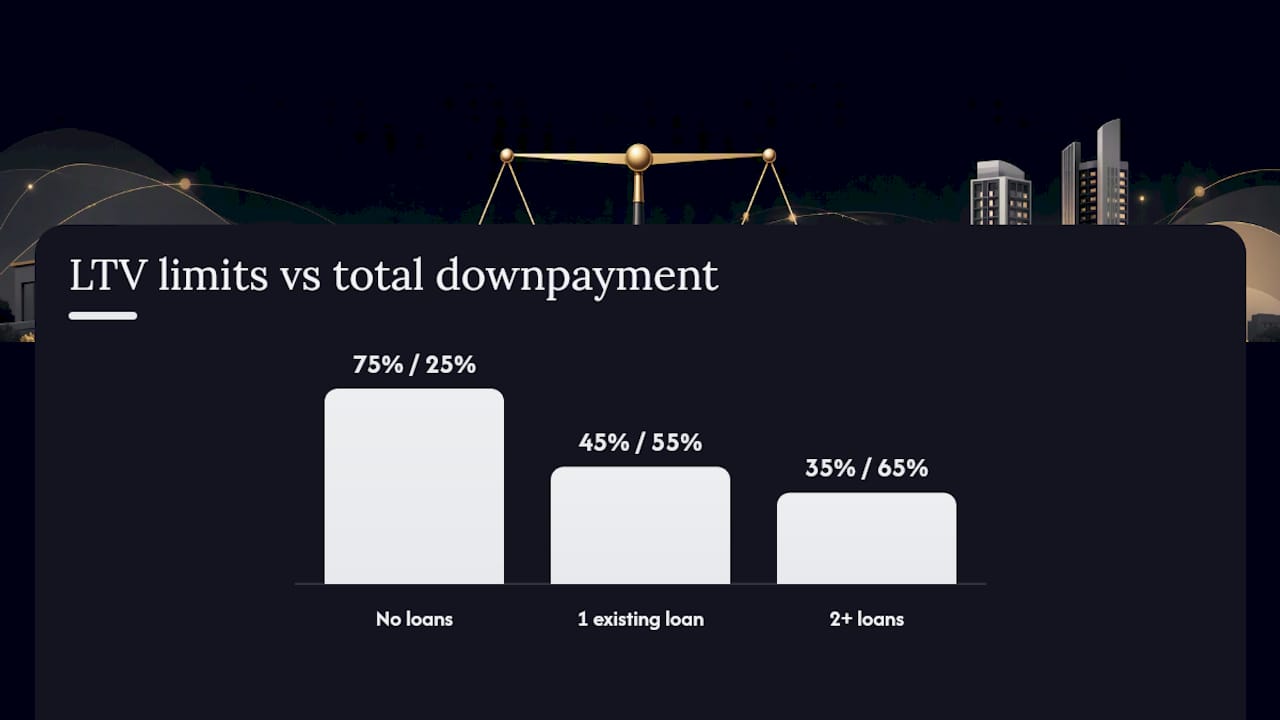
The loan you can get for a second property is materially smaller than for a first. MAS sets LTV limits that fall as the number of outstanding housing loans increases.
| Outstanding Housing Loans | Max LTV | Min Cash Downpayment | Min CPF + Cash Downpayment |
|---|---|---|---|
| — | 75% | 5% cash | 25% total |
| 1 (one existing loan) | 45% | 25% cash | 55% total |
| 2 or more | 35% | 25% cash | 65% total |
Banks apply this automatically based on the borrower’s age and the requested tenure.
Banks do not use your actual mortgage rate for this calculation. If you already carry a car loan, personal loan, or credit card balance, those reduce the headroom available for the new mortgage.
CPF usage for a second property is permitted from your Ordinary Account, but the Valuation Limit and Withdrawal Limit rules apply. Once you have used CPF for a first property, the remaining CPF available for a second purchase depends on your CPF balance and whether you have already hit the Valuation Limit on the first property. The CPF usage guide for property explains the withdrawal mechanics in detail.
Parameters to run your own numbers:
- Purchase price (or market value if higher)
- Your ABSD rate by citizenship and property count
- LTV applicable (based on outstanding loans and tenure)
- CPF Ordinary Account balance available (net of first property usage)
- Outstanding monthly debt obligations (for TDSR calculation)
- Gross monthly income (individual or combined if joint purchase)
As DBS notes, the combination of higher ABSD and lower LTV means second-property buyers must bring significantly more cash to the table than first-time buyers.
How do you secure financing for a second property in Singapore?
Getting your financing confirmed before you commit to an Option to Purchase is not optional. Two approval letters matter here: the In-Principle Approval (IPA) from a bank, and the HDB Flat Eligibility (HFE) letter if you are applying for an HDB concessionary loan.
The IPA is a bank’s conditional commitment to lend you a stated amount, subject to final credit and property checks. It is not a guarantee, but it tells you your realistic loan ceiling before you negotiate. The HFE letter, issued by HDB, confirms your eligibility for an HDB loan and the amount you qualify for. HDB loans are only available for HDB flat purchases, so if you are buying a private property as your second, you will be dealing with a bank IPA only.
Step-by-step loan application checklist:
- Gather income documents: last three months’ payslips (salaried) or last two years’ NOA and financial statements (self-employed).
- Pull your CPF statement from the CPF Board portal showing current Ordinary Account balance and past property withdrawals.
- Obtain your outstanding loan schedule from your current mortgage lender, showing remaining principal and monthly installment.
- Prepare NRIC (and passport for PRs/foreigners), proof of citizenship or PR status, and any existing property title documents.
- Submit IPA application to your preferred bank(s). Most banks return an IPA within three to five working days.
- If applying for an HDB loan, apply for the HFE letter via the HDB portal before viewing flats.
Joint borrower assessment uses an income-weighted average age to determine the maximum loan tenure. If you are 40 and your co-borrower is 55, the weighted average age will be between those two figures depending on income split, and the bank will cap tenure so the loan ends before the older borrower turns 65 (or 75 for some banks, subject to MAS rules). A higher weighted age shortens tenure, which raises monthly installments and may push you into the lower LTV tier.
Pro Tip: Get your IPA before you exercise any OTP. Banks routinely take longer than buyers expect when an existing mortgage is involved, and a lapsed OTP means you lose your option fee. Build in at least two weeks of buffer between IPA application and OTP exercise.
For a full walkthrough of Singapore mortgage types and affordability modeling, the Singapore mortgages and affordability guide covers the IPA process and stress-test mechanics in detail.
What are all the upfront and ongoing costs to budget?
The stamp duty figures get the headlines, but the full cash requirement is larger. Here is a complete cost breakdown for a second private property purchase.
Upfront costs:
- ABSD: 20% (SC), 30% (PR), or 60% (foreigner) of purchase price or market value, whichever is higher
- Buyer’s Stamp Duty (BSD): tiered rate on purchase price; use the IRAS stamp duty calculator to compute your exact figure
- Minimum cash downpayment: 25% of purchase price when one existing loan is outstanding (5% must be cash; the remainder can be CPF)
- Legal/conveyancing fees: typically $2,500–$5,000 for a standard private property purchase
- Valuation fee: $300–$800 depending on property type and firm
- Agent commission: typically 1% of purchase price for buyer’s agent (negotiable; sometimes absorbed by seller)
- Loan-related charges: processing fee, fire insurance, mortgage-reducing term assurance (MRTA) if required by the bank
Ongoing costs:
- Monthly mortgage installment (principal + interest)
- Property tax: owner-occupier rate if you live there, non-owner-occupier rate (higher) if you rent it out
- Maintenance/management fees (condo: $200–$600/month depending on development)
- Home contents and fire insurance
- Vacancy and rental management costs if held as investment
Worked budget example: SC buying a $1.2 million private condo as second property (one existing housing loan):
- Purchase price: $1,200,000
- BSD: 1% × $180,000 + 2% × $180,000 + 3% × $640,000 + 4% × $200,000 = $1,800 + $3,600 + $19,200 + $8,000 = $32,600
- ABSD at 20%: $240,000
- Total stamp duty: $272,600 (payable within 14 days of S&P)
- Maximum loan at 45% LTV: $1,200,000 × 45% = $540,000
- Minimum downpayment (55%): $1,200,000 × 55% = $660,000 (of which at least $300,000 must be cash; remainder can be CPF)
- Legal fees: approx. $3,500
- Valuation: approx. $500
- Total minimum cash required at purchase: $272,600 (stamp duty) + $300,000 (cash downpayment) + $4,000 (fees) = approximately $576,600
CPF can cover up to $360,000 of the downpayment in this example, but only if sufficient CPF balance is available after accounting for any prior property withdrawals. The downpayment requirements guide breaks this down further for different price points.
What are the lawful ways to reduce or recover ABSD?
There are three routes buyers commonly consider: the married-couple remission, decoupling, and sell-first sequencing. Each has real constraints.
Married-couple remission (the most practical route for upgraders):
- Both spouses must be Singapore Citizens.
- The second property must be purchased jointly by both spouses (both names on the title).
- The couple must not own any other residential property at the time of purchase (other than the one being sold).
- The first residential property must be sold and the sale completed within a specified timeframe after the purchase of the second property (or from TOP for uncompleted properties).
- If all conditions are met, IRAS refunds the ABSD paid on the second property. The refund application must be filed within six months of the disposal of the first property.
- Timing of the sale of the first property is critical for the ABSD refund; delays beyond the allowed period forfeit the refund.
Decoupling (private property only):
Decoupling means one co-owner transfers their share of a jointly-owned private property to the other, so one owner becomes sole owner and the other is “free” to buy a new property as a first-time buyer. The transferring owner pays ABSD on the transferred share at the applicable rate. For HDB flats, decoupling is generally not permitted. Attempting to decouple an HDB flat to avoid ABSD is treated as an illegal arrangement.
Sell-first sequencing:
The risk is a gap in housing between disposal and completion of the new purchase. Many buyers bridge this with a short-term rental or negotiate a deferred completion on the sale.
IRAS and the Ministry of Finance actively enforce against contrived arrangements. The MOF has published recovery actions against 99-to-1 and similar schemes where buyers artificially split ownership to reduce ABSD exposure. Authorities claw back the full duty plus surcharges. Buying through a company or trust triggers 65% ABSD and is not a loophole. Before structuring any arrangement aimed at reducing ABSD, get written advice from a qualified conveyancing lawyer and confirm the tax position with IRAS directly.
For a detailed look at how ownership structures affect ABSD exposure, the property title types guide covers joint, sole, trust, and company ownership mechanics.
Two worked examples showing the real cash required
Scenario A: SC upgrader holding HDB with outstanding loan
Assumptions: Singapore Citizen, age 38. Owns a 4-room HDB flat with $280,000 outstanding loan. MOP satisfied. Buying a $1.2 million private condo as second property. CPF OA balance: $120,000 (net of prior HDB withdrawals). Gross monthly income: $12,000. Existing monthly mortgage: $1,400.
- ABSD (20%): $240,000
- BSD: $32,600
- Total stamp duty: $272,600
- Max loan at 45% LTV: $540,000
- Total downpayment (55%): $660,000
- CPF available for downpayment: $120,000
- Cash required for downpayment: $660,000 minus $120,000 = $540,000 (well above the 25% cash minimum of $300,000)
- Legal and misc fees: $4,000
- Total cash out of pocket at purchase: $272,600 + $540,000 + $4,000 = $816,600
- TDSR check: new mortgage on $540,000 at 4% stress rate over 25 years ≈ $2,850/month. Existing HDB mortgage: $1,400/month. Total debt service: $4,250/month. TDSR: $4,250 / $12,000 = 35.4%. Passes the 55% cap.
This buyer can proceed, but needs over $800,000 in cash. If CPF balance were higher, the cash requirement drops, but the ABSD is fixed regardless.
Scenario B: Investor keeping first mortgage, buying second condo for rental
Assumptions: Singapore Citizen, age 45. Owns a private condo with $400,000 outstanding loan. Buying a $900,000 condo as investment. CPF OA balance: $80,000. Gross monthly income: $15,000. Existing mortgage: $2,100/month.
- ABSD (20%): $180,000
- BSD: 1% × $180,000 + 2% × $180,000 + 3% × $540,000 = $1,800 + $3,600 + $16,200 = $21,600
- Total stamp duty: $201,600
- Max loan at 45% LTV: $405,000
- Total downpayment (55%): $495,000
- CPF available: $80,000
- Cash for downpayment: $415,000
- Legal and misc: $4,000
- Total cash at purchase: $201,600 + $415,000 + $4,000 = $620,600
- TDSR check: new mortgage on $405,000 at 4% over 20 years ≈ $2,450/month. Existing: $2,100/month. Total: $4,550/month. TDSR: $4,550 / $15,000 = 30.3%. Passes.
- Yield threshold: to cover the new mortgage of approximately $2,450/month plus $400/month maintenance plus $200/month property tax (non-owner-occupier rate), the property needs to generate at least $3,050/month in rent. On a $900,000 purchase, that is a gross yield of approximately 4.1% annually. In most Singapore districts, that is achievable but not guaranteed, and vacancy months compress the effective yield.
Calculator parameters (plug in your own numbers):
- Purchase price (P)
- ABSD rate (R_ABSD): 20% SC, 30% PR, 60% foreigner
- LTV applicable (L): 45% with one existing loan, 25% if tenure or age triggers lower tier
- CPF available ©: from CPF statement, net of prior withdrawals
- Cash downpayment = P × (1 minus L) minus C (minimum cash floor = P × 25%)
- Monthly debt service on new loan = use bank’s stress rate (approx. 4%)
- TDSR check = (all monthly debts including new loan) / gross monthly income ≤ 55%
Pro Tip: If the numbers in Scenario A make you pause, run the sell-first path. The trade-off is a temporary housing gap, but for most upgraders, that gap costs far less than the ABSD.
A step-by-step checklist for executing a second-property purchase
- Decide your objective (Week 1–2). Investment rental income, family upgrade, or portfolio diversification? The answer determines which property type, district, and financing structure makes sense.
- Check eligibility (Week 1–2). Confirm MOP date for HDB owners. Verify citizenship/PR status implications for ABSD. Check whether a joint purchase with a spouse opens the remission pathway.
- Run affordability numbers (Week 2–3). Use the calculator parameters above. Confirm CPF balance, outstanding loan schedule, and gross income. Model TDSR at a 4% stress rate.
- Get IPA or HFE letter (Week 3–5). Submit to at least two banks for IPA comparison. For HDB purchases, apply for the HFE letter via the HDB portal. Do not exercise any OTP without a confirmed IPA.
- Engage a conveyancing lawyer (Week 3–4). Especially critical if you are considering any remission structure or decoupling. Get written legal advice before signing anything.
- Inspect properties and negotiate OTP (Week 4–8). Conduct real estate due diligence including title checks, valuation, and physical inspection. Negotiate OTP terms including completion date and any deferred payment schedule.
- Exercise OTP and sign S&P Agreement (within OTP validity period). Typically 14–21 days from OTP grant date.
- Pay stamp duty (within 14 days of S&P). File BSD and ABSD via myTax Portal. If applying for married-couple remission, pay ABSD first and file for refund after disposing of the first property within six months.
- Loan drawdown and legal completion (6–8 weeks after S&P). Bank releases funds to seller’s solicitors on completion date. Keys handed over.
- File for ABSD remission if applicable (within 6 months of first property disposal). Submit refund application to IRAS with proof of sale completion.
Timing notes: for new launches, the ABSD remission six-month window runs from the date of the S&P Agreement, not TOP. If TOP is delayed, you may need to sell your first property before the new unit is ready to move into. Plan the bridge housing arrangement early.
Documents to have ready: NRIC, CPF statement, last three months’ payslips or two years’ NOA, outstanding loan schedule, HDB title or private property title documents, and IPA letter.
What are the key risks to stress-test before you commit?
The ABSD is a sunk cost the moment you complete the purchase. Unlike BSD, there is no general refund pathway for ABSD outside the narrow remission windows. That changes the risk calculus significantly compared to a first-property purchase.
Main risk categories:
- ABSD as permanent drag: 20% of purchase price is gone on day one. For the investment to break even on a capital basis, the property must appreciate by more than 20% just to recover the stamp duty, before accounting for transaction costs on exit.
- Higher cash requirement and reduced leverage: the 45% LTV cap means you are putting in more equity and borrowing less. Lower leverage reduces return on equity in a rising market and limits your ability to redeploy capital elsewhere.
- Interest-rate risk: Singapore’s mortgage rates are linked to SORA (Singapore Overnight Rate Average) or fixed-rate packages. A 200–300 basis point rise in rates materially increases monthly debt service. Run your TDSR at the stress rate plus 200 bps to see whether you still pass.
- Rental vacancy risk: model six to twelve months of zero rental income in your first year. Can you service both mortgages from salary alone? If not, the second property is a liquidity risk, not just an investment.
- Regulatory and tax-change risk: ABSD rates have been raised multiple times since 2011. There is no guarantee the current rates are the ceiling. Buyers who locked in at lower ABSD rates in earlier years benefited; buyers today are pricing in the current regime with no certainty about future changes.
- Seller’s Stamp Duty (SSD): if you sell within three years of purchase, SSD applies at 12% (Year 1), 8% (Year 2), or 4% (Year 3). Holding for at least three years avoids SSD entirely. For investment properties, a minimum five-to-seven year horizon is generally advisable to absorb ABSD, transaction costs, and SSD risk.
Simple stress tests to run:
- Mortgage at current rate plus 200 bps: does monthly debt service still fit within 55% TDSR?
- Six months vacancy: can you cover both mortgages from income alone?
- 5–10% price decline at exit: does the net sale proceeds still cover the outstanding loan and transaction costs?
When does buying a second property actually make financial sense?
The buyers who come to Aesthetic Havens with a clear case for a second property share a few common traits: they have a cash buffer that covers ABSD and the higher downpayment without straining their liquidity, they have a genuine long-term horizon of at least five to seven years, and they have a specific purpose, whether that is a rental yield that covers holding costs or a family upgrade where the first property is being sold.
Where the math usually does not work: buying a second property primarily for short-term capital gain, where the ABSD alone consumes the expected appreciation. Or buying when the TDSR is already tight, leaving no room for a rate rise or a vacancy month. In those cases, paying down the existing loan faster, waiting until the first property is sold, or considering a REIT for property exposure often produces a better risk-adjusted outcome.
The remission pathway for married SC couples is genuinely useful for upgraders, but it requires precise timing and a willingness to be temporarily without a home.
For complex cases involving decoupling, trust structures, or cross-border portfolios, get a conveyancing lawyer and a tax advisor involved before you commit to any structure. The MOF enforcement record on avoidance schemes is not a theoretical risk.
Aesthetic Havens helps you model the real numbers before you commit
Most second-property buyers underestimate the total cash required by $100,000 or more because they focus on the purchase price and miss the interaction between ABSD, reduced LTV, and prior CPF usage. Aesthetic Havens, operating under ERA Realtors, runs a numbers-first affordability model for every client before any property viewing, so you know your exact cash position, maximum loan, and TDSR headroom before you negotiate.
The consultancy covers the full transaction: ABSD and remission eligibility assessment, conveyancing lawyer coordination, IPA facilitation with bank partners, and OTP negotiation support. For investors, the team models rental yield against holding costs and stress-tests the return at realistic vacancy rates.
Three outcomes clients consistently get: an accurate upfront cash budget (no surprises at stamp duty filing), a faster OTP process because financing is confirmed before viewing, and clear guidance on whether the married-couple remission applies to their specific situation.
If you are weighing a second property purchase and want a clear-eyed view of whether the numbers work for your profile, speak with a property consultant at Aesthetic Havens for a personalized review.
Sources
Use these official pages to confirm current rates, compute your stamp duty, and file for remission or refund:
- Loan tenure and loan-to-value limits
- Housing Loan from HDB
- Tax avoidance cases found and amounts clawed back under 99-to-1 arrangement for property purchases
- Considerations before buying a second property
For ABSD remission applications, file through myTax Portal within six months of completing the sale of your first property. For BSD computation, the IRAS stamp duty calculator on the quick-links page handles tiered rates automatically.
This article is general information, not a substitute for advice from a qualified financial advisor. Consult a qualified financial professional about your own circumstances before acting on anything here.


