


HDB flats and private properties differ fundamentally in price, ownership rules, financing options, and lifestyle amenities. Understanding these differences is the starting point for any serious housing decision in Singapore. About 80% of Singapore’s resident population lives in public housing managed by the Housing Development Board (HDB). That figure tells you something important: HDB is not a fallback option. It is the backbone of Singapore’s housing system. Knowing how HDB and private properties differ gives you the clarity to choose the path that fits your income, lifestyle, and long-term goals.
How do HDB and private properties differ financially?
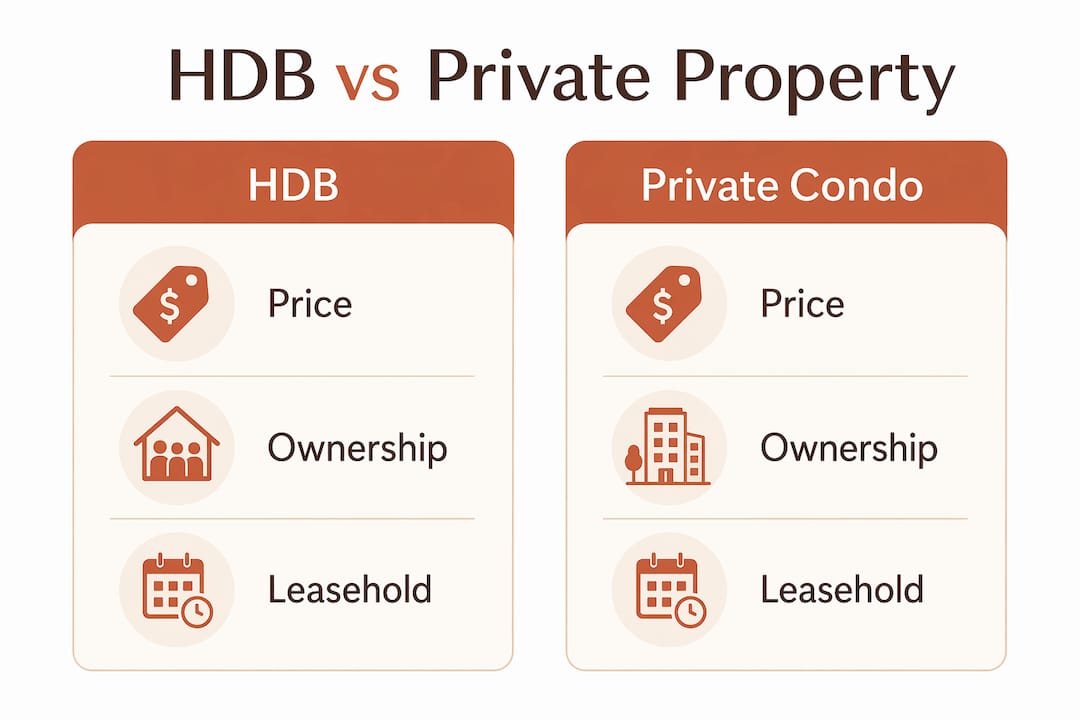
Price is the sharpest dividing line between the two property types. The average price per square foot for a condo sits at $2,123.95, compared to $638.80 for an HDB flat. That gap means condos cost roughly 3.3 times more per square foot. For most families, that difference alone reshapes the entire financial picture.
Upfront costs follow the same pattern. Buying a condo requires about $424,600 upfront, covering the 25% down payment and Buyer’s Stamp Duty (BSD). An equivalent HDB flat demands around $150,600 upfront. That $274,000 difference is money that could fund years of investments, education, or retirement savings.

Monthly commitments widen the gap further. A 3-bedroom condo costs around $5,400 per month, covering mortgage, maintenance fees, and property tax. A comparable HDB unit runs about $1,930 per month. That is roughly 2.8 times more every single month, for years.
The type of loan available also differs. HDB buyers can access an HDB concessionary loan, which carries a lower interest rate and requires a smaller cash down payment. Private property buyers must use a bank loan, which carries market interest rates and stricter loan-to-value limits. CPF Ordinary Account savings can fund both types, but the rules on how much CPF you can use differ depending on the remaining lease. You can read more about Singapore mortgage options to understand how loan structures affect your total cost.
| Cost element | HDB flat | Private condo |
|---|---|---|
| Average price per sq ft | $638.80 | $2,123.95 |
| Typical upfront cost | $150,600 | $424,600 |
| Estimated monthly cost | $1,930 | $5,400 |
| Loan type available | HDB loan or bank loan | Bank loan only |
| Maintenance fees | Low (town council) | Higher (MCST managed) |
Pro Tip: Financial experts advise against maximizing your borrowing capacity for a private condo. The monthly strain is real and sustained. Build a buffer of at least six months of mortgage payments before committing.
What are the ownership rules and eligibility requirements?
HDB ownership comes with strict criteria. You must be a Singapore Citizen or Permanent Resident, and you need to form a family nucleus, meaning you apply with a spouse, parent, or child. Singles can only buy certain flat types after age 35. Private properties have far fewer restrictions and allow foreigners to purchase most types, including condominiums, though landed properties remain largely restricted to citizens.
The Minimum Occupation Period (MOP) is one of the most consequential rules for HDB owners. The MOP is typically five years, during which you cannot rent out the entire flat or purchase a private residential property. That five-year window locks in your housing situation in ways that private property ownership does not.
Key ownership rules to know before you decide:
- HDB buyers must meet citizenship, income ceiling, and family nucleus requirements before applying.
- MOP restrictions mean HDB owners cannot buy private property until the five-year period ends.
- Private property owners who later buy an HDB flat must sell their private property within six months of taking possession of the HDB unit.
- Dual ownership is possible after MOP: you can own both an HDB flat and a private property simultaneously, but Additional Buyer’s Stamp Duty (ABSD) applies on the second purchase.
- Foreigners can buy private condos without restriction but face ABSD rates significantly higher than those for citizens.
- Rental flexibility differs sharply: private property owners can rent out their entire unit at any time, while HDB owners must complete MOP before doing the same.
These rules matter most for families planning to upgrade. Many couples buy an HDB flat first, complete the MOP, then sell and move into a condo. That pathway is common, but it requires careful timing and financial planning.
What lifestyle differences should you expect?
Private condominiums typically include amenities like swimming pools, gyms, and 24-hour security. HDB estates do not provide these within the development, though many mature estates sit near public parks, hawker centers, and well-connected MRT stations. The lifestyle trade-off is real, but it is not always in favor of the condo.
Here is what daily life looks like across both property types:
- Space and layout: HDB flats in newer Build-to-Order (BTO) projects tend to offer generous floor plans relative to their price. Many condos, especially in the Core Central Region, deliver smaller unit sizes at premium prices.
- Community feel: HDB estates often have a stronger neighborhood character, with void decks, community centers, and hawker culture built into the fabric of daily life.
- Facilities access: Condo residents enjoy private pools, function rooms, and gyms within their development. HDB residents rely on public sports centers and parks, which are widely available but shared with the broader public.
- Maintenance structure: HDB town councils manage common areas and charge relatively low monthly fees. Private condos are managed by a Management Corporation Strata Title (MCST), and monthly maintenance fees can range from a few hundred to over a thousand dollars depending on the development’s facilities.
- Privacy and security: Condos provide gated access and security personnel. HDB blocks are open-access, though most residents report feeling safe in their estates.
The lifestyle gap is most visible for families with young children. A condo pool and playground within the compound is a genuine convenience. But a mature HDB estate with a good school nearby and a hawker center downstairs offers a different kind of quality of life that money alone does not capture.
How do leasehold terms and investment value compare?
Both HDB flats and private condos in Singapore are typically sold on 99-year leasehold terms. That shared structure masks an important difference in how lease decay affects each property type. As a condo ages, it loses value more slowly as a percentage of its original price. But because the absolute price is so much higher, the dollar amount lost to depreciation can be far greater than for an HDB flat.
Consider this: a condo bought at $1.5 million that loses 20% of its value over 30 years loses $300,000 in absolute terms. An HDB flat bought at $500,000 losing the same percentage loses $100,000. The percentage looks the same. The financial impact does not.
| Factor | HDB flat | Private condo |
|---|---|---|
| Lease tenure | 99 years (leasehold) | 99 years (leasehold) |
| Depreciation rate | Faster as percentage near lease end | Slower as percentage, but higher absolute loss |
| Rental income potential | Limited by MOP and HDB rules | High, no MOP restriction |
| Capital appreciation | Moderate, tied to resale market | Higher potential, location dependent |
| Investment flexibility | Lower | Higher |
The HDB resale market has shown consistent demand, particularly for well-located flats in mature estates. That demand supports resale prices, but HDB flats are not designed as investment vehicles. They are homes first. Private condos offer more investment flexibility, including rental income from day one and stronger capital appreciation in prime locations.
Pro Tip: Viewing a condo upgrade as a lifestyle decision rather than a purely financial one sets more realistic expectations. Appreciation is possible but not guaranteed. Plan for the lifestyle cost, not just the investment upside.
Key Takeaways
HDB and private properties serve fundamentally different purposes: one prioritizes affordability and owner-occupation, the other offers lifestyle flexibility and investment potential at a significantly higher cost.
| Point | Details |
|---|---|
| Price gap is substantial | Condos cost roughly 3.3 times more per square foot than HDB flats. |
| Upfront costs differ sharply | Condos require about $424,600 upfront versus $150,600 for an HDB flat. |
| MOP shapes your timeline | HDB owners must wait five years before renting out the flat or buying private property. |
| Lifestyle trade-offs are real | Condos offer private amenities; HDB estates offer community infrastructure and lower monthly costs. |
| Leasehold decay hits differently | Both are 99-year leasehold, but absolute dollar depreciation is higher for condos due to higher prices. |
What I tell families who ask me this question
Most families come to me thinking the condo is the obvious upgrade. They see the pool, the gym, the address, and they want it. I understand that completely. But the financial math tells a different story for many of them.
A household earning a combined $10,000 a month can afford an HDB flat comfortably and still invest the difference in unit trusts, REITs, or a second property later. The same household stretching into a $1.5 million condo is often left with very little financial room to maneuver. One job loss, one medical bill, one interest rate spike changes everything.
What I have seen repeatedly is that the families who thrive financially are not always the ones who bought the biggest property. They are the ones who bought the right property for their income stage and then moved up deliberately. The HDB-to-condo upgrade path works well when it is planned, not rushed.
The other misconception I encounter often is that a condo is automatically a better investment. It is not. A well-located HDB flat in Bishan or Queenstown has outperformed many suburban condos over the past decade. Location and timing matter more than property type.
My honest advice: match your property choice to your income, your family’s actual lifestyle needs, and your five-year financial plan. Do not let market hype or social pressure drive a decision that will shape your finances for the next 20 years.
— Aman
Ready to make the right property call?
Choosing between an HDB flat and a private property is one of the most significant financial decisions a Singapore family makes. Aesthetic Havens, operated under ERA Realtors, provides personalized guidance for buyers at every stage of this decision.
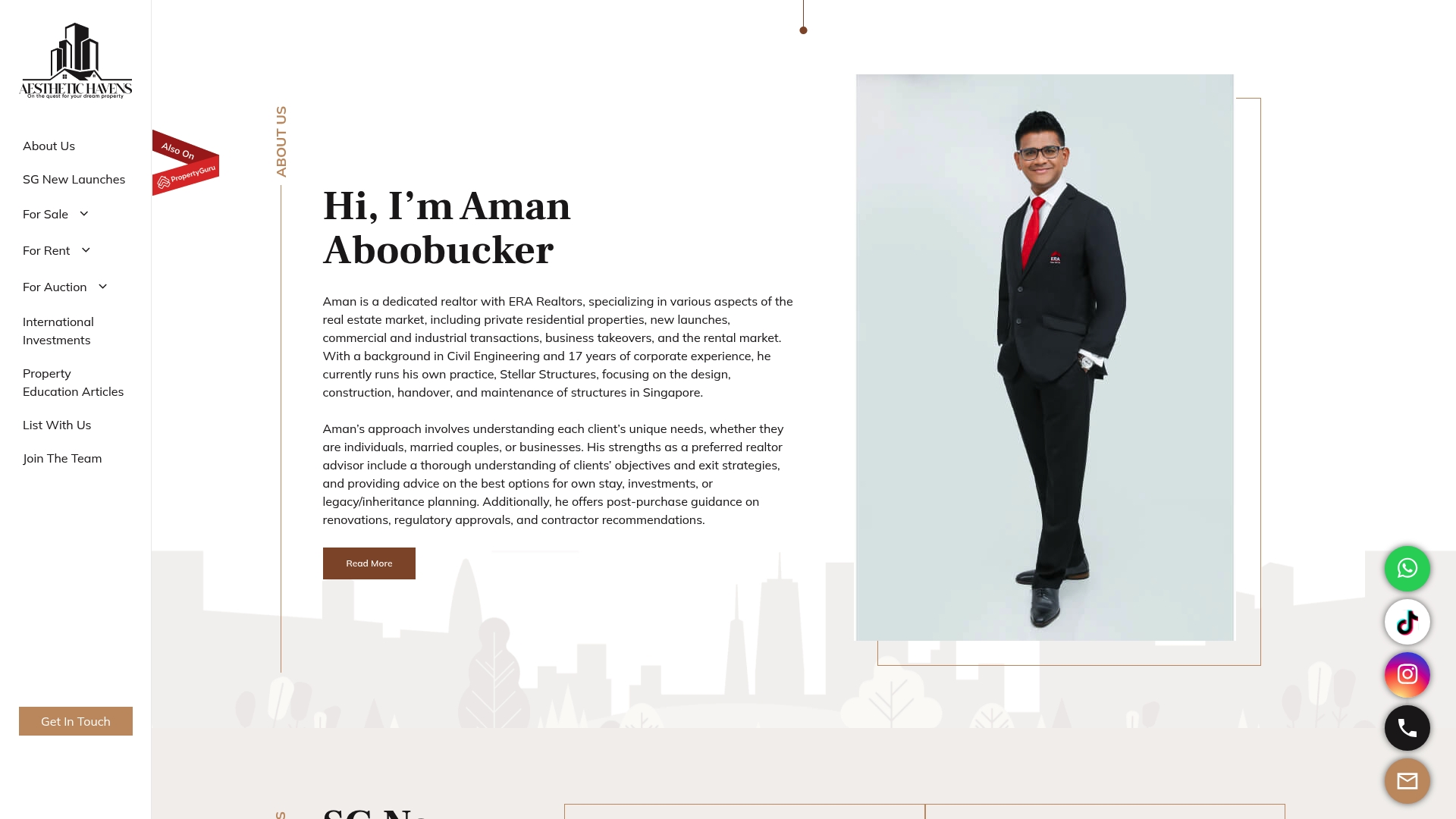
Whether you are a first-time buyer weighing BTO options or a family considering an upgrade, Aman and the Aesthetic Havens team offer clear, data-backed advice tailored to your income and goals. If you are leaning toward private property, the benefits of private home ownership page walks through what that decision actually involves. For broader guidance on working with a professional, the property consultant benefits page explains how expert advice changes outcomes. Reach out to Aesthetic Havens directly to start a conversation grounded in your specific situation.
FAQ
What is the main difference between HDB and private property?
HDB flats are government-subsidized public housing with strict eligibility rules and ownership restrictions. Private properties operate on open market terms with fewer restrictions and higher price points.
Can foreigners buy HDB flats in Singapore?
Foreigners cannot buy new or resale HDB flats. Private condominiums are generally open to foreign buyers, though Additional Buyer’s Stamp Duty applies at higher rates for non-citizens.
How long is the HDB Minimum Occupation Period?
The HDB Minimum Occupation Period is typically five years. During this period, owners cannot rent out the entire flat or purchase a private residential property in Singapore.
Is a condo a better investment than an HDB flat?
Not automatically. Both are 99-year leasehold properties, and location drives appreciation more than property type. Well-located HDB flats in mature estates have historically delivered solid resale returns.
Can I own both an HDB flat and a private condo?
Yes, but only after completing the HDB Minimum Occupation Period. Buying a private property while still within MOP is not permitted, and Additional Buyer’s Stamp Duty applies when you purchase the second property.
Recommended
- Foreigner’s Guide to Buying Property in Singapore (2025 Regulations & Taxes) | Aesthetic Havens
- Singapore HDB Resale Market Deep Dive (H2 2025): Top Estates & Price Forecasts | Aesthetic Havens
- CCR vs OCR in 2026: Where is the Better Value for Money? | Aesthetic Havens
- New Launch vs Resale 2026: Singapore Property Market Guide | Aesthetic Havens


