


A buyer’s agent is a licensed real estate professional who works exclusively for the buyer in a property transaction, from the first home search through closing day. Unlike a listing agent, whose legal duty runs to the seller, a buyer’s agent owes every obligation to you. That distinction shapes every conversation, every offer, and every negotiation. Understanding the role of a buyer’s agent before you start viewing properties is the single most effective way to protect your money and your interests in a real estate deal.
The core value a buyer’s agent delivers is not finding listings. Public platforms surface most of the same properties agents see. The real value sits in the contract phase, where missed deadlines, weak contingencies, and poor negotiation can cost buyers tens of thousands of dollars. Contract expertise and protection against liability is where a buyer’s agent earns their fee. Buyers who skip professional representation often discover this too late.
What does a buyer’s agent do throughout the home buying process?
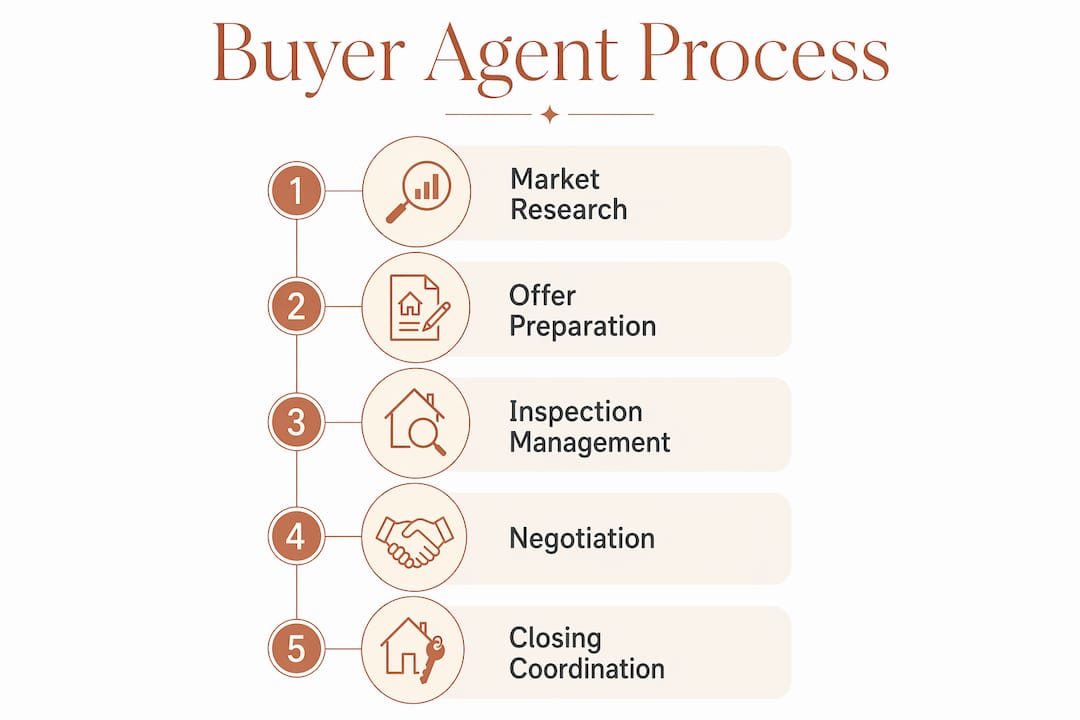
A buyer’s agent manages five distinct functions during a transaction, and each one carries real financial consequences.

Market research and pricing analysis
A buyer’s agent runs a comparative market analysis before you make any offer. This analysis compares recent sales of similar properties in the same area to determine whether a listing is priced fairly, overpriced, or undervalued. Buyers who skip this step routinely overpay. Comparative market analysis gives you a defensible number to anchor your offer.
Inspection coordination and specialist referrals
After an offer is accepted, the inspection window opens. Inspection windows typically last 7–10 days, and missing that deadline can strip you of your right to negotiate repairs or walk away without losing your earnest money. A buyer’s agent schedules the general inspector, flags issues that need specialists such as structural engineers or mold assessors, and helps you interpret the findings. Most buyers do not know which inspection findings are deal breakers and which are routine maintenance.
Contract deadline and contingency management
Real estate contracts run on hard deadlines. Financing contingencies, appraisal contingencies, and inspection contingencies each have expiration dates. A buyer’s agent tracks every date and sends you reminders before each one passes. Missed contingency deadlines can legally cost you your earnest money deposit or eliminate your negotiation rights entirely. That is not a technicality. It is a binding financial consequence.
Negotiation of offers and repairs
A buyer’s agent structures your initial offer to be competitive without revealing your ceiling. After inspections, the agent negotiates repair credits or price reductions based on documented findings, not emotion. Escalation clauses can help win bidding wars but reveal your maximum willingness to pay. An experienced agent advises when to use one and when to hold back to preserve your leverage.
Pro Tip: Ask your agent to show you the comparable sales data behind any offer price they recommend. A good agent explains the numbers, not just the conclusion.
Final walkthrough and closing coordination
The final walkthrough happens 24–48 hours before closing. Your agent checks that agreed repairs are complete, no new damage has occurred, and the property matches the contract terms. They also coordinate with the title company, lender, and escrow officer to confirm all documents are ready. A buyer’s agent who is thorough at this stage prevents last-minute surprises from derailing the deal.
How have recent regulatory changes affected buyer’s agent agreements?
The rules governing buyer’s agent services changed significantly in 2024. Since august 2024, buyers must sign a written buyer representation agreement before an agent can show any property. This agreement defines the scope of services, the compensation structure, and whether the relationship is exclusive. The change formalized what was previously an informal arrangement in many markets.
The 2024 National Association of Realtors (NAR) settlement drove a second major shift. Buyer-agent compensation must now be disclosed upfront, and sellers can no longer advertise buyer-agent commissions through MLS listings. That means buyers and their agents must negotiate compensation directly, separate from the seller’s listing.
Here is what this means in practice:
- Transparency improves. You know exactly what your agent earns before you commit to working with them.
- Negotiation becomes your responsibility. You may need to ask the seller to cover buyer-agent fees as part of your offer terms.
- Agreements are binding. A buyer representation agreement is a professional contract. Read every clause before signing.
- Exclusivity terms vary. Some agreements lock you to one agent for a set period. Others are property-specific. Negotiate the terms that fit your timeline.
Buyer representation agreements minimize misunderstandings by clearly outlining what the agent will do and what you owe. Treat the agreement the way you would treat any professional services contract. Negotiate the duration, the compensation rate, and the termination clause before you sign.
What advantages do buyer’s agents have over self-service home searches?
Online property platforms give buyers access to most listed properties. That overlap is real, and it narrows the search advantage a buyer’s agent once held. The advantage does not disappear, though. It shifts.
Access to off-market properties through professional networks is one area where agents hold a clear edge. Pre-market listings, pocket listings, and properties sold through agent-to-agent referrals never appear on public platforms. In competitive markets, these off-market deals often close at better prices because fewer buyers are competing.
The larger advantage sits in the post-offer phase. The critical value of buyer’s agents emerges after an offer is accepted, where negotiation, contingencies, and appraisal issues require professional skill. An online search tool cannot read an inspection report and tell you which findings justify a $15,000 price reduction. It cannot call the listing agent to gauge the seller’s motivation. It cannot advise you whether to waive an appraisal contingency in a specific market.
Buyer’s agents also bring appraisal negotiation skills that most buyers lack entirely. When an appraisal comes in below the purchase price, the agent can challenge the appraisal with comparable sales data, renegotiate the price, or structure a split between buyer and seller. Without an agent, buyers often accept the gap or walk away from a deal they could have saved.
Pro Tip: Before hiring an agent, ask how many transactions they closed in the past 12 months and what percentage of their clients were buyers. Volume and buyer-side experience are not the same thing.
You can read more about the specific tasks agents handle across market research, inspections, and negotiations to understand where professional support adds the most value.
What are the common concerns buyers have about using a buyer’s agent?
Fee anxiety is the most common objection. Typical buyer agent fees range between 1% and 3% of the purchase price, or flat fees that often exceed $10,000 on higher-value properties. Those numbers feel large. Buyers who focus on the fee without calculating the risk of going unrepresented often underestimate what a single missed deadline or a poorly negotiated repair credit actually costs.
The second concern is dual agency. Dual agency occurs when one agent represents both the buyer and the seller in the same transaction. Dual agency can undermine fair representation because the agent cannot fully advocate for opposing interests at the same time. Avoiding dual agency is straightforward: confirm in writing that your agent represents only you, and do not contact the listing agent directly to make offers.
A few practical steps protect buyers from the most common pitfalls:
- Read the buyer representation agreement in full. Do not sign a long-term exclusive agreement before you have seen how the agent works.
- Negotiate the compensation rate. Fees are not fixed. Ask whether the rate is negotiable, especially on higher-priced properties.
- Clarify the termination clause. Know how to exit the agreement if the relationship is not working before you are locked in.
- Confirm exclusivity. Make sure your agent is not simultaneously representing the seller on any property you are considering.
Buyers who treat the buyer representation agreement as a negotiable professional contract, rather than a standard form to sign quickly, consistently get better terms and clearer expectations from the start.
Key takeaways
A buyer’s agent’s greatest value is not finding listings. It is protecting your money and your legal rights from the moment an offer is accepted through closing day.
| Point | Details |
|---|---|
| Exclusive representation matters | A buyer’s agent owes full legal duty to you, not the seller, on every decision. |
| Contract phase is highest risk | Missed deadlines and weak contingencies can cost you earnest money or negotiation rights. |
| Written agreements are now required | Since august 2024, you must sign a buyer representation agreement before any property showing. |
| Off-market access is a real edge | Agent networks surface pre-market and pocket listings that never appear on public platforms. |
| Fees are negotiable | Buyer agent fees typically range 1%–3% and can be negotiated before signing any agreement. |
Why I think most buyers misread what a buyer’s agent actually does
Most buyers I speak with assume a buyer’s agent is primarily a search tool with a license. They think the agent’s job ends when they find the right property. That misreading is expensive.
The search phase is the easy part. The contract phase is where transactions fall apart. I have seen buyers lose earnest money deposits because they did not understand that an inspection contingency has a hard expiration date. I have seen buyers pay $20,000 over market value because no one ran a proper comparative market analysis before the offer went in. These are not rare edge cases. They are common outcomes for unrepresented buyers in competitive markets.
The 2024 regulatory changes actually improved the situation for buyers who pay attention. Upfront compensation disclosure means you can negotiate the fee before you commit. The written buyer representation agreement forces both sides to define expectations clearly. Buyers who read and negotiate that agreement before signing are in a far stronger position than buyers who treated the old informal arrangement as a handshake deal.
My advice: treat your buyer’s agent the way you would treat any professional you hire for a high-stakes transaction. Interview more than one. Ask about their experience with the specific property type and price range you are targeting. Ask how they handle appraisal gaps and what their approach is to escalation clauses. The answers will tell you quickly whether you have found someone who will genuinely protect your interests or someone who will simply open doors.
— Aman
Working with a property consultant who puts your interests first
Buying a property is one of the largest financial decisions you will make. Having the right professional in your corner changes the outcome.

At Aesthetic Havens, Aman Aboobucker provides dedicated buyer-side advisory services across residential, commercial, and investment properties in Singapore and internationally. From comparative market analysis to contract negotiation and closing coordination, the focus is on protecting your position at every stage. Whether you are buying your first home or expanding an investment portfolio, professional guidance reduces risk and improves results. Learn more about working with a property consultant and how dedicated representation makes a measurable difference in your transaction.
FAQ
What is the role of a buyer’s agent?
A buyer’s agent is a licensed professional who represents the buyer exclusively in a real estate transaction, managing everything from property search and pricing analysis to contract negotiation and closing coordination.
Do buyers have to pay their agent’s fees directly?
Buyer agent fees typically range 1%–3% of the purchase price and are negotiable. Since the 2024 NAR settlement, buyers negotiate compensation directly with their agent rather than relying on seller-side MLS disclosures.
What is a buyer representation agreement?
A buyer representation agreement is a written contract that defines the agent’s duties, the compensation structure, and the exclusivity terms. Since august 2024, this agreement is required before an agent can show any property to a buyer.
What is dual agency and why should buyers avoid it?
Dual agency occurs when one agent represents both the buyer and the seller in the same deal. It creates a conflict of interest because the agent cannot fully advocate for both sides simultaneously, which can compromise the buyer’s negotiating position.
Can a buyer find properties without an agent?
Buyers can search public listing platforms independently, but off-market properties and pre-market listings are only accessible through agent networks. More critically, the contract and negotiation phase requires professional expertise that online tools cannot provide.


