

Introduction
Private property owners in Singapore who want to right-size into an HDB resale flat have operated under strict timing rules since September 2022. The 15 month wait out period forced private residential property owners to sell their condo, landed home, or overseas residential property and then wait a full 15 months before they could purchase a non subsidised HDB resale flat. That changed on 28 July 2026, when Minister for National Development Chee Hong Tat announced the removal of the 15-month wait-out period with immediate effect.
The removal aims to ease housing transitions for private owners, but this policy change does not mean every restriction has disappeared. If you plan to use an HDB housing loan or apply for CPF housing grants, the 30-month wait-out period for subsidised flats remains unchanged. Seniors aged 55 and above continue to enjoy specific exemptions that give them even greater flexibility when moving into a 4-room or smaller flat. Understanding exactly which rules apply to your situation is the difference between a smooth right-sizing move and a costly miscalculation.
In short: as of 28 July 2026, many private property owners buying a non subsidised HDB resale flat with a bank loan or cash no longer face the 15 month wait. But the wait out period still bites if you need an HDB loan or want subsidised housing. Careful planning around financing, timelines, and the new six month window to sell your private property is essential.
This article covers the original rule, what changed in 2026, who it still affects, senior exemptions, right-sizing strategies, timeline planning, cost and cash flow planning, and advisory angles from AESTHETIC HAVENS. It does not cover step-by-step BTO application processes, detailed legal conveyancing, or non-Singapore property regulations beyond their relevance to HDB eligibility.
Target readers: Private condo and landed home owners, couples nearing retirement, business owners holding residential property, and investors who now want to move into a resale HDB flat.
Key outcomes you will gain from this article:
-
Understand exactly when the 15 month wait out rule still applies and when it no longer does
-
Know how seniors 55 and above can right-size into a 4-room or smaller resale HDB with minimal disruption
-
Learn how to plan transaction timelines (sale vs purchase), bridge housing, and cash flow
-
See practical right-sizing scenarios relevant to different life stages and portfolio strategies
-
Know when to seek professional advisory, and what AESTHETIC HAVENS can help with
Understanding The 15‑Month Wait‑Out Rule
The 15-month wait-out period was a cooling measure designed to moderate demand in the HDB resale market and keep public housing accessible for first time buyers and lower-income households. Before exploring who is exempt under the new rules and how to plan your move, you need to understand how this rule originally worked and what specifically shifted in 2026.
How The 15‑Month Rule Originally Worked (2022–2026)
The rule was introduced on September 30, 2022. Under it, any Singapore citizen or permanent resident who owned private residential property-whether a condo, landed home, or overseas property-had to dispose of that property and then wait 15 months before purchasing a non subsidised HDB resale flat. This applied regardless of flat size, though an old exemption existed for seniors aged 55 and above buying 4-room or smaller flats.
Separately, the 30-month wait out period already governed more subsidised pathways. Private property owners buying BTO flats, resale flats with housing grants, or applying for an HDB housing loan faced this longer waiting period-and that has always been a distinct, stricter requirement.
In practical terms, the 15-month rule meant a private owner who sold their condo in January 2024 could not even begin looking to buy a non subsidised resale flat until April 2025. During that waiting period, many owners rented-spending tens of thousands of dollars on temporary housing-while their sale proceeds sat idle. The emotional and financial toll of double moves, storage costs, and uncertainty made right-sizing painful for many private owners who simply wanted to downgrade.
Policy Shift In 2026: What Changed On 28 July 2026
On 28 July 2026, Minister Chee Hong Tat announced the removal of the 15 month wait out period, effective immediately. Private property owners can now buy HDB resale flats immediately, provided the purchase is a non subsidised HDB resale flat financed through a bank loan or cash-not an HDB loan.
However, removing the 15-month waiting period does not eliminate other restrictions associated with HDB ownership. In place of the wait, a six month window was introduced: private property owners must sell their private property within six months after buying an HDB flat. If buyers cannot meet the disposal timeframe, HDB may enforce compulsory sale of one of the properties.
The 30-month wait out period for subsidised flats, balance flats, BTO flats, and any purchase using an HDB housing loan remains unchanged. The new rules affect only the non-subsidised resale pathway with private financing.
This sets up the critical question: who exactly benefits from this change, and who still faces restrictions?
Key Terms You Must Understand Before Planning Your Move
Before diving deeper, anchor yourself with these definitions-they recur throughout the article:
-
Private residential property owner (PPO): Anyone who owns a condo, landed home, strata-titled apartment, or overseas residential property. Properties acquired through inheritance, gift, or via nominees also count.
-
Non subsidised HDB resale flat: A resale flat purchased on the open market without any government grant or subsidy, and not financed with an HDB housing loan. Buyers use cash or a bank loan. This is the category where the 15 month wait has been removed.
-
Subsidised flat: A flat purchased from HDB directly (BTO, balance flats), or a resale flat bought with CPF housing grants. These carry the 30-month wait out period for former private owners.
-
Minimum occupation period (MOP): The period-typically five years for most resale flats bought-during which an owner must occupy the flat before selling, renting it out entirely, or acquiring private property. Around 13,500 flats will reach their minimum occupation period in 2026, with supply growing to 15,000 in 2027 and 19,500 in 2028.
-
Right-sizing: Moving to a home that better fits your current space needs, cash flow, and lifestyle. Particularly relevant for retirees, empty-nesters, and business owners seeking to unlock liquidity from an expensive private home.

Who The 15‑Month Wait‑Out Rule Applies To Today (And Who Is Exempt)
The rule has not vanished for everyone. Its application now depends mainly on your financing type and whether the flat is subsidised. Making the wrong assumption can cost you months-or disqualify your flat purchase entirely.
Private Owners Buying Non‑Subsidised Resale HDBs With Bank Loans Or Cash
As of 28 July 2026, there is no 15 month wait out period for private property owners buying a non subsidised HDB resale flat financed with a bank loan or cash. This is the core change. Eligibility for HDB purchase requires no HDB loan for immediate buying.
Private property owners must apply for an HDB Flat Eligibility (HFE) letter before purchasing an HDB flat. Once this letter confirms eligibility under the non-subsidised, non-HDB-loan pathway, the purchase can proceed without the former waiting period.
Typical buyer profiles include: downgraders moving from larger units to a smaller flat, empty-nesters releasing capital from a family condo, and investors cashing out of over-leveraged private property. In practice, this means you can either sell your private home first and buy a resale HDB flat almost immediately, or buy the resale flat first and then sell your private property within the six month window after HDB purchase completion.
Private Owners Who Still Face The 15‑Month (Or 30‑Month) Wait
Wait-out periods remain in force for several categories:
-
Using an HDB housing loan: Even for a non subsidised resale flat, financing with an HDB loan triggers the 30-month wait out period from the date you complete the sale of your private property. This is the single most common trip-up for buyers who assume the 15 month wait is entirely gone.
-
Applying for CPF housing grants or buying subsidised options: If you want to buy a BTO flat, a subsidised HDB resale flat with grants, or an Executive Condominium from a developer, you must wait 30 months after disposing of your private property. First-time HDB buyers may qualify for grants between S$5,000 to S$80,000, but accessing these grants as a former private owner requires the full 30-month wait.
-
Gradual disposal of multiple properties: If you own more than one private property, the wait-out clock starts from the date the last private residential property is legally completed for sale-not the first.
Key distinction: The 15 month wait applied specifically to non-subsidised resale HDB purchases. The 30 month wait applies to subsidised pathways and HDB loan usage. Both clocks start from the legal completion date of disposal-not the date you sign the option or list the property.
Special Exemptions For Seniors Aged 55 And Above
Seniors aged 55 and above, along with their spouses, have enjoyed and continue to enjoy greater flexibility under both the old and new rules. Even before the 2026 policy change, they could move from a private home to a 4-room or smaller non subsidised resale flat without facing the 15 month wait, subject to financing and eligibility conditions.
Under the current framework, this exemption remains-but it is now less unique because the 15 month wait has been removed for all eligible non-senior PPOs as well. Seniors still benefit from additional pathways, including access to 2-room Flexi flats and Community Care Apartments designed for ageing in place.
Why this matters for seniors:
-
Retirement planning: Right-sizing supports freeing up CPF funds and cash from a high-value private property, providing a financial buffer for healthcare and living expenses.
-
Proximity and lifestyle: Moving into a well-located HDB flat puts seniors closer to amenities, healthcare facilities, and family-without enduring long rental periods.
-
Business considerations: AESTHETIC HAVENS often works with SME owners in their late 50s who use this route to de-risk their business and personal balance sheets simultaneously. Selling a $2 million landed home and moving to a $600,000 resale HDB flat can free over a million dollars for business working capital or reinvestment.
Seniors should verify their eligibility and any conditions through the latest HDB circulars, especially if they prefer certain forms of HDB financing.

Right‑Sizing From Private Property To A Resale HDB: How To Plan Around The Rules
Understanding the policy is only half the challenge. The other half is sequencing your sale, purchase, financing, and move so that every deadline is met and your cash flow stays healthy. This section turns policy knowledge into a step-by-step right-sizing framework.
Step‑By‑Step Timeline: From Selling Private Property To Moving Into Your Resale HDB
-
3–6 months before selling: Get your private property valued at current market value, review any loan lock-in penalties, and calculate your seller’s stamp duty exposure. Selling a condo too soon can incur a Seller’s Stamp Duty of 16% if sold within the first year of purchase, scaling down to 0% after four years. Use this assessment to set a realistic budget for your HDB purchase.
-
1–3 months before listing: Apply for your HDB Flat Eligibility letter. At this stage, confirm whether you will use a bank loan or HDB loan-this is the decision that determines whether any wait out period applies. Homeowners must understand financing options before making an HDB purchase decision. If you choose the HDB loan path, the 30-month clock starts from disposal completion.
-
When listing your private home: Coordinate your marketing and viewing windows. If you plan to buy the resale flat first, you need confidence you can complete the condo sale within the six month window after HDB purchase completion. Avoid a fire-sale scenario by starting early.
-
Once you secure a buyer for your private property: Negotiate the completion date to give enough buffer for your HDB purchase process. Legal completion of your private property sale is the date that officially counts for disposal-not the option-to-purchase signing date.
-
During HDB search: Shortlist locations, flat sizes, and remaining lease profiles that match your right-sizing goals. Align timing with your sale completion so that bridge housing is minimised or eliminated.
-
Completion and move-in: Factor in renovation lead times (typically 4–10 weeks for HDB resale flats), interim housing if needed, and handover sequencing. The bridge period spans 3 to 6 months during transition for most right-sizers.
The 15-month and 30-month considerations enter primarily at Steps 2 and 3-making your financing decision early is critical to avoid timeline surprises.
Planning Your Financing Structure: Bank Loan vs HDB Loan
Your financing choice directly determines whether the wait out period applies. This single decision shapes your entire right-sizing timeline.
Key factors to evaluate:
-
Loan-to-value (LTV) limits: HDB loan limits were reduced from 80% to 75% in 2024. Bank loans offer broadly similar LTV ratios but with different assessment criteria based on household income, age, and the flat’s remaining lease.
-
Interest rate trade-offs: HDB loans offer a concessionary rate pegged at 0.1% above the CPF Ordinary Account rate. Bank loan packages may start lower but carry variable rate risk. For right-sizers expecting to hold the flat long-term, rate stability matters.
-
Wait-out impact: Using an HDB loan triggers the 30-month wait out period for former private owners. A bank loan or cash purchase incurs no such delay under the new rules. For many private property owners, this interest rate vs. timeline trade-off is the decisive factor.
-
Grant access: Opting for a bank loan means forfeiting CPF housing grants. First-time buyers who have never owned subsidised housing and meet income ceilings could potentially access grants-but only by accepting the 30-month wait.
AESTHETIC HAVENS does not sell loans, but can help you structure a property roadmap before you approach lenders-ensuring your financing choice aligns with your right-sizing timeline and broader investment goals.
Coordinating Property Sale, Purchase And Possible Bridge Housing
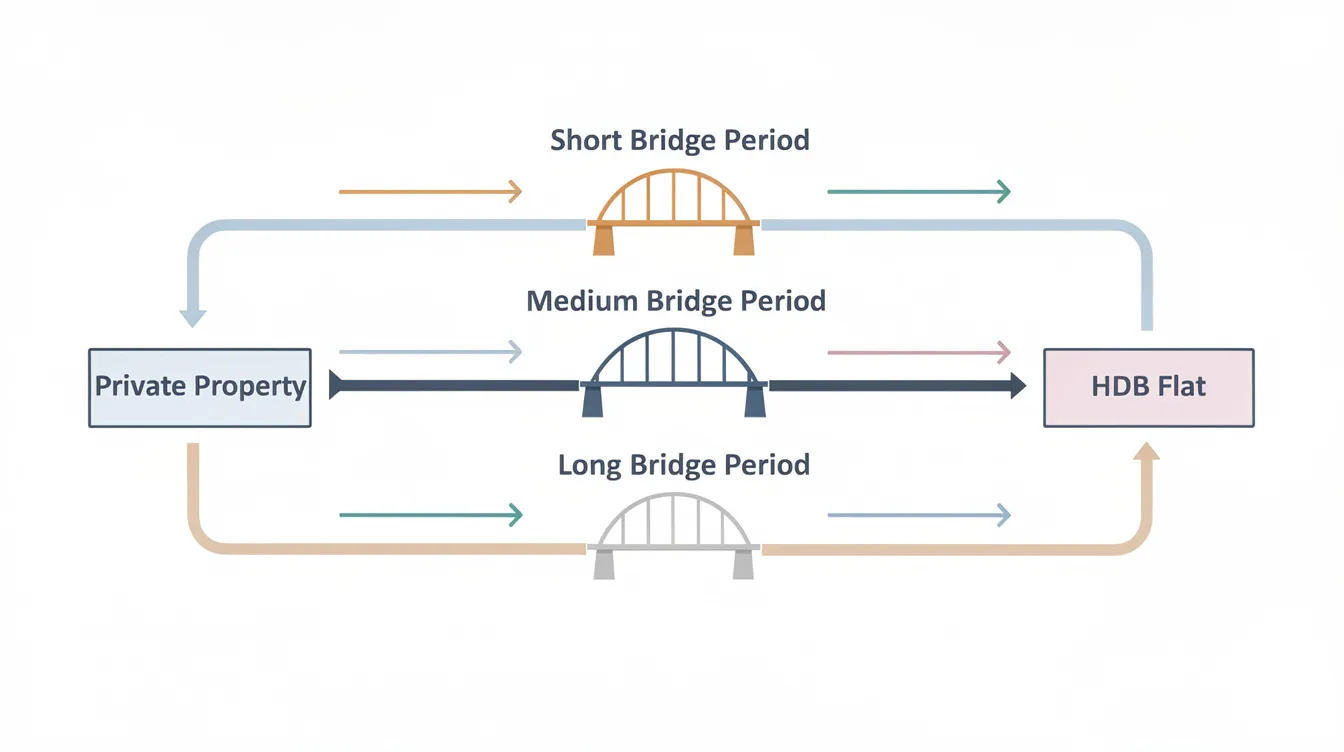
The typical bridge period-between handing over your current home and collecting keys to your resale HDB flat-spans 3 to 6 months. This is where many right-sizers face their biggest stress points.
Option 1: Sell first, then rent while searching. This eliminates disposal deadline pressure but introduces rental costs. Renting during the bridge period can cost $6,000 to $16,000 when factoring in monthly rents for family-sized units ranging from $3,000 to $5,000, plus security deposits for rentals that typically require two months’ rent. Security deposits for rentals can range from $6,000 to $16,000 depending on unit type and location.
Option 2: Buy the HDB flat first, then sell your private property within six months. This avoids double-moving but demands financial capacity to hold two properties simultaneously and confidence that market conditions will allow a timely sale. Private property owners must sell their property within six months after buying an HDB flat under the new rules.
Option 3: Negotiate completion dates to align. Work with your buyer and seller to coordinate legal completion of both transactions so that you move once-directly from private home to resale flat. This requires careful planning and flexibility from all parties, but eliminates rental costs entirely.
The bridge period is often where cash flow squeeze appears: HDB downpayment can run into tens of thousands of dollars, dual mortgage servicing may apply, and for SME owners, business working capital needs compete with housing transition costs.
Financial And Operational Considerations For Private Owners
Moving into a resale HDB flat is not just a housing decision-it is a financial and operational one, especially for business owners whose personal and commercial balance sheets are interconnected.
Cash, CPF And SSD: What You Actually Have After Selling Your Private Home
Your actual sale proceeds after a condo sale may be significantly less than the headline price. Here is what reduces your take-home:
-
Outstanding mortgage: The remaining loan balance is repaid from sale proceeds at completion.
-
Agent and legal fees: Typically 1–2% of sale price for agent commissions, plus $3,000–$5,000 for conveyancing.
-
Seller’s stamp duty (SSD): If you purchased your private property less than four years ago, SSD rates apply: 16% if sold in year one, 12% in year two, 8% in year three, and 4% in year four. On a $1.4 million condo sold at the 3.5-year mark, SSD of 4% would cost $56,000-money that directly reduces your available downpayment.
-
CPF refund: Any CPF funds used for the private property purchase, plus 2.5% accrued interest, must be returned to your CPF account. This reduces immediate cash but the refunded amount can be reused for HDB purchase.
Realistic example: A private owner selling a $1.4M condo bought 5 years ago faces no SSD, keeps roughly $1.35M after fees, repays a $700K outstanding loan, refunds $200K to CPF (with accrued interest), and walks away with approximately $450K in cash. If the same condo were sold at 3.5 years, SSD alone would consume $56K, reducing cash to roughly $394K. That difference materially affects whether you can comfortably afford a $700K resale flat with a bank loan requiring 25% down ($175K).
Buyer’s Stamp Duty for HDB flats can reach up to 6%, which must be factored into your total acquisition cost for the resale flat.
For SME owners, aligning property decisions with business capital needs is critical-selling at the wrong time can starve the business of working capital precisely when it’s needed most.
Monthly Outgoings After Right‑Sizing: From Condo Maintenance To HDB Conservancy
Right-sizing produces recurring savings, not just a one-time capital release. The monthly cash flow improvement can be substantial:
-
Condo maintenance fees: Typically $300–$800 per month for a mid-range condo, often higher for larger units or premium developments.
-
HDB Service & Conservancy Charges (S&CC): Approximately $70–$95 for a 4-room flat, $85–$110 for a five room flat. This represents savings of $200–$700 per month compared to condo fees.
-
Property tax: HDB flats attract lower annual values and therefore lower property tax compared to most private homes.
-
Utilities and town council charges: Generally comparable or slightly lower in HDB flats due to smaller floor areas.
For business owners, reducing personal housing outgoings by $500–$1,000 per month frees capacity for business expansion, an industrial unit purchase, or simply holding more working capital as a buffer against uncertain market conditions.
Impact On Your Wider Property Portfolio And Investment Strategy
View right-sizing as a portfolio rebalancing exercise, not merely a housing downgrade:
-
Capital redeployment: Selling a $1.5M private property and purchasing a $700K resale flat releases $300K–$500K (after CPF refund, fees, and loan repayment) that can be invested in income-producing assets-such as industrial units, business premises, or diversified financial instruments.
-
Concentration risk reduction: Many private owners have 70–90% of their net worth locked in a single residential property. Right-sizing into a more affordable HDB flat and redeploying capital diversifies your exposure.
-
Future flexibility: After serving the minimum occupation period on your resale HDB flat, you regain the ability to acquire private property if desired-but from a position of greater liquidity and lower leverage.
AESTHETIC HAVENS can advise on redeploying freed-up capital into industrial or commercial property, helping clients assess whether ownership or leasing of business premises offers better returns given current market conditions and interest rate cycles.
Comparing Your Main Pathways: Options For Private Owners In 2026 And Beyond
Now that you understand the rules, financing implications, and financial mechanics, let’s compare the most common pathways side by side.
Resale HDB Now Vs Waiting For BTO Or Subsidised Flat
|
Factor |
Non-Subsidised Resale HDB (Bank Loan/Cash) |
BTO / Subsidised Resale (With Grants/HDB Loan) |
|---|---|---|
|
Wait-out period |
None (as of 28 July 2026) |
30 months from private property disposal |
|
Time to move in |
3–6 months from flat selection |
3–7 years (BTO construction) or 30+ months (subsidised resale) |
|
Upfront cash/CPF required |
25% downpayment + BSD + fees |
Lower with grants, but longer wait |
|
Housing grants available |
No |
Yes-first-time HDB buyers may qualify for grants between S$5,000 to S$80,000 |
|
Minimum occupation period |
5 years (standard) |
5–10 years depending on flat type |
|
Best suited for |
Seniors right-sizing, investors, business owners needing speed |
Younger families, those who can afford to wait for subsidies |
Synthesis: If speed and flexibility matter-especially for retirees or business owners who need to redeploy capital quickly-a non subsidised resale flat with bank financing is the clear winner. If household income allows and you can wait 30 months, the subsidised route offers significant grant benefits but locks you into a much longer timeline.
Staying In Private Property Vs Right‑Sizing To Resale HDB
|
Factor |
Staying in $1.5M Private Property |
Right-Sizing to $700K Resale HDB |
|---|---|---|
|
Monthly outlay (loan + maintenance) |
$5,500–$7,500 |
$2,500–$3,500 |
|
Capital locked in housing |
$500K–$1M+ in equity |
$300K–$500K, with remainder freed |
|
Lifestyle |
Pool, gym, security-but higher costs |
Location flexibility, lower costs, MRT proximity |
|
Regulatory exposure |
ABSD on future purchases, SSD risk |
Simpler ownership, MOP applies |
|
Portfolio diversification |
Concentrated in one asset |
Smaller home + liquid capital or business investment |
Right-sizing often strengthens long-term financial resilience, especially heading into retirement or volatile business cycles. The monthly savings of $3,000–$4,000 compound meaningfully over a 10–20 year retirement horizon.
Bridge Housing Choices: Renting, Interim Stays Or Single‑Move Strategies
|
Option |
Cost |
Disruption |
Best For |
|---|---|---|---|
|
Renting standalone |
$6,000–$16,000+ (deposit + 2–3 months’ rent) |
Two moves, stamp duty on rental |
Owners who sell before securing HDB |
|
Staying with family / serviced apartment |
$0–$8,000 |
Moderate-limited space, temporary |
Short bridge periods of 1–2 months |
|
Single-move strategy (aligned completions) |
$0 additional |
Minimal-one move only |
Owners who can coordinate both transactions |
Monthly rents for family-sized units range from $3,000 to $5,000, making a 3-month rental bridge potentially cost $9,000–$15,000 before deposits. A single-move strategy eliminates this cost entirely but demands careful planning and negotiation of completion dates.
Common Challenges And How To Avoid Them
Most costly mistakes come from misreading rules or mis-sequencing the two transactions. Here are the four most common pitfalls and their solutions.
Misunderstanding When The 15‑ Or 30‑Month Clock Starts
The problem: Many private owners assume the wait out period is counted from the date they sign the Option to Purchase for their private property sale. In reality, the clock starts from the date of legal completion of disposal-which typically occurs 8–12 weeks after exercising the option. This misunderstanding has led to surprise rejection of HFE applications.
The solution: Always verify with official HDB circulars and your conveyancing lawyer when your official disposal date will be recorded. Engage advisory support early-AESTHETIC HAVENS can conduct a timeline review before you commit to contracts, ensuring your HDB flat eligibility letter aligns with actual completion dates.
Underestimating The 6‑Month Deadline To Sell Your Private Property
The problem: Some buyers purchase a replacement resale HDB flat first, then scramble to sell their private home in a soft market. Market watchers have noted that transaction volumes can slow during uncertain periods, and a six month window is tighter than it appears once you account for marketing time, buyer mortgage approval, and legal completion.
The solution: Start marketing your private property early-ideally before or concurrently with your HDB search. Build in realistic buffers for delays. If buyers cannot meet the disposal timeframe, HDB may enforce compulsory sale of one of the properties. Aim to have a buyer secured (or at least strong interest) before committing to a resale flat purchase.
Cash‑Flow Squeeze During The Transition
The problem: Large rental deposits (security deposits for rentals can range from $6,000 to $16,000), overlapping loan instalments, renovation costs, and business cash needs can collide simultaneously. CPF may be tied up temporarily during the sale process while cash is needed for booking fees and stamp duty. HDB downpayment can run into tens of thousands of dollars.
The solution: Prepare a month-by-month cash flow plan covering conservative rental estimates, renovation costs (staged into essential vs. nice-to-have phases), and any business working capital requirements. Negotiate progressive payment schedules with renovation contractors. If you are an SME owner, align property moves with lower-risk windows in your business cycle-avoid transitioning during peak cash demand periods.
Choosing The Wrong Flat Type Or Lease Profile When Right‑Sizing
The problem: Seniors or investors sometimes purchase larger flats or older flats with very short remaining leases. A flat with less than 20 years of lease remaining may face severe bank financing restrictions and valuation challenges, limiting both resale potential and loan availability.
The solution: Assess the flat’s remaining lease against your age and financing horizon. Banks generally require the lease to extend beyond the borrower’s age of 95. Factor in multi-generation living needs, potential domestic helper requirements, or home office space if you run a business. A smaller flat with a longer lease often serves right-sizers better than a larger, cheaper flat with a short lease that becomes illiquid.
Conclusion And Next Steps
The 15 month wait out period no longer blocks most private owners from buying non subsidised resale HDBs-but it still matters for those seeking HDB loans, subsidised flat options, or CPF housing grants. The removal, effective from 28 July 2026, has streamlined the pathway for cash and bank loan buyers, while introducing the new six month window for private property disposal.
Right-sizing decisions should integrate financing structure, lifestyle needs, and broader investment plans. Seniors and business owners can unlock meaningful cash flow advantages by moving strategically-converting an expensive, illiquid private property into a modest HDB flat plus deployable capital. Market watchers note that HDB resale prices fell 0.1% in Q1 2026 and 0.3% in Q2 2026 across two consecutive quarters, and analysts expect HDB resale prices to rise by only 0.5% to 2% in 2026, suggesting the current window may offer relatively favourable entry points in the HDB resale market.
Your next steps:
-
Check your current position: Determine your private property’s market value, SSD exposure, and outstanding loan status.
-
Decide your financing route: Confirm whether you will use a bank loan or HDB loan for the resale flat, and verify what wait out period (if any) applies to your specific situation.
-
Map your timeline: Build a sale-and-purchase timeline including possible bridge housing, renovation schedules, and the six-month disposal deadline.
-
Speak with an advisor: Contact AESTHETIC HAVENS to explore how right-sizing could free up capital for business expansion, industrial property opportunities, or retirement planning.
FAQs About The 15‑Month Wait‑Out Rule And Moving To A Resale HDB
Is the 15‑month wait‑out rule completely gone for private property owners as of 2026? Not entirely. The 15-month wait-out period was removed on July 28, 2026 for private owners buying a non subsidised HDB resale flat without an HDB housing loan. If you use an HDB loan or apply for subsidised housing or grants, the 30-month wait out period still applies.
As a private owner, can I buy a resale HDB first and then sell my condo later? Yes, under the new rules. Private property owners must sell their property within six months after buying an HDB flat. If you miss this deadline, HDB may enforce compulsory sale of one of the properties. Ensure you have realistic confidence in your condo’s saleability before committing.
What if I need an HDB loan to afford my resale flat-do I still have to wait? Yes. Any flat purchase financed with an HDB housing loan triggers the 30-month wait out period from the date of legal completion of your private property disposal. This rule has not changed. Chief researcher Christine Sun and other market watchers have noted this remains a significant constraint for former owners with limited cash reserves.
How does the rule differ for seniors over 55 who are right‑sizing into a 4‑room or smaller flat? Seniors 55 and above have enjoyed an old exemption allowing them to move from private property to a 4-room or smaller non subsidised resale flat without the 15 month wait, even before the 2026 changes. This exemption continues, and seniors benefit from additional housing options including 2-room Flexi flats.
Can I still get CPF housing grants if I used to own private property? Potentially, but you must wait 30 months after disposing of your private property before applying for a subsidised HDB resale flat with grants. The type and amount of grants depend on household income, citizenship status, and whether you are a first-time buyer of subsidised housing.
How will moving from a private home to a resale HDB affect my ability to invest in industrial or commercial property? There is no restriction on purchasing industrial or commercial property while owning an HDB flat, as these are not classified as private residential property. Right-sizing can actually enhance your investment capacity by freeing capital that was locked in residential real estate.
Do I need an agent or advisory firm, or can I handle this transition myself? While it is possible to manage the transition independently, the interplay between financing decisions, wait-out periods, HFE applications, disposal timelines, and cash flow planning creates significant complexity. A waiver appeal for missed deadlines is difficult. Engaging an advisory firm like AESTHETIC HAVENS ensures your timeline, financing structure, and capital redeployment strategy are aligned before you commit to contracts.
Additional Resources
The following tools and references support your right-sizing planning:
-
HDB official page on resale flat eligibility and purchase process – verify your HDB flat eligibility, wait-out rules, and financing requirements
-
HDB announcement on the removal of the 15-month wait-out period – full policy details and FAQs from HDB
-
HDB guidelines on acquiring private property and MOP – understand minimum occupation period implications
-
PropertyGuru analysis on demand shifts post-policy change – market data showing enquiry surges for million-dollar HDB resale flats
-
AESTHETIC HAVENS downloadable checklist for private-to-HDB right-sizers – covering timeline, required documents, and financial planning milestones
-
AESTHETIC HAVENS guides on redeploying freed-up housing capital into industrial assets, and comparing ownership vs leasing for business premises in Singapore


