


Yes, a foreigner, including a non-resident and non-PR, can generally buy a private condominium in Singapore without seeking special approval. The permission to purchase is not the hard part. The real constraint is cost: the Additional Buyer’s Stamp Duty) alone can add a significant portion to your purchase price, reaching up to 60% for foreign buyers as per IRAS guidelines, on top of standard stamp duty and closing costs.
TL;DR:
- Landed homes require case by case Singapore Land Authority approval, assessed individually on factors such as permanent residency and exceptional economic contribution.
- Foreign buyers may face Additional Buyer’s Stamp Duty of up to 60%, plus Buyer’s Stamp Duty calculated on price or market value, whichever is higher.
- Joint ownership with a citizen or permanent resident does not guarantee lower ABSD; the buyer with the highest applicable profile may set the rate.
- Overseas income can be discounted or require extra verification, so request a written loan assessment and prepare income, tax, and debt records before shortlisting.
- Before exercising the option, have a lawyer review the sale agreement and verify approved plans; projects with four or fewer units may have different protections.
Table of Contents
- What foreigners can and cannot buy in Singapore
- How ABSD and BSD apply when you buy
- Financing and borrowing limits for foreign buyers
- The buying process, step by step
- Budgeting beyond the purchase price
- Due diligence and red flags to catch early
- Should you buy now, as a foreigner?
- How Aesthetic Havens supports foreign buyers
- Currency and fund transfers for your purchase
- Other eligibility rules foreign buyers should know
- What the headlines about foreign buyers get wrong
- Get a clear picture before you commit
- FAQ
- Sources
What foreigners can and cannot buy in Singapore
The property type you choose determines whether you need approval at all. According to the Singapore Land Authority, foreign individuals can buy condominium units and apartments without applying for approval under the Residential Property Act. This covers the vast majority of private homes foreigners pursue here, from city-fringe developments to suburban new launches.
Landed property works differently. A bungalow, terrace house, or semi-detached home generally requires SLA approval, and that approval is assessed case by case, weighing factors like permanent resident status and whether the applicant has made an exceptional economic contribution to Singapore. Few non-resident foreigners clear that bar.
HDB flats sit in a separate category entirely, governed by their own household and citizenship rules rather than the Residential Property Act.
- Allowed without approval: private condominium units, apartments, and most strata-titled developments.
- Restricted, case-by-case approval: landed houses, bungalows, and terrace homes, including those in Sentosa Cove.
- Generally inaccessible: HDB flats, which follow their own eligibility scheme unrelated to foreign ownership rules.
Related reading: our guide on whether foreigners can buy a condo in Singapore walks through these distinctions in more detail.
How ABSD and BSD apply when you buy
Two taxes hit at the point of purchase, and both are calculated on the higher of the purchase price or market value. Buyer’s Stamp Duty applies to every property acquisition in Singapore and follows a tiered rate structure based on price bands.
ABSD is the figure that changes the math entirely. IRAS applies ABSD rates based on buyer profile, and its published rate table shows example computations where a foreign buyer’s rate reaches 60% in certain periods. That is on top of BSD, not instead of it.
A quick illustration, using purely illustrative figures: say a condo costs $1,500,000. BSD on that price works out to several percentage points under the tiered schedule, and ABSD at a foreign-buyer rate would add a sum far larger than BSD itself, often exceeding the condo’s down payment, given the high rates applied to foreign buyers. Together, these two taxes typically form the single largest cash outlay in the transaction besides the purchase price.
- ABSD is based on buyer profile at the time of purchase, not nationality alone.
- BSD applies regardless of residency status and is payable on every acquisition.
- Buying jointly with a citizen or PR does not automatically secure the lower rate; the highest applicable profile among buyers can set the ABSD rate, so get advice before signing anything.
For deadlines and common filing mistakes, see our stamp duty penalty guide.
Financing and borrowing limits for foreign buyers
Singapore banks lend against the Total Debt Servicing Ratio framework set by the Monetary Authority of Singapore. MAS’s TDSR explainer describes a formula using prescribed interest-rate assumptions and your total monthly debt obligations to cap how much you can borrow. Banks often apply further conservatism on top of the regulatory floor, especially for applicants without local income.
If your income is earned overseas, currency conversion and verification requirements can shrink your usable loan amount even when your income looks sufficient on paper. Lenders may discount foreign income or ask for additional documentation before counting it fully toward your debt ratio. Advertised loan maxima are not an entitlement: a non-PR borrower should treat them as a ceiling, not a starting assumption.
- Request an indicative assessment from a bank before shortlisting units, not after.
- Gather income documents, tax filings, and existing debt statements early, since overseas paperwork takes longer to verify.
- Understand your likely loan-to-value ratio and how much cash you will need upfront beyond the down payment.
Pro Tip: Ask your bank for a written indicative approval before signing an Option to Purchase, since a verbal estimate can change once underwriting reviews your full file.
Our TDSR explainer breaks down the calculation step by step.
The buying process, step by step
Buying a condo in Singapore follows a fairly fixed sequence, and knowing the order helps you avoid missed deadlines.
- Confirm eligibility and set a realistic budget, factoring in ABSD and BSD from the start.
- Get an indicative loan assessment from a bank so you know your actual borrowing capacity.
- Shortlist units, attend viewings, and negotiate price with the seller or developer.
- Sign the Option to Purchase and pay the option fee to secure the unit.
- Exercise the option within the stipulated period, which typically triggers the Sale and Purchase Agreement.
- Pay BSD and ABSD within the statutory deadlines, since late payment carries penalties.
- Complete conveyancing, including title checks, and finalize the transfer of ownership.
URA’s guidance for buyers walks through these same checks, including verifying approved plans and agent licensing before you commit.
New launches add their own layer: payments are staged against construction progress rather than paid in full upfront, and completion dates in the developer’s contract matter more than they do in a resale purchase. Our conveyancing timeline guide covers typical turnaround times and how to avoid missing a completion deadline.
Budgeting beyond the purchase price
The sale price and taxes are only part of the bill. Legal fees for conveyancing, MCST maintenance charges, fire and home insurance, annual property tax, and any renovation work all add up before and after you move in.
- Conveyancing legal fees, typically paid by the buyer, cover title searches and contract review.
- Monthly MCST maintenance fees fund upkeep of common property and facilities.
- Annual property tax is assessed on the property’s value and billed separately from stamp duty.
- Home insurance and, if financed, mortgage-linked insurance are usually required by the lender.
- Renovation and furnishing costs vary widely and are easy to underestimate for a new launch handed over bare.
A sensible approach is to build a contingency buffer of extra cash set aside specifically for unplanned costs, calculated after you have added every line item above to the purchase price and taxes, not before.
Due diligence and red flags to catch early
Checking the property itself matters as much as checking the price. URA’s buyer guidance recommends confirming that a unit’s current layout matches its approved plans, since unauthorized alterations can become the new owner’s problem to rectify after completion.
For new launches, review the developer’s contract closely: defects liability periods, promised completion dates, and how payment security is structured all deserve scrutiny, particularly for smaller projects. URA’s Home Buyers’ Guide flags extra risk in developments with four or fewer units, where buyer protections can differ from larger projects.
- Verify any agent and agency on the Council for Estate Agencies register before signing anything with them.
- Request the approved floor plan and compare it against the physical unit during viewing.
- Review the Sale and Purchase Agreement with a conveyancing lawyer before exercising the option, not after.
Pro Tip: Ask the seller or developer for the unit’s approval history in writing; a verbal assurance that renovations were “all approved” is not a substitute for the document.
Our due diligence checklist covers the full set of checks in one place.
Should you buy now, as a foreigner?
Buying makes sense when your stay in Singapore is long enough to absorb ABSD’s upfront hit, your financing is confirmed rather than assumed, and you have run the numbers on net return after taxes and holding costs. A multi-year posting with stable income and a clear exit horizon is the strongest case.
Renting or waiting makes more sense on a short assignment, when immigration status is uncertain, or when ABSD alone erodes the expected return to a level that no longer justifies ownership over renting.
Before signing anything, resolve three questions: is your financing locked in writing, have you modeled the after-tax return against renting, and do you have a realistic exit plan if your situation changes.

How Aesthetic Havens supports foreign buyers
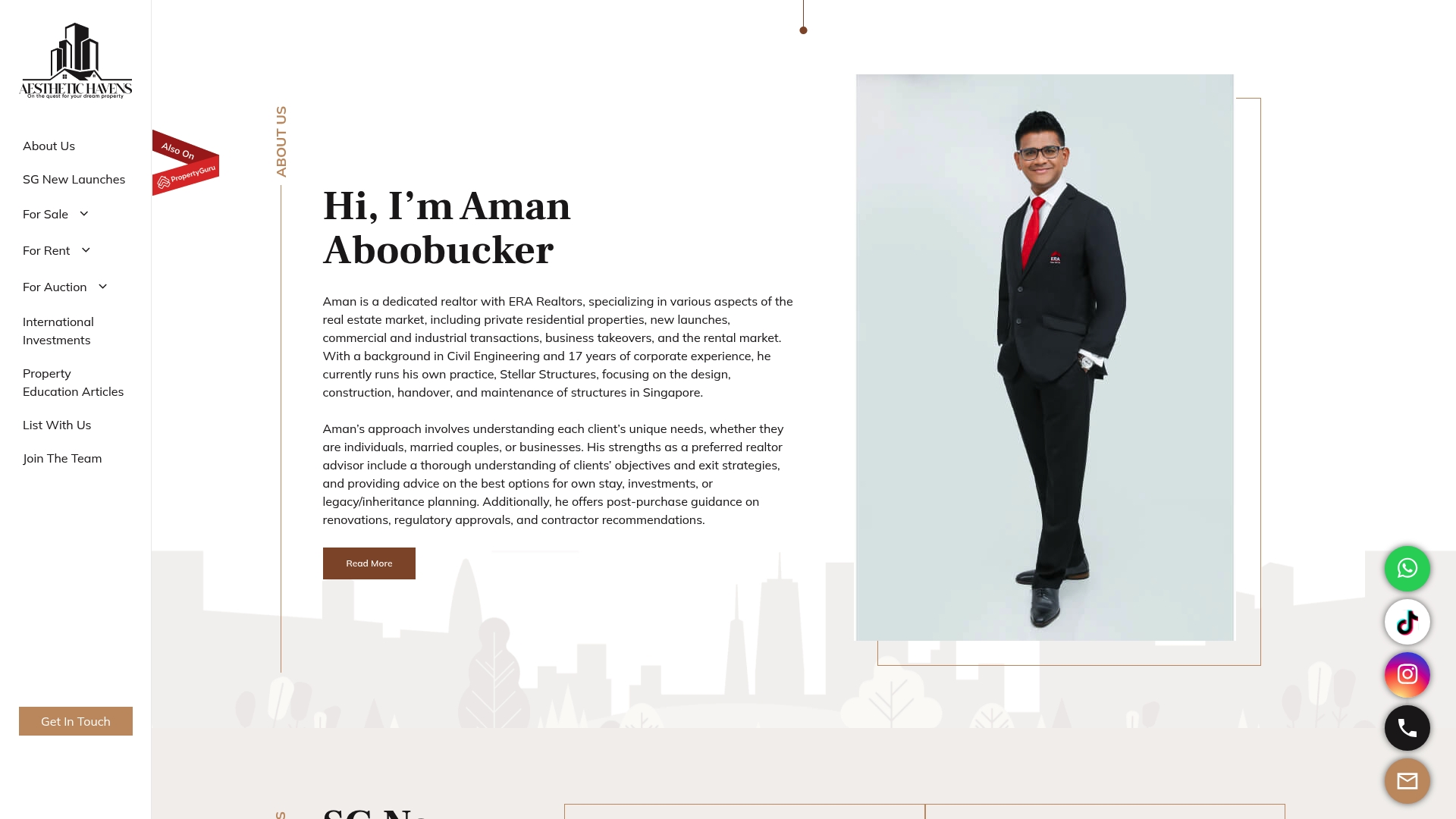
Aman Aboobucker runs Aesthetic Havens under ERA Realtors, focused on real estate consultancy for buying, selling, renting, and investing in Singapore property. Our guide for foreigners buying property in Singapore walks through eligibility and tax scenarios in more depth than a single article can cover.
Three practical steps we recommend before you commit to a unit: confirm your eligibility and property-type options first, get an indicative financing assessment in writing, and line up a conveyancing lawyer referral before you sign an Option to Purchase.
— Aman
Currency and fund transfers for your purchase
Funding a Singapore property purchase from overseas income or savings adds a layer most buyers underestimate: exchange rate movement between the time you commit to a price and the time you actually transfer funds. A shift of even a few percentage points in your home currency against the Singapore dollar can change your effective purchase cost meaningfully, especially on a staged new-launch payment schedule spread over months or years.
Banks and money transfer services typically offer different rates and fees, so comparing a few options before a large transfer is worth the time it takes. Some buyers lock in a rate ahead of a known payment date using a forward contract offered by their bank, which removes the uncertainty of where the rate will sit on the actual payment day. This matters more for ABSD and BSD payments, which fall within fixed statutory windows and cannot simply wait for a more favorable rate.
Transferring large sums into Singapore also triggers standard bank compliance checks, including source-of-funds documentation. Having bank statements, employment records, or sale proceeds documentation ready in advance keeps a transfer from stalling against a stamp duty deadline. Plan your transfer timing around your payment obligations, not the other way around, since a missed BSD or ABSD deadline carries penalties regardless of why the funds were delayed.
Other eligibility rules foreign buyers should know
Beyond property type, a few administrative realities shape what a foreign buyer can actually do with a Singapore condo purchase. None of these require a special license to buy a standard condominium unit, but they affect financing, ownership structure, and timing.
Your immigration status, whether you hold an Employment Pass, Dependant’s Pass, or no pass at all, does not change your right to buy a condominium under the Residential Property Act, but it does affect how banks assess your loan application and how long you are likely to stay, which feeds into your own decision on whether to buy at all.
If you plan to purchase jointly with a Singapore citizen or permanent resident, for example a spouse, get the ownership structure reviewed before signing the Option to Purchase. The buyer profile used for ABSD purposes can be set by the co-buyer with the higher rate, so joint ownership does not automatically reduce your tax exposure.
Corporate or trust structures for purchasing a condo carry their own ABSD treatment and added scrutiny, and are generally more complex than a straightforward individual purchase. If you are considering holding the property through an entity rather than in your own name, that decision needs dedicated legal and tax advice before you commit to a unit, since unwinding the wrong structure after purchase is far more expensive than setting it up correctly the first time.

What the headlines about foreign buyers get wrong
A foreigner staying five or more years with a clear financing plan can absorb the upfront tax in ways a two-year assignment cannot.
The conventional advice to “just check if you’re allowed to buy” undersells how much the real risk sits in financing assumptions and contract terms, not in SLA eligibility. Most non-landed purchases clear the eligibility bar easily. Where buyers run into trouble is assuming a bank’s advertised loan ceiling applies to them, or skipping a lawyer’s review of a new-launch contract because the developer’s sales team made it feel routine.
If you take one thing from this guide, prioritize the indicative financing assessment and the lawyer review before you fall in love with a unit. Everything else, including the ABSD math, is just arithmetic once those two pieces are settled.
— Aman
Get a clear picture before you commit
We work with foreign buyers through Aesthetic Havens on exactly the sequence this guide describes: eligibility and budget clarity first, financing referral second, then a shortlist that matches both. We also coordinate conveyancing referrals and, for buyers interested in new developments, guidance specific to staged payment schedules.
Before a first consultation, it helps to bring a few basics: identification, a rough budget range, and any indicative loan approval you already have. If you are weighing a new launch against resale stock, browse our SG New Launches listings or get in touch through our main site to start the eligibility and financing conversation.
- Review your eligibility and property-type options with a consultant before shortlisting units.
- Get a financing referral and indicative assessment before making any offer.
- Request a conveyancing lawyer referral once you are ready to sign an Option to Purchase.
FAQ
What taxes do foreigners pay when buying property in Singapore?
Foreign buyers pay Buyer’s Stamp Duty on every purchase, calculated on the purchase price or market value, whichever is higher. They also pay Additional Buyer’s Stamp Duty based on their buyer profile, which for foreign buyers can reach a rate that significantly increases total acquisition cost.
Do foreigners need to pay ABSD?
Yes, foreign buyers are subject to ABSD under IRAS rules, which apply rates based on buyer profile at the time of purchase. This applies whether the buyer purchases alone or jointly, with the co-buyer’s profile potentially setting the applicable rate.
Can I buy a house in Singapore as a foreigner?
You can generally buy a private condominium unit without approval, but landed houses require approval from the Singapore Land Authority, assessed case by case. Approval for landed property is uncommon for non-PR, non-resident buyers and typically considers factors like exceptional economic contribution.
Can a Singaporean and a foreigner buy an HDB flat together?
HDB flat eligibility follows HDB’s own household and citizenship rules, separate from the private property rules that govern condo purchases. Whether a mixed-citizenship couple can buy an HDB flat together depends on the specific scheme and household composition, so this needs direct confirmation with HDB rather than assumption.
How much deposit does a foreigner need for a Singapore condo?
The deposit structure follows the same Option to Purchase and exercise process as any Singapore property purchase, with the option fee and exercise payment set as a percentage of price under standard practice. Your actual cash requirement also depends on your loan-to-value ratio, which TDSR rules and bank risk assessment determine on a case-by-case basis.
Sources
- Foreign ownership of property | Singapore Land Authority (SLA)
- Buying property | Urban Redevelopment Authority (URA)


