

Introduction
Pledging S$100,000 in fixed deposits with your lending bank for four years adds S$2,083 to your recognised monthly income under Singapore’s Total Debt Servicing Ratio framework. Showing the same S$100,000 without locking it up adds only S$625. That difference alone can determine whether you qualify for the property loan you need.
This article covers MAS Notice 645 rules governing how financial institutions convert eligible financial assets into recognised income for TDSR purposes. The focus is on private property and investment loans in Singapore, including industrial and commercial purchases. HDB flat and executive condominium buyers face an additional Mortgage Servicing Ratio cap at 30%, which limits how much asset recognition helps for those property types; this article addresses MSR only briefly.
The target reader is a business owner, investor, or higher-net-worth individual in Singapore who holds liquid assets (cash deposits, fixed deposits, bonds, listed company shares) but whose declared income alone falls short of qualifying for the desired loan amount. Pledging funds by locking eligible assets with the bank for 48 months allows up to 100% recognition for cash and fixed deposits, while unpledged assets (showing funds) retain full liquidity but receive only about 30% recognition. Pledging almost always yields a larger loan if you can tolerate the four-year lock-up.
By the end of this article, you will:
-
Understand the difference between pledging and unpledging (show funds) under MAS Notice 645
-
Know how banks convert dollars of assets into recognised monthly income over 48 months
-
See concrete numerical examples showing how much extra loan a S$100k or S$200k pledge can unlock
-
Identify when pledging is worth the four-year lock versus when unpledging or doing nothing is safer
-
Have a step-by-step guide for discussing pledge or show-funds strategies with your banker
Understanding How Liquid Assets Affect TDSR
Under MAS rules, banks can treat certain liquid assets as a form of income when running the TDSR calculation. This section explains the framework and which assets qualify.
What Is TDSR and Why It Limits Your Loan Size
The total debt servicing ratio is calculated by dividing total monthly debt obligations by gross monthly income. TDSR caps total monthly debt at 55% of income. A TDSR exceeding 55% requires a reduction in loan amount. Medium-term interest rates are used for TDSR calculations; banks typically stress-test at around 3.5% to 4.0% over a 25- to 30-year tenor to determine the maximum monthly instalment you can handle.
“Gross monthly income” in this context includes fixed salary at 100%, plus variable income (commissions, bonuses, rental income) at 70% after a 30% haircut mandated by MAS. It also includes any eligible financial assets amortised over 48 months via pledging or showing funds.
For borrowers purchasing an HDB flat or executive condominium, the Mortgage Servicing Ratio (MSR) caps mortgage payment at 30% of gross monthly income. This tighter cap limits the practical benefit of asset recognition for public housing. The remainder of this article focuses on private property and industrial or commercial property purchases, where TDSR is the binding constraint for most buyers.
What Counts as “Liquid Financial Assets” for TDSR
Eligible financial assets under MAS rules include:
-
SGD cash deposits and fixed deposits
-
Singapore Government Securities (T-bills, SGS bonds)
-
Listed company shares on recognised exchanges (Singapore, US, Hong Kong)
-
Unit trusts and money market funds
-
Gold (held in bank custody)
-
Foreign currency deposits
-
Structured deposits and investment-linked policies with cash surrender value
CPF balances, physical properties, private company shares without a quoted market value, and cryptocurrency are generally excluded from the eligible assets list. Each bank (DBS, OCBC, UOB, and others) maintains its own internal eligibility list and may apply stricter criteria than MAS requires. one lender might accept pledged foreign currency deposits while another rejects them entirely.
The next two sections explain how these assets are converted into extra income through pledging or unpledging, and the precise numerical difference between the two routes.
Pledging vs Unpledging: Core Concepts
Banks recognise liquid assets for TDSR in two ways: pledging (lock-up with the lending bank) and unpledging, also called showing funds (no lock-up, lower recognition).
What Is Pledging Liquid Assets?
Pledging means signing a pledge agreement that places specific assets under the bank’s charge for at least 48 months, tied to the new mortgage. Pledged assets are locked for four years under MAS rules. During that period, you cannot withdraw, sell, or re-pledge those assets elsewhere without refinancing or fully redeeming the outstanding loan.
Recognition rates depend on asset type. Pledging cash is more efficient than pledging equities. SGD cash deposits and fixed deposits pledged for four years receive 100% recognition. Only 70% of equities’ value is recognized when pledged, because banks apply a 30% haircut to account for price volatility. Other pledged assets such as foreign currency deposits, gold, and bonds receive similar haircuts in most cases.
The conversion to recognised monthly income works as follows: recognised amount ÷ 48 months = additional monthly income for TDSR. Pledging S$100,000 in fixed deposits adds S$2,083 to monthly income (S$100,000 ÷ 48). The same S$100,000 in listed equities, after a 30% haircut, adds about S$1,458 per month (S$70,000 ÷ 48).
Pledged assets can also protect against capital gains taxes by avoiding liquidation; you retain ownership of shares or funds without triggering a sale event.
Lock-up notice: Pledged assets cannot be withdrawn, sold, or re-pledged elsewhere during the 48-month pledge period. Early release is typically permitted only upon full loan redemption, property sale, or refinance to another lender.
What Is Unpledging / Showing Funds?
Unpledged assets mean presenting proof of liquid funds without locking them up. You provide bank statements, brokerage records, or custodian reports to the lending bank at loan application and again before loan disbursement.
Showing assets recognizes only 30% of their value. That shown portion is then amortised over 48 months. For S$100,000 in any asset class, the result is: S$100,000 × 30% ÷ 48 = S$625 added to monthly income. Showing funds requires no lock-up period for assets; unpledged assets can improve financial flexibility since they are not locked up. You retain full control to sell, reinvest, or spend.
Banks typically require 3 to 6 months of statements showing consistent balances. If your balances drop before disbursement, the bank may recalculate and reduce your recognised income. Unpledged assets allow borrowers to demonstrate financial capacity without collateralizing assets, but showing assets increases borrowing power less than pledging.
Why MAS Uses a 48-Month Period
MAS Notice 645 mandates amortising asset-derived income over 48 months because liquid assets are finite. Unlike salary, savings deplete when spent. The 48-month horizon forces a conservative assumption: even a large cash holding can sustain only a limited monthly “income” stream.
-
The four-year period also aligns with the pledge lock-up, ensuring the lending bank has recourse to the pledged amount during the riskiest early years of the loan.
-
This 48-month figure is fixed in MAS Notice 645 and cannot be negotiated with the bank, regardless of whether the loan tenor is 10 years or 30 years.
The next section puts these recognition rates into concrete loan amounts so you can calculate the trade off between pledging and showing funds for your own situation.
How Pledging and Unpledging Change Your Loan Eligibility
This section answers the core question: by how much does pledging versus unpledging increase your maximum mortgage loan? The examples below use 2024-era Singapore conditions.
Numerical Example: S$200,000 in Fixed Deposits
Base scenario: A couple earns S$10,000 combined gross monthly income, has no other debts, and is applying for a 25-year private property loan stress-tested at 4%.
At a 4% rate over 25 years, each S$1,000 of monthly instalment capacity supports roughly S$190,000 in loan amount (standard amortisation). TDSR at 55% means the couple can service up to S$5,500 per month in total monthly debt.
|
Scenario |
Extra Monthly Income |
Total Recognised Income |
Max Monthly Debt (55%) |
Approximate Max Loan |
|---|---|---|---|---|
|
No assets |
S$0 |
S$10,000 |
S$5,500 |
~S$1,045,000 |
|
Unpledged S$200k |
S$1,250 |
S$11,250 |
S$6,188 |
~S$1,176,000 |
|
Pledged S$200k FD |
S$4,167 |
S$14,167 |
S$7,792 |
~S$1,480,000 |
Pledging increases maximum loan by about S$435,000 versus the no-asset baseline. Unpledging the same S$200,000 adds roughly S$131,000. Pledging delivers approximately 3.3× more loan headroom than showing funds for the same asset amount.
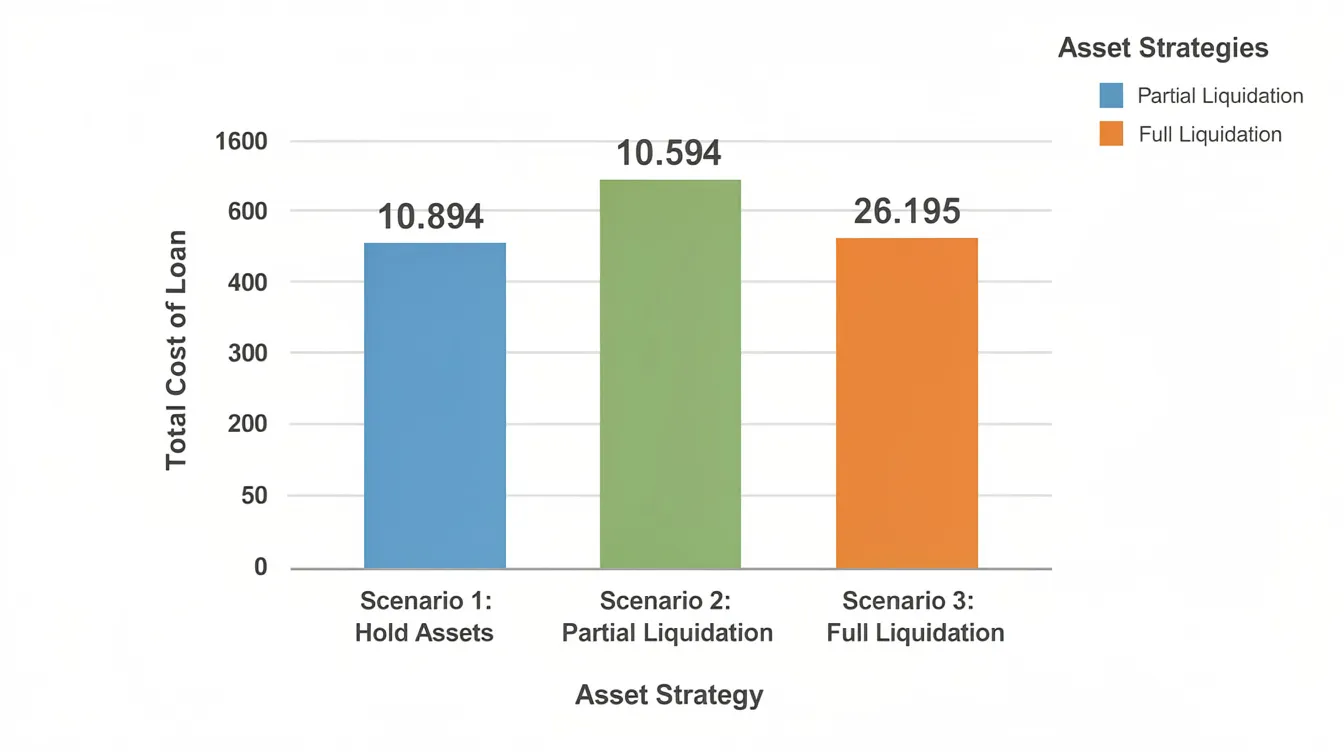
One source estimated that pledging S$100,000 increases maximum loan by approximately S$217,000, while showing S$100,000 unlocks around S$65,000; the ratio holds consistently across different starting incomes.
Numerical Example: Bridging a Small Income Shortfall
Marcus and Li Mei want to buy a S$1.8M private property with 75% LTV, requiring a S$1.35M bank loan. Their combined monthly income is S$12,000. They carry S$2,500 per month in existing obligations (car loans and a personal loan).
At a 4% stress rate over 25 years, the S$1.35M loan requires about S$7,100 in monthly instalments. Adding their existing S$2,500, total monthly debt would be S$9,600. TDSR = S$9,600 ÷ S$12,000 = 80%, which exceeds 55%. They need to raise their recognised income or reduce the target loan.
To bring TDSR to exactly 55%, their required gross monthly income is S$9,600 ÷ 0.55 = S$17,455. The income shortfall is S$17,455 – S$12,000 = S$5,455 per month.
-
Pledged assets required: S$5,455 × 48 = S$261,840 in cash or FDs (at 100% recognition)
-
Unpledged assets required: S$5,455 × 48 ÷ 0.30 = S$872,800
The gap is stark. To bridge the same shortfall, unpledging demands over three times the capital. For Marcus and Li Mei, pledging roughly S$262,000 for four years solves the problem. Showing funds would require S$873,000 in liquid assets, capital that many buyers simply do not have sitting idle.
For a couple deciding whether to ring-fence part of their portfolio for four years, the question reduces to whether they can absorb the liquidity lock. If Marcus runs a business that might need that S$262,000 as working capital within the next four years, unpledging (or a smaller property) may be the more prudent path.
Impact on Industrial and Commercial Property Investors
Business owners looking at B1/B2 industrial units, warehouses, or small offices often show low taxable income due to legitimate business tax planning. Some lenders allow substantial assets to enhance mortgage eligibility despite lower income, making pledging or showing funds a practical route for these buyers.
Industrial and commercial property loans differ from residential home loan products in ways that affect the calculus:
Industrial loans carry higher stress-test rates (often 4.5% to 5.0%) and shorter tenors of 15 to 20 years. A 15-year tenor at 4.75% requires roughly S$7,800 per month per S$1M borrowed, compared to about S$5,260 for a 25-year residential loan at 4%. Each dollar of extra recognised income therefore buys less additional loan quantum for industrial property.
Consider an SME owner with S$8,000 in declared monthly income and S$300,000 in a liquid portfolio (S$200,000 cash, S$100,000 in blue-chip equities). Pledging the full S$300,000 generates roughly: (S$200,000 × 100% + S$100,000 × 70%) ÷ 48 = S$5,625 per month in extra income. Unpledging the same portfolio: S$300,000 × 30% ÷ 48 = S$1,875 per month. For a strata industrial unit priced at S$1.5M with 70% LTV (S$1.05M loan), the pledged route may be the only way to pass TDSR.
Implementing a Pledge or Unpledged Asset Strategy
Once you understand the numbers, execution matters. Errors in timing, documentation, or asset selection can delay or derail a loan application.
Step-by-Step: How to Pledge Assets with a Bank
Choose pledging when you need a large TDSR uplift and can spare four years of liquidity.
-
Calculate the income shortfall between your current TDSR and the 55% threshold for your target loan. Work with your banker or adviser to determine the precise pledged amount needed.
-
Identify which assets to pledge. Fixed deposits and SGD cash deposits receive 100% recognition. Listed company shares and unit trusts receive roughly 70%. Prioritise cash and FDs for the best recognition-to-risk ratio.
-
Transfer or place the funds with the lending bank. If your assets sit in an external brokerage or another bank, the lending bank will typically require a custody transfer or fresh deposit placement.
-
Sign the pledge agreement and charge documents. Confirm the 48-month lock-up duration and the conditions under which early release is permitted (loan redemption, property sale, refinance).
-
The bank updates the TDSR calculation using the pledged amount amortised over 48 months. Your loan application proceeds with the higher recognised income.
-
Upon approval, loan disbursement occurs. Pledged assets remain locked until the pledge period ends or you refinance or sell the property.
-
At year three or four, review your pledge status. You may be able to refinance to a lower interest rate with a different lender once the pledge expires, or extend the pledge if needed for continued servicing.
Assets already pledged to another loan may reduce eligibility for new credit applications. Before pledging, confirm that none of your target assets are encumbered elsewhere.
Step-by-Step: How to Use Unpledged “Show Funds”
Choose unpledging when your income gap is modest, or when you need funds for renovation, working capital, or additional property purchases within the next four years.
-
Calculate the income gap and the approximate asset amount needed at 30% recognition. Remember that only 30% of shown assets count towards TDSR calculations.
-
Confirm with your banker which statement formats are acceptable. Some banks require original statements from the custodian bank or brokerage; screenshots of trading apps are typically rejected.
-
Prepare three to six months of statements showing stable balances in eligible liquid assets. Consistency matters; a balance that appeared last week after a sudden transfer may raise questions.
-
Submit the statements with your loan application. Ensure balances remain at roughly the same level until at least just before loan disbursement.
-
Re-evidence your assets shortly before disbursement if the bank requests updated statements. Banks want assurance that you have not moved or spent the shown funds.
-
After disbursement, you technically can move the money. Be aware that doing so may affect future refinancing or top-up loan applications if the bank re-assesses your TDSR.
Comparing Pledge vs Unpledge: Key Trade-offs
|
Criterion |
Pledging |
Unpledging (Show Funds) |
|---|---|---|
|
Recognition rate |
100% for cash/FDs; ~70% for equities and other assets |
~30% for all asset types |
|
Liquidity |
Locked for 48 months |
Fully liquid; no lock-up |
|
Administrative process |
Transfer assets to lending bank; sign charge documents |
Provide statements from existing accounts |
|
Best suited for |
Large income shortfalls; borrowers who can spare liquidity |
Modest top-ups; borrowers who need funds for business or renovations |
|
Risk factors |
Opportunity cost of locked capital; early release restrictions |
Lower TDSR uplift; balance must remain stable until disbursement |
|
Loan uplift per S$100k |
~S$217,000 additional borrowing |
~S$65,000 additional borrowing |
Pledging liquid assets can increase mortgage borrowing power when the income shortfall is large relative to your available capital. Many buyers with tight incomes but healthy portfolios find that pledging the minimum amount needed to pass TDSR, rather than pledging everything, strikes the right balance between loan eligibility and retained liquidity.
Showing strategically works when you have ample assets but only a small TDSR gap. If you need only S$600 per month in extra income, unpledging S$96,000 solves the problem without any lock-up.
You can also combine pledging and showing: pledge just enough cash to close most of the gap, then show additional assets for the remaining shortfall, keeping the rest of your portfolio free.
Common Challenges and How to Avoid Them
Borrowers frequently encounter these issues when attempting to use eligible financial assets for TDSR improvement.
Overestimating Eligible Assets and Recognition Rates
A borrower holding S$150,000 in US-listed small-cap shares may assume the full value will be recognized. In practice, one bank may apply a 50% haircut on foreign small-caps; another may exclude them entirely. Lenders typically apply a 70% haircut on unpledged assets when calculating income, but this figure varies by asset class and by bank. Before structuring your approach, request the bank’s current internal eligibility list and haircut schedule. Comparing lists across two or three banks can reveal that the same portfolio produces different TDSR outcomes at each lender.
Ignoring the 4-Year Liquidity Lock and Opportunity Cost
Pledging S$300,000 in fixed deposits earning 3% per year means forgoing potential returns from equities, property down payment on another investment, or business expansion for four years. If your business needs that capital for inventory financing or a new contract within the pledge period, the locked funds could create cashflow strain.
Before pledging, build a 48-month cashflow projection. Keep a separate emergency buffer (at least 6 to 12 months of expenses) outside the pledged amount. Compare the expected return on your pledged capital versus the benefit of qualifying for the larger loan.
Treating Pledging as a Way Around LTV Limits
Pledging and unpledging influence the income side of TDSR. They do not change LTV (loan-to-value) caps set by the Monetary Authority of Singapore. For a first residential property loan, LTV is typically capped at 75%. For a second outstanding loan, LTV drops to 45% with a 25% minimum down payment in cash. If LTV is the binding constraint, no amount of pledging will increase your loan amount. Focus instead on increasing your down payment, paying down an existing outstanding loan, or restructuring property holdings.
Poor Coordination Between Personal and Business Financing
SME owners sometimes pledge personal assets needed for business working capital, then face pressure when the company needs funds. A S$200,000 pledge for a condo purchase that coincides with a seasonal cash crunch in the business can force expensive short-term borrowing elsewhere. Review corporate credit lines, invoice financing options, and trade facilities alongside personal housing plans. Working with a single adviser who sees both the personal and corporate balance sheet reduces the risk of conflicting commitments.
Conclusion and Next Steps
-
Pledging eligible financial assets for 48 months can increase TDSR-based mortgage capacity by approximately 3.3× more than unpledging the same amount, because pledged cash receives 100% recognition versus 30% for shown funds.
-
Unpledged show-funds treatment preserves liquidity and avoids the four-year lock, but produces only a fraction of the TDSR uplift per dollar of assets.
-
The right choice depends on the size of your income shortfall, your need for liquidity over the next four years, and whether you hold cash-heavy or equity-heavy assets.
Immediate next steps:
-
Calculate your current TDSR by dividing total monthly debt by gross monthly income, and identify the shortfall relative to 55% for your target loan.
-
List all your eligible liquid assets and sort them by stability: cash and fixed deposits first, then bonds and Singapore Government Securities, then listed equities and unit trusts.
-
Model pledge versus unpledge scenarios for 48 months using the formulas in this article or an online calculator such as Redemption.sg’s pledging tool.
-
Speak with your banker or adviser to confirm recognition rates at your chosen lender and structure the approach that matches your cashflow needs.
Related topics worth exploring next: refinancing strategies after the pledge period ends, using rental income from industrial units to further improve TDSR, and restructuring existing debts (paying down car loans or credit lines) before pledging to maximise the net benefit.
Additional Resources and FAQ
FAQ: Is Pledging Allowed for HDB or Only for Private Property?
Recognising assets for TDSR applies to private property and investment loans. Buyers of an HDB flat or executive condominium face the MSR cap at 30% of gross monthly income, which is tighter than TDSR’s 55%. Asset pledging can still technically be used, but the MSR limit reduces how much additional borrowing the pledge unlocks. Check with HDB and your bank for current policy before assuming pledging will close an eligibility gap on public housing.
FAQ: Can I Cancel the Pledge Before 48 Months?
Early release of a pledge is permitted in specific circumstances: full loan redemption, sale of the property, or refinancing to another bank where a new TDSR assessment is conducted. Breaking the pledge without one of these events is generally not allowed and could trigger a loan review or recall. If you anticipate needing the funds before four years, the unpledged route or a smaller pledge amount is a safer structure.
FAQ: What Happens if the Value of My Pledged Shares Drops?
Banks apply conservative haircuts at the outset (typically 30% for equities) to buffer against price declines. If a pledged equity portfolio drops below the bank’s comfort level, the bank may request additional collateral or a partial cash top-up. This is one reason many borrowers prefer pledging cash or fixed deposits: their value does not fluctuate, removing the risk of a margin-call-style request during the pledge period.
FAQ: Does Stamp Duty Change When I Pledge Assets?
No. Buyer’s stamp duty and additional buyer’s stamp duty are based on the purchase price or market value of the property, not on how you finance the purchase or structure your TDSR. Pledging or unpledging assets has no effect on stamp duty obligations.
Tools and Advisory
For borrowers weighing pledge versus show-funds strategies across multiple banks, working with an adviser who models scenarios bank by bank can save time and avoid costly missteps. Key services to look for include:
-
Custom TDSR and loan capacity modelling for both residential and industrial property purchases
-
Side-by-side comparisons of how different banks in Singapore treat pledged versus unpledged assets, including haircut rates and eligible asset lists
-
Scenario planning for SME owners balancing business liquidity and property investment
Prepare your current income documentation, existing debt schedule, and a list of liquid assets with approximate values before your first consultation. That information allows an adviser to run preliminary numbers and identify the most efficient path to qualifying for your target loan.


