


If you bought your residential property on or after July 4, 2025, you’re on a four-year Seller’s Stamp Duty clock with rates starting at sixteen per cent and stepping down in stages. Sell before the four-year mark ends and you’ll owe SSD on the higher of your sale price or IRAS-assessed market value. Buy before that date, and you’re still governed by the older three-year ladder with lower rates. Everything else, from exemptions to filing deadlines, follows from which side of that line your purchase falls on.
TL;DR:
- The acquisition date, based on the exercise of the option to purchase or signing of the sale and purchase agreement, determines which SSD regime applies, not the date of key collection or occupancy permit.
- SSD is calculated on the higher of the sale price or the IRAS market value assessment, which can result in larger bills if the sale appears below market value or is a related-party transfer.
- Most exemptions are limited to specific cases like death, divorce, government acquisition, or approved corporate restructuring, requiring documented approval from IRAS.
- Sellers should verify their exact SSD exposure, run calculations early with their lawyer, and incorporate the potential tax into their selling strategy before listing their property.
Table of Contents
- What Are SSD Rules and Who Do They Cover?
- SSD Rates and Holding Periods: The Full Breakdown
- How Is SSD Calculated and When Do You Pay?
- What SSD Exemptions and Remissions Actually Exist?
- Do HDB Flats, Inherited Homes, and Related-Party Sales Follow Different Rules?
- Worked SSD Calculation Examples
- How Do You File and Pay SSD Without Penalties?
- A Seller’s Checklist Before You List
- Why the July 2025 Changes Should Reshape How You Think About Timing
- Get Your SSD Exposure Checked Before You List
- Where to Verify These SSD Rules Yourself
- Sources
- FAQ
What Are SSD Rules and Who Do They Cover?
Seller’s Stamp Duty applies to residential properties and residential land in Singapore, charged when you sell within a defined holding period after buying. It does not touch commercial property, but industrial property has its own separate SSD framework administered under different IRAS industrial SSD guidance-for-industrial-property).
The entire system hinges on two dates, and getting either one wrong is the single most common mistake sellers make.
- Acquisition date: the date you exercised your Option to Purchase (OTP), or the date of your Sale and Purchase Agreement (SPA) for new launches bought directly from a developer.
- Disposal date: the date of the transfer instrument, or the date you exercise the OTP as a seller, whichever the transaction structure calls for.
Buyers often assume the acquisition date is when they collected keys or when the property reached Temporary Occupation Permit (TOP). It isn’t. IRAS SSD guidance anchors everything to the OTP exercise or SPA signing date, and that single date decides which rate ladder you sit under. A resale unit bought on July 3, 2025, follows the old three-year regime. The same unit type bought a day later falls under the new four-year, higher-rate regime.
This matters just as much for gifts and related-party transfers. IRAS doesn’t treat a below-market transfer to a family member as exempt from scrutiny. The authority can reassess the transaction at market value, and SSD still applies on that reassessed figure unless a specific relief condition is met and formally approved.
If you’re unsure whether your purchase was structured as an OTP resale or a developer SPA, check your original stamp certificate rather than relying on memory. That single document settles the argument every time.
SSD Rates and Holding Periods: The Full Breakdown
Two separate rate ladders exist right now, and which one applies depends entirely on your acquisition date. There’s no blending or averaging between them.
Properties acquired between March 11, 2017, and July 3, 2025, sit under the older three-year regime. Properties acquired on or after July 4, 2025, fall under the new four-year regime with steeper rates across the board, confirmed in the MOF/MAS media release announcing the change.
| Acquisition date | Holding period sold | SSD rate |
|---|---|---|
| 11 Mar 2017 to 3 Jul 2025 | Up to 1 year | around twelve percent |
| 11 Mar 2017 to 3 Jul 2025 | More than 1, up to 2 years | around eight percent |
| 11 Mar 2017 to 3 Jul 2025 | More than 2, up to 3 years | around four percent |
| 11 Mar 2017 to 3 Jul 2025 | More than 3 years | None |
| On or after 4 Jul 2025 | Up to 1 year | about sixteen percent |
| On or after 4 Jul 2025 | More than 1, up to 2 years | about twelve percent |
| On or after 4 Jul 2025 | More than 2, up to 3 years | about eight percent |
| On or after 4 Jul 2025 | More than 3, up to 4 years | about four percent |
| On or after 4 Jul 2025 | More than 4 years | None |
The year bands are counted from the exact acquisition date, not the calendar year, so a sale on the 366th day after purchase already sits in a lower band than a sale on day 364. This is confirmed directly in the IRAS SSD page for residential property, which remains the authoritative reference for both ladders.
Industrial property owners should not apply either table above. Industrial SSD runs on its own schedule and rate structure, detailed separately on IRAS’s industrial property page, and mixing the two frameworks up is a common and costly error among sellers who own mixed portfolios.
How Is SSD Calculated and When Do You Pay?
SSD is charged on whichever figure is higher: your actual sale price or the market value IRAS assesses at disposal. This detail catches sellers off guard more than any other part of the SSD framework.
Sell at a genuine arm’s-length price and IRAS usually accepts the sale price as market value. If the sale price looks artificially low, such as in related-party transactions, IRAS may use its own market-value assessment for SSD calculation. IRAS will substitute its own market-value assessment and calculate SSD on that higher figure instead, leaving the seller with a larger bill than expected and, in serious cases, penalties for understatement.
Here’s how the payment process actually runs in practice:
- The sale contract is executed, or the transfer instrument is dated, whichever applies to your transaction structure.
- SSD becomes payable within 14 days of that date, per IRAS’s stated payment timeline.
- Your conveyancing lawyer typically calculates the SSD, stamps the relevant documents, and arranges payment as part of the completion process, so most sellers never touch the IRAS portal directly.
- IRAS may query or adjust the declared price if it deviates meaningfully from comparable transactions, triggering a market-value reassessment before the sale is finalized.
Pro Tip: Ask your lawyer to run the SSD computation before you sign the sale contract, not after. Once the contract is executed, the 14-day clock starts regardless of whether you’ve confirmed your net proceeds.
What SSD Exemptions and Remissions Actually Exist?
Genuine SSD remissions are narrower than most sellers assume, and personal hardship almost never qualifies. Retrenchment, medical bills, or financial distress are understandable reasons to sell quickly, but they are not recognized grounds for remission under current IRAS policy.
The remissions that IRAS recognizes are specific, documented, and tied to circumstances outside the seller’s control, including death of the owner, divorce court orders, compulsory acquisition by the government, qualifying en-bloc sales, and approved corporate restructuring relief.
Every one of these categories requires documentation, and IRAS reviews eligibility case by case rather than granting blanket exemptions. IRAS’s own guidance is explicit that remission conditions are specific, and assuming eligibility without verification is one of the more expensive mistakes a seller can make.
Pro Tip: If your situation looks like it might qualify for remission but doesn’t fit neatly into one of the categories above, apply for an IRAS advance ruling before listing the property. Getting the answer in writing beats finding out during conveyancing that you owe tens of thousands of dollars you didn’t budget for.
Do HDB Flats, Inherited Homes, and Related-Party Sales Follow Different Rules?
Most HDB resale sellers never encounter SSD at all, and the reason is timing rather than exemption. The Minimum Occupation Period (MOP) for HDB flats runs five years, which already exceeds even the new four-year SSD holding period. By the time you’re legally allowed to sell your flat on the open market, SSD has already lapsed to nil in almost every case.
The exceptions worth knowing:
- Sub-sale or Selective En-bloc Redevelopment Scheme (SERS) situations can create scenarios where SSD timing interacts unusually with MOP, so verify your specific case rather than assuming the general rule applies.
- Inherited properties reset the SSD acquisition date to the date of inheritance, not the deceased owner’s original purchase date. Executors selling shortly after probate should confirm this reset with a lawyer before assuming any SSD exposure.
- Spousal and related-party transfers get looked through by IRAS on a market-value basis. Transferring a property to a spouse or family member below market rate does not sidestep SSD; it just shifts the calculation basis.
- Zoning or use changes during the holding period can, in some cases, affect how IRAS treats the disposal date, particularly where a property transitions between residential and other use classifications mid-ownership.
None of these edge cases are rare in Singapore’s property market, and each one has tripped up sellers who assumed the general rule applied to their specific situation.
Worked SSD Calculation Examples
Numbers make this concrete faster than any explanation can, so here are three scenarios that cover the situations sellers actually ask about.
Example 1: Post-July 2025 purchase sold within Year 1
You buy a condo unit for $1,500,000 in August 2025. Financial pressure forces a sale eight months later at $1,550,000, still within the first year of ownership. SSD is calculated on the higher of sale price or market value, and IRAS assesses market value at roughly the transacted price here, so the base is $1,550,000.
Example 2: Related-party sale below market value
You sell a unit to a sibling for $1,000,000, but comparable transactions in the same development show market value closer to $1,200,000. IRAS uses the higher figure, market value, as the SSD base rather than the discounted family price.
Example 3: One day, one rate band
Two identical units purchased on the same date, July 4, 2025. The other sells one day later, at exactly 4 years and 1 day, landing in the nil band. On a $1,400,000 sale price, that single day is the difference between owing $56,000 in SSD and owing nothing at all.
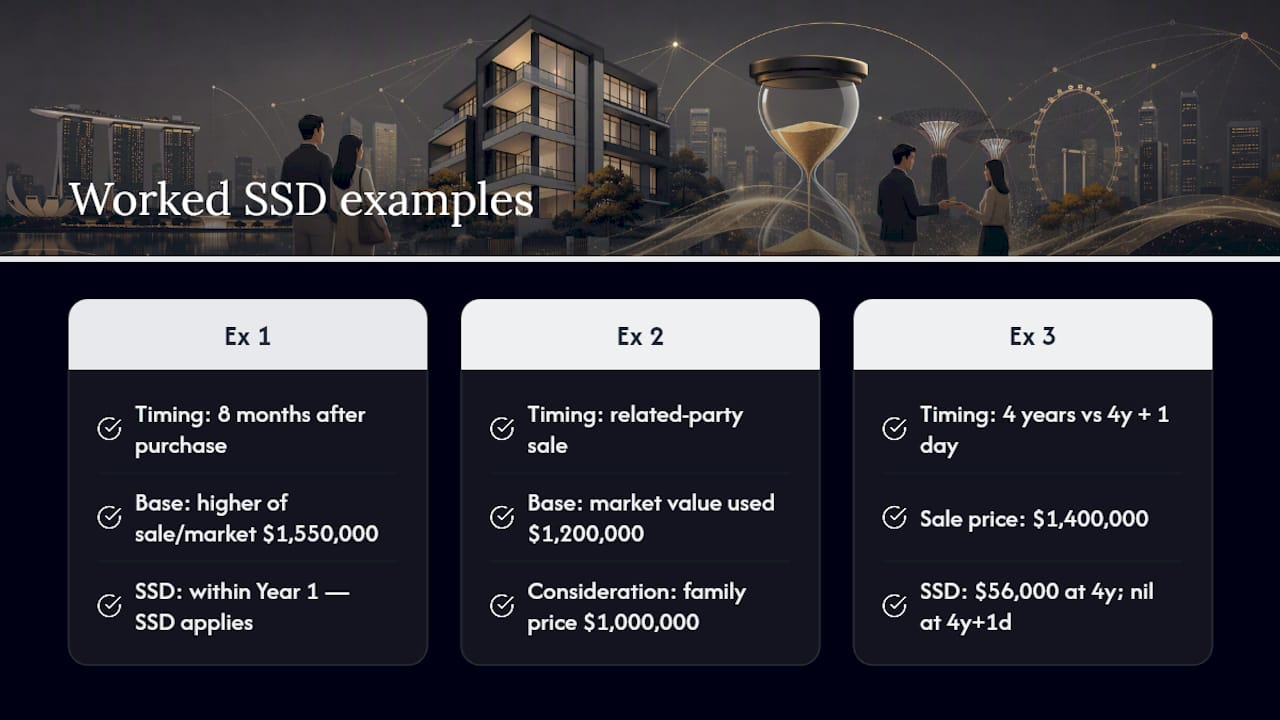
Net proceeds calculations should factor SSD in alongside agent commission, outstanding loan redemption, and legal fees, since SSD is often the single largest deduction sellers overlook when budgeting a quick sale.
How Do You File and Pay SSD Without Penalties?
The mechanics are straightforward once you know the deadline and where responsibility sits.
- SSD must be paid within 14 days of the executed sale contract date, or the transfer instrument date where no formal contract exists.
- Payment and stamping run through IRAS’s stamp duty e-services, accessible via the Mytax, which lets you compute the exact figure before submission.
- Late stamping or late payment attracts penalties and interest under IRAS practice, and the amounts escalate the longer the delay runs.
- In nearly every residential transaction, your conveyancing lawyer handles the actual stamping and payment as part of completion, coordinating the timing so SSD, legal fees, and loan redemption all clear together.
The 14-day window moves fast once a contract is signed, so confirm your SSD exposure before that clock starts, not after.
A Seller’s Checklist Before You List
Run through this before you sign anything, not after.
- Confirm your exact acquisition date from the stamp certificate, then check which regime, three-year or four-year, actually applies.
- If your intended sale price sits noticeably below comparable transactions nearby, ask your lawyer or agent to flag a potential IRAS market-value adjustment before listing.
- Have your conveyancing lawyer run the full SSD computation and fold it into your net proceeds estimate before you sign the sale contract.
- If your situation touches inheritance, divorce, or corporate restructuring, request an IRAS advance ruling or consult a tax specialist before assuming any remission applies.
Pro Tip: Run the SSD number before you set your asking price, not after an offer comes in. Sellers who calculate SSD late often end up negotiating from a weaker position because they didn’t know their real floor.
Why the July 2025 Changes Should Reshape How You Think About Timing
The policy intent behind extending the holding period from three years to four, while raising every rate band, is straightforward: discourage short-term flipping in a market where speculative buying pushes prices up for everyone else. That’s not a controversial reading of the change; it’s the stated purpose behind previous SSD adjustments too, going back to the original 2010 introduction.
What’s changed practically is the planning horizon. My honest read: anyone buying residential property today should treat the four-year mark as a real commitment, not a formality, and build SSD into cashflow planning before the purchase, not after a sale is already in motion.
Investors who built strategies around the old three-year ladder need to rerun their models. The math that worked in 2024 does not work the same way in 2026, and pretending otherwise is how sellers end up surprised at completion.
— Aman
Get Your SSD Exposure Checked Before You List
Working out your exact SSD liability means nailing down your acquisition date, checking whether your intended price could trigger an IRAS market-value adjustment, and coordinating the numbers with your conveyancing lawyer before contracts get signed. This verification can be run early, coordinating directly with solicitors and valuers so your net proceeds estimate is accurate before you commit to a sale timeline.

This isn’t tax advice, and if your situation touches inheritance, divorce, or corporate restructuring, we’ll point you to a qualified lawyer or tax specialist rather than guess. What we do handle well is the practical groundwork: confirming your holding period, flagging valuation risk, and making sure SSD is factored into your numbers from day one. If you’re weighing whether to sell now or wait out your holding period, start with our property sales workflow to see how we coordinate the full process from valuation through to completion.
Where to Verify These SSD Rules Yourself
- MOF/MAS press release: confirms the July 2025 policy change.
- Legislative supplement (egazette): the statutory text implementing the change.
- IRAS stamp duty calculator: compute your exact SSD figure.
Sources
- Extension of the Holding Period of Seller’s Stamp Duty — MAS
- Legislative supplement — egazette (2025)
FAQ
Does SSD Apply to Inherited Property?
Inherited property resets the acquisition date to the date of inheritance, so the SSD clock generally starts fresh rather than carrying over the deceased owner’s original purchase date. Executors selling shortly after probate should still confirm this with a lawyer given the specifics of the estate.
What Is the SSD Holding Period in Singapore?
It depends on when you bought: properties acquired between March 11, 2017, and July 3, 2025, follow a three-year holding period, while properties acquired on or after July 4, 2025, follow a four-year holding period under the updated IRAS rules.
Does SSD Apply to Commercial Property?
No, commercial property in Singapore generally does not attract SSD. Industrial property has its own separate SSD framework, distinct from both the residential ladder and commercial exemption.
What Are the Current ABSD Rates?
ABSD is a separate buyer-side tax from SSD, charged on purchase rather than sale, and rates vary by buyer profile and property count. Check our breakdown of ABSD rates and exemptions for the current buyer-side figures, since confusing ABSD with SSD is one of the most common mistakes sellers and buyers make.
How Is SSD Different From Buyer’s Stamp Duty?
SSD is paid by the seller on disposal within the holding period, while Buyer’s Stamp Duty (BSD) is paid by the buyer on every purchase regardless of holding period. They’re calculated differently and apply to different parties in the same transaction.


