


Most property transactions in Singapore trigger three separate stamp duties: Buyer’s Stamp Duty (BSD), Additional Buyer’s Stamp Duty (ABSD), and Seller’s Stamp Duty (SSD) if you sell within a set holding period. Every rate, remission, and calculator sits on IRAS’s official portal, and you must stamp and pay within 14 days of signing in Singapore, or 30 days if the document was signed overseas.
TL;DR:
- Buyers must compare the property’s market value and purchase price because stamp duty is based on the higher of the two, not just the offer price.
- ABSD rates vary sharply by buyer type, reaching 60% for foreigners and 65% for entity purchases, with some relief available for specific scenarios like trust or marriage.
- Stamp duty deadlines are strict, requiring payment within 14 days if signed in Singapore or 30 days if signed abroad, with penalties and invalidation risks for late payment.
- Buyers should obtain professional valuation reports early and budget separately for BSD and ABSD, as these are due upfront and can significantly impact cash flow.
- ABSD remissions require timely sale of previous properties and full payment upfront, with refunds processed later if conditions are met, making planning crucial.
Table of Contents
- Stamp Duty Singapore: Quick Rates and How It’s Calculated
- Calculating BSD and ABSD Before You Sign
- Selling, Leasing, and Other Property Stamp Duties
- Stamping Deadlines, Certificates, and Penalties
- How ABSD Remissions and Refunds Actually Work
- Your Pre-Signing Stamp Duty Checklist
- Why Buyers Still Get Blindsided by ABSD
- Get Help Structuring a Stamp-Duty-Sensitive Purchase
- Sources
Stamp Duty Singapore: Quick Rates and How It’s Calculated
Every stamp duty in Singapore uses the same base rule: IRAS charges duty on whichever is higher, the purchase price or the property’s market value. That single sentence trips up more buyers than any other part of the process, because a low offer price doesn’t shrink your tax bill if the valuation comes in higher.
BSD applies to every buyer, regardless of nationality or how many properties you already own. As of the current IRAS rate table), BSD is charged on marginal bands:
- 1% on the first $180,000
- 2% on the next $180,000
- 3% on the next $640,000
- 4% on the next $500,000
- 5% on the next $1,500,000
- 6% on any remaining amount above $3,000,000
IRAS rounds the computed duty down to the nearest dollar, and the minimum duty payable is $1.
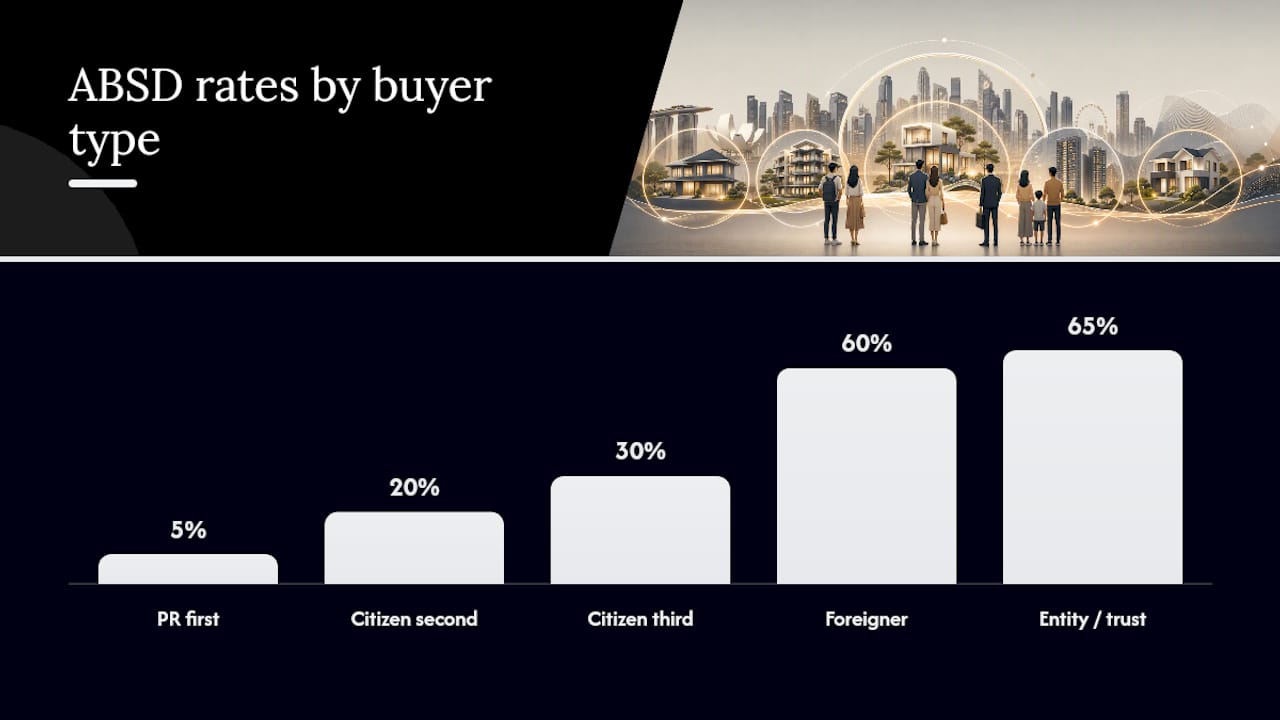
ABSD sits on top of BSD, and this is where the real budgeting shock happens. Rates depend entirely on who’s buying: Singapore citizens pay nothing extra on a first home, but 20% on a second property and 30% on a third. Permanent residents face 5% on a first home and steeper rates after that. Foreigners currently pay a flat 60% ABSD on any residential purchase, and entities buying property, including most trusts, pay 65% in the majority of cases. Buyers from countries with a Free Trade Agreement carve out, such as US nationals, get treated like Singapore citizens for ABSD purposes.
SSD works differently. It only applies if you sell residential property within a defined holding period after buying, and the rate scales down the longer you hold. It exists specifically to discourage flipping, not to tax normal resale activity.
Here’s a worked example. Say a Singapore citizen buys a private condo for $1,500,000 as a second property. BSD comes to roughly $44,600 using the marginal bands above. ABSD at 20% adds $300,000. Total stamp duty due at signing: about $344,600, payable well before any rental income or resale gain materializes. That gap between purchase price and total cash needed is exactly why IRAS’s e-Stamping calculators are worth running before you make an offer, not after.
Calculating BSD and ABSD Before You Sign
Get your buyer profile straight before you fall in love with a listing. That one classification, citizen, permanent resident, foreigner, or entity, decides whether your ABSD bill is zero or six figures.
- Confirm your buyer profile and count your existing properties. ABSD is assessed per buyer, and joint purchases are taxed at the highest applicable profile among all buyers, applied to the entire purchase price, not just one person’s share.
- Get an early read on market value. Because duty is charged on the higher of price or valuation, a professional property valuation check before you sign the Option to Purchase avoids an unpleasant surprise at completion.
- Check whether a remission applies. Married couples selling their first matrimonial home to buy a second can often claim ABSD remission if they sell within six months. Buyers aged 55 and above combining households into a single smaller home may also qualify for relief under specific conditions.
- Budget for BSD and ABSD as separate cash outlays, both due at stamping, not at completion.
- Keep every valuation report, sale and purchase agreement, and IRAS correspondence for at least five years in case of an audit.
Buying through a trust or a company doesn’t sidestep ABSD. IRAS tightened these rules specifically because entity purchases were being used to plan around higher rates, and most trust structures now attract the 65% entity rate regardless of the eventual beneficiary’s citizenship.
Pro Tip: Run the numbers on a sole-name purchase versus a joint purchase before signing anything. If one buyer already owns property and the other doesn’t, structuring the purchase in the debt-free buyer’s name alone can sometimes avoid triggering the higher ABSD tier, but this has real implications for CPF usage, loan eligibility, and inheritance planning. Get advice from a lawyer or tax advisor first, not after.
For a deeper breakdown of buyer categories and remission mechanics, our full ABSD guide covers scenarios this section doesn’t have room for.
Selling, Leasing, and Other Property Stamp Duties
Buying isn’t the only trigger for stamp duty. Sellers, landlords, and anyone financing a purchase all run into duty obligations that get far less attention than BSD and ABSD.
- SSD applies when you sell residential property within the holding period IRAS sets for properties acquired on or after 20 February 2010. The rate is computed on whichever is higher between the selling price and market value, and it steps down the longer you’ve held the property, structured this way specifically to deter quick flips rather than penalize genuine long-term owners.
- Lease duty kicks in on tenancy agreements once the average annual rent crosses a threshold, calculated as a percentage of rent based on the lease term, not the property’s value.
- Mortgage duty applies to loan and charge documents when you take out financing, calculated on the loan amount secured against the property.
- Share duty applies when you transfer shares in a property-holding entity, since IRAS treats that as an indirect transfer of the underlying property for ABSD purposes in many cases.
Landlords and investors juggling multiple units often overlook lease duty entirely until a tenancy renewal flags it.
Stamping Deadlines, Certificates, and Penalties
Missing your stamping window is one of the costliest, and most avoidable, mistakes in a property transaction. IRAS requires documents executed in Singapore to be stamped within 14 days of signing. If the document was executed overseas, you get 30 days from the date it’s received in Singapore.
- Stamp exclusively through the IRAS e-Stamping portal, the only official channel for computing and paying duty.
- Pay immediately upon stamping, since the certificate isn’t issued until payment clears.
- Download and retain your stamp certificate, and keep it alongside your sale documents for at least five years.
Late stamping carries real financial risk. Penalties can run up to four times the unpaid duty for extended delays, though short lapses sometimes attract a smaller fixed fine instead. Either way, an unstamped document also can’t be relied on in court, which matters if a dispute ever arises over the transaction.
If your Option to Purchase timeline is tight, our step-by-step OTP guide walks through exactly when the stamping clock starts.
How ABSD Remissions and Refunds Actually Work
Remissions don’t reduce what you pay at stamping. You pay the full ABSD amount upfront, then apply for a refund once you meet the qualifying conditions, and that timing gap catches a lot of buyers off guard.
- Married couples remitting ABSD on a replacement home must sell their previous matrimonial property, typically within six months of the new purchase’s completion.
- Trust and entity purchases face narrower remission paths, and IRAS generally requires the full entity rate to be paid before any remission claim can even be considered.
- Refund and appeal applications go through IRAS directly, with supporting documents like the sale agreement for the disposed property and proof of the qualifying relationship or condition.
Plan your cashflow assuming you’ll pay the higher amount first. The Propkaki ABSD guide walks through several remission scenarios with worked figures if you want to model your own situation.
Your Pre-Signing Stamp Duty Checklist
Before you commit to any purchase, run through this list:
- Confirm your exact buyer profile, including citizenship and existing property count.
- Get a market valuation, not just the asking price, to anticipate the true duty base.
- Budget BSD and ABSD as combined upfront cash, separate from your down payment.
- Clarify with your lawyer who’s responsible for stamping and by which deadline.
- Stamp within the statutory window and retain the certificate.
The most common mistake is assuming the purchase price is automatically the taxable amount. It isn’t, if the valuation is higher. The second most common: forgetting that trust and entity purchases almost always land in the highest ABSD bracket.
Pro Tip: Loop in your lawyer, a property valuer, and a tax advisor before signing the Option to Purchase, not after. Once you’ve committed, your remission options narrow fast.
Why Buyers Still Get Blindsided by ABSD
Stamp duty math looks simple on paper. In practice, most costly mistakes happen because buyers price the property first and treat duty as an afterthought calculation, when it should shape the offer itself.
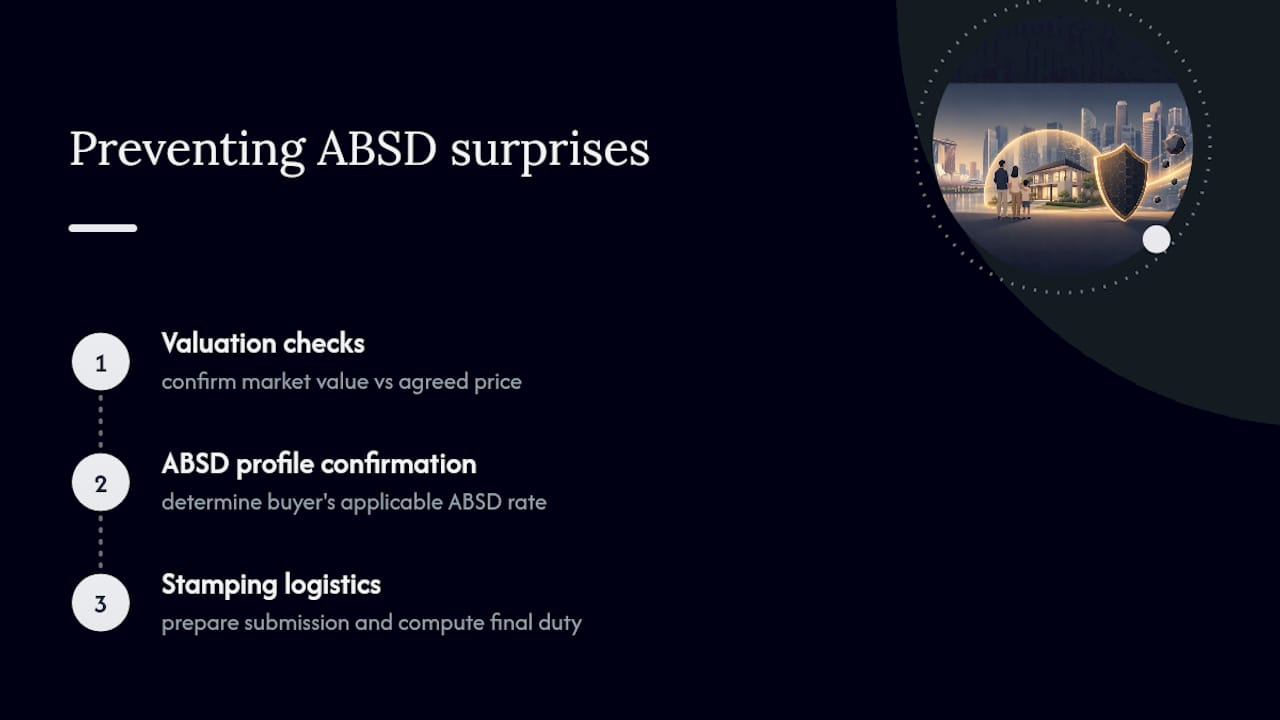
The gap between purchase price and market valuation is where I see the most avoidable financial pain. A buyer who assumes their agreed price is the taxable base can be off by tens of thousands of dollars once IRAS applies the higher-of-two-values rule. Aesthetic Havens works through valuation checks, ABSD profile confirmation, and stamping logistics as a standard part of every transaction we support, precisely because these details get glossed over when buyers focus purely on negotiating the sale price.
— Aman
Get Help Structuring a Stamp-Duty-Sensitive Purchase
Working out BSD, ABSD, and the right buyer structure before you sign isn’t something you want to improvise, especially when six-figure remissions hinge on timing you only get one shot at. Aesthetic Havens coordinates the practical side of this directly: valuation checks, ABSD profile review, and stamping timelines, so nothing falls through the cracks between your Option to Purchase and completion.

If you’re weighing property title structures against your ABSD exposure before making an offer, our guide on property title types in Singapore is a solid starting point, and for hands-on tools, Haio offers additional calculators worth cross-checking against your own figures. Book a consult with Aesthetic Havens before you sign your next Option to Purchase, and let us walk through your specific buyer profile and duty exposure together.


