


PSF means “per square foot” — a standardized ratio of price or rent divided by a property’s square footage, used to compare assets of different sizes on equal footing. Two formulas cover almost every situation you’ll encounter:
Purchase PSF = Sale price ÷ Total square footage
Rent PSF = Annual rent ÷ Total square footage (monthly equivalent = Rent PSF ÷ 12)
A quick example: a 5,000 sq ft office building that sells for $1,250,000 has a purchase PSF of $250. If that same building leases for $100,000 per year, the rent PSF is $20 sf/yr, or roughly $1.67 per sq ft per month. Those two numbers let you compare it instantly against any other listing, regardless of size.
Table of Contents
- How do you calculate PSF for a purchase or lease?
- Gross PSF vs. net PSF: why the denominator changes everything
- What does PSF actually tell you, and what does it miss?
- How to compare properties by PSF without getting misled
- Where do square-foot numbers come from, and how accurate are they?
- Key Takeaways
- PSF is a tool, not a verdict
- Working with a property consultant to get PSF right
- Useful sources for further reading
How do you calculate PSF for a purchase or lease?
The math is simple. Getting the inputs right is where most people slip up.
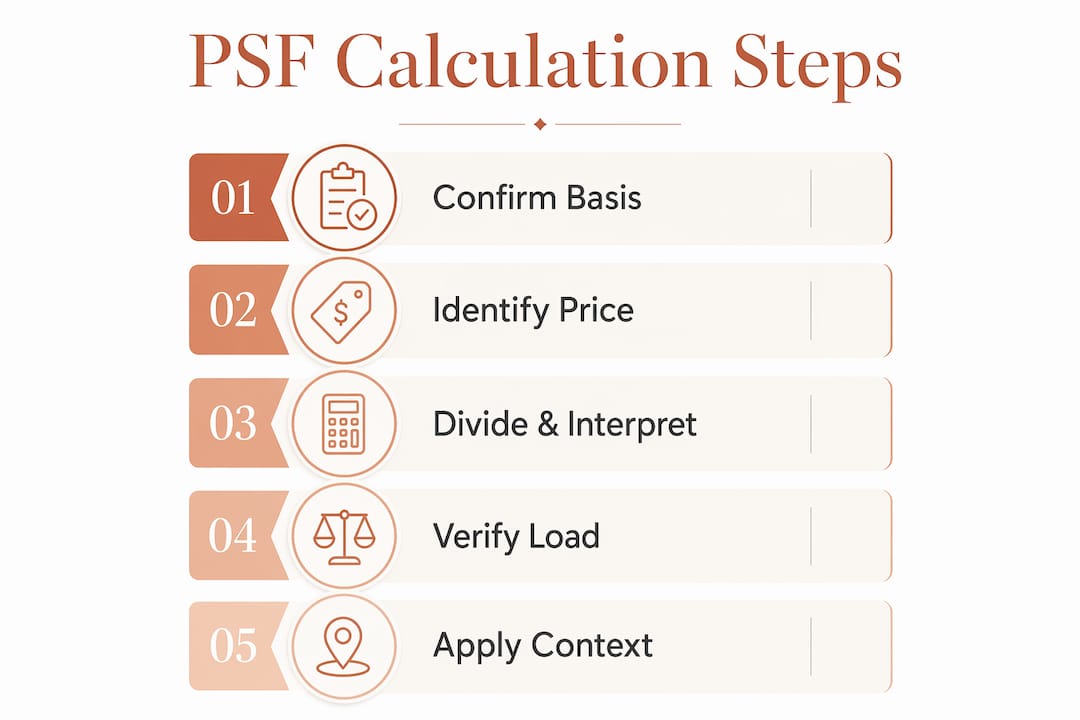
Step 1: Confirm the square-foot basis. Before dividing anything, find out whether the figure you have is gross area, rentable area, or usable area. Using the wrong denominator produces a PSF that can’t be compared to anything else.

Step 2: Identify the price or rent figure. For purchases, use the total sale price. For leases, use the annual rent unless the listing explicitly states monthly — commercial rent listings commonly quote an annual PSF, so $20 PSF typically means $20 per sq ft per year, not per month.
Step 3: Divide and interpret. Divide the price or annual rent by the square footage. The result is your PSF. A higher PSF signals a premium location, better finishes, or stronger demand — but it doesn’t tell you why.
Worked examples
| Property | Sale Price / Annual Rent | Square Footage | PSF | Monthly Equivalent |
|---|---|---|---|---|
| Office suite (purchase) | — | — | $250/sq ft | N/A |
| Retail unit (lease) | — | — | $30 sf/yr | — |
The warehouse PSF looks low compared to the retail unit, but that’s expected. PSF varies widely across property types: industrial spaces routinely trade at a fraction of retail or office PSF because of location, finish, and demand differences. Comparing a warehouse PSF to an office PSF tells you almost nothing useful.
Gross PSF vs. net PSF: why the denominator changes everything
Two listings can quote the same PSF and mean completely different things, depending on which square-foot figure sits in the denominator.
Gross PSF uses the total building area, including structural walls, mechanical rooms, and shared spaces. It’s common in sales comparisons and gives a broad view of overall building value.
Net or usable PSF uses only the space a tenant or owner actually occupies — no hallways, lobbies, or restrooms. This produces a higher PSF number for the same rent, because the denominator is smaller.
Rentable area and the load factor
In commercial leasing, the figure that actually drives your rent check is rentable area, not usable area. Landlords allocate a share of common areas to each tenant through a load factor (also called a loss factor or add-on factor).

The formula: Rentable area = Usable area × (1 + Load factor)
Say your usable office space is 2,000 sq ft and the building’s load factor is 15% (0.15). Your rentable area is 2,000 × 1.15 = 2,300 sq ft. If the lease quotes $30 PSF on rentable area, your annual rent is $69,000 — not $60,000. That $9,000 gap is real money, and it comes entirely from failing to convert usable to rentable before applying the listed PSF.
Pro Tip: Always ask a broker or landlord: “Is this PSF based on rentable or usable square footage?” before running any rent calculation. A listing that doesn’t specify is almost always using rentable area — but confirm it.
What does PSF actually tell you, and what does it miss?
PSF earns its place as a screening tool. It lets you rank a dozen listings in minutes, spot a market trend over time, and set an opening benchmark for underwriting. For deal sourcing, nothing beats it for speed.
The limitations are just as real.
that should trigger deeper due diligence, not replace it. Here’s what a headline PSF number can’t tell you:
- Building condition and capex. A $200 PSF office with a 20-year-old HVAC system and no recent renovation may cost far more to own than a $230 PSF building that’s move-in ready.
- Location premium within a submarket. Two buildings on the same street can have very different PSF values because one faces a park and the other faces a parking garage.
- Tenant creditworthiness. A fully leased building looks great on PSF; it looks different if the anchor tenant is on a month-to-month lease.
- Operating expenses. Gross leases bundle expenses into rent; net leases don’t. The same PSF means different things depending on lease structure.
- Building age and deferred maintenance. Neither shows up in a PSF figure.
Valuation guides recommend pairing PSF with net operating income (NOI), cap rate, rent rolls, and broker comps before making any underwriting decision. PSF opens the door; those metrics tell you whether to walk through it.
One statistical note worth keeping: median PSF is preferable to average PSF for submarket comparisons. A handful of trophy-asset sales can push average PSF well above what most properties actually trade at, distorting your benchmark. Median is harder to skew.
How to compare properties by PSF without getting misled
A short checklist before you put two listings side by side:
- Confirm the square-foot basis. Rentable or usable? Gross or net? Get this in writing.
- Normalize the frequency. Is the rent quoted annually or monthly? Always confirm lease frequency — mixing annual and monthly figures is one of the most common calculation errors in commercial leasing.
- Adjust for load factor. Convert usable to rentable (or vice versa) so both listings use the same basis.
- Adjust for capex and finish. If one property needs $50/sq ft in tenant improvements and the other doesn’t, add that to the effective PSF before comparing.
- Use the median PSF for the submarket. Gather several comparable transactions and use the median value for a less distorted benchmark.
Questions to ask before signing anything
- “Is this $/sf/yr or $/sf/mo?”
- “Does this PSF apply to rentable or usable square footage?”
- “What is the building’s load factor?”
- “Are tenant improvement allowances included, or is this base rent only?”
Three mistakes that cost money
- Mixing measurement bases. Comparing a gross-area PSF to a usable-area PSF is like comparing apples to square footage — the numbers are incompatible.
- Ignoring operating expenses. A $25 PSF gross lease and a $25 PSF triple-net lease are not the same deal. The net lease adds taxes, insurance, and maintenance on top.
- Over-relying on average PSF. One luxury sale in a submarket can inflate the average enough to make an ordinary building look like a bargain or a rip-off. Always check the commercial property value factors driving outlier transactions.
Where do square-foot numbers come from, and how accurate are they?
The PSF is only as reliable as the square footage in the denominator. That number can come from several sources, and they don’t always agree.
| Source | What It Measures | Common Issues |
|---|---|---|
| ANSI Z765 measurement | Exterior perimeter, excludes garages and below-grade space | Requires a professional; most accurate for GLA |
| Tax assessor records | Varies by county; often based on permit data | May not reflect renovations or additions |
| MLS / broker listings | Depends on local MLS rules; may use GLA or other measures | Inconsistent methodology across markets |
| Owner-provided plans | As-built or architectural drawings | May not match current physical condition |
ANSI Z765 is the standard U.S. appraisers and many lenders prefer for gross living area. It requires exterior measurements and excludes garages and below-grade finished space from the GLA calculation. MLS data and tax records frequently diverge from ANSI measurements because they follow different local rules.
The practical consequence: discrepancies between sources can be significant, which translates directly into notable errors in your PSF calculation with substantial impact on implied value.
Verification steps that actually reduce risk:
- Commission an ANSI Z765–compliant measurement before closing on any significant purchase.
- Request current floor plans and compare them to tax records.
- Cross-check the broker’s stated square footage against the most recent appraisal.
- For leased space, ask for the measurement methodology used in the lease.
Tracking rental efficiency metrics alongside verified square footage gives you a far cleaner picture of what a space is actually worth per dollar spent.
Key Takeaways
PSF is a reliable screening metric only when the square-foot basis, lease frequency, and load factor are confirmed before any comparison is made.
| Point | Details |
|---|---|
| PSF formula | Price PSF = sale price ÷ sq ft; Rent PSF = annual rent ÷ sq ft (÷ 12 for monthly). |
| Confirm the basis first | Always verify whether PSF uses rentable, usable, or gross area before comparing listings. |
| Load factor adds real cost | Rentable area = usable area × (1 + load factor); a 15% load factor on 2,000 sq ft means your rentable area increases accordingly. |
| PSF is a starting point | Pair PSF with NOI, cap rate, rent rolls, and capex estimates before making any underwriting decision. |
| Aesthetic Havens advisory | Aesthetic Havens helps buyers and tenants verify square footage, source median PSF comps, and underwrite deals correctly. |
PSF is a tool, not a verdict
Most people who misread a PSF figure aren’t bad at math. They’re comparing numbers that were never meant to be compared directly — one based on rentable area, one on usable, one quoted monthly while the other is annual. The metric itself is sound; the inputs are where deals go sideways.
The other thing worth saying plainly: PSF can mask a bad deal as easily as it can reveal a good one. A property trading at a 20% discount to submarket PSF might be a genuine opportunity — or it might have $80/sq ft in deferred capex that the headline number doesn’t show. The PSF gets you in the room. The rental property valuation work — NOI, cap rate, physical inspection — is what tells you whether to stay.
Use median PSF for comps, confirm your measurement basis every single time, and treat any PSF figure from a tax record or owner estimate as a starting point that needs verification, not a fact.
Working with a property consultant to get PSF right
Getting PSF right isn’t just about the formula. It’s about having verified square footage, reliable comps, and a clear picture of what the number actually includes. That’s where a consultant earns their fee.

Aesthetic Havens offers the specific services that reduce PSF risk at every stage of a transaction: commissioning accurate measurements, sourcing median PSF comps from comparable transactions, underwriting capex and NOI alongside the headline rent figure, and parsing lease terms to confirm whether a quoted PSF is annual or monthly, rentable or usable. For buyers and tenants who want to remove measurement and underwriting uncertainty before committing, this is a concrete alternative to relying on broker-provided figures alone.
If you’re evaluating a commercial property and want a second set of eyes on the numbers, working with a property consultant is a straightforward next step. Reach out to Aesthetic Havens to discuss your specific situation.
Useful sources for further reading
- ANSI Z765 draft — Square Footage Measurement Standard — The primary U.S. standard for measuring gross living area; essential reading if you’re commissioning a professional measurement or reviewing an appraisal.
- How to measure square footage — Opendoor — Practical walkthrough of measurement methods and why source discrepancies of 10–30% are common.
- Price per square foot (PPSF) — Wall Street Prep — Concise explainer of the PPSF formula and why it should be paired with deeper financial metrics rather than used alone.
- Complete guide to square footage — MeasureFloorPlan — Covers rentable vs. usable area, load factors, and how different measurement standards interact with lease calculations.
- Real estate appraisal and valuation methods — Dealpath — Explains how underwriters use PSF as an entry point and then move to NOI, cap rate, and rent roll analysis.
- PSF meaning in real estate — Lev — Straightforward commercial leasing explainer with worked examples of annual vs. monthly PSF conversions.


