


CPF usage property refers to Singapore’s CPF Housing Scheme, which lets eligible members apply Central Provident Fund Ordinary Account (OA) savings toward specific residential purchase costs in Singapore. It has no bearing on U.S. property transactions. If you encountered this term in a deal, here is what you need to know before going further:
- Singapore CPF = a mandatory social security savings scheme; the OA portion can fund certain Singapore residential purchase costs under the CPF Housing Scheme.
- Brazilian CPF = Cadastro de Pessoas Físicas, a taxpayer identification number required in Brazilian real estate closings. Entirely different concept, same acronym.
- U.S. buyers are not CPF members and cannot use Singapore’s CPF for any property outside Singapore.
- Properties with a short remaining lease are ineligible for CPF OA funds.
Table of Contents
- What does CPF allow you to use for property purchases in Singapore?
- Why Singapore’s CPF rules don’t apply to U.S. property
- If you’re buying in Singapore with a CPF member as co-owner
- Pre-purchase checklist for buyers using CPF in Singapore
- What U.S. buyers use instead of CPF
- Key Takeaways
- Why jurisdiction checks matter more than most buyers realize
- How Aesthetic Havens helps U.S. buyers navigate CPF questions
- Authoritative sources and further reading
What does CPF allow you to use for property purchases in Singapore?
Only the Ordinary Account is in play here. The Special Account (SA) and Retirement Account (RA) are reserved strictly for retirement and cannot touch property purchases.
Permitted uses of CPF OA savings:
- Down payment on HDB flats or private residential properties in Singapore
- Monthly housing loan installments (bank loan or HDB loan)
- Buyer’s Stamp Duty (BSD) and Additional Buyer’s Stamp Duty (ABSD)
- Legal and transaction fees
- Home Protection Scheme (HPS) premiums for HDB flats
What CPF OA cannot cover:
- Monthly service and conservancy charges
- Property taxes
- Utilities and maintenance fees
Those ongoing operating costs must be paid in cash, no exceptions.
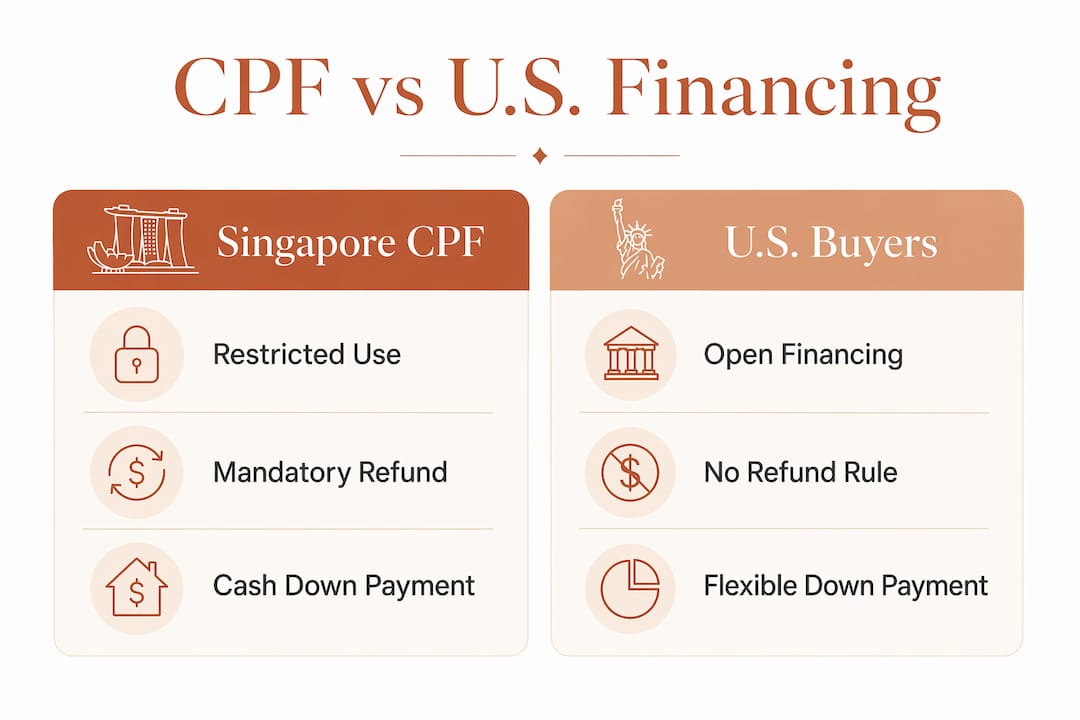
The mandatory cash down payment rule
Regardless of how much OA you have, a minimum 5% cash down payment of the lower of the purchase price or valuation is required at the time of purchase. CPF cannot substitute for this cash portion.
Retirement sum limits
The CPF Housing Usage Calculator gives personalized estimates, but the broad rule is this: members may need to set aside the Basic Retirement Sum (BRS) or Full Retirement Sum (FRS) before drawing on OA savings for property. For buyers aged 55 and above, the BRS is half of the FRS applicable at that age. Owning multiple properties tightens these limits further.
Pro Tip: CPF Board guidance recommends keeping some OA savings as an emergency buffer (an example figure commonly cited: retaining $20,000 OA as buffer) so monthly housing installments remain serviceable in unexpected events. Educational resources suggest retaining OA savings as a safety net and considering a mix of cash and OA payments.
The refund obligation on sale is not optional. When you sell, you return the principal used plus the interest your CPF account would have earned. Making voluntary refunds earlier reduces what you owe at sale and leaves more cash proceeds in your pocket.
Why Singapore’s CPF rules don’t apply to U.S. property
Singapore’s CPF Housing Scheme is tied to CPF membership, which is limited to Singapore citizens and permanent residents contributing to the fund. No membership, no access. A U.S. buyer purchasing property in the United States has no CPF account to draw from, and Singapore’s CPF Board has no jurisdiction over transactions outside Singapore.

The confusion usually comes from one of two places: either a buyer has seen “CPF” in documentation for a Singapore co-purchase, or they have encountered “CPF” in a Brazilian real estate transaction.
Singapore CPF vs. Brazilian CPF at a glance:
- Singapore CPF (Central Provident Fund): A mandatory savings scheme. The OA portion funds housing costs for eligible members buying Singapore residential property.
- Brazilian CPF (Cadastro de Pessoas Físicas): A taxpayer identification number issued by Brazil’s Receita Federal. Required for foreigners buying in Brazil to execute public deeds, register property, open bank accounts, pay taxes, and handle foreign-exchange documentation.
For foreigners buying in Brazil, the CPF functions as the central identifier linking registry systems, banking compliance, foreign-exchange flows, and tax administration. It is not a savings account and carries no funds.
Practical note for U.S. investors: When a counterparty mentions “CPF” in an international deal, ask immediately which country’s CPF they mean. The answer changes your entire checklist.
If you’re buying in Singapore with a CPF member as co-owner
This is where CPF becomes directly relevant to a U.S. buyer. If any co-owner on the title is a Singapore citizen or permanent resident with an active CPF account, their OA savings can be applied to the purchase. Your share of the transaction is still funded through conventional means.
Scenarios to watch for:
- Buying with a Singapore spouse or co-investor: The Singapore party’s OA can cover their share of the down payment, loan installments, and eligible fees. You fund your share in cash or through a bank loan.
- HDB vs. private condo: Foreigners generally cannot buy HDB flats. Private condominiums are the typical route, and CPF OA rules for private properties differ from HDB rules. The HDB vs. private property distinctions affect CPF eligibility, loan limits, and stamp duty exposure.
- Buying through a local entity: CPF OA savings cannot be used when purchasing through a company. The scheme applies to individuals only.
Eligibility checks to run before signing anything:
- Confirm whether any buyer on title is an eligible CPF member with sufficient OA balance.
- Verify the property’s remaining lease. Anything at or below 20 years is ineligible.
- Check whether the co-buyer must set aside BRS or FRS before OA funds are available.
- Factor in ABSD exposure for foreigners. The ABSD implications for foreign buyers can be substantial and must be paid in cash before CPF reimbursement is processed.
Stamp duties are typically paid in cash first, then reimbursed from CPF OA after the CPF charge is lodged. For completed properties, reimbursement is processed on the completion date. For under-construction properties, reimbursement may be available if lodgment is completed within 14 days. That cash-first requirement creates a short-term liquidity need you should plan for.
Pro Tip: Confirm with your Singapore lawyer exactly when the CPF charge will be lodged and when reimbursement will hit. A timing mismatch between legal completion and CPF processing can stall a closing.
Pre-purchase checklist for buyers using CPF in Singapore
- Confirm CPF membership and OA balance for every buyer on title who plans to use CPF funds.
- Run the CPF Housing Usage Calculator to estimate the maximum OA amount usable, factoring in age, property type, and loan type.
- Check remaining lease and property type. Private condo or HDB? Remaining lease above 20 years? These two filters determine eligibility before anything else.
- Plan cash reserves for the mandatory 5% cash down payment, stamp duties (paid upfront), and any option fees.
- Confirm lawyer and bank roles in lodging the CPF charge and processing reimbursements. Your lawyer must be appointed by the CPF Board for this step.
- Plan for the refund on sale. The principal used plus accrued interest goes back to CPF when you sell. Model this into your exit projections from day one.
Pro Tip: Making voluntary CPF refunds before you sell reduces the mandatory refund amount and can meaningfuly increase your net cash proceeds at exit.
What U.S. buyers use instead of CPF
No CPF equivalent exists in the United States. U.S. buyers fund property purchases through a different set of tools:
- Conventional mortgages (fixed or adjustable rate): the standard route for most buyers with strong credit and documented income.
- FHA loans: lower down payment requirements, government-backed, suited to first-time buyers.
- VA loans: available to eligible veterans and service members; no down payment required in most cases.
- Jumbo loans: for purchases above conforming loan limits, typically requiring stronger credit and larger reserves.
- Bridge loans and portfolio lenders: useful for buyers with non-standard income or those bridging between a sale and a new purchase.
- HELOCs: draw on existing home equity to fund a new purchase or down payment.
- 401(k) loans: some plans allow borrowing against retirement savings, but repayment terms are strict and default triggers a taxable event.
- Down payment assistance programs: state and local programs vary widely; check HUD-approved housing counselors for your state.
Unlike Singapore’s CPF system, U.S. mortgage financing carries no mandatory refund-to-retirement-account rule when you sell. That is a meaningful structural difference: your equity is yours on exit, but you also have no built-in mechanism forcing retirement savings restoration. The discipline has to come from you.
Key Takeaways
CPF usage for property is a Singapore-specific housing savings mechanism that U.S. buyers cannot access for domestic purchases, and it must not be confused with Brazil’s CPF taxpayer identification number.
| Point | Details |
|---|---|
| Singapore CPF is jurisdiction-locked | CPF OA savings apply only to Singapore residential properties; U.S. properties are ineligible. |
| Lease length is a hard filter | Properties with a short remaining lease cannot use CPF OA funds. |
| Cash is always required upfront | A minimum 5% cash down payment of the lower of price or valuation is mandatory regardless of OA balance. |
| Refund obligation on sale | Principal used plus accrued CPF interest must be returned to the CPF account when the property is sold. Guidance commonly suggests retaining $20,000 in OA as an emergency buffer to ensure monthly installments remain covered. |
| Aesthetic Havens can help | Aesthetic Havens coordinates CPF eligibility checks, Singapore transaction workflows, and cross-border funding strategy for international buyers. |
Why jurisdiction checks matter more than most buyers realize
The CPF refund-plus-interest obligation is the detail that catches international buyers off guard most often. Using OA savings feels like spending money you already have, but the accrued interest component means the longer you hold the property, the larger the refund obligation grows. That affects your net proceeds on exit in ways that a simple purchase-price-minus-mortgage calculation will miss entirely.
For U.S. buyers entering Singapore through a co-ownership structure, the practical implication is this: your Singapore co-buyer’s CPF usage is not a free resource. It is a deferred liability against the property title. Understanding that before you sign protects both parties and prevents surprises at closing.
Early coordination with a Singapore-qualified lawyer and a U.S. tax advisor is not optional. It is the difference between a clean closing and a stalled one.
How Aesthetic Havens helps U.S. buyers navigate CPF questions
Buying in Singapore from the United States means managing two legal systems, two sets of financing rules, and a CPF framework that most U.S. advisors have never encountered. Aesthetic Havens handles the coordination: CPF eligibility checks, remaining lease verification, stamp duty cash-flow planning, and referrals to Singapore-qualified lawyers who manage CPF charge lodgment.
For U.S. buyers who need help structuring an international real estate investment or want to understand how property title and tenure affect CPF eligibility before committing to a purchase, reach out to Aesthetic Havens directly. The consultation starts with your specific situation, not a generic checklist.
This article is general information, not legal, tax, or financial advice. Verify current CPF rules with the CPF Board and consult a qualified tax advisor for your own situation.
Authoritative sources and further reading
Official CPF Board guidance:
- Using your CPF to buy a home — overview of OA usage, permitted costs, and retirement considerations.
- Which property-related fees can I use my CPF savings for? — detailed breakdown of eligible and excluded costs.
- How much CPF savings can I use for my property purchase? — limits, retirement sum rules, and lease-length thresholds.
- CPF Housing Usage Calculator — personalized OA estimate tool.
- How much CPF OA should you use when buying your first home — CPF Board guidance on balancing housing use and retirement savings.
Brazilian CPF guidance:
- CPF for foreigners buying property in Brazil — SCCM Advogados on the operational role of Brazil’s CPF in real estate transactions.
Aesthetic Havens resources:
- Foreigner’s guide to buying property in Singapore — eligibility, taxes, and CPF context for cross-border buyers.
- HDB vs. private property in Singapore — CPF eligibility differences between public and private housing.
- Singapore mortgages and property affordability — how CPF OA payments interact with bank loans.
- How much downpayment do you need for a condo in Singapore? — cash planning when CPF reimbursements are delayed.


