


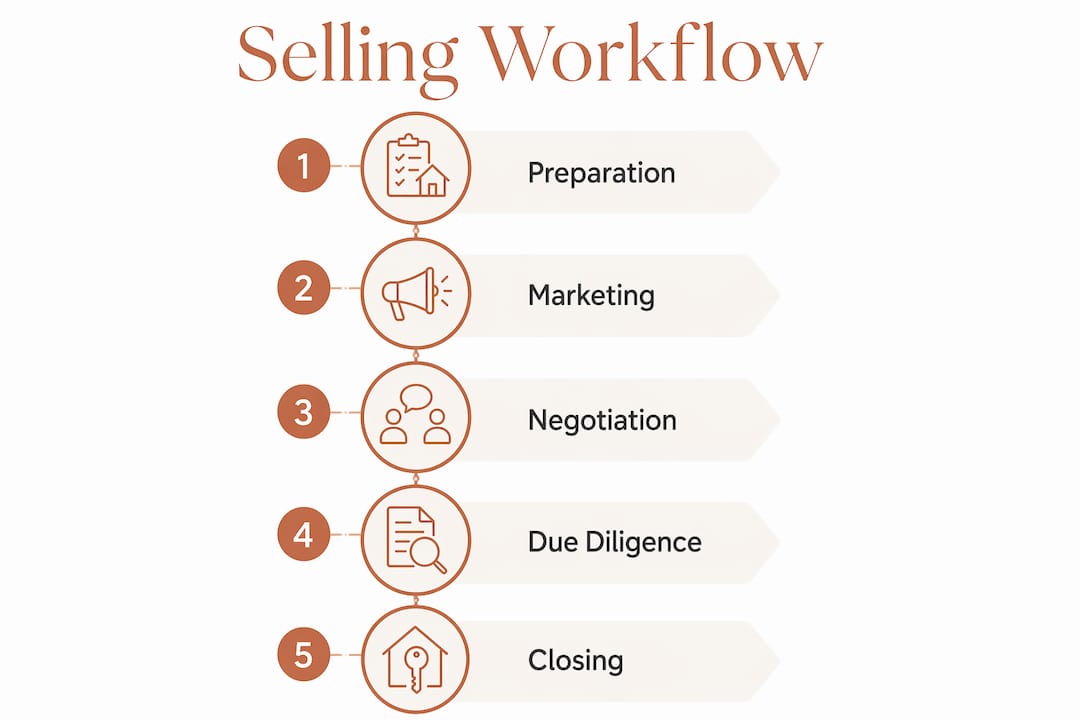
A structured workflow for selling commercial properties is defined as a sequence of distinct phases, from pre-marketing preparation through legal completion, that sellers must execute in order to close deals efficiently and at maximum value. The full commercial property sales process averages 6 to 12 months, broken into pre-marketing (2–4 weeks), active marketing (4–12 weeks), offer negotiation (2–6 weeks), due diligence and legal (8–16 weeks), and exchange through completion (1–2 weeks). Singapore’s commercial market in 2026 rewards sellers who treat each phase as a professional project, not a series of reactive decisions. Skipping steps or compressing timelines is the single most common reason deals collapse before closing.
What are the essential preparations before listing a commercial property?
Preparation is the phase most sellers underestimate, and it is where deals are won or lost before a single buyer walks through the door. Effective sellers begin strategic planning 12–18 months before their target listing date. That lead time gives you room to fix problems on your terms, not the buyer’s.

Internal due diligence: what to audit first
The first task is a sell-side audit. Proactive sell-side due diligence conducted 6–12 months before listing, covering rent rolls, lease documents, and maintenance records, reduces the risk of last-minute buyer renegotiations. Buyers will request all of this during their own due diligence. If your records are clean and organized, you control the narrative. If they are not, buyers use every gap as leverage to push the price down.
The core documents every seller needs to organize before listing:
- Ownership proof: Title deeds, strata certificates, or land registry documents
- Lease documentation: Signed leases, renewal options, rent schedules, and any side letters
- Rent roll: Current tenant list, monthly income, lease expiry dates, and occupancy rates
- Compliance certificates: Fire safety, building permits, and any outstanding regulatory notices
- Maintenance records: Recent repair history, outstanding works, and service contracts
- Corporate resolutions: If the property is held in an LLC or company structure, board resolutions authorizing the sale
Organizing these documents into a virtual data room before marketing begins is standard practice for institutional-grade assets. For smaller commercial properties in Singapore, a well-structured shared folder with clear naming conventions achieves the same result.
Pro Tip: Fix visible maintenance issues before listing, even minor ones. Buyers use deferred maintenance as a negotiating anchor. A $5,000 repair that costs you nothing in time can prevent a $50,000 price reduction.
| Preparation task | Recommended timing before listing |
|---|---|
| Internal audit of leases and rent roll | 12–18 months prior |
| Address outstanding maintenance | 6–12 months prior |
| Organize compliance certificates | 6 months prior |
| Set up virtual data room | 4–8 weeks prior |
| Engage legal counsel | 4–6 weeks prior |
How to market and list your commercial property effectively?
Marketing a commercial property is not the same as marketing a residential one. The buyer pool is smaller, more sophisticated, and motivated by financial returns rather than lifestyle. Your marketing must speak directly to that mindset.
Broker versus FSBO: which approach fits your asset?
Engaging a professional broker is advisable for complex or multi-tenant commercial assets because brokers bring wider qualified buyer pools and manage institutional due diligence complexity. For a single-tenanted shophouse or a small strata office unit, a capable owner can manage the sale independently. For a multi-tenanted retail block or a commercial building with mixed uses, a broker’s network and negotiation experience justify the commission.
The core marketing steps for commercial property in Singapore:
- Commission a professional Offering Memorandum (OM). The OM is your primary sales document. It covers the asset description, tenancy schedule, financial summary, location analysis, and investment thesis. A weak OM signals an unprepared seller.
- Produce high-quality visual assets. Professional photography, floor plans, and a virtual tour are non-negotiable for commercial listings above SGD 2 million.
- List on commercial property platforms. Singapore’s commercial market uses platforms like CommercialGuru and PropertyGuru Commercial, as well as ERA Realtors’ internal network.
- Target off-market buyers. Brokers and experienced sellers maintain lists of investors who have expressed interest in specific asset types. Off-market approaches often produce faster, cleaner offers.
- Qualify buyers before sharing sensitive data. Require signed non-disclosure agreements and proof of funds before releasing the full OM or financial details.
Targeting the right buyer with financial capability and genuine asset understanding matters more than reaching the largest possible audience. A broad, unqualified buyer pool wastes time and exposes sensitive financial information unnecessarily.
Pro Tip: Ask every prospective buyer two questions upfront: what is their financing structure, and have they purchased a similar asset before? The answers tell you more about deal viability than any offer letter.
Understanding Singapore’s 2026 commercial market trends helps you time your listing and set realistic price expectations before you go public.
What happens during offer negotiation and contract formation?
Negotiation in commercial real estate is a structured process, not a bidding war. The goal is to reach a signed Heads of Terms document before instructing lawyers to draft the formal sale and purchase agreement.
The role of the Heads of Terms
The Heads of Terms document outlines the agreed price, deposit amount, conditions, and timeline before legal drafting begins. It is non-binding in most jurisdictions, but it sets the framework that lawyers work from. Sellers who skip this step often find that legal negotiations reopen price and condition discussions that both parties thought were settled.
Key points to negotiate and confirm in the Heads of Terms:
- Purchase price and deposit: Typically 1%–5% of the purchase price as a good faith deposit in Singapore commercial transactions
- Completion timeline: Agree on a realistic date that accounts for the buyer’s financing approval period
- Contingencies: Financing contingency, due diligence period, and any conditions tied to tenant leases
- Vacant possession versus tenanted sale: Clarify whether the buyer is acquiring the property with existing tenants or expects vacant possession at completion
- Seller representations: Confirm what warranties the seller will provide regarding the property’s condition and lease status
Evaluating an offer means looking beyond the headline price. A lower offer from a cash buyer with no financing contingency is often worth more than a higher offer from a buyer dependent on complex commercial loan approval.
When reviewing offers, assess buyer credibility by requesting proof of funds or a bank letter of commitment. A buyer who cannot produce either within 48 hours of making an offer is a risk. Understanding how buyers approach commercial property purchases helps sellers anticipate objections and structure counteroffers more effectively.
What is involved in due diligence and closing stages?
Due diligence is the phase where most deals either solidify or fall apart. Sellers who are prepared move through it quickly. Sellers who are not spend weeks scrambling to answer buyer queries.
Commercial sale contracts typically allow 30–45 days for buyer due diligence and financing contingencies. That window covers the buyer’s review of all property documents, physical inspections, environmental assessments, and financing approval. Sellers should treat this period as an active phase, not a waiting period.
Why financing is the real closing risk
Delays in commercial property closings rarely stem from legal processes. Seventy percent of transaction delays originate after the third week of due diligence, when buyer financing timelines slip. Commercial loans, portfolio loans, and construction financing take longer to approve than residential mortgages. Sellers who do not account for this in their timeline end up frustrated and exposed to deal collapse.
Pro Tip: Build a two-week buffer into your expected completion date. If your buyer is using commercial financing, ask for a bank approval letter before the due diligence period ends. This one step eliminates most late-stage surprises.
| Due diligence stage | Typical duration | Seller action required |
|---|---|---|
| Document review by buyer | Week 1–2 | Respond to queries within 24–48 hours |
| Physical and structural inspection | Week 2–3 | Provide access and maintenance records |
| Environmental and compliance checks | Week 2–4 | Supply certificates and permit history |
| Financing approval | Week 3–6 | Monitor progress and maintain communication |
| Contract exchange | Post-due diligence | Instruct lawyers to finalize contract pack |
The closing sequence in Singapore follows a standard path: contract pack preparation by the seller’s lawyer, exchange of contracts with deposit payment, and then completion on the agreed date with full payment and title transfer. Sellers should have their legal team ready to move quickly once due diligence is cleared. Delays on the seller’s side at this stage are uncommon but damaging to buyer confidence.
Reviewing a Singapore commercial real estate market guide before entering the closing phase helps sellers benchmark their transaction terms against current market norms.
Key takeaways
A successful commercial property sale requires preparation starting 12–18 months before listing, targeted buyer marketing, a clear Heads of Terms, and active management of the due diligence period to prevent financing delays from collapsing the deal.
| Point | Details |
|---|---|
| Start preparation early | Begin audits and document organization 12–18 months before your target listing date. |
| Qualify buyers before sharing data | Require proof of funds and a signed NDA before releasing financial details. |
| Use Heads of Terms | Agree on price, deposit, and conditions in writing before instructing lawyers. |
| Monitor financing closely | Seventy percent of delays occur after week three due to buyer financing bottlenecks. |
| Respond fast during due diligence | Answer buyer queries within 24–48 hours to maintain deal momentum and buyer confidence. |
What I’ve learned about selling commercial property that most guides won’t tell you
Most sellers focus on the listing. The real work happens six months before the listing goes live.
I have seen deals collapse at the contract stage because a seller could not produce a clean rent roll. The buyer’s lawyer found inconsistencies between the signed leases and the income schedule the seller had been quoting. The buyer walked. That deal had been in negotiation for three months. A two-week internal audit at the start would have caught the problem and fixed it before it became a deal-breaker.
The other mistake I see constantly is chasing the largest buyer pool instead of the right buyer. Overreliance on AI pricing tools leads to unrealistic valuations, and broad marketing campaigns attract unqualified inquiries that consume time without producing offers. The sellers who close fastest are the ones who identify three to five financially capable buyers with a track record in the asset class and go to them directly.
Singapore’s commercial market in 2026 is active, but it rewards preparation and precision. Buyers are sophisticated. They will find every gap in your documentation, and they will price it into their offer. The best defense is a clean, well-organized asset with a realistic price and a seller who responds quickly. That combination closes deals.
— Aman
Professional commercial property selling support in Singapore
Selling a commercial property in Singapore involves regulatory requirements, buyer qualification, and legal coordination that benefit from experienced guidance.
Aesthetic Havens, operated under ERA Realtors, provides sellers with end-to-end advisory covering property valuation, marketing strategy, buyer targeting, and transaction management. Whether you are selling a strata office, a shophouse, or a multi-tenanted commercial building, the team brings direct market knowledge and a qualified buyer network to your sale. Sellers who work with an experienced real estate consultant in Singapore close faster and with fewer late-stage surprises. Reach out for a personalized selling strategy consultation tailored to your asset and timeline.
FAQ
How long does the commercial property sales process take?
The full commercial property sales process averages 6 to 12 months, covering preparation, marketing, negotiation, due diligence, and legal completion. Complex multi-tenanted assets typically sit at the longer end of that range.
When should I start preparing to sell my commercial property?
Sellers should begin internal audits and document organization 12–18 months before listing to avoid last-minute concessions and reduce buyer-driven renegotiations.
What is a Heads of Terms document in a commercial sale?
A Heads of Terms is a non-binding document that records the agreed price, deposit, conditions, and timeline before lawyers draft the formal sale and purchase agreement. It prevents disputes by aligning both parties early.
Why do most commercial property closings get delayed?
Seventy percent of closing delays occur after the third week of due diligence because commercial loan approvals take longer than residential mortgages. Sellers can reduce this risk by requiring a bank approval letter before the due diligence period ends.
Do I need a broker to sell commercial property in Singapore?
A broker is advisable for complex or multi-tenanted assets because they bring a wider qualified buyer pool and manage institutional due diligence. Simpler assets, such as single-tenanted strata units, can be sold independently with proper preparation.


