


The Total Debt Servicing Ratio (TDSR) is a regulatory cap that limits total monthly debt payments to 55% of a borrower’s gross monthly income for any Singapore property loan. Introduced by the Monetary Authority of Singapore (MAS) in 2013, TDSR applies to all residential property loans from banks like DBS, OCBC, and UOB. Understanding what is TDSR in real estate is not optional for buyers or investors. It directly controls how much you can borrow, and getting the math wrong before you commit to a purchase can cost you the deal. This guide covers the formula, the rules, the interplay with the Mortgage Servicing Ratio (MSR), and the strategies that actually move the needle.
What is TDSR in real estate and how is it calculated?
TDSR is expressed as a percentage of your gross monthly income that goes toward all debt repayments combined. The formula is straightforward: divide your total monthly debt obligations by your gross monthly income, then multiply by 100. The result must not exceed 55%.
Monthly debt obligations counted in the TDSR calculation include:
- Mortgage repayments on all properties you own or are buying
- Car loan installments
- Personal loan repayments
- Education loan repayments
- Credit card minimum monthly payments
- Any other outstanding loan commitments
Here is a concrete example. Say your gross monthly income is S$8,000. Your TDSR ceiling is S$4,400 per month (55% of S$8,000). If you already pay S$800 on a car loan and S$200 in credit card minimums, only S$3,400 remains for a home loan repayment. That remaining headroom, not the bank’s maximum loan offer, is what sets your real borrowing limit.
Variable income, such as commissions or bonuses, is counted at 70% of its assessed value. Banks apply a haircut to variable pay because it is not guaranteed month to month. If your base salary is S$5,000 and your average monthly commission is S$2,000, the bank counts S$5,000 plus S$1,400 (70% of S$2,000), giving you a gross monthly income of S$6,400 for TDSR purposes.

Pro Tip: Run your TDSR calculation before you start property hunting, not after you fall in love with a unit. Knowing your ceiling early prevents expensive surprises at the loan application stage.
Why did MAS introduce TDSR, and why does it matter?
TDSR was introduced in 2013 by MAS to prevent households from taking on more debt than they could realistically service. Before TDSR, banks could approve loans based primarily on property value and Loan-to-Value (LTV) ratios, with less weight on a borrower’s total debt load. The result was rising household leverage tied to a hot property market.
MAS tightened the cap from 60% to 55% in december 2021 as household debt levels climbed alongside surging property prices. That 5-percentage-point reduction sounds small, but for a borrower earning S$10,000 per month, it cuts the maximum allowable debt repayment from S$6,000 to S$5,500 per month. That difference can translate to tens of thousands of dollars in reduced loan eligibility.
The broader purpose is financial stability. As DBS notes, TDSR ensures borrowers can comfortably manage repayments over the long term, not just at the point of approval. A borrower stretched to 59% TDSR before 2021 was technically approved but financially fragile. The tighter cap creates a buffer against income shocks, interest rate rises, and unexpected expenses.
“TDSR is not just about loan approval numbers. It ensures borrowers do not overstretch financially and that banks maintain prudent lending standards.” — DBS
The Singapore property cooling measures introduced alongside TDSR changes reflect MAS’s consistent goal: a stable housing market where prices reflect genuine demand, not leveraged speculation.
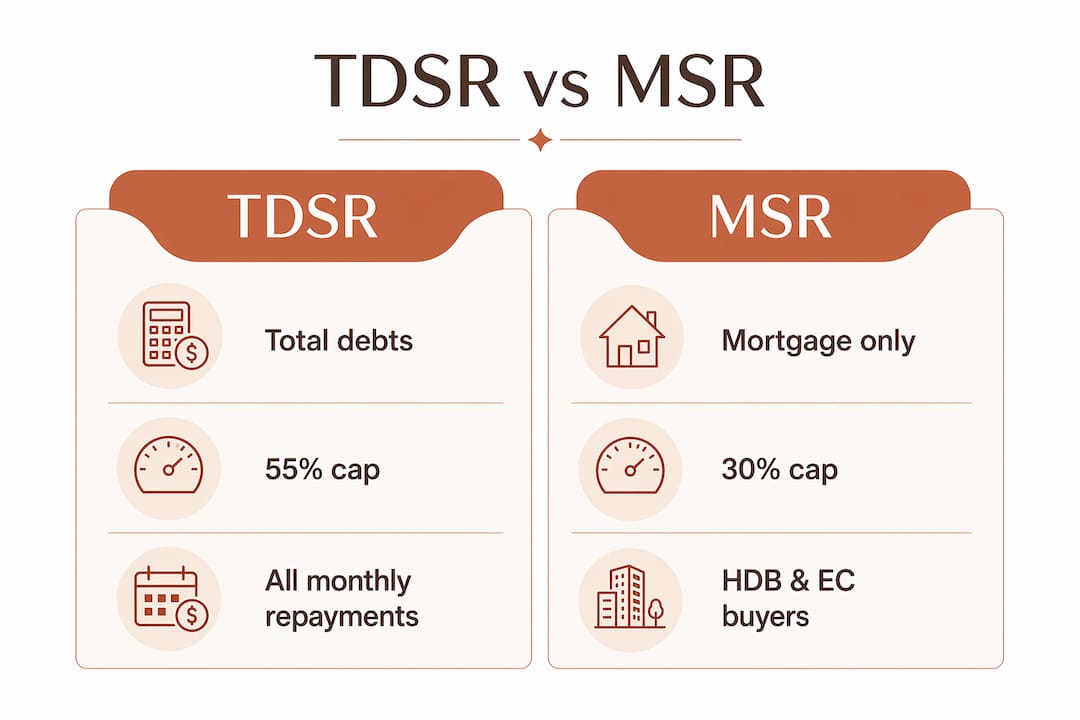
How does TDSR differ from the Mortgage Servicing Ratio (MSR)?
TDSR and MSR are separate rules that can both apply to the same loan. Understanding which one binds you first is critical for HDB flat and Executive Condominium (EC) buyers.
| Feature | TDSR | MSR |
|---|---|---|
| What it caps | All monthly debt repayments | Mortgage repayment only |
| Cap percentage | 55% of gross monthly income | 30% of gross monthly income |
| Applies to | All residential property loans | HDB flats and ECs only |
| Debts counted | Mortgage + car + personal + credit card | Home loan repayment only |
| Can bind independently | Yes | Yes |
Buyers of HDB flats and Executive Condominiums must satisfy both ratios simultaneously. MSR limits the mortgage repayment itself to 30% of gross monthly income. TDSR then caps all debts combined at 55%. Whichever ratio produces the lower loan amount is the one that controls your borrowing.
Here is where it gets practical. A buyer earning S$8,000 per month faces an MSR ceiling of S$2,400 for the home loan repayment alone. Under TDSR, if they have no other debts, they could theoretically service up to S$4,400 in total debt. MSR binds first in this case, limiting the mortgage to S$2,400 per month regardless of the TDSR headroom. Add a S$700 car loan to the picture, and TDSR now allows only S$3,700 for the mortgage, while MSR still caps it at S$2,400. MSR still binds.
Flip the scenario to a private condominium purchase. MSR does not apply. Only TDSR governs. That same buyer with the S$700 car loan can now direct up to S$3,700 per month to the mortgage, a significantly larger loan than the HDB scenario allows.
Pro Tip: If you are buying an EC, check your EC eligibility requirements alongside your TDSR and MSR numbers. Both ratios apply, and the MSR limit often bites harder than buyers expect.
How does TDSR affect your maximum loan amount?
TDSR can reduce your maximum loan amount even when the LTV ratio technically permits more borrowing. Banks calculate both limits and approve only the lower figure. TDSR is often more constraining than LTV for buyers who carry existing debts.
The practical effects on borrowing capacity include:
- Existing debts shrink your headroom. Every S$500 per month in car or personal loan repayments reduces the amount available for a home loan by the same S$500. Over a 25-year mortgage at current rates, that S$500 reduction translates to roughly S$100,000 less in loan eligibility.
- Joint applications pool income and debts. Applying with a spouse or co-borrower adds their income to the TDSR calculation but also adds their debts. A co-borrower with a large personal loan can reduce the combined TDSR headroom significantly.
- Income timing matters. A recent job change, a pay cut, or a new loan taken out just before application can drastically affect approval. Banks assess income and debts at the point of application, not at their historical best.
- Stress-tested rates apply. Banks do not calculate TDSR at the current interest rate alone. They apply a medium-term stress rate to test whether you can still service the loan if rates rise.
The most effective way to increase your loan eligibility is to reduce non-mortgage debts before applying. Reducing non-mortgage monthly debts increases usable TDSR headroom more effectively than negotiating a lower interest rate or a higher LTV. Clearing a S$600 per month car loan before your mortgage application can add meaningful loan capacity that no rate negotiation can match.
Pro Tip: Review your Singapore mortgage affordability picture at least six months before applying. That window gives you time to pay down debts and let your TDSR headroom recover before the bank runs its assessment.
Practical tips for homebuyers and investors managing TDSR
Getting TDSR right requires preparation, not reaction. The buyers who run into problems are almost always those who treat financing as the last step rather than the first.
- Model your cash flow before you sign anything. Map every monthly debt commitment you currently carry. Include credit card minimums, which many buyers forget. Then calculate your TDSR ceiling and subtract existing debts to find your real home loan capacity.
- Pay down revolving debt first. Credit card balances generate minimum monthly payments that eat into TDSR headroom. Clearing a S$20,000 credit card balance can eliminate S$400 or more in monthly obligations, freeing up equivalent TDSR capacity.
- Understand the public versus private property difference. HDB and EC buyers face both MSR and TDSR. Private property buyers face TDSR only. This distinction changes your financing strategy entirely, especially if you are upgrading from an HDB flat to a private condominium.
- Stay current on MAS policy changes. The cap moved from 60% to 55% in december 2021. MAS can adjust it again. Investors building multi-property portfolios should factor in the possibility of further tightening when stress-testing their numbers.
- Use professional financial modeling. A qualified real estate advisor can run TDSR scenarios across different loan tenures, income combinations, and debt paydown strategies. Generic online calculators give you a number. A professional gives you a plan.
Pro Tip: For investors buying a second or third property, the condo downpayment requirements interact directly with TDSR. Higher downpayments reduce loan size, which lowers monthly repayments and improves your TDSR position.
Key Takeaways
TDSR is the single most binding constraint on Singapore property loan eligibility for buyers who carry existing debts, and clearing those debts before applying is the most effective way to increase borrowing capacity.
| Point | Details |
|---|---|
| TDSR definition | Total monthly debts must not exceed 55% of gross monthly income for loan approval. |
| What counts as debt | Mortgage, car loans, personal loans, education loans, and credit card minimums all factor in. |
| MSR vs. TDSR | MSR caps HDB/EC mortgage repayments at 30%; TDSR caps all debts at 55%. Both can bind. |
| Best way to increase loan capacity | Pay down non-mortgage debts before applying; this frees more TDSR headroom than rate negotiation. |
| Timing is critical | Income changes or new debts taken just before application can reduce your approved loan amount significantly. |
What I have learned from watching buyers misread TDSR
Most buyers I work with understand TDSR in theory. They know the 55% cap. What they consistently underestimate is how fast existing debts eat into that ceiling. I have seen buyers with strong incomes lose S$150,000 or more in loan eligibility because they kept a car loan they could have cleared six months earlier. The math is not complicated. The discipline to act on it early is where most people fall short.
The other misconception I encounter regularly is treating TDSR and MSR as the same rule. They are not. HDB and EC buyers who plan their finances around TDSR alone often get a shock when MSR bites first and cuts their mortgage ceiling to a number well below what TDSR would have allowed. I always walk clients through both calculations side by side before they commit to a property type.
The deeper issue is that TDSR is not just a bank rule. It is a signal about your financial health. If your TDSR is already at 45% before a home loan, you are not in a comfortable position regardless of whether the bank approves you. The 55% cap is a ceiling, not a target. Borrowing to the limit leaves no room for life to happen. The buyers I see thrive long-term are the ones who target 40–45% TDSR after the mortgage, not 54%.
— Aman
How Aesthetic Havens helps you navigate TDSR and secure the right loan
Understanding TDSR is one thing. Applying it correctly to your specific income, debts, and property goals is another.
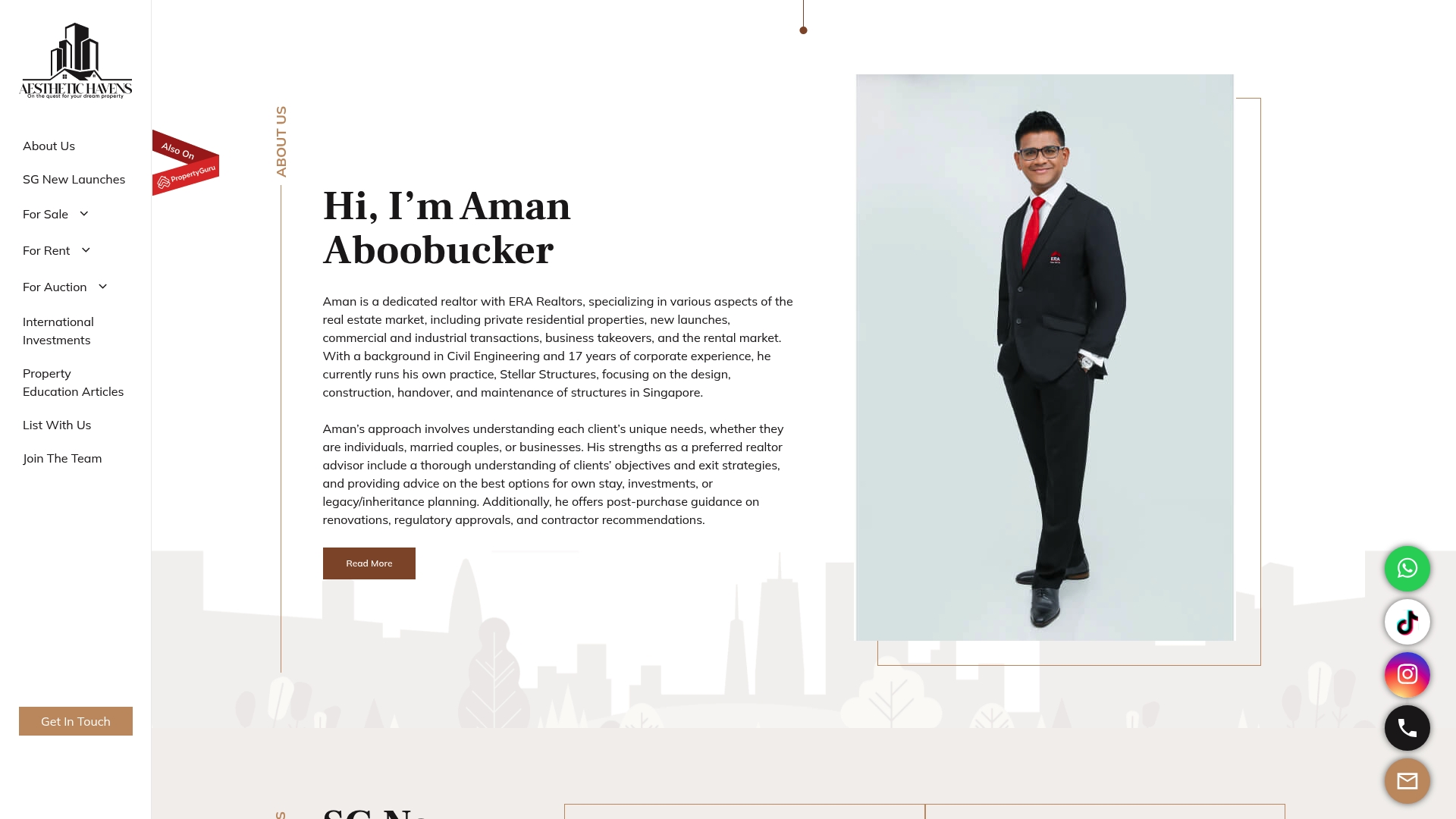
At Aesthetic Havens, Aman works directly with homebuyers and investors to model TDSR scenarios before they commit to a purchase. That means running real numbers on your current debt profile, identifying which debts to clear first, and matching your borrowing capacity to the right property type. Whether you are buying your first HDB flat, upgrading to a private condominium, or building an investment portfolio, getting the financing structure right from the start protects both your approval and your long-term financial position. Reach out for a personalized consultation before you sign.
FAQ
What is the current TDSR limit in Singapore?
The TDSR cap is 55% of gross monthly income. MAS tightened it from 60% to 55% in december 2021 to reduce household debt levels.
Does TDSR apply to HDB loans from HDB directly?
TDSR applies to bank loans for property purchases. HDB concessionary loans have their own assessment criteria, but buyers should verify current HDB rules directly as policies can change.
What is the difference between TDSR and MSR?
TDSR caps all monthly debt repayments at 55% of gross monthly income. MSR caps only the mortgage repayment at 30% of gross monthly income and applies only to HDB flats and Executive Condominiums.
Can I improve my TDSR before applying for a home loan?
Yes. Paying down car loans, personal loans, and credit card balances reduces your monthly debt obligations and increases the TDSR headroom available for a home loan repayment.
Does variable income count toward TDSR calculations?
Variable income such as commissions and bonuses counts at 70% of its assessed value. Banks apply this haircut because variable pay is not guaranteed each month.
Recommended
- Foreigner’s Guide to Buying Property in Singapore (2025 Regulations & Taxes) | Aesthetic Havens
- CCR vs OCR in 2026: Where is the Better Value for Money? | Aesthetic Havens
- New Launch vs Resale 2026: Singapore Property Market Guide | Aesthetic Havens
- What is real estate advisory? A guide for Singapore investors


