


A property investment checklist in Singapore is a structured framework that covers financial readiness, regulatory compliance, instrument selection, and ongoing portfolio management before you commit capital. Singapore’s investment environment is shaped by the Monetary Authority of Singapore (MAS), the Central Provident Fund (CPF), and a property market governed by strict cooling measures and foreign ownership rules. Skipping any step in this investment checklist for Singapore investors costs money and time. The sections below move from financial foundations through regulatory requirements to property-specific decisions, giving you a complete guide for 2026.
1. What financial foundations must precede investing in Singapore?
Financial preparation is the first item on every investment guide for Singapore investors. Without it, a market downturn can force you to sell assets at a loss just to cover living costs.
Build your emergency fund first. An emergency fund covering 3–6 months of core living expenses belongs in a high-yield savings account or fixed deposit, not a brokerage account. Keeping it separate prevents forced liquidation when markets fall and you need cash urgently.
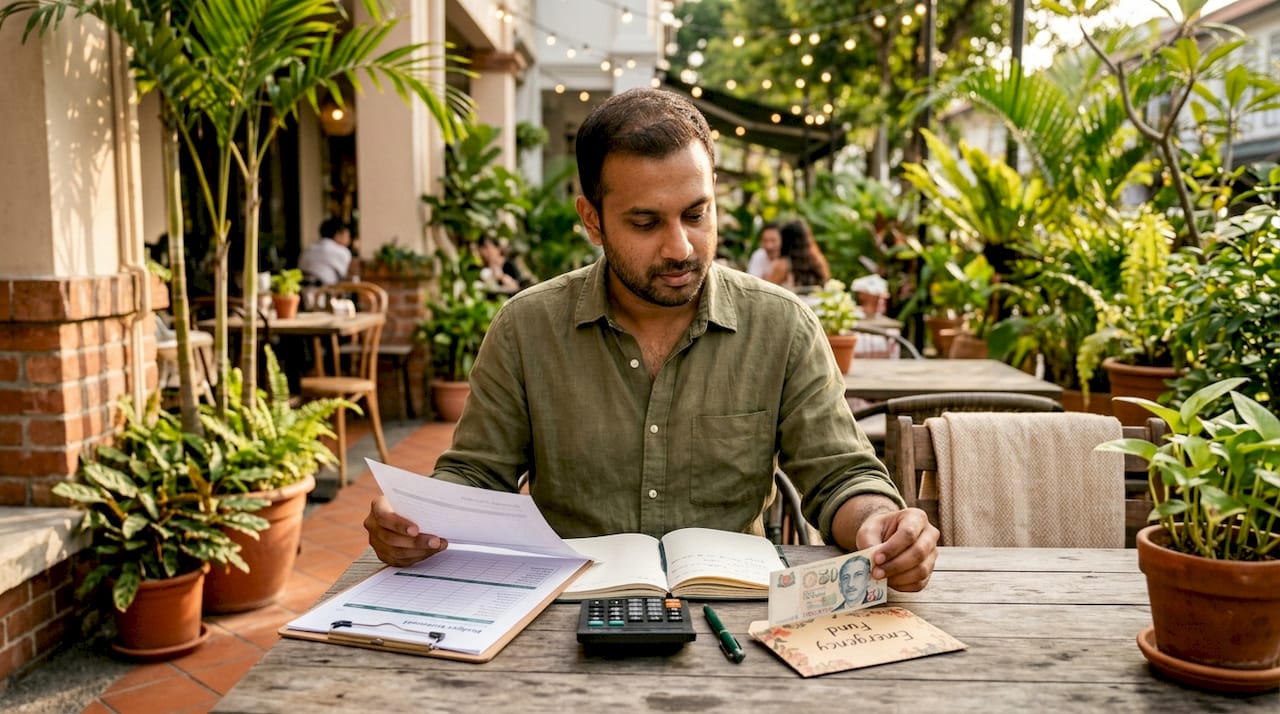
Clear high-interest debt before investing. Credit card debt in Singapore typically carries interest rates above 25% per year. No investment instrument reliably beats that rate, so paying off the balance first is the highest-return move available to most investors.
Set a defined investment budget. Decide what percentage of monthly income goes toward investing and treat it as a fixed expense. This creates consistency and prevents emotional overspending during bull markets.
- Establish 3–6 months of expenses in a high-yield savings account or fixed deposit
- Pay off credit card and other high-interest debt before opening a brokerage account
- Define a monthly investment budget as a fixed line item
- Set specific financial goals: retirement, property down payment, or passive income target
Pro Tip: Never park your emergency fund inside a brokerage account. Even cash held in a brokerage can be swept into positions or become inaccessible during platform outages, leaving you without liquidity when you need it most.
2. How do Singapore’s regulatory frameworks affect investment choices?
Singapore’s regulatory structure directly determines which accounts you can open, how much CPF money you can invest, and how quickly you can get started. Ignoring these rules leads to compliance failures and missed opportunities.
CPFIS reserve requirements are non-negotiable. Under the CPF Investment Scheme, you must retain S$20,000 in your Ordinary Account and S$40,000 in your Special Account before investing any CPF funds. Only the amount above these thresholds is eligible for investment. You must also complete a Self-Awareness Questionnaire (SAQ) before making any CPF investment, confirming you understand the risks involved.
Account type determines asset ownership. CDP-linked accounts give you direct ownership of SGX-listed shares, recorded in your name at the Central Depository. Custodian accounts, offered by most online brokers, hold assets on the broker’s behalf. CDP accounts cost more per trade but give you clearer legal ownership. Custodian accounts are cheaper and more flexible for international instruments.
SingPass cuts account opening time dramatically. SingPass reduces brokerage account opening from roughly 30 minutes to under 5 minutes at MAS-regulated brokers. That speed matters less than the compliance it signals. MAS-regulated platforms carry investor protections that unregulated offshore brokers do not.
Foreign investors face additional requirements. Foreign investors must check cross-border tax and reporting obligations from both Singapore and their home country before investing. Using MAS-regulated entities is the safest path to compliance. For property specifically, foreign ownership rules restrict purchases of landed residential property and impose the Additional Buyer’s Stamp Duty (ABSD). The foreigner’s guide to buying property covers the current ABSD rates and legal procedures in detail.
- Confirm CPFIS OA balance exceeds S$20,000 and SA balance exceeds S$40,000 before investing CPF funds
- Complete the SAQ before any CPF investment transaction
- Choose between CDP-linked and custodian accounts based on your cost and ownership priorities
- Use SingPass for fast identity verification at MAS-regulated brokers
- Verify cross-border tax obligations if you hold foreign citizenship or residency
3. Which investment instruments best suit beginners and property investors?
The right instrument depends on your risk tolerance, time horizon, and whether you want direct property exposure or financial market exposure. Singapore offers a wide range of options across both categories.
| Instrument | Risk Level | Minimum Entry | Best For |
|---|---|---|---|
| Index funds and ETFs | Low to medium | S$100 via RSP | Long-term diversified growth |
| REITs | Medium | S$200–S$500 | Real estate exposure with liquidity |
| Singapore Savings Bonds | Very low | S$500 | Capital preservation, risk-averse investors |
| Treasury Bills | Very low | S$1,000 | Short-term, stable returns |
| Robo-advisors | Low to medium | S$1 | Automated, hands-off portfolio management |
Index funds and ETFs are the top starting point. Index funds and ETFs offer diversified, low-cost investment suited for cautious beginners. They spread risk across dozens or hundreds of companies, reducing the impact of any single stock’s failure. The STI ETF, which tracks the Straits Times Index, gives you exposure to Singapore’s 30 largest listed companies in one trade.
REITs give you real estate returns without direct ownership. Singapore-listed REITs like CapitaLand Integrated Commercial Trust and Mapletree Logistics Trust pay regular distributions and trade on the SGX. They provide real estate income without the capital outlay, illiquidity, or management burden of direct property ownership. For investors building toward property, REITs serve as a productive holding position.
Government bonds anchor the conservative end of your portfolio. Treasury Bills and Singapore Savings Bonds carry AAA credit ratings and provide stable, low-risk returns. They suit investors who need capital preservation alongside growth-oriented holdings.
Dollar-Cost Averaging removes the timing problem. Investing S$100 monthly through a Regular Savings Plan is a proven beginner strategy that removes the pressure of picking the right entry point. You buy more units when prices are low and fewer when prices are high, averaging your cost over time.
Pro Tip: Robo-advisors like StashAway and Syfe automatically rebalance your portfolio and reinvest dividends. For investors who want consistent contributions without active management, they are the most practical starting point in Singapore.
4. What key property investment checklist items should Singapore investors consider?
Property investment in Singapore requires a more detailed checklist than financial market investing. The capital involved is larger, the regulatory environment is stricter, and the due diligence process is longer.
Financial and financing checklist:
- Calculate your Total Debt Servicing Ratio (TDSR). The TDSR cap is 55% of gross monthly income, covering all debt obligations including the new mortgage.
- Confirm your Loan-to-Value (LTV) ratio eligibility. First property buyers can borrow up to 75% of the property value from a bank.
- Budget for stamp duties. Buyer’s Stamp Duty (BSD) applies to all purchases. ABSD applies to second and subsequent properties for Singapore citizens, and to all purchases for permanent residents and foreigners.
- Assess mortgage affordability at a stressed interest rate, not just the current rate.
- Confirm CPF usage eligibility for the property type and remaining lease.
Property evaluation checklist:
- Check the property’s tenure: freehold versus 99-year leasehold affects long-term value and CPF usage rules.
- Research rental demand in the target neighborhood using URA rental transaction data.
- Compare new launch versus resale options. The new launch vs. resale comparison for 2026 shows distinct risk and return profiles for each.
- Assess proximity to MRT stations, schools, and commercial hubs, which are the primary drivers of rental yield in Singapore.
- Review the property’s valuation and market pricing against recent comparable transactions.
Legal and procedural checklist:
- Engage a conveyancing lawyer before signing the Option to Purchase (OTP).
- Verify foreign ownership eligibility if applicable.
- Confirm the property is not subject to any encumbrances or outstanding charges.
- Check the development’s track record if buying a new launch from a developer.
Understanding why Singapore property remains a strong long-term asset helps contextualize these checklist items within a broader wealth-building strategy.
5. How to maintain and optimize your investment portfolio over time in Singapore?
Building a portfolio is the starting point. Maintaining it through market cycles, regulatory changes, and personal life events is where most investors lose discipline.
Review and rebalance at least once a year. A portfolio that started at 60% equities and 40% bonds can drift to 75% equities after a strong bull run, exposing you to more risk than you intended. Annual rebalancing restores your target allocation by trimming outperformers and adding to underperformers.
Automate contributions to remove behavioral risk. Setting up a Regular Savings Plan or a standing instruction to a robo-advisor removes the temptation to pause contributions during market downturns. Consistent investing through volatility is the single most effective long-term strategy available to retail investors.
Monitor regulatory and market changes in Singapore. MAS updates its guidelines periodically. CPF contribution rates, ABSD rates, and property cooling measures have all changed multiple times in the past decade. Staying current with Singapore commercial property trends and broader market signals helps you adjust allocations before changes affect returns.
Know when to seek professional advice. Portfolio complexity increases with net worth. When your holdings span multiple asset classes, property, and international instruments, a licensed financial advisor or real estate advisory professional adds measurable value. The cost of advice is almost always lower than the cost of an uninformed decision at scale.
- Rebalance annually to maintain your target asset allocation
- Automate monthly contributions via RSP or robo-advisor
- Track MAS regulatory updates and CPF policy changes
- Consult a licensed advisor when portfolio complexity increases
- Review property holdings against current rental yield and capital appreciation data
Key Takeaways
A complete Singapore investment checklist covers financial foundations, regulatory compliance, instrument selection, property due diligence, and active portfolio management in that exact order.
| Point | Details |
|---|---|
| Emergency fund first | Keep 3–6 months of expenses in a high-yield account before investing any capital. |
| CPFIS reserve rules | Retain S$20,000 in OA and S$40,000 in SA before investing CPF funds. |
| Account type matters | CDP accounts give direct ownership; custodian accounts offer lower costs and broader access. |
| Property checklist depth | Assess TDSR, LTV, tenure, stamp duties, and rental demand before committing to any property. |
| Automate and review | Set up automated contributions and rebalance your portfolio at least once a year. |
What I’ve learned from building portfolios in Singapore’s market
Most investors I work with arrive with the same blind spot: they focus entirely on picking the right asset and skip the foundational steps. They want to know which property to buy or which ETF to hold before they have confirmed their emergency fund, cleared their credit card debt, or understood their TDSR. The checklist approach exists precisely to prevent that sequence error.
The CPFIS rules catch people off guard more than any other regulatory item. Investors assume their CPF balance is fully available for investment. Finding out that S$20,000 in the Ordinary Account and S$40,000 in the Special Account must stay untouched changes the math on their plan significantly. Knowing this before you build your strategy saves weeks of recalculation.
On the property side, the investors who do best are the ones who treat the purchase as a business decision, not an emotional one. They run the TDSR numbers, check the URA rental data, and get a proper valuation before they fall in love with a unit. The ones who reverse that process almost always overpay or buy in the wrong location.
My consistent recommendation is to start with the simplest instruments, index funds or Singapore Savings Bonds, build the habit of regular investing, and add complexity only when you have the knowledge and capital to manage it. Singapore’s regulatory framework rewards disciplined, compliant investors. The checklist is not bureaucracy. It is the structure that protects your capital.
— Aman
Property investment support from Aesthetic Havens
Investors who work through a property investment checklist for Singapore often reach a point where the data points to a clear opportunity but the execution requires local expertise.
Aesthetic Havens, operated by Aman Aboobucker under ERA Realtors, provides property selection guidance, market analysis, and transaction support for residential, commercial, and investment properties across Singapore. Whether you are buying your first investment property or expanding an existing portfolio, the team at Aesthetic Havens connects you with the right opportunities and walks you through every regulatory and financial step. For investors focused on returns, the property selection guide for maximum returns is a practical next resource.
FAQ
What is the minimum amount needed to start investing in Singapore?
S$100 per month through a Regular Savings Plan is sufficient to begin investing in Singapore. A starting lump sum of S$1,000 is enough to open positions in index funds, ETFs, or Singapore Savings Bonds.
How much CPF can I invest under the CPF Investment Scheme?
You can invest CPF funds above S$20,000 in your Ordinary Account and above S$40,000 in your Special Account. You must also complete the mandatory Self-Awareness Questionnaire before making any CPFIS investment.
What is the TDSR limit for property loans in Singapore?
The Total Debt Servicing Ratio cap is 55% of gross monthly income, covering all debt obligations including the new mortgage. Exceeding this limit disqualifies you from bank financing for the property.
Do foreign investors face restrictions on Singapore property purchases?
Foreign investors cannot buy landed residential property without government approval and pay a higher Additional Buyer’s Stamp Duty rate on all residential purchases. Foreign investors must also check cross-border tax obligations from their home country and use MAS-regulated platforms for compliance.
What is the difference between a CDP account and a custodian account?
A CDP account gives direct ownership of SGX-listed shares recorded in your name at the Central Depository. A custodian account holds assets on the broker’s behalf, offering lower trading costs but less direct legal ownership.


