


The Management Corporation Strata Title (MCST) is the mandatory legal body responsible for managing and maintaining the common property of strata-titled developments in Singapore. Every condo, mixed-use development, or commercial building registered under a strata title plan automatically has an MCST. If you own a unit in any of these developments, you are already a member. Understanding what is MCST Singapore means understanding who controls your building’s shared spaces, how your monthly fees are spent, and what rights you hold as a co-owner. The BMSMA 2004 (Building Maintenance and Strata Management Act) is the governing law, and it covers over 750,000 strata lots across Singapore today.
What is MCST Singapore and how does it form?
The MCST is not created by a vote or a developer’s decision. It forms automatically the moment a strata title plan is registered with the Singapore Land Authority (SLA). That single act creates the legal entity, and every subsidiary proprietor, meaning every unit owner, becomes a member by default. No application is needed. No opt-out exists.
Singapore currently has over 12,000 strata-titled developments governed under this framework. That scale reflects just how central the MCST is to urban living here. Whether you own a one-bedroom condo in Tampines or a shophouse unit in Tanjong Pagar, the same legal structure applies.
The MCST’s core job is to manage common property. This includes corridors, lobbies, swimming pools, gyms, lifts, and the building facade. Your individual unit is yours alone. Everything outside it is collectively owned and collectively managed through the MCST. This distinction matters because it defines where your personal responsibility ends and your shared responsibility begins.

The BMSMA 2004 sets the rules for how MCSTs must operate, from financial reporting to dispute resolution. The Building and Construction Authority (BCA) oversees compliance. Knowing this framework exists protects you as an owner because it means the MCST cannot simply do whatever it wants.
How is an MCST structured and governed?
The MCST is run by a Management Council, an elected group of between 3 and 14 members drawn from the subsidiary proprietors. Think of the council as the board of directors for your development. They set policy, approve budgets, and hire service providers. They do not personally manage the building day to day.
That day-to-day work falls to a licensed Managing Agent, a professional property management firm hired by the council. The Managing Agent handles maintenance schedules, vendor contracts, security, and administrative tasks. The council governs. The Managing Agent executes. This separation of roles is what makes well-run estates function smoothly.
Key governance requirements under MCST regulations Singapore include:
- Annual General Meeting (AGM): Must be held once per calendar year, no more than 15 months apart. The first AGM is mandatory within 13 months of MCST formation.
- Ordinary resolutions: Passed by a simple majority of votes at a general meeting.
- Special resolutions: Required for major decisions such as capital expenditure over S$200,000 or by-law amendments. These need a 75% majority vote by share value.
- Management Council elections: Held at the AGM. Any subsidiary proprietor in good standing may stand for election.
Pro Tip: Attend your development’s AGM every year. It is the single most effective way to influence decisions that directly affect your property’s condition and value.
The distinction between ordinary and special resolutions matters in practice. Repainting the lobby is an ordinary resolution. Installing a new lift system or amending the house rules requires a special resolution. Knowing which category a proposal falls into tells you how much support it needs and how you should vote.
What financial responsibilities does the MCST manage?
Every MCST manages two separate funds, and understanding both is critical before you buy or continue owning a strata property.
| Fund | Purpose | Typical Contribution Split |
|---|---|---|
| Management Fund | Daily operations: cleaning, security, utilities, minor repairs | ~75% of monthly fees |
| Sinking Fund | Long-term capital works: lift replacement, roof repairs, repainting | ~25% of monthly fees |
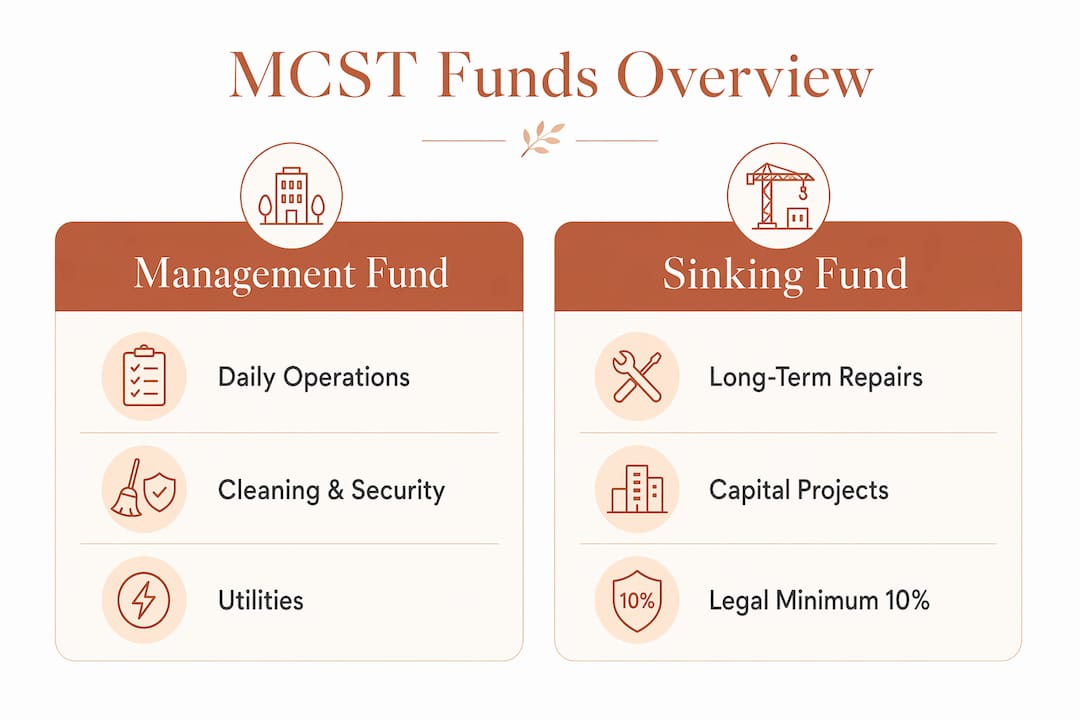
The Sinking Fund must hold at least 10% of total annual contributions by law. That is the legal floor, not the target. Well-managed developments typically maintain two to five years of reserves. A fund sitting at the bare minimum is a warning sign.
The Management Fund covers what keeps the building running today. The Sinking Fund covers what will keep it running in 10 or 20 years. Lift replacements typically happen every 20–25 years. Facade repainting happens every 8–10 years. These are predictable costs. An MCST that has not been saving for them will issue a special levy, a one-time charge to all owners, when the bill arrives.
Pro Tip: Before purchasing any resale condo, request the last three years of AGM minutes and the Sinking Fund balance report. A depleted fund means you may face a large special levy shortly after moving in.
Owners also have the right to inspect the MCST’s financial records. Recent public consultations have proposed rules that would prevent MCSTs from withholding documents from owners who have outstanding fee arrears. Transparency is a legal right, not a privilege. If your MCST is reluctant to share accounts or contracts, that reluctance itself is a red flag worth pursuing.
How does MCST governance affect your rights as an owner?
Owning a strata unit means you hold two things simultaneously. You own your individual lot outright. You also hold a proportional share in the common property as a tenant-in-common, alongside every other owner in the development. That share is expressed as a share value, and it determines how much you pay in monthly fees and how much voting weight you carry at general meetings.
This dual ownership is where most disputes originate. Owners sometimes assume that because they pay fees, they have no further obligations. The reality is the opposite. Co-ownership of common property means you share collective responsibility for its upkeep. If the pool deck cracks, every owner shares the cost of fixing it, regardless of whether they use the pool.
Your rights as an owner under MCST management in Singapore include:
- Voting rights at AGMs and extraordinary general meetings, weighted by share value
- The right to stand for election to the Management Council
- The right to inspect financial records, contracts, and meeting minutes
- The right to raise motions at general meetings for consideration by all owners
- Protection under BMSMA against arbitrary decisions by the council or Managing Agent
Active participation in MCST decisions directly protects your property value. A development with a well-funded Sinking Fund, a competent Managing Agent, and an engaged council commands higher resale prices. Buyers notice the difference between a well-maintained estate and one that has been neglected. Your vote at the AGM is not just a formality. It is a financial decision.
Understanding that you own a strata lot plus a share in common property also clarifies why MCST governance is as much a financial matter as an administrative one. Treating it as purely bureaucratic is the mistake most passive owners make.
What should homeowners know about living under an MCST?
Living in a strata development means interacting with the MCST regularly, whether you realize it or not. Here is what experienced owners know that first-time buyers often do not.
-
Attend every AGM. The AGM is where budgets are approved, fees are set, and council members are elected. Missing it means others make decisions that affect your money and your home.
-
Review the budget before voting. The proposed annual budget is distributed before the AGM. Read it. Check whether the Sinking Fund contribution is growing or stagnant. Ask questions if the numbers do not add up.
-
Evaluate the Managing Agent’s track record. The quality of daily living depends heavily on the Managing Agent’s competence. Before buying into a development, research the firm managing it. Ask current residents about responsiveness and maintenance standards.
-
Understand special levies before they surprise you. A special levy is issued when the Sinking Fund cannot cover a major repair. Older developments with aging infrastructure are most at risk. Always check the fund balance before purchasing a resale unit.
-
Request financial records proactively. You have the right to inspect ledgers, vendor contracts, and AGM minutes. Exercising this right regularly keeps the council and Managing Agent accountable.
The MCST regime is evolving. Increased accountability measures are being proposed to encourage owners to become active stakeholders rather than passive fee payers. Singapore’s regulatory direction is clear: owners who engage with their MCST are better protected than those who do not.
Key takeaways
The MCST is the legal and financial backbone of every strata development in Singapore, and your engagement with it directly determines the quality and value of your property.
| Point | Details |
|---|---|
| Automatic formation | The MCST forms when a strata plan is registered with SLA; all unit owners are members by default. |
| Dual fund structure | Monthly fees split into a Management Fund for operations and a Sinking Fund for long-term capital works. |
| Voting rights matter | Share value determines your voting weight at AGMs; attending meetings protects your financial interests. |
| Sinking Fund health | Always check the Sinking Fund balance before buying resale; a depleted fund signals future special levies. |
| Transparency is a right | Owners can inspect financial records and contracts; a reluctant MCST is a governance warning sign. |
Why I think most condo owners are leaving money on the table
Most owners I speak with treat their MCST like a utility bill. They pay the monthly fees, ignore the AGM notice, and assume someone else is handling things. That assumption is expensive.
I have seen developments where a disengaged ownership base allowed a poorly performing Managing Agent to stay in place for years. The result was deferred maintenance, a depleted Sinking Fund, and a special levy that caught owners completely off guard. The owners who showed up to AGMs and asked hard questions about the fund balance were the ones who saw it coming and pushed for change before the damage was done.
The separation between the Management Council and the Managing Agent is not just an administrative detail. It is the accountability mechanism that keeps your estate well-run. When that line blurs, when the council rubber-stamps everything the Managing Agent proposes without scrutiny, governance breaks down. I have watched it happen in otherwise well-located developments, and it always shows up in the resale price eventually.
My honest advice: treat your MCST participation the same way you treat your CPF contributions. It is not optional, and the returns compound over time. A well-governed development with a healthy Sinking Fund and an active council is worth more. Full stop. If you are buying a condo in Singapore, the MCST’s financial health should be part of your due diligence, not an afterthought.
— Aman
How a property consultant helps you navigate MCST matters
Understanding MCST governance is one thing. Applying that knowledge before you sign a sales and purchase agreement is another.
At Aesthetic Havens, we help buyers and owners interpret MCST documents, review AGM minutes, and assess Sinking Fund health before committing to a purchase. We have seen too many buyers discover a depleted fund or a problematic Managing Agent only after the deal closes. A property consultant who understands strata governance can flag these risks early, saving you from costly surprises. Whether you are buying your first condo or expanding your portfolio, professional guidance on MCST-related due diligence is one of the most practical investments you can make. Reach out to Aman at Aesthetic Havens to get a clear picture of any development before you commit.
FAQ
What does MCST stand for in Singapore?
MCST stands for Management Corporation Strata Title. It is the mandatory legal body that manages the common property of strata-titled developments under Singapore’s BMSMA 2004.
How is an MCST formed in Singapore?
An MCST forms automatically when a strata title plan is registered with the Singapore Land Authority. No separate application is required, and all unit owners become members immediately upon registration.
What is the difference between the Management Fund and the Sinking Fund?
The Management Fund covers daily operational costs such as cleaning and security, while the Sinking Fund covers long-term capital works like lift replacements and facade repairs. The law requires the Sinking Fund to hold at least 10% of total annual contributions.
Can an MCST withhold financial records from owners?
Owners have a legal right to inspect MCST financial records. Proposed regulatory changes in Singapore aim to prevent MCSTs from withholding documents even when owners have outstanding fee arrears.
What is a special resolution in an MCST context?
A special resolution requires a 75% majority vote by share value and is needed for major decisions such as capital expenditure exceeding S$200,000 or amendments to the development’s by-laws.
Recommended
- CCR vs OCR in 2026: Where is the Better Value for Money? | Aesthetic Havens
- New Launch vs Resale 2026: Singapore Property Market Guide | Aesthetic Havens
- From Showflat to Key Collection: The Ultimate 2025 First-Timer’s Guide to Buying a New Launch Condo in Singapore | Aesthetic Havens
- Singapore’s Green Revolution 2025: The Ultimate Guide to Sustainable Homes & Future-Ready Buildings | Aesthetic Havens


