


Most investors assume international real estate is a game reserved for billionaires with offshore accounts and private bankers on speed dial. That assumption is costing them real money. Real estate serves as an inflation hedge across six countries studied from 1990 to 2023, meaning global property has quietly protected wealth through recessions, currency crises, and market shocks that wiped out stock portfolios. This guide breaks down what international property investment actually is, why it works, where the real risks live, and how to identify markets worth your attention. No fluff, no theory for theory’s sake.
Table of Contents
- What makes international property investment different?
- Key benefits: Diversification, protection, and growth
- Risks and challenges: What you need to know
- Choosing the right markets: Where opportunity meets stability
- A contrarian view: Why smart investors still hesitate—and how to win
- Take the next step: Trusted support for your international investment
- Frequently asked questions
Key Takeaways
| Point | Details |
|---|---|
| Global portfolio diversification | International property investing spreads risk across markets and reduces vulnerability to home-country downturns. |
| Inflation and crisis protection | Direct real estate consistently acts as an inflation hedge and retains value during economic shocks. |
| Navigating risks wisely | Success depends on understanding and mitigating legal, currency, and political risks in diverse markets. |
| Market selection is critical | Prioritizing stable, transparent markets can provide both safety and upside for new international investors. |
What makes international property investment different?
International property investment means owning, buying, or holding real estate assets outside your home country. That sounds simple, but the implications are significant. You’re not just buying a building in another zip code. You’re accessing a different economic cycle, a different currency, a different legal framework, and often a completely different demand driver.
Local-only investors are exposed to a single market’s ups and downs. When Singapore cools, every property in your domestic portfolio feels it. When the US raises interest rates aggressively, American investors holding only domestic real estate have nowhere to hide. International property breaks that single-point dependency.
Here’s what sets it apart:
- Inflation protection: Direct real estate investment is an effective long-term inflation hedge, outperforming many financial assets during high-inflation periods.
- Off-cycle recovery: Different markets peak and trough at different times. When one region slows, another may be accelerating.
- Access to emerging growth: Developing markets can offer outsized returns unavailable in mature, saturated domestic markets.
- Currency diversification: Holding assets in multiple currencies reduces your exposure to any single monetary policy decision.
- Stability through spread: A portfolio spread across three regions is structurally more resilient than one concentrated in a single city.
This isn’t speculation. It’s structural risk management. Think of it like not keeping all your savings in one bank. The logic is the same, just applied to physical assets across borders.
The commercial property benefits that Singapore investors already recognize locally, things like stable yields and tenant demand, translate well when applied internationally with the right due diligence. The key difference is that international markets add a layer of complexity that rewards preparation and penalizes shortcuts.
Global real estate also offers something domestic markets rarely provide: the ability to invest in a country’s long-term demographic or economic story. Japan’s aging population, Southeast Asia’s rising middle class, and Europe’s housing shortage are all investable narratives that don’t show up in a Singapore condo listing.
Key benefits: Diversification, protection, and growth
Having established what defines international property opportunities, let’s explore the concrete benefits for your portfolio.
Portfolio diversification is the most cited reason investors go global, and for good reason. When your assets are spread across markets with low correlation, a downturn in one region doesn’t torpedo your entire net worth. The US and APAC property cycles, for example, have historically moved out of sync. During the 2008 financial crisis, while American real estate collapsed, parts of Asia continued to appreciate.
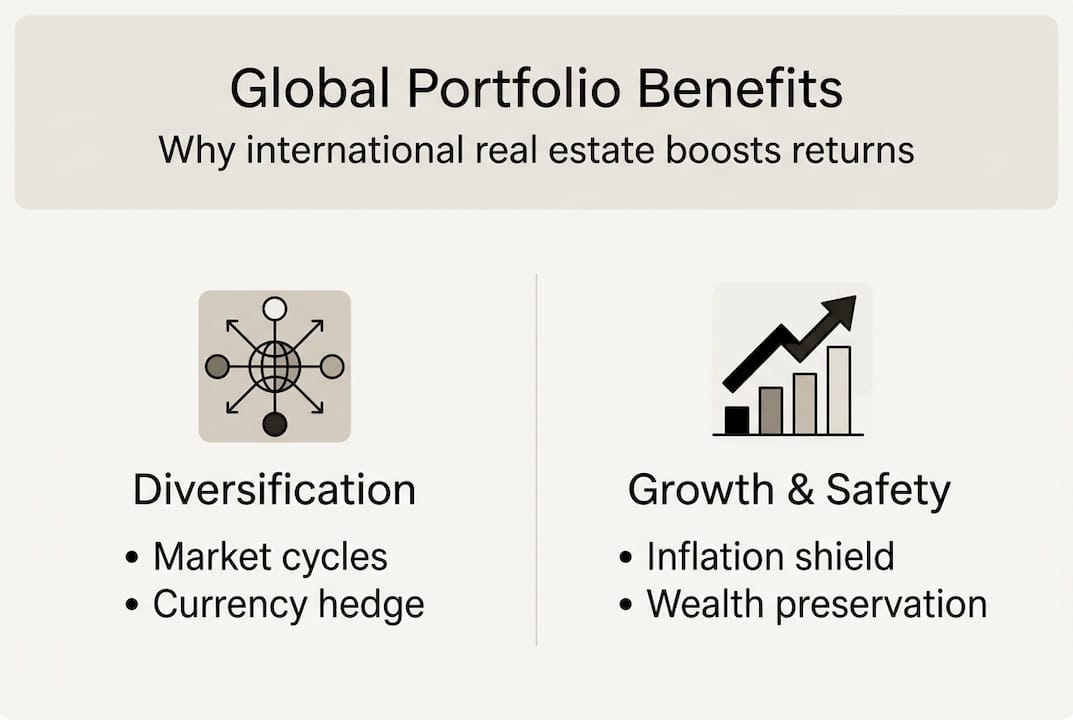
Direct real estate provides positive protection against inflation during crises, which matters enormously when central banks are printing money and bond yields are negative in real terms. Physical property holds intrinsic value in a way that paper assets simply don’t.
Here’s a practical comparison to frame the decision:
| Factor | International property | Domestic-only portfolio |
|---|---|---|
| Market cycle exposure | Multiple, offset cycles | Single cycle risk |
| Inflation protection | Strong, especially in direct real estate | Moderate |
| Growth potential | Access to emerging markets | Limited to local conditions |
| Currency risk | Present but manageable | None |
| Regulatory complexity | Higher | Lower |
| Diversification benefit | High | Low |
The table makes the tradeoff clear. International property adds complexity, but it adds far more resilience and upside access in return.
Wealth preservation is another underrated benefit. Investors who held property in stable APAC markets during the 2020 pandemic shock saw far less erosion than those concentrated in retail-heavy domestic portfolios. The geographic spread acted as a buffer.
Keeping an eye on market trends in Singapore gives you a useful benchmark for comparing how local conditions stack up against global opportunities at any given moment.
Pro Tip: Pairing assets in two regions with historically low correlation, such as Singapore and a stable European market, can reduce portfolio volatility while increasing your exposure to independent growth drivers.
Risks and challenges: What you need to know
Before jumping globally, you must understand the specific risks and how to handle them smartly.
International property is not a free lunch. The same features that make it attractive also introduce risks that domestic investing simply doesn’t carry. Risks include currency fluctuations, geopolitical instability, legal and tax complexities, financing difficulties, and low transparency in developing markets like Nigeria. These aren’t hypothetical. They’ve cost investors real money.
Currency risk is often the most underestimated. A 15% gain on a property in Brazil can be completely erased by a 20% depreciation in the Brazilian real against your home currency. You can hedge this with financial instruments, but that adds cost and complexity.
Legal complexity varies wildly by country. In some markets, foreigners cannot own freehold land. In others, title registration systems are opaque or poorly enforced. Nigeria, for example, has documented issues with land tenure security that have caught foreign investors off guard.
“The absence of a reliable, transparent property registry is one of the most common and costly surprises for international investors entering developing markets.”
Here are the main risk categories and how to address each:
- Currency risk: Use forward contracts or hold assets in currencies that correlate positively with your home currency.
- Legal complexity: Always hire independent local legal counsel, separate from the seller’s agent.
- Title uncertainty: Conduct independent title verification before any deposit changes hands.
- Political and regulatory risk: Consider political risk insurance for markets with unstable governance.
- Financing difficulty: Understand that local mortgage access for foreigners is often restricted. Plan for higher equity requirements.
Before you commit to any market, review property red flags specific to buying abroad. The regulatory guide for foreigners in Singapore is a useful model for understanding how a transparent market structures foreign ownership rules.
Pro Tip: Never skip independent title verification, regardless of how reputable a market appears. Even in developed countries, title disputes happen. In developing markets, they’re far more common.
Choosing the right markets: Where opportunity meets stability
Once you’re clear on risks, the most important question becomes: where should you look internationally?
Not all markets deserve equal consideration. The criteria for selection should be consistent: legal system quality, market transparency, economic stability, and long-term growth potential. These four filters eliminate most of the noise.
Here’s a practical framework for evaluating any international market:
- Rule of law: Can you enforce a contract? Is the judiciary independent?
- Transparency index: Does the country have a functioning property registry and accessible transaction data?
- Economic fundamentals: Is GDP growing? Is unemployment stable? Is inflation controlled?
- Demographic tailwinds: Is the population growing, urbanizing, or aging in ways that drive property demand?
- Foreign ownership rules: Are restrictions in place, and are they changing? Upcoming regulatory shifts can either open or close markets quickly.
- Exit liquidity: Can you sell the asset when you want to, or will you be stuck?
Developed regions like Europe and APAC offer more stability than developing markets like Nigeria, especially during periods of US market volatility. This doesn’t mean developing markets are off-limits. It means you need a higher return expectation to justify the added risk.
Singapore stands out as a model market. Strong rule of law, transparent pricing, consistent foreign investment frameworks, and a track record of resilience make it a natural anchor for an APAC-focused international portfolio. Undervalued Singapore neighborhoods still offer entry points even as the broader market matures. Meanwhile, Singapore commercial trends in 2026 point to continued institutional demand that supports long-term values.

Europe offers a different profile. Markets like Germany, Portugal, and the Netherlands have strong tenant protections, predictable yields, and deep liquidity. They won’t double in three years, but they also won’t collapse when a US Fed decision rattles emerging markets.
Pro Tip: Always investigate changes in foreign ownership laws before committing capital. Several markets, including New Zealand and Canada, have tightened restrictions on foreign buyers in recent years. What’s legal today may not be tomorrow.
A contrarian view: Why smart investors still hesitate—and how to win
Here’s what most guides won’t tell you: the biggest barrier to international investing isn’t risk. It’s the illusion that you need perfect information before acting.
Seasoned investors routinely wait for “clarity” on macro cycles, interest rates, or geopolitical outcomes. By the time clarity arrives, so has every other investor. The inflection point, the moment of maximum opportunity, almost always looks uncertain from the inside.
The real edge in international property comes from acting on rigorous research and trusted local partners before the mainstream narrative catches up. Regulatory changes, demographic shifts, and infrastructure investments telegraph future value years in advance. Most investors read these signals as risk. Elite investors read them as opportunity.
The contrarian truth is this: global real estate is not more dangerous than domestic investing. It’s differently dangerous. And for investors who build the right frameworks and relationships, the asymmetry strongly favors going global. Smarter Singapore investing starts with the same mindset: diligence first, conviction second, action third.
Reframe “global” not as exotic or risky, but as accessible with the right partners and preparation.
Take the next step: Trusted support for your international investment
If you’re ready to expand your global footprint, here’s how to start smartly and safely.
Entering a new market without local expertise is the single most common and costly mistake international investors make. The data, the legal nuances, and the on-the-ground realities require someone who lives and breathes that market daily.

At Aesthetic Havens, we help investors navigate both Singapore and international opportunities with clarity and confidence. Singapore’s transparency, legal strength, and consistent returns make it an ideal base for a global strategy. Whether you’re exploring Singapore property benefits or tracking commercial trends in Singapore as part of a broader APAC play, our team at Aesthetic Havens is ready to guide your next move with research-backed advice and proven local knowledge.
Frequently asked questions
What are the biggest risks in international property investment?
Currency fluctuations, geopolitical instability, and low transparency in developing markets are the primary risks, alongside legal and tax complexity that varies significantly by country.
How does international real estate help during inflation?
Real estate acts as an inflation hedge over the long term and during economic crises, making direct property ownership one of the more reliable stores of value when purchasing power erodes.
Which markets are best for first-time international investors?
Developed markets like Europe and APAC generally offer more predictable returns and stronger legal protections, making them a lower-risk starting point compared to developing markets.
How do I protect myself from scams or regulatory issues abroad?
Hire independent local lawyers, verify titles separately from the selling agent, and consider political risk insurance for markets with less stable governance before completing any transaction.


