

Introduction
Deciding when is the right time to upgrade from HDB to condo is one of the highest-stakes financial and lifestyle decisions a Singapore family will ever make. Get the timing right, and you unlock a powerful asset progression path – HDB to condo to possibly landed property – that compounds wealth across decades. Get it wrong, and you risk being house-rich but cash-poor, locked into a mortgage that chokes your family’s daily life.
This guide is specifically about when to upgrade, not just how. Most people focus on the mechanics of buying and selling, but the timing signals – the ones that separate a smooth upgrade from a stressful one – are what families consistently miss.
The direct answer: The right time to upgrade from HDB to condo is when at least five or six of seven key signals align across your equity position, household income, MOP status, family life stage, market conditions, cash buffer, and long-term plan. No single signal is sufficient on its own.
This article focuses on owner-occupied HDB flats moving to private condos (including Executive Condominiums) under Singapore rules as of 2026. It is not a complete legal, tax, or renovation handbook. The target audience is HDB owners – typically in their 30s to 50s – with families, thinking about asset progression and worried about making a premature or poorly timed move.
By the end of this guide, you will understand:
-
The 7 specific timing signals most families miss when deciding to upgrade
-
How to read your equity, income, and MOP correctly before committing
-
How to avoid costly ABSD and TDSR traps that catch upgraders off guard
-
Why condo vs HDB space often doesn’t compare the way you expect
-
How to map a practical upgrade timeline using your own numbers
Understanding Asset Progression and the HDB → Condo Step
Asset progression in Singapore is more than just “buying a bigger home.” It is a deliberate, staged plan to grow both your living standard and your household wealth through property – typically moving from an HDB flat to a condo, and potentially to landed property over time. The first jump, from HDB to condo, is the most critical because it involves the steepest regulatory hurdles, the largest financial leverage, and the greatest lifestyle trade-offs. Mistiming this step can make every subsequent step harder or even unaffordable.
The philosophy that matters here is balancing lifestyle needs, long-term wealth building, and operational cash flow – rather than chasing speculative gains or upgrading under social pressure.
What Asset Progression Really Means in Singapore
Asset progression, in simple terms, means upgrading your home as a long-term financial and life plan – not just buying bigger. The common path for Singapore citizens looks like this: BTO → resale HDB → mass-market condo → possibly landed or multiple investment properties.
Private property can offer better long-term capital appreciation compared to HDB flats if market conditions are favorable. HDB flat values can stabilize after the Minimum Occupation Period, while private properties may offer varied appreciation potential. Executive Condominiums (ECs) sit in a unique middle ground – purchased from developers under HDB-like rules but privatised after a set period, making them a popular intermediate step.
The key point is timing. Wrong timing at the HDB to condo step can lock families out of future steps or strain retirement planning. If you over-leverage at age 40 to buy a condo, you may lack the CPF balances or loan capacity to pursue a landed home at 50 – or worse, face retirement with heavy outstanding debt.
Key Concepts: Equity, MOP, and Loan Rules
Before examining the seven signals, you need to understand three foundational concepts:
Equity in your current HDB flat is not the same as its market value. Equity is what you actually walk away with: the difference between a realistic sale price and your outstanding loan balance, CPF used with accrued interest that must be refunded, agent commissions, legal fees, and any outstanding upgrading levies. Selling price does not equal cash proceeds after costs – this is a point most people underestimate.
Minimum Occupation Period (MOP) is the first hard timing gate. The Minimum Occupation Period (MOP) for HDB flats is generally five years. However, under the classification framework introduced in October 2024, Plus and Prime flats carry a 10-year MOP. You cannot exercise an Option to Purchase for any private property before your MOP is complete.
Loan rules shape what you can borrow. Bank loans for private property purchases typically allow a maximum loan-to-value (LTV) ratio of 75% if you have no outstanding housing loan. This drops to 45% for a second housing loan. The total debt servicing ratio caps all debt repayments at 55% of gross monthly income. Critically, loan limits decrease if the loan extends past age 65 – if you are 45, your maximum tenure may be 20 years, sharply increasing monthly payments.
Now that you understand equity, MOP, and loan rules, let’s examine the seven specific timing signals you should be watching.
The 7 Signals Most Families Miss When Deciding to Upgrade from HDB to Condo
These seven signals are the core answer to “when is the right time.” Each one addresses a different dimension – personal finances, regulatory milestones, family life stage, or market data – and families should check them systematically, not in isolation. Think of it as a dashboard: only when most indicators are green should you seriously plan your move.
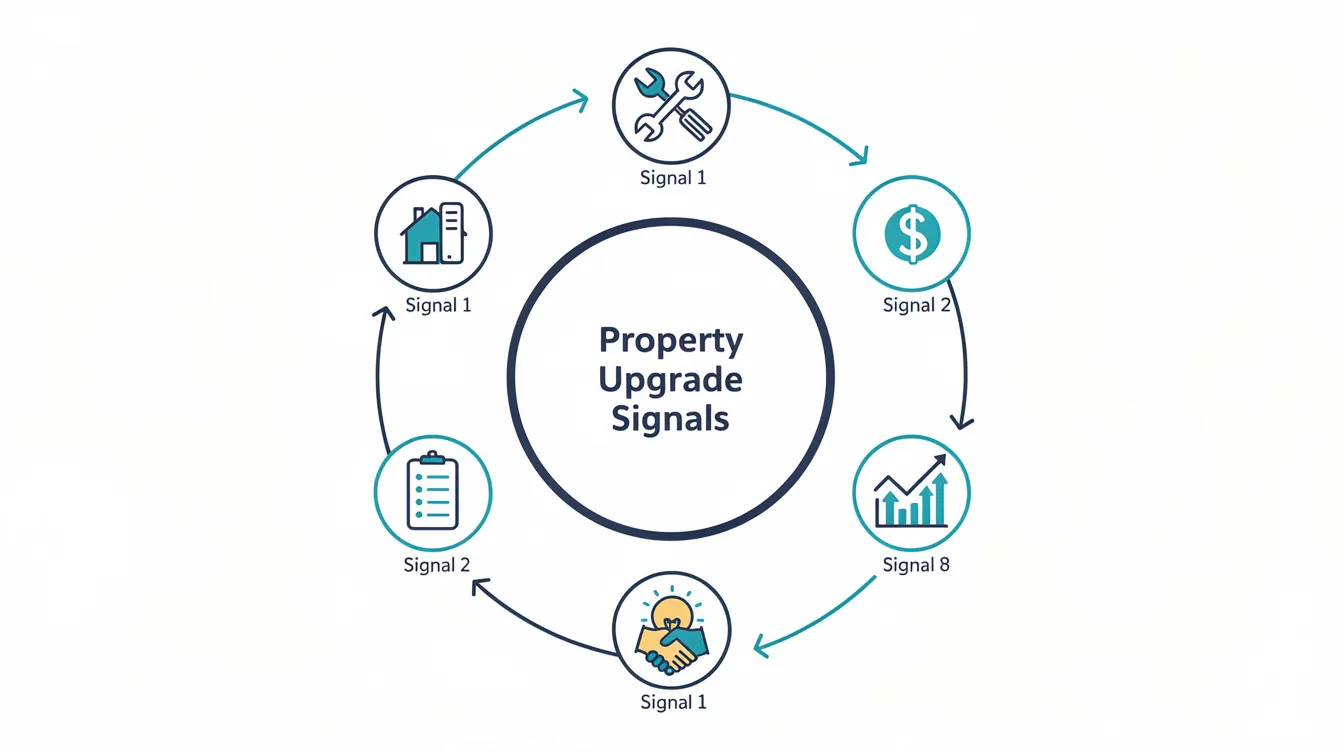
Signal 1: Your HDB Equity Has Reached a “Workable” Threshold
A “workable” threshold means your net sale proceeds – after paying off everything – can comfortably cover at least 20–30% of a realistic target condo price. Upgrading from HDB to a condominium often requires a minimum downpayment of 25%, so this is not a soft guideline; it is a hard financial requirement.
Here is a worked example for 2026:
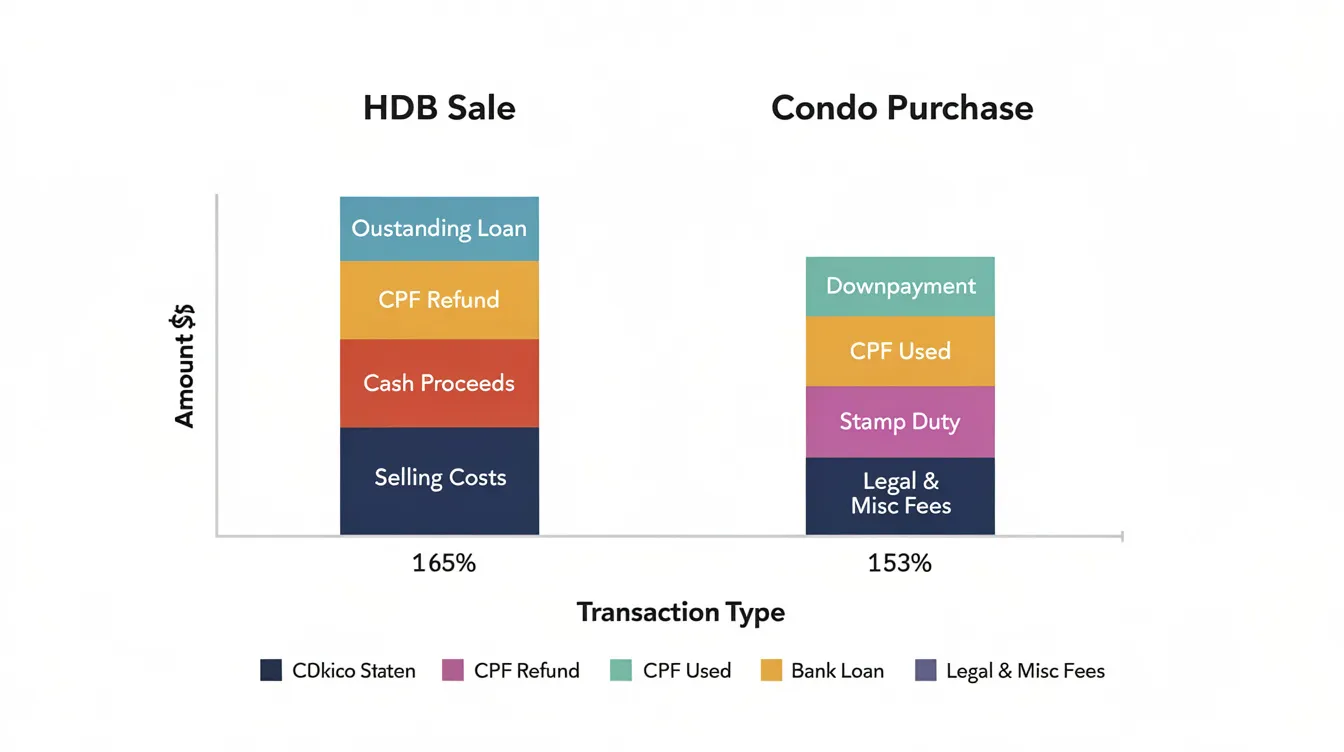
Suppose your 4-room HDB flat has a realistic market value of S$750,000. Subtract your outstanding loan (say S$200,000), CPF refund with accrued interest (say S$100,000), and selling costs including agent fees and legal (roughly S$15,000–20,000). Your net sale proceeds come to approximately S$430,000–435,000. If your target mass-market condo is priced at S$1.4 million, you need S$350,000–420,000 for the 25–30% downpayment alone. At S$430,000, you barely cover the downpayment – with almost nothing left for stamp duty, renovation, or a cash buffer.
CPF refunds can significantly reduce available cash for upgrades. Many families look at the headline HDB price and assume that is their upgrade budget. It is not. The accrued interest component alone can consume tens of thousands of dollars.
Quick equity estimation checklist:
-
Check recent transaction prices for your flat type and town on the HDB Resale Flat Prices portal
-
Obtain your outstanding loan statement from your bank or HDB
-
Log in to your CPF account to see total housing usage plus accrued interest
-
Subtract estimated agent commission (1–2%), legal fees, and any upgrading levy
-
Compare net proceeds to 25–30% of your realistic condo price target
Only when net proceeds reliably exceed your downpayment requirement – with room to spare – has this signal turned green.
Signal 2: Your Household Income Can Support the Condo Loan Comfortably
Qualifying for a loan and comfortably affording it are two very different things. TDSR limits how much of your income can service debt – capped at 55% of gross monthly income – but spending right up to that limit leaves almost no margin for life.
Consider a household with gross monthly income of S$12,000. The maximum allowable total debt repayment is S$6,600. If you have existing debts (car loan, credit cards) of S$1,500 per month, that leaves S$5,100 for your new mortgage plus condo-related costs. A loan of S$825,000 over 30 years at a stress-test rate of 4% gives monthly repayments of approximately S$3,900. Add condominium maintenance fees – which can significantly exceed HDB conservancy charges – of S$400 or more, plus property tax and utilities, and you are looking at roughly S$4,500–4,600 per month. That leaves a buffer of only about S$500 within your TDSR limits for all other obligations.
If your household runs on one income, or if your spouse is not working, the margin shrinks even further. Financial readiness for upgrading includes understanding not just the purchase price, but also ongoing costs – maintenance, sinking fund contributions, and special assessments for condo maintenance that can lead to unexpected costs not faced with HDB flats.
Age matters enormously here. A borrower at 35 can take a 30-year loan; a borrower at 45 is limited to roughly 20 years (loan must not extend past age 65), pushing the same S$800,000 loan from ~S$3,820/month to over S$4,800/month.
|
Age at Upgrade |
Max Tenure (to age 65) |
Monthly Payment (S$800k at 4%) |
TDSR Impact |
|---|---|---|---|
|
35 |
30 years |
~S$3,820 |
Lower |
|
40 |
25 years |
~S$4,220 |
Moderate |
|
45 |
20 years |
~S$4,850 |
High |
|
50 |
15 years |
~S$5,910 |
Very High |
The signal is green when your mortgage, maintenance, and all debts stay well within total debt servicing ratio limits – ideally below 45% of gross income rather than the maximum 55% – and you still have enough left over for children’s education, parents’ support, emergencies, and saving for retirement.
Signal 3: Your MOP and Ownership Rules Line Up with Your Plan
Many families forget that MOP is not just a box to check – it is a timing anchor that affects everything from when you list your flat to when you can legally commit to a condo purchase. You are prohibited from exercising an OTP for private property before MOP is fulfilled.
Concrete scenario: You collected your BTO keys in January 2021. Your MOP ends in January 2026. Ideally, you should begin planning 12–18 months before – around mid-2024 – to research condo options, get your finances in order, and understand what your HDB flat will realistically sell for. Here is a practical timeline:
-
12–18 months before MOP: Start researching target condos, review CPF usage, get a property valuation
-
6–12 months before: Obtain in-principle approval from banks, shortlist condo options, engage a property agent
-
MOP month: List your HDB flat for sale, begin viewing condos seriously
-
3–6 months after listing: Complete HDB sale, exercise OTP on condo
If you plan to buy a condo before selling your HDB, be aware that Additional Buyer’s Stamp Duty (ABSD) applies when purchasing multiple residential properties in Singapore. ABSD can add 20% to the cost of a second property – for a S$1.5 million condo, that is S$300,000 in additional stamp duty payable upfront. Singapore citizens may qualify for ABSD remission if they sell their existing HDB within six months, but the cash must still be available at the point of purchase.
For Prime or Plus flat owners with 10-year MOPs, the planning horizon is even longer. Check your flat’s classification early – this is a hard constraint that no amount of money can override.
Signal 4: Your Family Life Stage Is Changing in Predictable Ways
The emotional pull to upgrade often comes from life changes: expecting a child, children approaching Primary 1 registration, PSLE transitions, aging parents needing closer care, or a permanent work-from-home arrangement demanding a dedicated study room.
These are legitimate timing factors – but they should be anticipated, not reacted to. For example, if your child is entering P1 in 2028 and you want to secure a condo within 1 km of a preferred school, the time to plan the move is 2026, not 2027. Waiting too long means buying under pressure, often paying more and settling for a unit that does not truly fit your family’s needs.
Here is where many families get surprised: condo layouts may utilize a portion of the total square footage for non-livable areas – corridors, planter boxes, air-con ledges, bomb shelters – impacting usable living space. A 90–100 sqm 4-room HDB flat can feel more spacious than an 80–90 sqm 3-bedroom condo because of layout efficiency. Before you decide to upgrade, compare floor plans side by side with a tape measure, not just the marketing brochure.
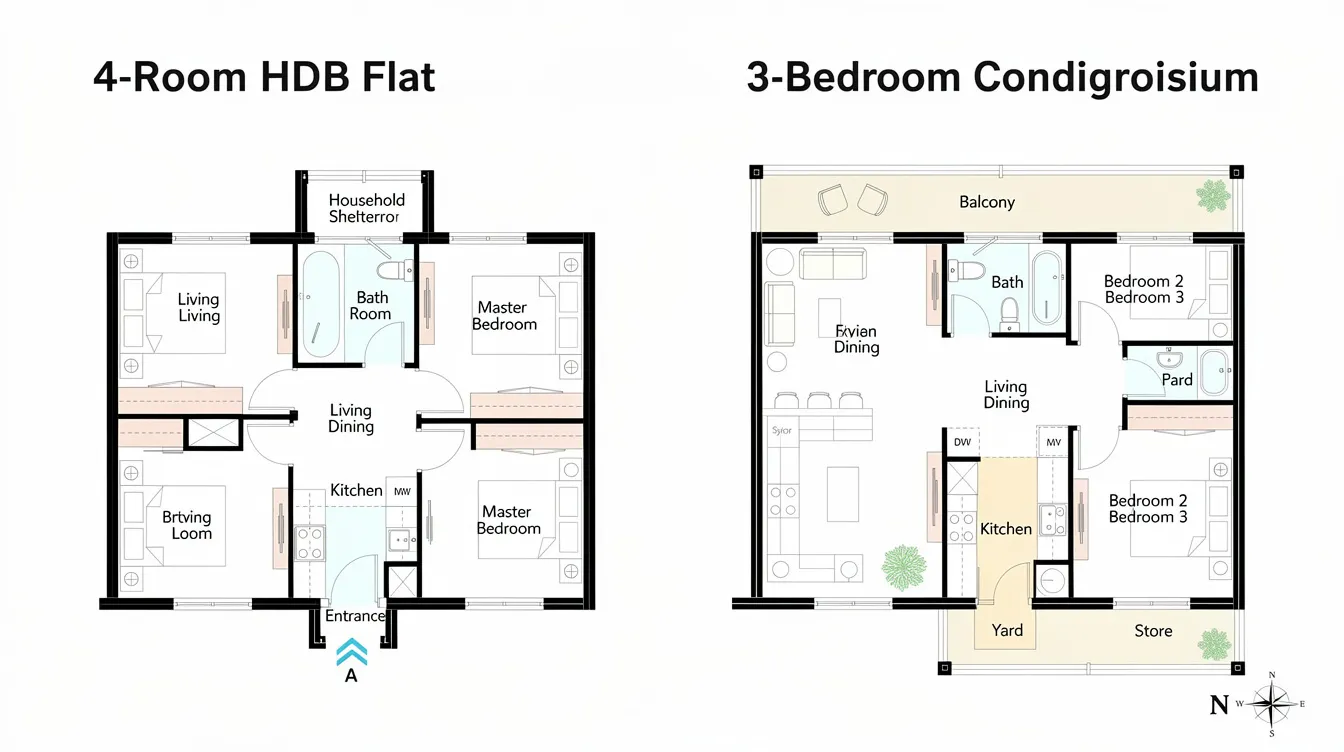
Proximity to amenities like hawker centres may also diminish when moving to private properties – a trade-off that matters more than most families expect, especially for those with young children or elderly parents.
The signal is green when your family’s life changes are predictable (not speculative), and you have mapped exactly what space, location, and amenities your household needs over the next 5–10 years.
Signal 5: The HDB and Condo Markets Are Moving in Your Favour (Enough)
You cannot time the market bottom – nobody can. But you can recognise when conditions give you a relatively favourable gap between what your HDB is worth and what a condo will cost.
As of Q1 2026, HDB resale prices declined slightly: the HDB Resale Price Index sat at approximately 203.4, down 0.1% from Q4 2025. HDB resale prices declined in 1Q2026, affecting upgrade demand – but also potentially signalling a window before further softening. Meanwhile, Singapore’s private residential market shows measured price growth: URA’s Private Property Price Index indicates overall private home prices rose approximately 0.9% in Q1 2026, with Outside Central Region (OCR) condos up around 2.2% in certain segments.
The average price gap between a 4-room HDB resale flat (~S$630,000) and a median resale condo (~S$1,710,000) is roughly S$1,080,000 – about 170–180% of the HDB price. When this gap narrows (HDB prices strong, condo prices moderate), the upgrade becomes more manageable. When it widens, you need proportionally more equity and income.
Three data points to monitor quarterly:
-
HDB Resale Price Index (RPI) – is your HDB value stable or declining?
-
URA Private Property Price Index (PPI) – are condo prices accelerating or moderating?
-
Interest rate trends – are current rates rising (shrinking borrowing capacity) or stable?
The signal is green when you can sell strong (HDB demand resilient) and buy reasonable (condo market not overheated), and interest rates are not spiking.
Signal 6: You Have a Realistic Cash Buffer After All Costs
This is the signal that trips up even financially savvy households. Beyond the downpayment, upgrading requires significant cash for buyer’s stamp duty (BSD), potential ABSD, legal fees, valuation fees, renovation, furnishings, moving costs, and possibly interim housing if you sell first.
Selling price does not equal cash proceeds after costs. Consider a S$1.6 million condo purchase in 2026:
-
BSD: Progressive rates could amount to approximately S$44,600
-
ABSD (if buying before selling HDB): 20% = S$320,000 upfront
-
Legal and valuation fees: ~S$3,000–5,000
-
Renovation for a family of four: S$80,000–150,000 is typical
-
Moving and furnishing: S$10,000–20,000
-
Interim rental (if selling HDB first): S$3,000–5,000/month for 3–6 months
Families transitioning from HDB flats to condos may face new cash flow considerations due to higher overall costs. Condo bylaws often impose stricter regulations on renovations and property usage than HDB living, which can also affect your renovation budget and timeline.
The signal is green when you can complete the entire purchase and move – including renovation and stamp duty – and still retain at least 6–12 months of living expenses as an emergency fund. If every dollar is tied to the condo, you are not ready. Operational cash-flow safety is non-negotiable.
Signal 7: You Can See the Next Step After Condo (Not Just This Upgrade)
Upgrading from HDB to condo is rarely the final chapter. Whether the condo is your forever home or a stepping stone to landed property or an investment portfolio, your age, income trajectory, CPF savings growth, and retirement horizon all matter today – not just when you plan the next property move.
Sample trajectory A: A 35-year-old couple upgrades to a mass-market condo in 2028. They hold it for 12–15 years, building equity through capital appreciation. By their late 40s, they have enough equity and CPF for a small landed home or a second investment unit.
Sample trajectory B: A 48-year-old couple with children in secondary school upgrades to a larger freehold condo as their likely final home. Their shorter loan tenure means higher monthly payments, so they plan conservatively – ensuring mortgage is fully paid before retirement at 62–65.
Upgrading too late – say in your mid-50s – shortens your loan tenure dramatically, limits capital appreciation benefits, and can leave you house-rich but cash-poor in retirement. If you cannot see how the condo fits into your path beyond this single purchase, the timing signal is amber at best.
Once you understand these seven signals, the next step is checking them systematically against your own numbers.
Translating the 7 Signals into a Concrete Upgrade Decision
Theory without application is useless. This section shows you how to run through all seven signals with your actual finances, family situation, and market data – and then make a concrete decision about whether to proceed, wait, or adjust your position.
A Practical 6-Step Assessment Process
Use this process 12–24 months before you think you might upgrade, and run it again before you sign any Option to Purchase. Upgrading requires careful planning around sale proceeds and costs – there are no shortcuts.
-
Estimate your HDB’s conservative sale price. Look up recent transactions for your flat type, town, and block on the HDB Resale Flat Prices portal. Use the lower end of comparable sales – not the highest reported price. Account for your flat’s floor, orientation, condition, and remaining lease.
-
Obtain your outstanding loan and CPF Housing usage. Request your latest loan statement from your bank or HDB. Log in to your CPF account to see total housing withdrawals plus accrued interest. CPF refunds can significantly reduce available cash from sales – do not skip this step.
-
Calculate net sale proceeds and simulate costs. Subtract outstanding loan, CPF refund (including accrued interest), agent commission (~2%), and legal fees from your estimated sale price. Then model downpayment, BSD, and possible ABSD for 2–3 different condo price points to see what you can afford.
-
Obtain in-principle approval (IPA) from at least 2 banks. This tells you your real loan ceiling and maximum tenure given your age, income, and existing debts. Compare offers – even small differences in interest rates or loan quantum matter over 20–30 years.
-
Map family milestones over the next 5–10 years. School entry dates, anticipated job changes, parents’ health trajectory, potential career breaks, and whether your spouse plans to return to work. These are not soft considerations – they directly affect your income stability and space requirements.
-
Score each of the 7 signals as red, amber, or green. Be honest. Only when at least 5–6 signals are green should you seriously commit. If 3–4 are green, wait another 6–18 months and improve your position – increase savings, pay down debt, or secure a higher income before making the jump.
Sell HDB First vs Buy Condo First: Timing and Cost Comparison
This decision interacts directly with ABSD exposure, cash flow, and emotional stress. Here is how the two approaches compare for an HDB upgrader in 2026:
|
Factor |
Sell HDB First |
Buy Condo First |
|---|---|---|
|
ABSD |
None for Singapore citizens (no second property owned) |
20% ABSD payable upfront; remission possible if HDB sold within 6 months |
|
Cash needed upfront |
Lower – sale proceeds fund the new purchase |
Very high – need ABSD + downpayment in cash before HDB sale closes |
|
Loan structure |
Single mortgage; cleaner debt profile |
Potentially two mortgages temporarily; tighter TDSR |
|
Interim housing |
May need 3–6 months of rental |
Can stay in HDB until condo is ready |
|
Emotional stress |
Pressure to find condo quickly after selling |
Pressure to sell HDB quickly to reclaim ABSD |
|
Financial clarity |
Selling first provides financial clarity before the next purchase |
Buying first can lead to carrying two mortgages temporarily |
Interpretation: Selling first avoids 20% ABSD on the new property and is the safer path for most families. Buying first requires upfront cash for ABSD and down payment and is only viable for households with strong cash reserves, low existing debt, and high confidence in selling the HDB within the remission window. The right sequence depends on cash position and loan eligibility.
Many families mis-time their move by ignoring ABSD deadlines. If you buy first and fail to sell your HDB within six months, you lose the ABSD remission – potentially hundreds of thousands of dollars. Plan the sequence before you fall in love with a unit.
Even families with strong signals can stumble on technical details. Let’s look at the most common timing mistakes.
Common Timing Mistakes HDB Upgraders Make – and How to Avoid Them
These are practical mistakes that come up repeatedly when families try to time their upgrade. Each one is fixable – but only if you recognise it before you commit.
Mistake 1: Assuming “Bigger Condo” Automatically Means More Space
The “condo” label carries an expectation of more room, better finishes, and a lifestyle upgrade. The reality is more nuanced. Condo layouts may utilize a portion of the total square footage for non-livable areas, impacting usable living space. A 90–100 sqm 4-room HDB flat often has more efficient layouts – fewer corridors, no planter boxes counted in floor area, and more practical storage – than an 80–90 sqm 3-bedroom condo.
Solution: Visit showflats and resale units with a tape measure and your household inventory list. Measure actual bedroom dimensions, storage space, and common areas. Compare them against your current HDB. Do not decide based on marketing renders alone.
Mistake 2: Ignoring CPF Accrued Interest Until It’s Too Late
When you sell your HDB flat, the CPF funds you used for the purchase must be refunded to your CPF Ordinary Account – including accrued interest at the OA rate (currently 2.5% per annum). If you used S$200,000 in CPF over 10 years, the accrued interest alone could be S$50,000 or more, depending on the compounding. This money comes directly out of your sale proceeds.
Many families calculate their upgrade budget based on the gross sale price minus the outstanding loan – and then discover at completion that a large chunk must go back to CPF, leaving far less cash than expected for the condo downpayment.
Solution: Check your CPF housing usage early – the CPF online dashboard shows exactly how much you have used and the accrued interest to date. Model different sale dates to see how the interest accumulates. Adjust your condo budget downward if needed.
Mistake 3: Upgrading Just Before Major Life or Career Shocks
Buying a condo just before a job change, a career pivot, the birth of a new child, or a parent’s serious illness is one of the most dangerous timing errors. If your income drops by even 20–30%, the mortgage that seemed affordable becomes a burden. If you are on probation, starting a business, or about to take a career break, this is not the moment to take on the largest financial commitment of your life.
Solution: Stress-test your mortgage payments under a 20–30% income reduction scenario. If you cannot cover all housing costs (mortgage, maintenance, property tax) plus essential family expenses under that reduced income for at least 12 months, waiting is the safer choice. Align the upgrade with stable employment periods.
Mistake 4: Treating Condo Purchase as a Pure Investment Bet
Some families buy far-flung or undersized units purely based on “future en bloc” rumours, speculative price rise projections, or the promise of a new MRT line. For owner-occupiers, this approach is dangerous: you are subject to living in the unit daily, and if the investment thesis fails – as it often does in oversupplied locations – you are stuck in an inconvenient home that may not even appreciate.
Solution: Set a clear hierarchy for your purchase decision: (1) housing function – does this unit genuinely serve your family’s daily needs? (2) financial resilience – can you hold it comfortably for 10+ years even if prices stagnate? (3) upside potential – only then consider capital appreciation as a bonus, not the primary reason to buy.
Mistake 5: Not Having a Contingency Plan if Sale or Purchase Is Delayed
HDB resale can take longer than expected. Condo TOP dates get pushed back. Buyers sometimes exercise and then forfeit options. If your plan has zero flexibility, a single delay can cascade into double housing costs, expensive bridging loans, or panicked decision-making.
Solution: Always plan 1–2 backup options. Identify short-term rental possibilities near your preferred location. Understand the cost and process of bridging finance from your bank. Have at least one alternative condo choice in case your top pick falls through. Build a 3–6 month buffer into your timeline.
With these mistakes accounted for, you are in a much stronger position to decide and act.
Conclusion and Next Steps
The right time to upgrade from HDB to condo is not a single date – it is a convergence. Your equity needs to cover a workable downpayment. Your income must support the loan comfortably, not just technically qualify. Your MOP must be complete. Your family’s life stage should point clearly toward the move. Market conditions should offer a manageable price gap. You need a real cash buffer after every cost is accounted for. And you should be able to see how this condo fits into your longer-term property path and retirement plan.
Upgrading is not urgent just because friends are doing it or because you passed your MOP last month. The trade offs are real: higher monthly costs, less liquid wealth, and a longer commitment. Timing should serve your family’s cash flow, your children’s education plans, and your own retirement security – not social pressure or fear of missing out.
Your immediate next steps:
-
Download your flat’s recent resale transaction history from the HDB portal and check URA condo data for your target area
-
Log in to your CPF account and get your exact Housing Usage Statement, including accrued interest
-
Run a simple equity and cash buffer calculation using the method outlined in Signal 1
-
Request an independent home valuation from a licensed appraiser or two banks (obtain in-principle approval at the same time)
-
Score each of the 7 signals honestly – if fewer than 5 are green, save this article and revisit in 6–12 months
For families – especially business owners balancing home and commercial property needs – professional guidance on asset progression can save significant money and stress. A data-backed review of your upgrade timing, factoring in both residential and investment-oriented property paths, is worth the time.
Related topics worth exploring: Executive Condominiums as an intermediate upgrade step, long-term property portfolio planning, and how commercial or industrial property fits into a broader wealth-building strategy alongside residential holdings.
Additional Resources and Visual Ideas
Supporting resources for your own research:
-
HDB Resale Flat Prices portal – latest transaction data by town, flat type, and block
-
URA Private Residential Property Price Index – quarterly trends from 2016 to 2026 across OCR, RCR, and CCR
-
CPF Housing Usage dashboard – check your withdrawals and accrued interest online
-
MAS mortgage calculator – estimate monthly payments at different interest rates and loan tenures
Visual ideas for this article:
-
7 Signals infographic: Circular or step-flow diagram with icons for each signal (equity, income, MOP, family stage, market, cash buffer, long-term plan)
-
Equity breakdown diagram: Before/after visual showing HDB sale price → subtract loan, CPF refund, fees → net proceeds → how they stack against condo downpayment and costs
-
Floor plan comparison: Side-by-side sketch of a 4-room HDB (~95 sqm) vs a typical 3-bedroom condo (~85 sqm) showing actual usable space differences
-
Upgrade timeline graphic: From Year 0 (MOP approaching) through listing, sale, purchase, interim housing, and move-in – marking key milestones and deadlines
-
Monthly instalment comparison chart: Same S$800,000 loan at ages 35, 40, 45, and 50 – showing how shorter tenure increases monthly cost
If you are considering an upgrade and want a personalised asset progression and timing review – backed by real market data and tailored to your family’s numbers – reach out for a consultation. The right report today can save you from a costly mistimed decision tomorrow.

