

Introduction
For Singapore families weighing their next move up the property ladder, the choice between a two property strategy Singapore households increasingly debate and consolidating everything into one bigger home is arguably the most consequential financial decision they will make. Both paths tap into Singapore’s property wealth system – yet they build wealth through fundamentally different mechanics, and the gap in outcomes over 10–15 years can reach hundreds of thousands of dollars.
This article focuses on asset progression paths common to Singaporean households – from HDB flat to private condo to landed property – and specifically compares owning two properties (via decoupling or staggered purchases) against selling up and buying a single larger home. It is written for families already in, or about to enter, their first HDB or condo, planning their next purchase between 2026 and 2035. This is not a guide for overseas property or short-term flipping.
The core conclusion: In many cases, a prudently structured two-property strategy builds wealth faster because it harnesses leverage and rental income across two appreciating assets. However, the 20% additional buyer’s stamp duty on a second property, tighter loan-to-value limits, individual risk tolerance, and life stage priorities (space, children’s education, retirement planning) can make one bigger home the smarter choice for certain families.
Here is what you will gain from reading this article:
-
A clear understanding of the numbers behind each path – equity growth, cash flow, and risk exposure
-
Worked examples for different family profiles (young couples, established families, pre-retirees)
-
How ABSD, decoupling, TDSR, and LTV rules shape feasibility in 2026
-
A practical step-by-step framework to compare both options using your own figures
-
Guidance on when to prioritise lifestyle over returns – and when not to
All insights are based on Singapore’s current rules (ABSD, TDSR, LTV as at 2026). Aesthetic Havens shares this framework to help you make informed decisions – this is not personal financial advice.
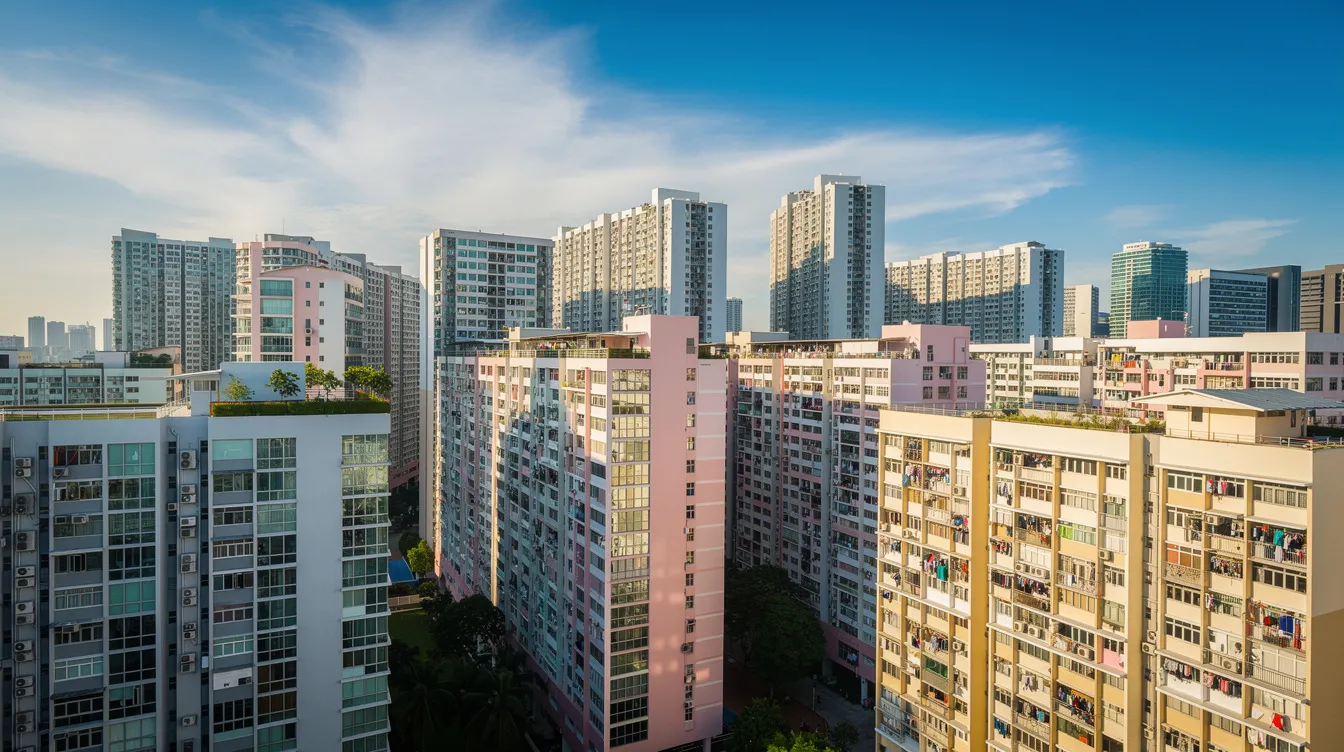
Understanding the Two Main Paths: Two Property Strategy vs One Bigger Home
Before diving into the numbers, it helps to define both strategies clearly. Both options generally start from the same place – an HDB flat or entry-level private condo – and use built-up equity plus borrowing capacity to progress. Where they diverge is in how that equity and capacity are deployed.
What Is the Two Property Strategy in Singapore?
The two property strategy means owning one “own stay” home and one investment unit simultaneously. For many homeowners, this is achieved through decoupling (one spouse transfers their share of a jointly-owned property to the other, freeing the second spouse to buy property as a first-time buyer), staggered purchases, or simply retaining an existing home while acquiring a second.
In practice, a typical property journey might look like this: a couple completes MOP on their HDB flat, sells it, buys a private condo for their family to live in, and uses remaining equity plus savings to purchase a smaller investment unit – perhaps an OCR condo with better rental yield. Alternatively, one spouse keeps the HDB (if rules allow) while the other purchases a private property.
The key mechanics are dual capital appreciation, rental income from the investment unit, and accelerated building equity through two parallel loan repayments. But the costs are significant: Singapore citizens face a 20% ABSD on a second property, the loan-to-value ratio drops to 45% on a second housing loan (from 75% on the first), and the total debt servicing ratio limits total monthly debt repayments to 55% of gross monthly income.
Quick recap:
-
Pros: Two streams of capital growth, passive income from rent, portfolio diversification
-
Cons: Heavy upfront cash outlay (ABSD + larger down payment), higher financing risk, tenant management complexity
What Does “One Bigger Home” Mean in Asset Progression?
The “one bigger home” path means selling your existing property and channelling all proceeds and borrowing capacity into a single, higher-value residential property – for example, upgrading from a 4-room HDB flat to a spacious 4-bedroom private condo, or from a mass-market condo to landed property.
Here, wealth is concentrated in a single, larger valuable asset. The priority is lifestyle – more space, better facilities, proximity to branded schools, and the comfort of home ownership in a premium location – rather than diversification and rental yield. Buying a single larger home provides capital appreciation primarily through property value growth rather than rental income.
The typical buyer profile: families with school-going children, higher but stable incomes, and a strong preference for simplicity. Many homeowners in this category value financial security through lower debt and less complexity over maximising returns.
Understanding these definitions sets up the deeper numerical comparison that follows – because the real question is not which path sounds better, but which one actually builds more wealth given your specific situation.
How Each Strategy Actually Builds Wealth in Singapore
Now that both paths are defined, this section breaks down the equity, cash flow, and risk mechanics that determine which is a more powerful wealth building tool over time.
Equity Growth: One vs Two Properties
Equity in a property grows through two channels: loan repayment (you gradually own more of the asset) and capital appreciation (the asset itself rises in value). Singapore’s property prices have historically appreciated over time – the URA private residential price index reached approximately 222.5 in Q3 2026, up roughly 119% since early 2009, translating to about 4.8% nominal compound annual growth for private homes. Private home prices rose 3.4% from Q3 2025 to Q3 2026, though non-landed growth was more modest at around 1.8% year-on-year while landed property surged approximately 7%.
With two properties appreciating in parallel, the compounding effect is significant. Even at a conservative 3% annual price growth, two properties worth S$1.2 million each produce more absolute equity gain than a single S$2.4 million property growing at the same rate – because the leverage on two properties is typically higher relative to equity invested (you control more asset value per dollar of your own capital). CPF contributions help homeowners build housing equity across both properties, though servicing two loans means more of your CPF and cash goes toward debt rather than discretionary spending.
Conversely, a single property with a higher quantum can benefit from stronger per-unit capital gains if located in a premium area. Larger properties may retain capital value more resiliently during economic downturns than smaller units, and a well-located property can appreciate faster and offer better liquidity.
Cash Flow and Rental Income vs Lifestyle Value
Owning two properties allows for dual rental income streams, potentially generating passive income that subsidises or covers the investment unit’s mortgage. The potential rental yield for private properties in Singapore often hovers around 2.5%, with OCR condos averaging about 3.3% gross and CCR properties closer to 1.9–2.0%. However, net cash flow after property tax, maintenance fees, agent commissions, and vacancy risk (typically 5–10% annually) shrinks that figure to roughly 1–2%.
A single bigger home generates zero rental income but delivers substantial non-cash value: shorter commutes, larger living spaces for growing families, proximity to preferred schools for children’s education, and the psychological comfort that comes with settling into a long-term home. Investing in one larger home can simplify financial management due to having only one mortgage and set of expenses.
For families who need surplus cash flow to fund children’s education, a business venture, or other financial commitments, the choice between rental income and lifestyle value becomes especially sharp. The right property decision depends on whether your family needs more monthly cash coming in, or more quality of life right now.
Risk Exposure: Concentration vs Diversification
With one bigger home, concentration risk is real: if that specific project or location underperforms – due to neighbourhood changes, lease decay, or oversupply – most of your family wealth is affected. High quantum properties have a smaller pool of prospective buyers when it comes time to exit, lengthening selling time and potentially reducing flexibility.
Two properties in different locations or segments (for example, an OCR investment condo plus an RCR own-stay unit) offer diversification within Singapore’s property market. If one underperforms, the other may compensate. But both are still in the same asset class – Singapore residential property – so the diversification is limited compared to spreading across truly different asset classes.
Managing multiple properties increases exposure to market downturns and economic fluctuations compared to a single property. Two mortgages also mean higher aggregate debt, greater sensitivity to interest rates, and more financing risk. The TDSR cap and stress tests provide guardrails, but they also limit how much you can borrow. Both strategies for property investment in Singapore carry different risk profiles and market liquidity implications.
The “better” strategy often hinges on age, income stability, and time horizon – which is exactly what the next section explores.

Which Strategy Is Better for Different Types of Singapore Families?
There is no one-size-fits-all answer. The right investment strategy depends on your stage of life, job stability, number of children, financial goals, and appetite for the risks involved.
Young Couples in Their 20s to Early 30s (HDB to First Private)
Typical starting point: Newly married, living in a BTO or resale HDB flat, first MOP date perhaps around 2031 for a 2026 BTO launch, limited upfront cash but a long runway of 25–35 working years ahead.
For this group, entering the property market early can yield greater long-term benefits. First-time buyers can receive grants up to S$80,000 for HDB flats (via the enhanced CPF housing grant and related schemes), and the loan-to-value ratio for a first housing loan is capped at 75%, giving maximum leverage. A well-chosen first property can enhance future upgrading opportunities down the road.
Rather than rushing into a two property strategy, young couples often benefit more from buying a sensibly-priced first private condo with strong future rentability – one that can serve as an own-stay home now and convert to an investment unit later. This approach builds equity without the 20% ABSD hit and keeps financial resilience intact during the most income-volatile years.
When a two-property path might still make sense early: dual high incomes, no children yet, high savings rate, and a clear plan to hold both properties for 10+ years. Even then, careful planning around ABSD and LTV is essential to avoid costly mistakes.
Established Families in Their Mid-30s to Mid-40s
Profile: One or two children, stable careers, meaningful equity built up in a current property (perhaps a 4-room HDB bought in 2015 or an executive condo purchased in 2018). HDB resale prices increased significantly from 40.9 in 1990 to over 152 in 2020, meaning long-term holders have substantial gains to deploy.
This group faces the sharpest trade-offs. Using equity to buy a bigger own-stay home near desired schools offers immediate lifestyle uplift and simplicity. But retaining the existing property (or splitting into two condos after selling) can accelerate wealth through leverage and rental income – if the numbers work after accounting for the 20% ABSD on a second property and the lower 45% LTV on the second housing loan.
Key considerations for this profile:
-
Children’s education: Proximity to preferred primary schools can be worth a premium; this often tips the scale toward one bigger home
-
Income stability: Two loans require consistent cash flow – if either spouse’s income is variable, concentration in one property may be safer
-
Time horizon: With 15–25 years to retirement, there is still enough runway for a two-property portfolio to compound meaningfully
Late 40s to 50s: Pre-Retirement Planning
Profile: MOP and SSD periods are over, significant equity in an existing home, but shorter loan tenure available because MAS rules require loans to be repaid by age 65.
Here, the priority often shifts from aggressive capital growth to stability, liquidity, and retirement planning. Homeowners can unlock housing equity for retirement planning by right-sizing their property or extracting equity from a second unit. A larger fully-paid or low-loan home plus modest investments elsewhere may provide greater financial security than stretching into a new two-property strategy.
Overleveraging often occurs during the second property purchase, and at this stage, the consequences are more severe – there is less time to recover from a downturn or vacancy spell. Each property purchase must stand on its own affordability, independent of optimistic rental assumptions.
A late-stage first-time two-property strategy can work, but only if backed by a clear exit plan, adequate reserves, and realistic future goals for retirement income. For many in this bracket, one right property – not necessarily the biggest – is the optimal move.
Next, let us walk through how to actually evaluate the numbers for both paths.
How to Compare Two Property Strategy vs One Bigger Home Using Numbers
This is the heart of the article: a practical, step-by-step way to compare both options using realistic 2026 Singapore assumptions. Whether you are 12–18 months from MOP or actively searching for your next property, this framework helps you make an apples-to-apples comparison.
Step-by-Step Framework to Evaluate Your Options
Use this framework as soon as you begin seriously considering your next purchase – ideally 12–18 months before MOP or sale of your current property.
-
Calculate your current equity. Market value of your property, less outstanding housing loan, less CPF principal and accrued interest to be refunded upon sale. This is the capital available for your next move.
-
Determine maximum borrowing capacity. Under TDSR rules, your total monthly debt repayments (including the new loan) cannot exceed 55% of gross income. Factor in age-based loan tenure limits – the loan must be fully repaid by age 65, which shortens maximum tenure for older borrowers.
-
Sketch Scenario A – one bigger home. Sell your current property, buy a single larger unit. List all upfront costs: buyer’s stamp duty, legal fees, renovation, and monthly instalments. Note that you get 75% LTV on your first housing loan.
-
Sketch Scenario B – two-property strategy. Structure the acquisition: will you decouple, sell and buy two units, or retain your current home? Include ABSD (20% for citizens on a second property), the lower 45% LTV on the second loan, and expected rental income. Transaction costs can accumulate significantly over multiple purchases – account for all of them.
-
Stress-test each scenario. Model what happens if interest rates rise by 1–1.5 percentage points and if the investment unit sits vacant for 6–12 months. These are realistic scenarios that reveal whether your cash flow holds up.
-
Compare projected net worth at year 10 and year 15. Use conservative capital appreciation (2–3% p.a. nominal) and include principal repayment. The path that leaves you both safer and wealthier – after accounting for all costs – is your answer.
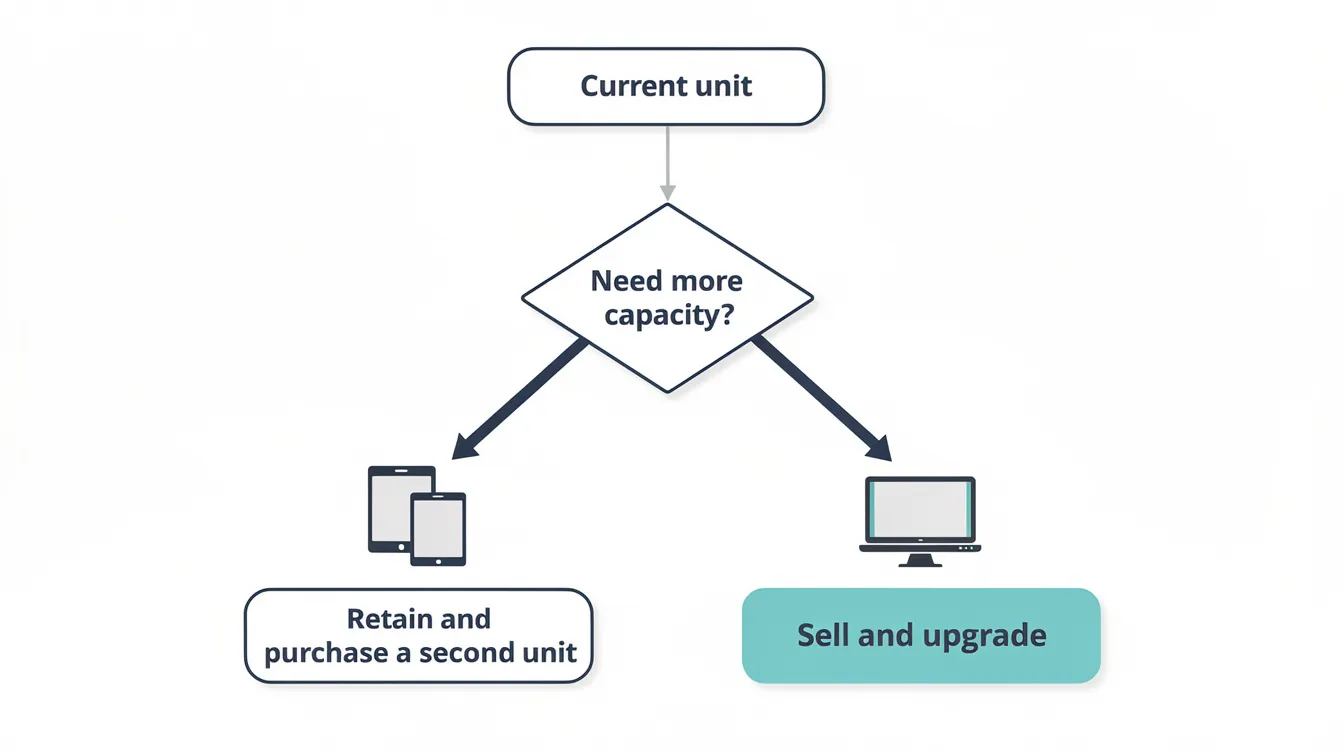
Side-by-Side Comparison: Two Property vs One Bigger Home
The following table compares both strategies for a typical Singapore family: combined gross income of S$18,000/month, existing fully-paid 4-room HDB flat worth S$700,000, looking at options in 2026.
|
Criterion |
Two Property Strategy |
One Bigger Home |
|---|---|---|
|
Initial upfront cash & CPF needed |
Higher: 55% down payment on second loan (45% LTV) + 20% ABSD on second property + BSD + legal fees on both |
Lower: 25% down payment (75% LTV) + BSD + legal fees on one property |
|
Monthly cash outlay after CPF |
Two loan instalments minus ~S$2,500–3,500/month rental income from investment unit; net outlay often comparable or slightly higher |
One loan instalment; simpler, predictable monthly outflow |
|
Estimated equity after 10 years (2% p.a. growth) |
Higher total equity from two appreciating assets + dual loan amortisation; rough estimate S$1.85–2.1M combined |
Solid equity in one asset; rough estimate S$1.6–1.8M depending on quantum and leverage |
|
Vacancy / tenant risk |
Material: 6–12 months vacancy over 10 years reduces returns by S$15,000–35,000+ |
None – no rental dependency |
|
Lifestyle comfort |
Moderate: own-stay unit may be smaller; investment unit managed remotely |
High: more space, better facilities, proximity to schools |
|
Complexity & time |
Higher: tenant sourcing, lease renewals, maintenance, property tax filings for two units |
Low: single set of expenses, one mortgage, minimal admin |
How to read this table: The two property strategy generally produces higher projected equity over a decade, but requires substantially more upfront cash, tolerates more risk, and demands active management. The one bigger home path offers simplicity, lifestyle quality, and lower financial stress – with solid but typically slower wealth accumulation. Your decision should hinge on which trade-offs your family can genuinely sustain for 10–15 years, not just on projected returns.
Transaction costs and government policies (ABSD, decoupling rules) can tilt this comparison heavily – so they deserve their own dedicated section.
Key Policy and Cost Factors That Change the Outcome
In Singapore’s property market, ABSD, LTV, TDSR, and transaction costs often determine whether a two-property strategy is even feasible – not just whether it is optimal. Getting these wrong leads to costly mistakes.
ABSD, Decoupling, and Legal Structures
The additional buyer’s stamp duty is the single largest cost differentiator. As of 2026, a Singapore citizen pays 0% ABSD on their first property, 20% on a second property, and 30% on a third. For Permanent Residents, rates are 5%, 30%, and 35% respectively.
Decoupling is the primary strategy families use to mitigate ABSD. Here is how it works: one spouse transfers their share of a jointly-owned property to the other spouse. This legally frees the transferring spouse to buy a new property as a “first-time” buyer at 0% ABSD. However, decoupling involves legal and financial complexities, including additional stamp duties and refinancing challenges.
Worked mini-example: Suppose a couple jointly owns a private condo valued at S$1.6 million. One spouse transfers their 50% share (S$800,000) to the other, incurring BSD on the transfer plus legal and refinancing fees – roughly S$30,000–80,000 in total. The freed spouse then buys a second property at S$1.6 million with 0% ABSD instead of 20%. The ABSD saving is S$320,000. Net saving after decoupling costs: approximately S$240,000–290,000. Substantial – but only if the couple still passes TDSR on separate incomes and can fund the new down payment.
Decoupling makes mathematical sense when ABSD savings significantly exceed all decoupling costs and the household still comfortably passes TDSR. It does not make sense when one spouse’s solo income cannot support the second loan, or when the existing property is difficult to refinance.
LTV, TDSR, and Interest Rate Risk
The loan to value ratio drops from 75% on a first housing loan to just 45% on the second – meaning you need 55% of the second property’s value in cash and CPF, a massive jump in upfront cash requirements. If the loan tenure exceeds 30 years or the borrower fails the age-65 repayment test, LTV drops further still.
Singapore’s Total Debt Servicing Ratio (TDSR) limits total monthly debt repayments to 55% of gross monthly income, with lenders stress-testing at a minimum 4% interest rate. For a family carrying two mortgages plus car loan and credit card obligations, hitting the TDSR ceiling is common – and it caps how much property you can control regardless of your savings.
Interest rate sensitivity matters more for two-property investors. If floating rates move from 3% to 4.5%, monthly servicing on two loans can increase by S$1,500–2,500 combined, while rental income typically does not adjust upward to compensate. This is why Singapore property owners pursuing a two-property strategy need robust cash flow buffers.
Since July 2025, the Singapore government has also tightened Seller’s Stamp Duty – properties purchased on or after 4 July 2025 face SSD of 16% if sold within the first year, 12% in the second, 8% in the third, and 4% in the fourth. This makes short-term exits from investment properties significantly more expensive and reinforces that either strategy requires a long-term holding commitment.
Aesthetic Havens can help model different financing structures and connect you to mortgage partners to assess which path is viable for your household’s specific numbers.

Common Mistakes Singapore Families Make When Choosing Between the Two
Even the right strategy on paper can fail in practice. These are the most common pitfalls observed in the local market – and how to avoid them.
Overestimating Rental Income and Underestimating Vacancies
Many families model their two-property strategy assuming 100% occupancy at or above current market rents. In reality, the average gross rental yield for private condos is about 2.5–3.3% depending on region, and net yields after all costs are often just 1–2%.
Solution: Use conservative assumptions – budget for at least 10% annual vacancy and rent slightly below current market rates when stress-testing. If your two-property strategy only works at full occupancy and peak rents, it is too fragile.
Ignoring Transaction and Holding Costs
Many property owners focus on purchase price and capital gains while overlooking ABSD, buyer’s stamp duty, legal fees, renovation, monthly maintenance fees, property tax based on annual value, and agent commissions. Owning two properties involves higher cumulative maintenance fees and property tax expenses than a single property. These costs erode returns quietly over years.
Solution: Create a comprehensive cost checklist for each scenario. Add a 5–10% buffer to renovation budgets and include every recurring holding cost. If a deal only works when you ignore these expenses, it is not a deal.
Letting Lifestyle Pressure Override Financial Reality
Property ownership in Singapore is deeply tied to social identity. The pressure to upgrade to a prestige address – or to acquire two condos because friends are doing so – drives emotional decisions that override sound financial analysis. A forced sale due to overextension is far more damaging to long-term financial security than staying in a modest home for a few more years.
Solution: Set hard numerical rules before committing – for example, maintain a minimum 6–12 months of emergency funds after completion, and ensure TDSR utilisation stays below 45% (not the maximum 55%) to preserve financial resilience against rate shocks or income disruptions. Stick to these rules regardless of peer pressure.
Avoiding these mistakes is as important as choosing the “right” strategy on paper.
Conclusion and Next Steps
A carefully structured two-property strategy can accelerate wealth via leverage and rental income – it is a powerful wealth building tool when executed with adequate capital, stable income, and a 10–15 year horizon. But for families prioritising lifestyle, simplicity, lower risk, or who face shorter time horizons, a single bigger home often delivers superior outcomes when you account for the full picture: ABSD, financing constraints, management burden, and the non-financial value of living well.
Singapore property prices have historically trended upwards over time, and land scarcity continues to underpin long-term demand – both strategies can build wealth. The question is which builds it faster and more sustainably for your family.
Your practical next steps:
-
Audit your current equity and projected income stability over the next 10–15 years
-
Run conservative number scenarios for both paths, including ABSD and stress-tested interest rates – use the six-step framework above
-
Clarify family priorities – space, schools, retirement age – and rank them honestly against pure financial returns
-
Speak to a qualified advisor to align your property purchase decisions with your overall financial goals and retirement planning
-
Explore tailored options with Aesthetic Havens – especially if you are a business owner or investor interested in asset progression paths beyond residential property, including industrial and commercial real estate across different asset classes
Singapore’s population is projected to reach 6.5–6.9 million by 2030, supporting continued demand in Singapore’s property market and creating future opportunities for property owners who plan ahead. Whether you choose one property or two, the families who build lasting wealth are those who make informed decisions based on numbers, not narratives.
Additional Resources
To help you decide between the two paths, consider downloading a comparison checklist that walks through every key question – from equity calculation to ABSD impact to lifestyle scoring – before committing.
Related reading you may find useful:
-
How to Build a Two Property Portfolio in Singapore Without Overleveraging
-
Understanding ABSD, LTV and TDSR for Singapore Families in 2026
-
HDB to EC to Condo: The Property Ladder Strategy for Singapore Families
Market reference data: Singapore’s strong economic growth and constrained land supply have driven the URA Private Property Price Index from roughly 105 in 2009 to 222.5 in Q3 2026. HDB resale prices have similarly trended upward over decades. Tracking these indices annually helps you time your property journey and calibrate expectations for price growth in both public housing and private property segments.

