

Introduction
In late 2024, a dual-income Singapore couple – let’s call them the Tans – committed $2.35 million to a three-bedroom condo just 600 metres from one of Bukit Timah’s most sought-after primary schools. Their goal was straightforward: secure a P1 registration advantage for their only child and ride the capital appreciation that school proximity historically delivers. This buy condo near primary school case study traces their journey across two years and one seismic MOE policy shift to answer the question every parent-investor asks – did paying the 1km school premium actually pay off?
The short answer is nuanced. The Tans’ child cleared Phase 2C in the 2027 P1 registration exercise with less stress than families living further away, and the condo has appreciated modestly in line with Bukit Timah’s prime-district trajectory. But the financial edge over a cheaper unit 1.5 km out is slimmer than the headlines suggest, and MOE’s 2027 two-track scheme means the same move today would yield a weaker admission advantage at 12 popular schools.
This article focuses on one detailed composite scenario – built from real transaction ranges, published balloting data, and MOE timelines – rather than a comprehensive guide to every two-track school. It is written for parents weighing a condo purchase near a popular primary school and for investors evaluating whether the “school ring” premium still holds in a shifting property market.
What you’ll take away:
-
The actual dollar premium the Tans paid versus a comparable condo 1–2 km away
-
How their P1 outcome and daily life changed because of the move
-
A realistic 5–7 year holding-period return calculation
-
How MOE’s 2027 changes affect the same strategy for families buying today
-
A step-by-step framework to evaluate your own school-ring purchase decision
Understanding School Rings and Property Decisions in Singapore
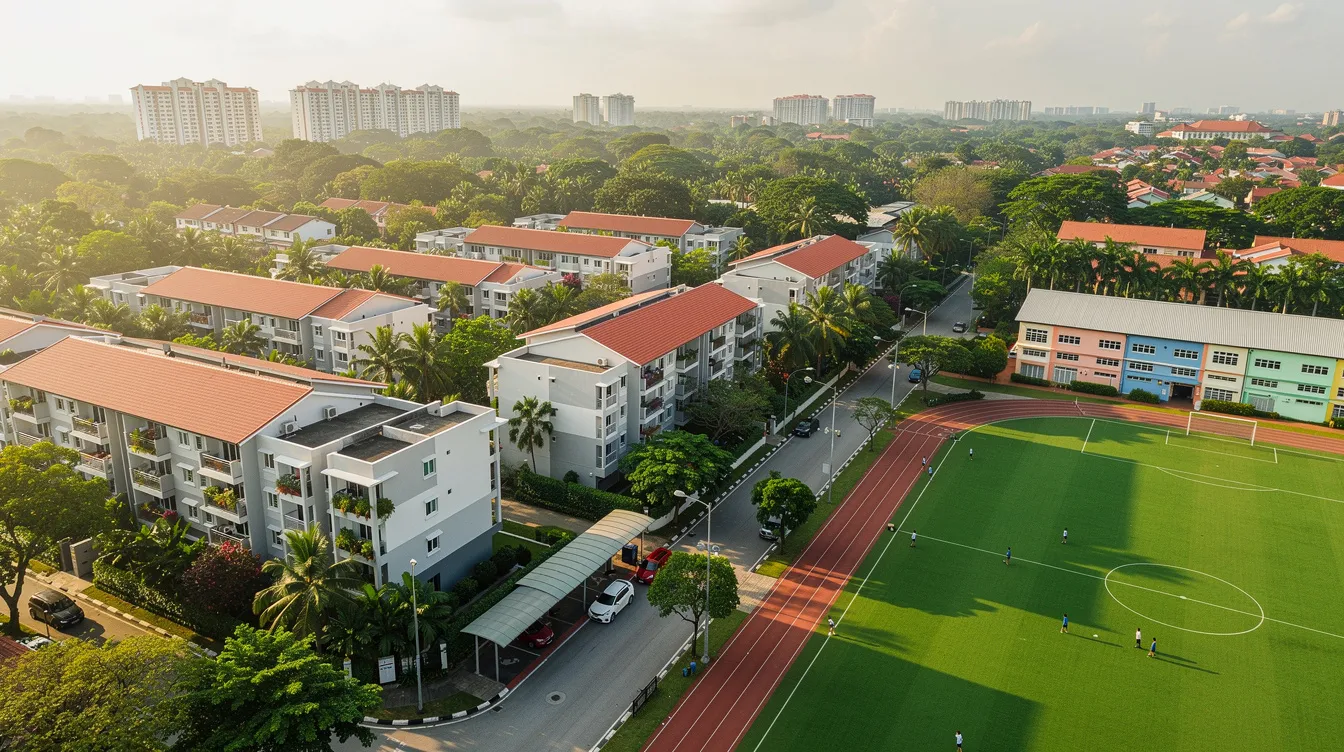
Singapore’s P1 registration system allocates places partly on home-school distance. Under MOE’s rules, children living within 1 km of a primary school receive distance priority over those in the 1–2 km band during oversubscribed phases – a mechanism that has quietly turned certain postcodes into premium real estate. Understanding how these distance bands work is essential before evaluating any family’s decision to pay more for proximity.
The 1km Primary School Ring as a Property Premium
Condos within 1 km of top schools such as Nanyang Primary, Methodist Girls School (Primary), Raffles Girls Primary School, and Pei Hwa Presbyterian Primary have historically commanded a measurable price uplift. In Bukit Timah’s District 10, private resale data from 2020–2025 shows premiums of roughly $150–$250 per square foot for units inside the 1 km ring compared with similar projects in the 1–2 km band. That premium was driven by two forces: the tangible home-school distance priority in Phase 2C balloting and the strong rental demand from families living close to schools nearby with good reputations. Buying a home within 1 km of a popular school influences admission advantages, and that fact alone has been enough to sustain pricing power for decades. This is exactly the kind of market dynamic that persuaded the Tans to stretch their budget.
MOE Rule Changes From 2027 and the Phase 2C Two-Track Scheme
On 10 September 2026, MOE announced reforms that reshape the calculus for every family considering a school-ring purchase. From the 2027 P1 registration exercise (for children entering Primary 1 in January 2028), Phase 2C places increase from 40 to 60 at most schools with an intake of 180 or more. More critically, twelve schools will adopt a two-track system: Phase 2C places are split equally between children living within 2km of the school and those living beyond that boundary, with no further distance priority inside the ≤ 2 km track. Within the ≤ 2 km track, applicants are considered by citizenship priority before ballot, meaning families living 1.9 km away have the same ballot odds as those within 1 km.
The 12 schools on the two-track scheme sit in private-housing-heavy neighbourhoods where fewer than 40 % of dwelling units within 2 km are public housing, far below the national average, which is why MOE targeted them to widen access. The list includes Anglo-Chinese School (Primary), Anglo-Chinese School (Junior), Methodist Girls School Primary, Nanyang Primary, Ngee Ann Primary School, Pei Hwa Presbyterian Primary, Raffles Girls Primary, Singapore Chinese Girls Primary, Singapore Chinese Girls School, St. Margaret’s School, Tanjong Katong Primary, and Tao Nan School. Living within 1 km no longer guarantees school admission priority at these schools – the two-track system eliminates distance priority inside the ≤ 2 km band for Phase 2C.
For the Tans, the timing mattered: they bought in late 2024, well before this announcement, so their child’s 2027 registration still fell under the transitional rules. But the policy shift colours their resale outlook and every new buyer’s decision going forward. Regulatory policies can impact the advantages of living within the school vicinity, and the Tans’ story illustrates that vividly.
Why Parents and Investors Still Ask: “Is Buying Near a Primary School Worth It?”
Even with the new two-track rules, demand remains strong for properties near reputable schools during market slowdowns. Convenience explains much of this resilience: families living close to schools typically experience shorter commutes for children, and the lifestyle appeal of walkability is independent of any registration phase. For investors, school proximity affects rental demand and perceived exit liquidity – tenants with young children actively seek condos within walking distance of a preferred primary school, regardless of which admission phase they qualify for. That persistent demand is why a concrete, numbers-based case study is more useful than anecdotes when deciding whether the premium is justified.
The Case Study: One Family’s 1km Condo Purchase
The Tans are a composite family built from typical transactions, published MOE timelines, and realistic Bukit Timah market data. No private client information is used. Their story is designed to mirror decisions thousands of Singapore families face every year – and to show the real numbers behind the rhetoric.
Profile of the Family and Their Objectives
David and Rachel Tan are both mid-career professionals – he in fintech, she in healthcare administration. They upgraded from a mature-estate HDB flat after their son, Ethan, was born in March 2021. With Ethan due to enter Primary 1 in January 2028, they needed to secure a qualifying address at least 30 months before the registration exercise – meaning they had to move in by roughly early 2025.
Their motivations were layered:
-
P1 admission: Secure a spot at a preferred school – specifically, one of the Bukit Timah belt’s oversubscribed schools – without alumni priority or prior ties
-
Shorter commute: Eliminate the need for a school bus and reduce daily travel to under 10 minutes on foot
-
Capital appreciation: Buy into a prime-district freehold condo that would hold or grow in value over a 5–7 year horizon
-
Avoid moving twice: Find a home that works for at least a decade, covering Ethan’s entire primary school phase
Their constraints were practical: a budget ceiling of roughly $2.3–2.4 million, a minimum three-bedroom layout of 1,000 sq ft, and a preference for freehold tenure in a location close to an MRT station.
The Property They Bought: Project, Price and Location
The Tans settled on a unit in a freehold Bukit Timah condo launched around 2019, positioned approximately 600 metres’ walking distance from their target school. The three-bedroom unit measured 1,050 sq ft. They purchased it in October 2024 at $2.35 million – around $2,238 per square foot.
At the time, a comparable 3-bed unit in an older resale property 1.5 km from the same school was listing at roughly $1,850 psf, translating to a total quantum of about $1.95 million. The gap was significant, but the Tans valued the newer build quality, the proximity, and the confidence that commitment to residency is required to secure admission through proximity-based advantages – meaning they needed to be physically living there, not just owning the unit.
The 1km Premium They Paid vs Alternatives 1–2km Away
Before committing, the Tans shortlisted three condos in the 1.3–1.8 km ring. These offered 10–15 % more floor area for roughly $300,000–$350,000 less. One project, about 1.5 km out, had a similar three-bedroom layout at $1.95 million ($1,857 psf) – an older development with larger rooms but dated facilities.
The explicit school premium they paid amounted to roughly $380 psf, or about $400,000 in absolute terms. For context, PropertyGuru data on the 12 two-track schools shows premiums varying wildly by school: around Methodist Girls School, the gap between within-1 km and 1–2 km listings averaged ~$287 psf, while near Nanyang Primary the difference was as little as ~$21 psf. The Tans’ premium sat toward the upper end, reflecting the newer vintage and freehold tenure of their chosen project.
What they gave up: a slightly smaller unit, higher monthly mortgage repayments (roughly $1,200 more per month versus the cheaper option), and less remaining cash buffer. What they gained: a brand-new condo with full facilities, a sub-10-minute walk to school, and – at the time of purchase – a clear home-school distance priority advantage in the Phase 2C ballot. They saw the extra outlay as “tuition prepaid” plus a bet on Bukit Timah’s long-term resale trajectory.
Did the School Bet Pay Off? P1 Outcome and Stress Levels
The Tans’ core objective was securing a place at their target school with minimal anxiety. This section examines whether their address delivered that outcome during the 2027 P1 registration exercise.
Registration Phase, Distance Band, and Balloting Experience
With no alumni ties, no prior connection as parent volunteers or active community leaders, and no siblings enrolled, the Tans entered at Phase 2C – the same phase as most families without connections to the school. Their registered address sat 600 metres from the school, comfortably inside the 1 km band and well within 2 km of the school.
Because their child’s cohort (born 2021, entering P1 in 2028) was covered by the 2027 registration exercise, the new two-track scheme applied. Within the ≤ 2 km track, Singapore citizens living at 600 m and those at 1.9 km were in the same ballot pool – distance priority inside that band no longer exists for Phase 2C at these 12 schools.
Still, the Tans benefited from the expanded allocation: Phase 2C places increased from 40 to 60 at their school, improving odds across the board. With roughly 1.3 Singapore citizen applicants per available place in the ≤ 2 km track (down from ~2.1× in the old within-1 km band at comparable schools like Pei Hwa Presbyterian Primary in 2025), Ethan cleared the first ballot. The stress was manageable – far less than what families beyond 2 km faced, where a separate, smaller pool of places served a much larger applicant base. Families beyond 2 km now have a dedicated track for school admission, but competition in that track remains fierce for popular schools.
Impact on Daily Life: Commute, Time and Convenience
Once Ethan started P1 in January 2028, the proximity dividend became tangible. The walk from their condo lobby to the school gate takes 8–9 minutes along a sheltered footpath – no school bus fee, no morning traffic anxiety.
Compared with a hypothetical 15–20 minute drive from a condo 3–5 km away, the Tans save roughly 30–40 minutes daily. Over a six-year primary school phase (approximately 200 school days per year), that adds up to 600–800 hours – the equivalent of more than 30 full days reclaimed for family time, work, or rest. Neighborhoods surrounding established schools often feature better community amenities, and the Tans enjoy easy access to Bukit Timah’s parks, enrichment centres, and food options.
By Primary 3, they expect Ethan to walk to school independently, and participating in after-school CCAs requires no additional logistics. From a lifestyle standpoint, the move unambiguously paid off.
Would They Still Have Got In Living 1–2km Away?
Under the new two-track rules, a family at 1.5 km would have been in the same ≤ 2 km track and faced the same ballot odds as the Tans at 600 m. The 1 km to 2 km distance now has equal admission odds at these 12 schools in Phase 2C. So purely for Phase 2C purposes, the Tans’ sub-1 km address did not confer an additional advantage over a 1.5 km address.
However, distance still matters in earlier phases. In Phases 2A and 2B – which serve families with alumni priority, siblings, or links as active community leaders and school leaders – the traditional distance bands remain. If the Tans had a second child and qualified for Phase 2B through a sibling tie, the 600 m address would still provide meaningful priority over a 1.5 km address. For families with prior ties or who serve as parent volunteers, the 1 km ring retains value beyond Phase 2C.
This leads to the tougher question: did the financial premium they paid get compensated by capital gains?
Financial Results: Resale Value, Rental Potential and True Cost
This section models the Tans’ total cost and projected return over a holding period from their October 2024 purchase to a hypothetical sale in mid-2030 – roughly six years. The assumptions use rounded, conservative figures consistent with Bukit Timah’s recent market trends: 2.5 % annual psf appreciation in CCR freehold condos, current BSD/ABSD rates, and standard agent and legal fees.
5–7 Year Holding Period: Entry vs Exit Price
The Tans purchased at $2.35 million ($2,238 psf). Applying 2.5 % annual appreciation over six years, their unit’s projected resale value in 2030 reaches approximately $2.72 million (~$2,590 psf). Recent PropKaki data shows median transactions within 1 km of Bukit Timah Primary School at ~$2,252 psf (as of October 2026), suggesting the trajectory is on track.
Gross capital gain: ~$370,000. After deducting legal fees (~$3,000), agent commission (~2 %, or ~$54,000), and noting that no seller’s stamp duty applies after the three-year holding period, the Tans net roughly $310,000–$315,000 from the sale.
The 1 km property premium is expected to compress around the twelve schools post-2027, and median resale prices near these schools may stabilise as the distance advantage fades. But core freehold value in Bukit Timah and the area’s broader desirability – proximity to nature reserves, top-tier amenities, and the city fringe – still underpin moderate appreciation. Proximity to a school does not guarantee superior property appreciation compared to farther homes, but in established belts like Bukit Timah, the location fundamentals are strong independent of school policy.
Comparing Against a “1–2km Away” Alternative Investment
|
Criterion |
Condo A – Within 1 km (Tans’ choice) |
Condo B – 1.5 km Away (Alternative) |
|---|---|---|
|
Purchase price (2024) |
$2.35 M (~$2,238 psf) |
$1.95 M (~$1,857 psf) |
|
Projected resale (2030) |
~$2.72 M (~$2,590 psf) |
~$2.30 M (~$2,190 psf) |
|
Gross gain |
~$370 K |
~$350 K |
|
Net gain (after fees) |
~$310–315 K |
~$305–310 K |
|
Monthly mortgage (est.) |
~$8,900 |
~$7,700 |
|
Cumulative extra interest (6 yrs) |
~$86,000 more than Condo B |
Baseline |
|
Rental potential (if leased) |
Stronger demand, ~$5,500–6,000/mo |
Moderate demand, ~$4,800–5,200/mo |
The absolute dollar gains are remarkably close. But the Tans paid roughly $86,000 more in cumulative mortgage interest over six years due to the higher loan quantum. Properties near popular schools may be less attractive to buyers without school-age children, meaning the exit pool for Condo A is somewhat narrower – though market data shows that properties near high-demand schools maintain consistent resale value even when policy shifts occur.
Percentage return on equity tells a slightly different story: if both families put down 25 % equity, Condo B’s return on invested capital edges ahead because of the lower entry price. The school premium bought convenience and peace of mind more than outsized financial returns.
Counting the Hidden Costs and Benefits
Several non-obvious factors tilt the ledger:
-
Higher buyer’s stamp duty: On a $2.35 M purchase, BSD is ~$79,600 vs ~$64,600 on $1.95 M – a $15,000 difference at entry
-
Larger monthly mortgage burden: Approximately $1,200/month more, creating tighter cash flow
-
School bus savings: At ~$180/month over 10 months per year for six years, the Tans saved roughly $10,800 by walking
-
Stronger rental demand: If the Tans ever lease out the unit, school proximity supports rental yields; tenants with children in primary school will pay a premium for walkability to a top school, and demand remains strong for properties near reputable schools during market slowdowns
-
Time value: The 600–800 hours saved on commuting over six years is difficult to price, but for two working parents it translates into real productivity and reduced stress
From a pure spreadsheet view, the 1 km premium may not dramatically outperform cheaper alternatives. But the total “return” includes time, stress reduction, and the schooling outcome itself – dimensions that resist clean quantification but dominate the lived experience.
Step-by-Step: How to Evaluate Buying Near a Primary School Today
For families considering a similar move under the post-2027 rules, here is a structured evaluation process.
Our Recommended Evaluation Process
-
Clarify your cohort and school list. Identify your child’s birth year, determine which P1 registration exercise applies, and check whether your preferred primary school is among the 12 schools on the new two-track scheme. If it is, understand that being within 1 km no longer guarantees priority – the ≤ 2 km track treats all applicants the same.
-
Map actual distances using OneMap. Use OneMap’s School Query function to verify whether shortlisted condos fall within 1 km, 2 km, or beyond. Note overlapping rings – some Bukit Timah addresses fall within 2 km of more schools, giving you fallback options at Ngee Ann Primary, other schools in the Marine Parade belt, or Tanjong Katong Primary if you are flexible on location.
-
Pull recent Phase 2C balloting history. Review published data for your target school’s last three to five registration exercises. Look at the ratio of Singapore citizen applicants to vacancies in the relevant distance category. Schools like Raffles Girls Primary School and Anglo-Chinese School Junior have historically balloted in Phase 2C – knowing the odds helps you gauge whether proximity alone is sufficient or whether earlier phases via volunteer or alumni connections are necessary.
-
Build a side-by-side financial comparison. Compare 1 km vs 1–2 km condos on entry price, psf, size, tenure, expected rental yield, and monthly instalments. Factor in stamp duty differentials, estimated appreciation rates, and transaction costs at exit. A resale property 1.5 km away may offer better cash flow even if absolute appreciation is similar.
-
Stress-test your plan against the 30-month stay rule and alternative scenarios. The commitment to residency is required to secure admission through proximity-based advantages. Run a conservative cash-flow projection assuming a 1–2 % interest rate increase and one partner losing income. If you cannot comfortably hold the property for 30+ months under stress conditions, the premium may be too risky.
Comparing 1km vs 1–2km Options: What Really Matters
|
Criterion |
Within 1 km |
1–2 km Away |
|---|---|---|
|
Purchase psf (Bukit Timah, 2024–2026) |
~$2,100–$2,400 |
~$1,750–$2,000 |
|
Phase 2C track (two-track schools) |
Same track as 1–2 km |
Same track as within 1 km |
|
Phase 2A/2B distance priority |
Higher priority |
Lower priority |
|
Walk-to-school time |
5–10 minutes |
15–25 minutes |
|
Rental demand from families |
Very strong |
Moderate to strong |
|
Long-term liveability |
Depends on project quality |
Often larger, quieter units |
For many families under the two-track rules, the 2 km line is now the more rational “hard filter” than insisting on sub-1 km. The financial and emotional cost of stretching for a 1 km address may not be justified unless the property independently passes investment criteria.
When Paying the 1km Premium Still Makes Sense
There are scenarios where the premium remains defensible:
-
The school is not on the two-track list and remains historically oversubscribed within 1 km – distance priority inside the 1 km band still applies at other schools outside the 12
-
You have younger siblings who will benefit from the same address for Phase 2B sibling priority, where school distance ordering still matters
-
Walkability is a genuine lifestyle priority – for parents managing school timing drop-offs, CCAs, and after-school pickups, 600 m versus 1.8 km is a daily quality-of-life difference
-
The property itself is high-quality, freehold, and likely to hold value beyond the school narrative – exactly the kind of asset that performs in any market condition, not just during peak enrolment years
Conversely, families who expect frequent policy changes, who have flexible school preferences, or who prioritise unit size and cash flow may find better value at 1–2 km or even beyond 2 km, pairing a larger home with a school bus arrangement. Families may reconsider moving due to new school admission rules, and that reconsideration is rational rather than defeatist.
Common Pitfalls When Buying for School Rings (and How to Avoid Them)
Many families focus narrowly on MOE distance bands and overlook legal, financial, and lifestyle risks. Here are four common mistakes and how to sidestep them.
Overestimating the 1km Premium’s Impact on Admission Odds
At the 12 two-track schools, being 400 m versus 1.8 km away no longer gives a Phase 2C advantage – both addresses sit in the same track and face the same ballot. Living within 1 km no longer guarantees school admission priority at these schools, and permanent residents face even longer odds regardless of distance.
Solution: Check whether your target school is on the two-track scheme. If it is, shift your focus to phase eligibility (can you qualify for Phase 2A or 2B through alumni or volunteer ties?), cohort size, and overall vacancy trends rather than obsessing over the 1 km line.
Ignoring the 30-Month Stay Requirement and Holding Power
Buying a “school condo” you cannot comfortably hold for at least 30 months before the registration exercise – and ideally five to six years total – can backfire if finances tighten. The Ministry of Education’s policies can shift, affecting the value of school proximity, and interest rate movements can stretch an already-thin budget to breaking point.
Solution: Run a conservative cash-flow projection stress-testing a 2 % rate rise and one partner’s income loss. If you cannot service the mortgage under those conditions for 30+ months, the premium unit is too risky. A cheaper property 1–2 km away with a comfortable buffer is a stronger long-term position.
Buying a Poor-Fit Property Just for School Branding
Cramped layouts, noisy traffic-facing stacks, or weak rental markets can erode long-term satisfaction – even if the school bet succeeds. Homes within 1 km of the 12 schools may lose their price premium if the property itself is uncompetitive, and properties near popular schools may be less attractive to buyers without school-age children when you eventually sell.
Solution: Require that any “school” property also passes independent criteria for liveability and investment: stack selection, facing, facilities, transport access, and neighbourhood amenities. The school ring is a bonus, not a substitute for sound property fundamentals.
Not Planning an Exit Strategy After the P1 Window
Some families assume they will sell immediately after securing a P1 spot, only to face cooling measures, seller’s stamp duty, or soft demand. The 1 km property premium will compress around the 12 schools as more buyers recognise the new rules, and the exit pool narrows to buyers who themselves have school-age children – a smaller subset of the market.
Solution: Map out multiple timelines – sell in three years, five years, or hold for rental – and understand the stamp duty and tax implications of each path. If your only exit plan depends on another parent paying the same school premium you did, your strategy is fragile.
Conclusion and Next Steps
For the Tans, did buying within the 1 km school ring pay off? Across the three dimensions that matter – P1 outcome, lifestyle, and financial return – the answer is a qualified yes. Ethan secured his place at a preferred school with manageable ballot stress, the family reclaimed hundreds of hours of commuting over six years of primary school, and the condo appreciated modestly in line with Bukit Timah’s long-term trajectory.
Financially, however, the edge over a cheaper alternative 1.5 km away was narrow. The additional $400,000 they paid at entry generated only marginally higher absolute returns, and the percentage return on equity was slightly lower once higher mortgage interest and stamp duty were factored in. The premium bought peace of mind and daily convenience more than outsized capital gains. Residing within a 1 km radius historically grants higher priority in school admissions, and that historical advantage did reduce the Tans’ stress – but under the new rules, the same purchase would not have delivered the same admission edge.
Your next steps:
-
Clarify your child’s P1 cohort year and shortlist two to three target schools, noting whether each is among the 12 schools adopting the new two-track scheme
-
Use OneMap to map actual distances and identify realistic property clusters within 1 km and 2 km
-
Build a simple 1 km vs 2 km cost-benefit comparison, modelling entry price, monthly instalments, projected appreciation, and rental yield
-
Factor in lifestyle value – commute time, school bus costs, walkability – alongside the numbers
-
Consult a property advisor before paying any school premium, especially in a market where the rules have just shifted
For readers exploring how residential purchases fit within a broader investment portfolio – including alternatives like industrial or commercial property – the same discipline of modelling entry cost, holding period, and exit strategy applies across asset classes.
Additional Resources and Frequently Asked Questions
Useful Tools and Data Sources
-
MOE P1 Registration page: Official source for the latest phase structure, distance rules, and the list of two-track schools
-
OneMap School Query: Measure exact home-school distance and verify whether a property sits within the 1 km or 2 km band
-
URA Realis and HDB Resale Transaction data: Check recent psf figures for condos around your target school to benchmark fair value
-
BusyParents.sg guide to the two-track scheme: Clear explainer of how the 2027 Phase 2C changes work at the 12 affected schools
Quick FAQ on Buying Near Primary Schools
Q: Is buying within 1 km of a two-track school still worth it after 2027? Living within 1 km no longer guarantees priority at these schools in Phase 2C – families living 1.9 km away have the same ballot odds as those within 1 km. The premium may still be justified by walkability and lifestyle, but not by admission advantage alone in Phase 2C. Distance still matters in earlier phases for families with prior ties.
Q: How early before P1 registration should we commit to a new address to meet the 30-month rule? You must have lived at the qualifying address for at least 30 months before the registration exercise. For a child entering P1 in January 2029 (registered in mid-2028), you should move in by approximately January 2026 at the latest. Build in a buffer for renovation and handover delays.
Q: Does renting near a school work as well as owning for P1 distance priority? Yes – MOE’s distance priority is based on your registered residential address, not ownership. A tenancy agreement at an address within 1 km or 2 km of the school can qualify, provided you actually reside there and meet the 30-month requirement.
Q: How big is the typical price difference between 1 km and 1–2 km condos? In Bukit Timah and similar prime districts, the gap ranges from as little as ~$20 psf (near Nanyang Primary) to ~$287 psf (near Methodist Girls School), depending on the specific school and available stock. Across District 10 broadly, expect a 5–10 % psf premium for within-1 km properties versus the 1–2 km band.
Q: What if we have more than one child – should we plan for overlapping school periods? Absolutely. If your second child can benefit from sibling priority in Phase 2A, the same address serves double duty. In that scenario, being within 1 km retains genuine value because distance ordering still applies in earlier phases, making the premium more justifiable over a longer horizon.
Q: How do MOE kindergarten affiliations affect this decision? Some primary schools have affiliated MOE kindergartens, and children enrolled in these may receive Phase 2A2 priority. If your target school has an MOE kindergarten within walking distance, factoring that pathway into your plan can reduce reliance on Phase 2C distance priority altogether.
If you’re weighing a school-ring property purchase against other investment options – or simply want a data-driven assessment tailored to your family’s timeline – reach out for a customised evaluation of your school-versus-investment property strategy.

